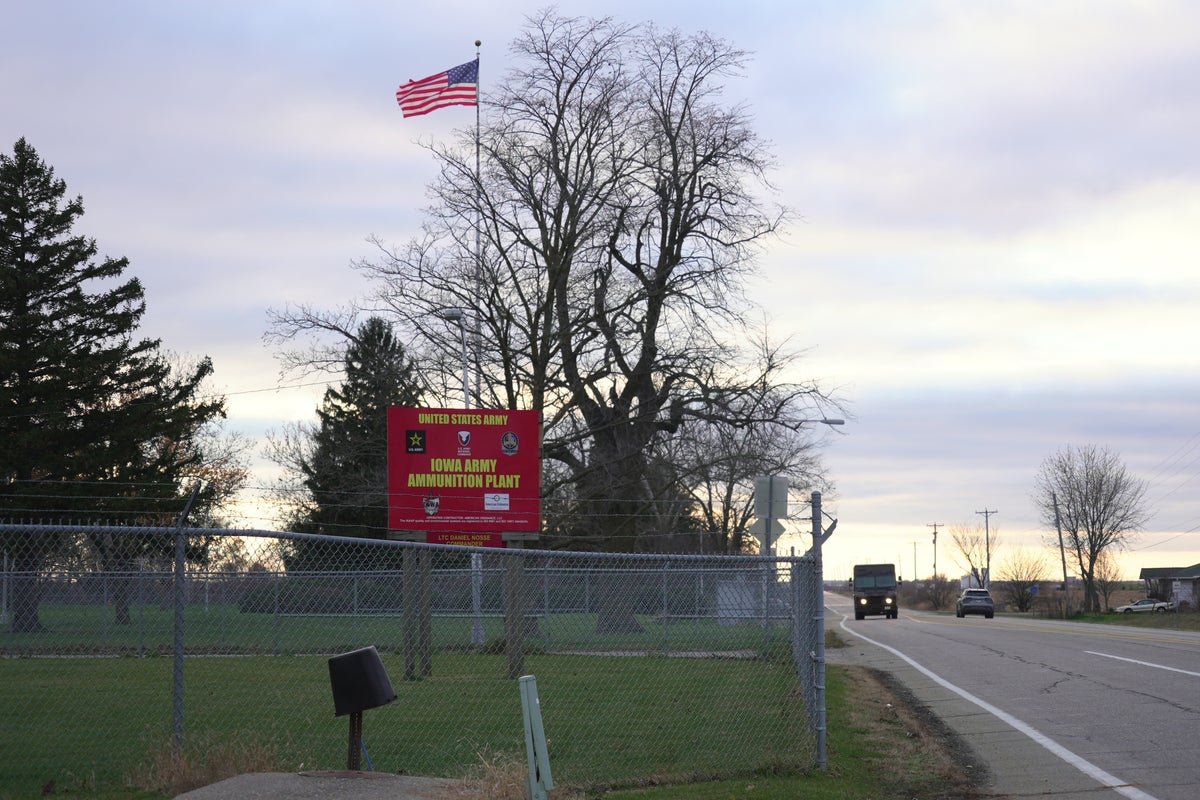
The U.S. Army is planning to detonate 5 tons of degraded and dangerous lead azide in southeastern Iowa Wednesday in what military officials say is an unprecedented effort to prevent a spontaneous, uncontrolled explosion at the site.
asserted
officials → plan → site
While authorities say a host of safety measures will be in place to limit the plume of lead particles that will drift from the Iowa Army Ammunition Plant, public concerns remain about the potential health and environmental effects.
asserted
concerns → say → effects
The Army says the lead azide, which is used as an initiating explosive in munitions, is degrading.
asserted
which → say → munitions
Crystallization inside the containers increases the risk of an explosion as the outside temperature changes, especially when it’s below freezing.
asserted
it → increase → freezing
Here’s what to know about the planned explosion:
asserted
Here → ’ → explosion
The use of lead azide began declining in the 1980s
Lead azide is a highly sensitive compound including lead and nitrogen that historically has been used in detonators to set off other explosives.
asserted
that → decline → explosives
The military moved away from using lead azide because of its hazards and officials have said it is no longer needed for munitions production.
asserted
it → move → production
Lead is a neurological toxicant that can harm the brain, nervous system and other organs.
asserted
that → harm → brain
Production of lead azide increased sharply during the Vietnam era, especially for use in gravel mines, according to the Army’s emergency application to detonate the Iowa stockpiles.
uncertain
Production → increase → stockpiles
Mass production began declining in the early 1980s and eventually ceased, the application said.
asserted
application → begin → 1980s
The 68 barrels of lead azide set for detonation in Iowa, transferred there in 2009 from an Army facility in Texas, are the nation’s entire stockpile of the compound, the Army said.
asserted
Army → set → compound
Army Col. Aaron Teller, a munitions emergency response specialist, said in a court filing that the Army will use a combination of C-4 explosives, explosive charges and diesel fuel to blow up the stockpile.
asserted
Army → say → stockpile
The diesel will be used to enhance the consumption of the lead azide, and the charges are intended to direct the blast effects downward, Teller said.
asserted
Teller → use → effects
The lead azide is stored at the Iowa site in reinforced structures, known as magazines.
asserted
azide → store → magazines
Sand barriers, screening and water are among safety steps being taken
asserted
barriers → take → steps
The Army and other federal agencies placed sand barriers about two stories high around the magazines along with walls consisting of four 16,000-gallon (60,000-liter) water tanks.
asserted
Army → place → tanks
Special screening to contain the lead has been installed.
asserted
screening → contain → lead
A 2-foot (61-centimeter) layer of foam that will flood the area is meant to dissipate the blast and capture particles that blow off the stockpiles, Army officials said.
asserted
officials → flood → stockpiles
The ground above and surrounding the storage magazines will be saturated with water before and during the detonation to reduce particle dispersal.
asserted
ground → surround → dispersal
The Army planned extensive drone surveillance of lead levels before and after the detonation to see if the levels rise and to identify areas that may need cleanup.
uncertain
that → plan → cleanup
Officials expect to contain most of the blast particles at the site.
asserted
Officials → expect → site
During the last lead azide detonation by the Army in Colorado in 1977, no mitigation measures were used and 75% of the lead particulate remained at the site, officials said.
asserted
officials → use → site
The plume likely will head southwest and away from nearby Burlington, a city of just under 25,000 people.
asserted
plume → head → people
Wednesday’s forecast for the area calls for winds of 5 to 10 mph (8 to 16 kph), blowing to the southwest, according to the National Weather Service.
Evacuations are recommended but won’t be mandatory
There were no mandatory evacuations as of Tuesday.
uncertain
Evacuations → call → Tuesday
The Federal Emergency Management Agency said it is supporting the recommended relocation of all residents of Middletown, Iowa, and immediate surrounding areas beginning Tuesday.
asserted
it → say → Tuesday
The recommended evacuation zone is a 5-mile (8-kilometer) cone that extends southwest of the Iowa plant.
asserted
that → extend → plant
An emergency notification sent to cellphones Tuesday morning told people up to 20 miles (32 kilometers) away to remain indoors with windows closed “to avoid airborne lead dust, noise and vibration.”
asserted
windows → send → dust
Government officials said support will be provided to people who choose to leave the area, including transportation, short-term lodging and food, water and other supplies.
asserted
who → say → transportation
People who evacuate will be notified when it’s safe to return.
asserted
it → evacuate → ?
Environmentalists who sued last week to stop the detonation said in court filings that there is no safe exposure level for lead, which is especially harmful to children.
asserted
which → sue → children
Lead has been shown to permanently damage children’s brains and development.
asserted
Lead → show → brains
They said lead also is harmful to adults and has been linked to heart, kidney and liver disease as well as reproductive harm, cognitive decline and cancer.
asserted
lead → say → disease
The environmentalists said the Army’s own modeling showed that a large amount of farmland in the area as well as waterways could be contaminated with lead dust from the detonation.
uncertain
amount → say → detonation
“Once lead dust is dispersed, there is no undoing the harm,” one filing stated.
asserted
filing → disperse → harm
“Lead persists in the environment and spreads easily between media.
asserted
Lead → persist → media
Lead dust in the air will not just disappear once it settles to the ground—people, cattle, chickens and wildlife will continue to face exposures to lead from soil, water runoff, and deposition into waterbodies.”
asserted
people → disappear → waterbodies
Federal officials said they are taking precautions to keep people safe.
asserted
they → say → people
Recommendations include cleaning outdoor surfaces, including areas children have touched.
asserted
children → include → areas
“The team overseeing this operation conducted extensive safety and environmental reviews, analyzed potential blast impacts, practiced the planned detonation procedures, and put safety zones, monitoring systems, and emergency-response plans in place,” the Army said.
asserted
Army → oversee → place

 The Aporia