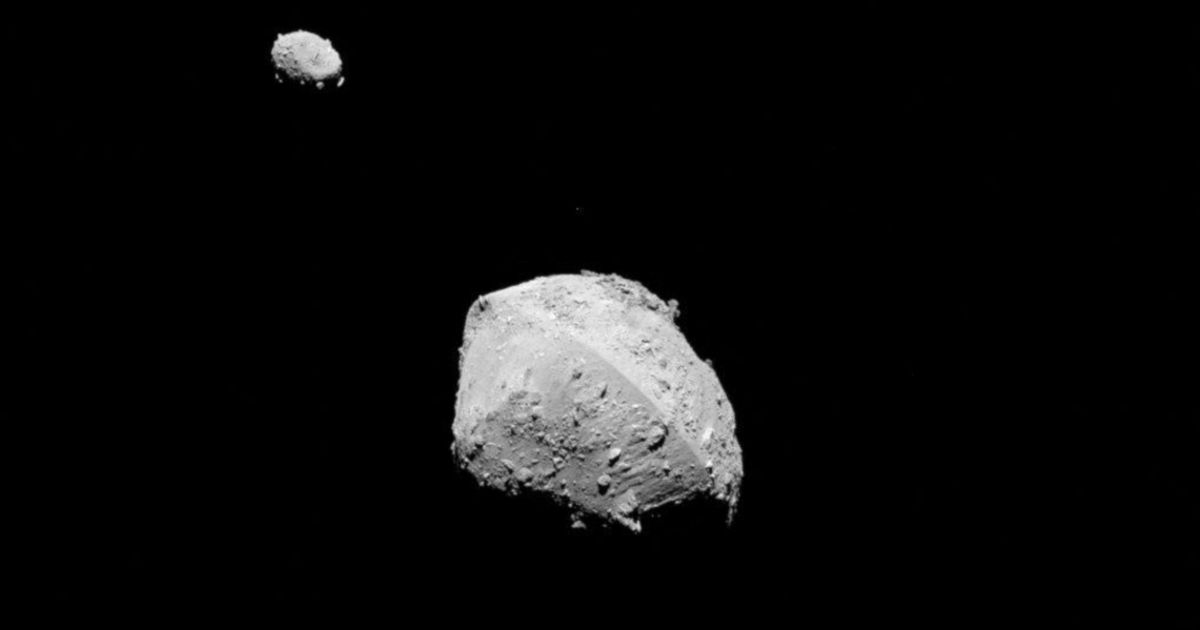
Photo via BBC News

Four years after huge asteroid crash, a spacecraft has now returned to assess the damage

Read the original at BBC News ↗
Cite

Francis, A., Morelle, R., & Jolliffe, T. (2026, November 25). Four years after huge asteroid crash, a spacecraft has now returned to assess the damage. BBC News. https://www.bbc.co.uk/news/articles/cw8dv112r5gmo?at_medium=RSS&at_campaign=rss

Dated from the outlet's own feed. Check the original for its byline.

BBC News · collected 2026-11-25 · by Alison Francis, Rebecca Morelle, Tony Jolliffe

Quick Summary

A European Space Agency (ESA) spacecraft named Hera has arrived at the asteroid Dimorphos to assess the impact site following the intentional collision of NASA’s Dart spacecraft in 2022. The Dart mission successfully altered Dimorphos’s orbit around its larger companion Didymos, with Dimorphos decreasing its orbital period by 33 minutes. Hera will study the asteroid’s current state, including the size and depth of any crater left by Dart, and measure Dimorphos’s mass to better understand the effectiveness of such deflection methods for future asteroid threats.
Written by AI on 2026-11-26, from this article's own text only (the story summary below draws on all the coverage).
See how they differ ↓

AI analysis

Story summary

Nasa's Dart spacecraft collided with the asteroid Dimorphos in 2022 to test planetary defense technology, and ESA's Hera spacecraft recently arrived at the asteroid to assess the impact. New images show a stadium-sized crater on Dimorphos, confirming that the mission successfully altered the asteroid's orbit. Dimorphos, which is 150m wide, orbits a larger asteroid called Didymos, and the pair pose no threat to Earth. The mission demonstrated the feasibility of using spacecraft to change the trajectory of an asteroid headed towards Earth, a crucial step in planetary defense strategies.

Written for “DART Mission Crater Revealed” on 2026-11-26, grounded in this article and the 6 other(s) covering the same event.

How they differ

6 outlets covered “DART Mission Crater Revealed”.

What each outlet says

One AI summary per outlet of its latest article on this story, written from that article alone and checked against it. Open the article for the outlet's own words.

BBCThis outlet25 Nov

A European Space Agency (ESA) spacecraft named Hera has arrived at the asteroid Dimorphos to assess the impact site following the intentional collision of NASA’s Dart spacecraft in 2022. The Dart mission successfully altered Dimorphos’s orbit around its larger companion Didymos, with Dimorphos decreasing its orbital period by 33 minutes. Hera will study the asteroid’s current state, including the size and depth of…

Four years after huge asteroid crash, a spacecraft has now returned to assess the damage (this article)2 articles from BBC on this story
CBC25 Nov

NASA's DART mission successfully crashed a spacecraft into the moonlet Dimorphos of the binary asteroid system Didymos in September 2022, changing its orbit by about 33 minutes, more than the anticipated 10 minutes. Four years later, the European Space Agency's Hera mission has released close-up images showing a significant crater on Dimorphos and hundreds of boulders moving around the pair of asteroids, the origin…

Remember when NASA slammed a spacecraft into an asteroid? We now have close-up images of the aftermath →
ABC News (AU)25 Nov

New photos from the European Space Agency's Hera spacecraft reveal a stadium-sized crater on the asteroid Dimorphos, caused by NASA's DART spacecraft impact in September 2022. The crater covers nearly the entire front side of Dimorphos, which orbits the larger asteroid Didymos, and the asteroid is now tumbling chaotically with hundreds of boulders floating around it. Hera, about the size of a small car, is currently…

New photos reveal stadium-sized crater in asteroid knocked off course by NASA →
The Straits Times26 Nov

Images released on November 25 by the European Space Agency’s Hera spacecraft show that the asteroid Dimorphos, struck by NASA’s DART spacecraft in September 2022, now has a large stadium-sized crater and is tumbling in space. The impact caused significant changes to one side of the asteroid, which is about 151 meters wide, while the opposite side remained largely unchanged. Hera is observing the asteroid pair from…

New images reveal crater on asteroid struck by DART spacecraft →
Dawn26 Nov

The European Space Agency’s Hera spacecraft has revealed new images of the asteroid Dimorphos, which shows a stadium-sized crater created by NASA’s DART spacecraft collision in 2022. The impact has caused Dimorphos to tumble chaotically in space, with hundreds of boulders floating around in the system. Dimorphos, a 495-foot-wide asteroid orbiting the larger Didymos asteroid, is now about 193.5 million kilometers…

New images reveal crater on small asteroid struck by spacecraft in 2022 →
Times of India26 Nov

The European Space Agency released the first images of the asteroid Dimorphos, showing a stadium-sized crater created by Nasa’s Dart spacecraft impact in 2022. The images, captured by the ESA’s Hera spacecraft, reveal that Dart collided with Dimorphos at 14,000 miles per hour, changing the asteroid's orbit by 33 minutes, demonstrating the potential to deflect asteroids from a collision course with Earth. Hera’s…

Nasa's asteroid crash test left stadium-sized crater; first images reveal →

Compared with similar articles

This article reads unscored and hedges 22% of its claims. Each row says how that neighbour differs.
ABC News (AU)
Hedges 2 of 20 claims Outlet record 66/100
The Straits Times
Hedges 1 of 21 claims Outlet record 64/100
BBC News
Hedges 0 of 6 claims Outlet record 65/100
“Article A describes the arrival of the Hera spacecraft to assess the aftermath, while Article B focuses on the initial impact and the release of the first images of the impact, describing different moments of the same broader event.”

Story

DART Mission Crater Revealed
Science · 7 article(s) covering the same event. See how they differ ↑
How this article was measured signals, leaning charts, publisher record, byline, topics and claims

Signals How these are calculated →

Claims extracted
41
sentences that state something as happening or true
Uncertain
22%
9 of 41 hedged ("reportedly", "may", "according to")
Leaning
not political
takes no side on a contested political question
Publisher signals
65/100
BBC News's corrections and hedging, across everything collected from it. Not a measure of accuracy.
Outlets on this story
7
Science
Same framing elsewhere
1
articles that frame the event the way this one does
Analyzed 2026-11-26 · how these are computed

How this is being covered How these are calculated →

Article leaning vs. publisher reliability
Source leaning vs. consistency

Publisher

BBC News · 6752 article(s) · 9 correction(s) detected
Running correction rate · 9 correction(s)

Who wrote this

Alison Francis
5 article(s) here · 1 carrying a prediction
It what may sound like the plot of a disaster movie, Nasa's Dart spacecraft deliberately smashed into the space rock in 2022 to knock it off course.
It will be entering an extremely hostile environment: Mercury is the closest planet to the Sun and temperatures can reach a fierce 430C and then plunge to -180C, and it is constantly blasted with intense solar radiation.
- Published SpaceX will attempt to catch both parts of its huge Starship rocket after it launches on its next test flight on Friday.
2026-11-13 · assertive framing · SpaceX to attempt double catch of huge Starship rocket
- Published A space mission is set to launch on Monday that will attempt to grab a piece of Mars' moon Phobos and bring it back to Earth.
The fact that none of the ship's wood remained meant techniques like radiocarbon dating - which measures a form of carbon in organic materials - could not be used to determine its age.
2026-10-14 · assertive framing · World's oldest shipwreck found off coast of Turkey
Also by Alison Francis
Nothing else under this byline is closely related to this article, so these are simply their most recent.
Rebecca Morelle
5 article(s) here · 1 carrying a prediction
It what may sound like the plot of a disaster movie, Nasa's Dart spacecraft deliberately smashed into the space rock in 2022 to knock it off course.
It will be entering an extremely hostile environment: Mercury is the closest planet to the Sun and temperatures can reach a fierce 430C and then plunge to -180C, and it is constantly blasted with intense solar radiation.
- Published SpaceX will attempt to catch both parts of its huge Starship rocket after it launches on its next test flight on Friday.
2026-11-13 · assertive framing · SpaceX to attempt double catch of huge Starship rocket
- Published A space mission is set to launch on Monday that will attempt to grab a piece of Mars' moon Phobos and bring it back to Earth.
The fact that none of the ship's wood remained meant techniques like radiocarbon dating - which measures a form of carbon in organic materials - could not be used to determine its age.
2026-10-14 · assertive framing · World's oldest shipwreck found off coast of Turkey
Also by Rebecca Morelle
Nothing else under this byline is closely related to this article, so these are simply their most recent.
Tony Jolliffe
2 article(s) here · 1 carrying a prediction
It what may sound like the plot of a disaster movie, Nasa's Dart spacecraft deliberately smashed into the space rock in 2022 to knock it off course.
It will be entering an extremely hostile environment: Mercury is the closest planet to the Sun and temperatures can reach a fierce 430C and then plunge to -180C, and it is constantly blasted with intense solar radiation.
Also by Tony Jolliffe
Nothing else under this byline is closely related to this article, so these are simply their most recent.

Topics

Dart ESA European Space Agency Hera Nasa

Subjects

ESA ORG · 2× Nasa ORG · 2× Carolyn Ernst PERSON · 1× Columbo PERSON · 1× Dimorphos PERSON · 1× European Space Agency ORG · 1× Johns Hopkins Applied Physics Laboratory ORG · 1× Michel PERSON · 1× Patrick Michel PERSON · 1× Simon Green PERSON · 1×

Narrative

Two spacecraft will head to Apophis, including Nasa's Osiris-Apex (which previously grabbed a sample from another asteroid called Bennu) and Ramses, a joint mission between ESA and the Japanese Space Agency (JAXA).
framing: mixed · carried by 1 article(s) · first seen 2026-11-26
It what may sound like the plot of a disaster movie, Nasa's Dart spacecraft deliberately smashed into the space rock in 2022 to knock it off course.

Claims (41 extracted, 9 hedged)

- Published A spacecraft has arrived at an asteroid to investigate the damage caused by an unprecedented cosmic crash. asserted
spacecraft → publish → crash
It what may sound like the plot of a disaster movie, Nasa's Dart spacecraft deliberately smashed into the space rock in 2022 to knock it off course. uncertain
spacecraft → sound → course
The Nasa craft was obliterated on impact. asserted
craft → obliterate → impact
Four years on, a European Space Agency (ESA) mission, called Hera, is scouring the scene to fully assess the aftermath of the collision - with the first images set to be released later on Wednesday. asserted
images → call → Wednesday
The asteroid poses no threat, instead this was the first ever test of our planetary defences to see what action we could take if a space rock was heading for our planet. uncertain
rock → pose → planet
"Hera is a sort of Inspector Columbo going back to the crash scene to investigate what is the outcome of this impact," said Patrick Michel, principal investigator of ESA's Hera mission. asserted
Michel → go → mission
The crash test focussed on a pair of asteroids: a larger one called Didymos - about 730m (2,400ft) wide - which is orbited by a smaller rock called Dimorphos, about 150m (490ft) wide. asserted
which → focusse → rock
The Dart spacecraft targeted Dimorphos, hurtling into the rock at 22,000km per hour (14,000mph). asserted
spacecraft → target → hour
Images beamed back showed the asteroid's rocky surface coming ever closer until the feed cut out on impact. asserted
feed → beam → impact
It was such a big smash-up that the trail of debris, measuring about 10,000km long (6,200 miles), was spotted by telescopes on Earth and in space. asserted
trail → measure → space
The crash showed it was possible to change the path of the smaller asteroid. asserted
it → show → asteroid
Before the collision it took Dimorphos 11 hours and 55 minutes to orbit around Didymos. asserted
it → take → Didymos
After the Dart crash, the duration of its orbit had shrunk by about 33 minutes. asserted
duration → shrink → minutes
But the arrival of the second spacecraft, Hera, will help scientists to answer many more questions. asserted
scientists → help → questions
"Dart exploded in the asteroid, and therefore we don't have the information of what is its final state," explained Michel. asserted
Michel → explode → information
"The impact could have left a crater - and if it is the case, we need to understand the size and the depth. uncertain
we → leave → size
Or [the impact] may have entirely reshaped the asteroid." uncertain
impact → reshape → asteroid
The Hera mission will spend the next year studying Dimorphos, and take a look at Didymos too. asserted
mission → spend → Didymos
The spacecraft is packed with instruments, and it also has two small shoe-boxed sized satellites onboard, which can study the impact site up close, and then later land on the asteroid. asserted
which → pack → asteroid
A key task is to measure the mass of Dimorphos, to work out how effective the spacecraft's shove was. asserted
shove → measure → Dimorphos
This information would be vital if we ever spotted a space rock that was on a collision course with Earth. " asserted
that → spot → Earth
It would help us to predict what would happen if we had to hit another asteroid," said Prof Simon Green, a planetary scientist who is on Hera's science team. asserted
who → help → team
"We [could] measure its properties and say: 'Well, we need this mass of spacecraft, travelling at this speed, this early, in order to deflect it enough so that it misses the Earth'. uncertain
it → measure → Earth
" Asteroids pose a significant threat to our planet. asserted
Asteroids → pose → planet
The biggest, which measure more than a kilometre across, could cause global devastation. uncertain
which → measure → devastation
But medium-sized asteroids around the same dimensions as Dimorphos could wipe out a city. uncertain
asteroids → wipe → city
"We all know what happened to the dinosaurs, right? asserted
what → know → dinosaurs
And we don't want that to happen to us," said Carolyn Ernst, Johns Hopkins Applied Physics Laboratory, who works on both the Dart and Hera missions. asserted
who → want → missions
"The good news for us is that there are far fewer potential threats out there in the Solar System than there were millions of years ago. asserted
news → be → years
She said the biggest asteroids have been spotted, and none are heading to Earth. asserted
none → say → Earth
"The smallest stuff isn't too much of a threat because our atmosphere protects us," she added. asserted
she → protect → us
"But there's a size range in the middle where we don't know where all of them are, and it could, if impacted, cause problems for humanity. uncertain
it → be → humanity
And if we can find out about that and know about that, well, we sure as heck would want to try to stop that." asserted
we → find → that
Scientists want to gather as much intelligence as they can about space rocks - to make us as well equipped as possible to deal with whatever the Universe throws at us. asserted
Universe → want → us
A new mission is launching in 2027 to track potentially hazardous asteroids: a space telescope called the Near-Earth Object (NEO) Surveyor. asserted
mission → launch → asteroids
There are also more visits planned to asteroids, including to one called Apophis, which is about 450m (1,480ft) long. asserted
which → be → one
Apophis was discovered in 2004 and it was initially thought it might hit the Earth as early as 13 April 2029. uncertain
it → discover → April
But now scientists understand its orbit better, and say it won't hit us for at least the next 100 years. asserted
it → understand → years
Instead of a crash in 2029, it will fly just 32,000km (20,000 miles) above our surface. asserted
it → fly → surface
This will give scientists the rare chance to study a space rock up-close. asserted
This → give → rock
…and 1 more, not listed.
Give feedback · no sign-in needed

No sign-in needed for now. Your note is sent without a name, so it cannot be answered.

History Support