Remember when NASA slammed a spacecraft into an asteroid?
asserted
NASA → remember → asteroid
We now have close-up images of the aftermath
'It's hard to describe in words all the excitement to finally see what happened,' says Hera mission scientist
asserted
scientist → have → excitement
In 2021, NASA embarked on an ambitious mission: Sending a spacecraft to slam into one of two asteroids in a double-asteroid system to test whether the impact could change its orbit.
uncertain
impact → embark → orbit
To see if the technology could be used to redirect any potentially hazardous asteroid that was on a collision course with Earth.
uncertain
that → see → Earth
The binary asteroid system consists of Didymos and its smaller moonlet, Dimorphos, which orbit a common centre of mass.
asserted
which → consist → mass
The mission was to slam into the moonlet to see if it would change its orbit around Didymos.
asserted
it → slam → Didymos
Fast forward to September 2022, and the Double Asteroid Redirection Test (DART) did just that.
asserted
Test → fast → that
It shortened Dimorphos's orbit around Didymos by roughly 33 minutes.
asserted
It → shorten → minutes
NASA had anticipated a change of roughly 10 minutes.
asserted
NASA → anticipate → minutes
While telescopes on Earth revealed the aftermath, another mission — the European Space Agency’s (ESA) Hera — was planned to take a closer look.
asserted
mission → reveal → look
Now, ESA has released close-up images and videos of the pair four years after DART.
asserted
ESA → release → DART
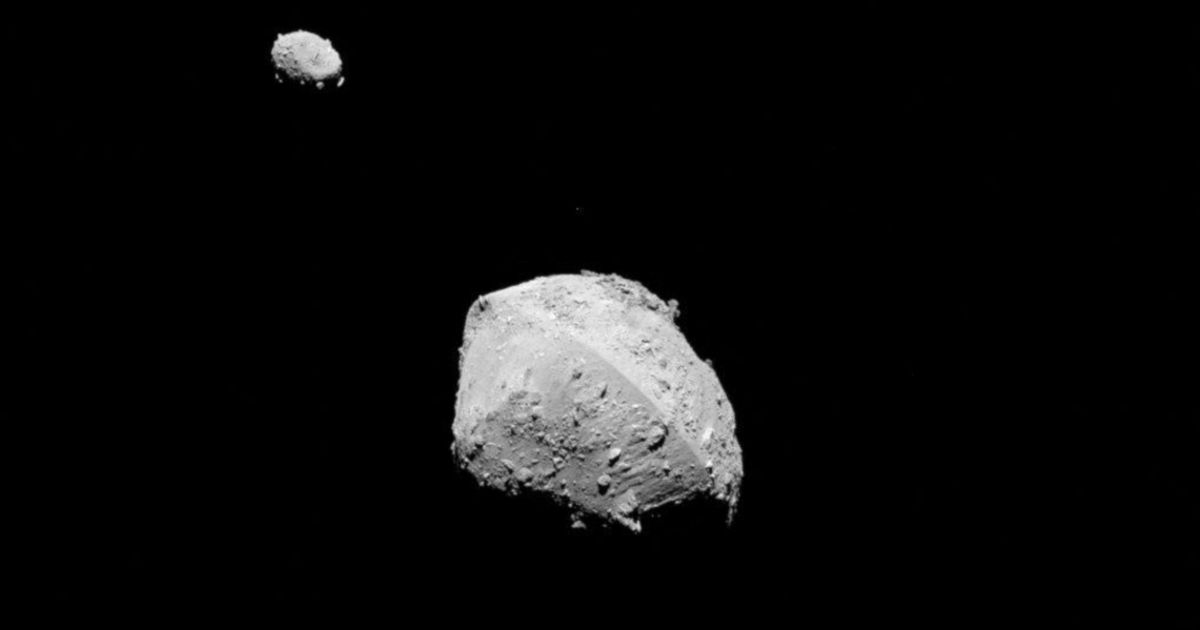
Looking closely at the images and video, there is a noticeable flattening on Dimorphos compared to pre-impact.
“But now where that rounded face was, now, well, it's a big crater … that is almost as large as the body itself, which is really, really spectacular,” said Sabina Raducan, planetary scientist with the International Space Science Institute and part of the Hera mission.
asserted
Raducan → look → mission
“It's hard to describe in words all the excitement to finally see what happened.”
asserted
what → describe → excitement
A big surprise
But there was more for Hera to discover.
asserted
Hera → be → ?
“Every space mission has surprises.
asserted
mission → have → surprises
But there was a particularly big one in store for Hera,” said Naomi Murdoch, planetary scientist with ISAE-SUPAERO at the Université de Toulouse, and part of the Hera science team.
asserted
Murdoch → be → team
“Hera has observed hundreds of boulders moving around these two asteroids and ranging in size from tens of centimetres to metre-sized,” she said.
asserted
she → observe → centimetres
The image produced by 11 long-exposure images look like fireflies are swarming around the pair of asteroids.
asserted
fireflies → produce → asteroids
This is a composite image combining 11 long-exposure Hyperscout H images, centred on the Didymos asteroid.
asserted
This → combine → asteroid
The dot trails correspond to hundreds of boulders of differing sizes in motion around the Didymos-Dimorphos system.
asserted
trails → correspond → system
The two asteroids have been subtracted from the image for improved visualisation of the boulders.
asserted
asteroids → subtract → boulders
These images were acquired on 6 November with an approximate distance of 29.9 km from the asteroids.
asserted
images → acquire → asteroids
But it’s not clear from where they originated.
asserted
they → ’ → ?
“We're still really trying to characterize them,” Murdoch said. “So, understanding with lots of imaging what their sizes are and how exactly they're moving in the space around the asteroids.
asserted
they → try → asteroids
So right now, we're not entirely sure where they came from.”
asserted
they → come → where
Hera has been orbiting the dual asteroid system for the past three weeks.
asserted
Hera → orbit → weeks
And scientists are eager to discover more.
asserted
scientists → discover → more
The right-side image is a view from Hera, aiming to match the previous mission's view angle as closely as possible.
asserted
image → aim → angle
Dimorphos appears entirely transformed, with its once-rounded face flattened into a crater that seems as wide as the impacted face of the asteroid and some weird structures inside it, including an apparent cigar-shaped structure at its centre.
asserted
that → appear → centre
For example, Didymos looks like a giant walnut, with a pronounced ridge across the 700-metre wide asteroid.
asserted
Didymos → look → asteroid
What we know is that the asteroid is rotating very fast, and we think that what happens when asteroids rotate fast is that the material on the surface actually flows down from the higher latitudes, down towards the equatorial region,” Murdoch explained.
asserted
Murdoch → know → region
NASA's asteroid deflection test for planetary defence even more successful than we thought
NASA's planetary defence test successfully shifts asteroid orbit
Another interesting thing is that, since the impact, Dimorphos is now tumbling as it orbits.
asserted
it → think → impact
So it was always showing the same face to Didymos,” Raducan said.
asserted
Raducan → show → Didymos
“It was behaving quite nicely.
asserted
It → behave → ?
More successful than anticipated
Not only did DART change Dimorphos’s orbit around Didymos, but it turns out it also changed the pair’s orbit around the sun.
asserted
it → anticipate → sun
In March, a study published in the journal Science Advances, reported that the impact changed its 770-day orbital period around the sun by a fraction of a second.
asserted
impact → publish → second
A fraction of a second may not seem like much, but it marks the first time in history that a human-made object has changed the orbit of an object around the sun.
uncertain
object → seem → sun
Over the next six months, Hera will continue to collect data about the binary asteroid system to see what else may have changed.
uncertain
what → continue → system
It will deploy two CubeSats (miniature satellites), to further explore both the mineral make-up of Dimorphos as well as the first radar sounding within an asteroid.
asserted
It → deploy → asteroid
After that, the pair will descend to the asteroid’s surface.
asserted
pair → descend → surface
…and 5 more, not listed.

 The Aporia