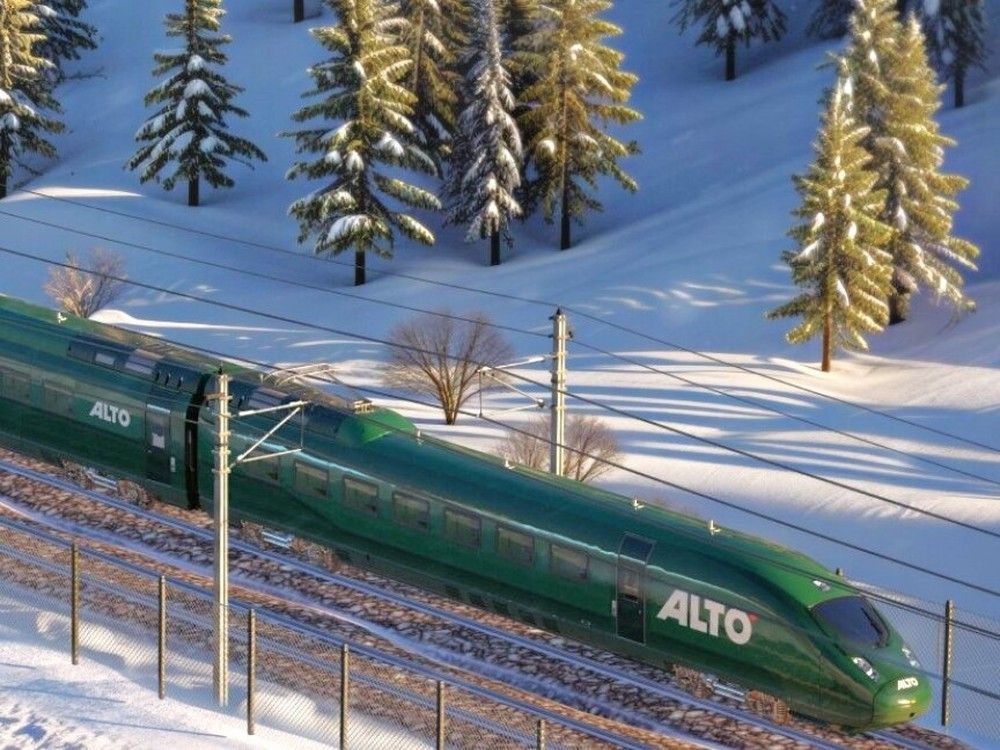
Transport Minister Steven MacKinnon on Tuesday defended a federal plan to widen Ottawa’s power to acquire land for the Alto high-speed rail line between Toronto and Quebec City, including the ability to expropriate property and hand it to a private consortium.
asserted
MacKinnon → defend → consortium
MacKinnon said the purpose-built rules preserve due process and head off land fights that could otherwise drag on “for 10, 12, 15 years.”
uncertain
that → say → years
Conservatives counter that the plan sidelines the federal Expropriation Act and puts homes, farms and businesses in rural eastern Ontario and Quebec at risk.
asserted
plan → counter → risk
Speaking to reporters on his way into a cabinet meeting in Ottawa, MacKinnon twice insisted “there is no removal of due process” and pointed to provincial transit projects as precedent.
asserted
MacKinnon → speak → precedent
“This is going to be a bespoke regime.
asserted
This → go → ?
It’s been used in Ontario, it’s been used in Quebec for public transit projects.
asserted
it → use → projects
It’s an extremely important component of this project and it’s one that we’re very comfortable with,” he said, according to The Canadian Press.
uncertain
he → ’ → Press
He cited Montreal’s Réseau express métropolitain and Toronto’s Ontario Line as examples, CBC News reported.
asserted
News → cite → examples
What the motion would do
The measures are in a notice of ways and means motion of more than 500 pages tabled Friday, the first step toward the government’s next budget implementation bill.
asserted
measures → table → bill
Under the proposal, land could be expropriated for transfer to a private partner—such as Cadence, the consortium selected to design and build the line—rather than only for the Crown.
uncertain
land → expropriate → Crown
The motion would also give the minister wider latitude to bar work on individual properties and would send disputes over crossings to private arbitration instead of public hearings, an arrangement that could leave farmers whose fields are split by the line covering part of the cost of building and maintaining those crossings.
uncertain
fields → give → crossings
According to CBC News, the draft would exempt Alto from the Expropriation Act entirely, as well as from parts of the Railway Relocation and Crossing Act, the Railway Safety Act and the Impact Assessment Act.
uncertain
draft → accord → Act
Transport Canada estimates the roughly 1,000-kilometre network will require acquiring 8,000 to 10,000 parcels.
asserted
network → estimate → parcels
Alto chief executive Martin Imbleau has said the Montreal–Ottawa leg alone, where construction is slated to begin in 2029 or 2030, would cross about 1,700 properties, some 500 of them agricultural.
asserted
500 → say → them
Building on powers already in law
Parliament has already given the project unusual reach.
asserted
Parliament → build → reach
The High-Speed Rail Network Act, enacted through the budget implementation bill C-15 and given royal assent on March 26, lets Alto seek expropriation without first trying to negotiate a purchase and removes the public hearings the Expropriation Act would otherwise provide.
asserted
Act → enact → hearings
It also lets Alto claim a right of first refusal on land it may need for up to eight years, without paying the owner anything upfront, and issue notices barring work on affected property.
uncertain
it → let → property
Conservative MP Michael Barrett, who represents the eastern Ontario riding of Leeds–Grenville–Thousand Islands–Rideau Lakes, argued the new motion goes further by swapping out the Expropriation Act for a standalone regime, a change he said deepens anxiety in rural communities along the route.
asserted
he → represent → route
“Residents are deeply concerned about the potential loss of homes and farmland, disruption to local businesses and lasting damage to our environment,” Barrett wrote in a public letter to MacKinnon on Tuesday.
asserted
Barrett → concern → Tuesday
Conservatives also warned that farmers and municipalities drawn into crossing disputes could face arbitration costs of up to $25,000 on top of their own legal fees.
uncertain
farmers → warn → fees
Party transport critic Dan Albas likened the plan to the heavy-handed expropriations for the Pickering and Mirabel airports.
asserted
Albas → liken → airports
This is a bulldozer,” he told reporters.
asserted
he → tell → reporters
The criticism is not confined to the Conservatives.
asserted
criticism → confine → Conservatives
Bloc Québécois Leader Yves-François Blanchet called the changes “authoritarian measures” that could reach provincial property, while NDP Leader Avi Lewis faulted the project’s public-private ownership model.
uncertain
Lewis → call → model
Alto told CBC News that landowners facing expropriation would receive fair compensation based on the property’s current use, its market value and the financial effect on the land they keep, and Transport Canada says the existing compensation regime is not affected.
asserted
regime → tell → land
Still unsettled are how far the new powers should reach and how crossing costs would be divided.
asserted
costs → reach → ?
Project’s financial case also questioned
asserted
case → question → ?
The land dispute comes as the project’s underlying rationale faces a separate challenge.
asserted
rationale → come → challenge
Warren Everson, writing for The Hub, argues the economics of the line are weak.
asserted
economics → write → line
Looking at systems abroad, he writes that “only a few HSRs pay for their annual operations, and none have recovered the cost of their construction.”
asserted
none → look → construction
Imbleau has spoken of 25 million passengers a year.
asserted
Imbleau → speak → passengers
Everson warns that the line would pull riders from VIA Rail’s busiest routes, leaving the conventional services behind as heavy money-losers.
asserted
line → warn → losers
According to VIA’s 2024 annual report, 81 percent of its passenger revenue came from intercity travel in the Quebec City–Windsor corridor, a route that extends well beyond Alto’s planned Toronto terminus.
uncertain
that → accord → terminus
Everson also argues that spending on this scale, with the government pegging the project at $60 billion to $90 billion, should be judged by whether it materially improves Canada’s competitive position at a time of weak business investment and pressure from the U.S.
asserted
it → argue → U.S.
He points to freight rail and port capacity as competing priorities.
asserted
He → point → priorities
“Transportation investment shouldn’t be based on buffing up our national prestige,” he writes.
asserted
he → base → prestige
The fight over expropriation may ultimately turn less on procedure than on whether the line justifies the powers sought to build it.
uncertain
line → turn → it
MPs will face that question directly when the budget implementation bill carrying the measures comes before the House.
asserted
bill → face → House
Transport Minister Steven MacKinnon defended the federal government’s plan to expand expropriation powers for the Alto high-speed rail project between Toronto and Quebec City.
asserted
MacKinnon → defend → Toronto
The proposal allows for land acquisition by a private consortium, raising concerns among Conservatives and other critics about potential risks to homes and farms.
asserted
proposal → allow → homes
…and 2 more, not listed.

 The Aporia