Photo via Times of India

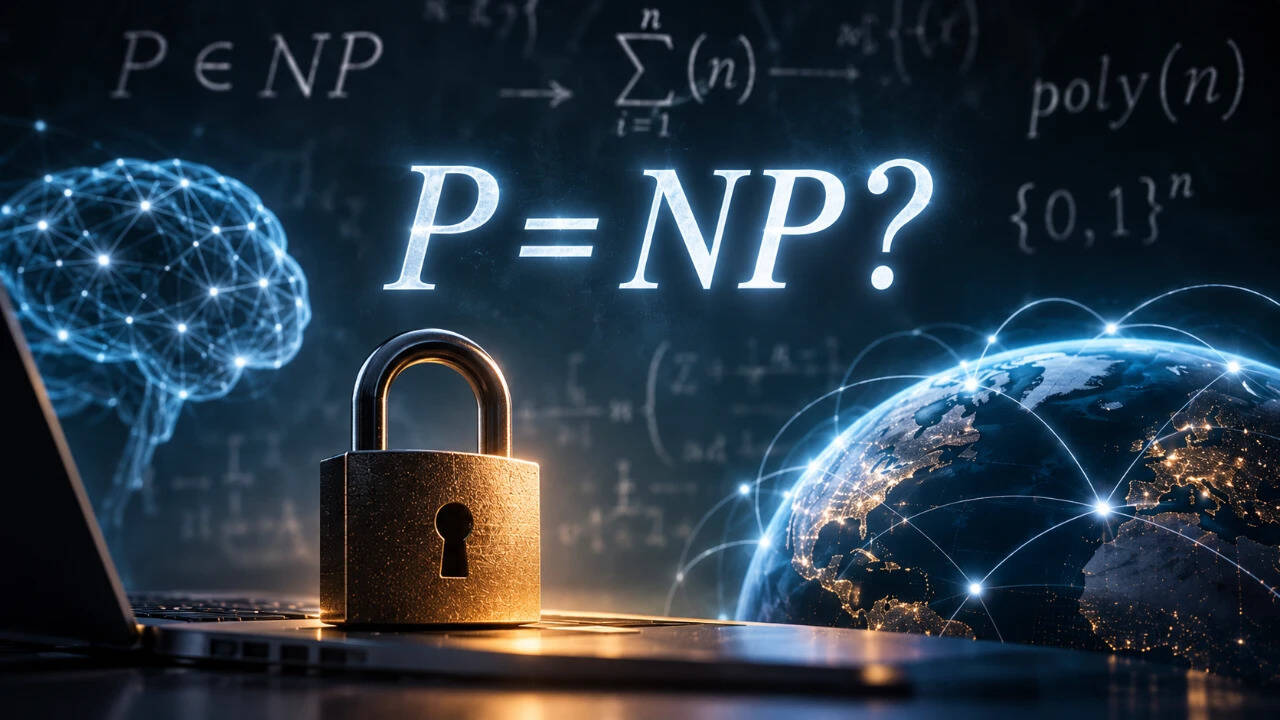
P vs NP: AI may crack maths mystery behind global encryption – report

Read the original at Times of India ↗
Cite

Patnaik, P. (2026, November 29). P vs NP: AI may crack maths mystery behind global encryption – report. Times of India. https://timesofindia.indiatimes.com/world/rest-of-world/p-versus-np-problem-ai-close-to-solving-maths-biggest-mystery-that-could-put-the-worlds-secrets-at-risk-report/articleshow/136259075.cms

Dated from the outlet's own feed. Check the original for its byline.

Times of India · collected 2026-11-29 · by Prisha Patnaik

Quick Summary

AI is making strides in solving one of the most significant unsolved problems in computer science, known as P vs NP, which has puzzled mathematicians for 55 years. This problem questions whether problems that can be quickly verified can also be quickly solved. Recent advances by AI companies like OpenAI and Anthropic have sparked speculation that AI could potentially crack encryption codes, posing a risk to global cybersecurity. However, it's noted that no AI system has demonstrated the ability to break modern encryption algorithms, and proving P equals NP wouldn't immediately provide a practical method for doing so.
Written by AI on 2026-11-29, from this article's own text only (the story summary below draws on all the coverage).

AI analysis

Story summary

Artificial intelligence (AI) could potentially solve the P vs NP problem, a longstanding mathematical challenge that has eluded mathematicians for 55 years. If AI were to prove that P equals NP, it would mean that any problem with a solution that can be verified quickly can also be solved quickly, fundamentally reshaping various fields including drug discovery and global finance. However, it would also render most cryptographic systems theoretically breakable, potentially exposing sensitive data that currently relies on encryption for protection.

Nicky Mouha, founder of KeyCryptic and a former cryptographer at the US National Institute of Standards and Technology, told Axios that while such a proof would make encryption theoretically vulnerable, practical threats might not immediately follow. Recent advancements by companies like OpenAI, Anthropic, and Google have sparked renewed interest in the P vs NP problem, as AI systems are making progress on mathematical problems that have long been challenging for humans. The breakthroughs have led to speculation about what further capabilities AI might achieve in the future.

Written for “P vs NP Math Mystery AI Breakthrough” on 2026-11-29, grounded in this article and the 0 other(s) covering the same event.
Why this leaning score
This article does not take a side on a contested political question, so it has no leaning score. That is an answer rather than a gap: a match report or a rescue can be warmly or critically written without being left or right, and scoring it anyway is how approval of a subject gets recorded as a political position.
No political leaning scored for article 188141 · logged 2026-11-29

Compared with similar articles

This article reads unscored and hedges 38% of its claims. Each row says how that neighbour differs.
Washington Examiner
Hedges 1 of 4 claims Outlet record 66/100
“The articles describe different mathematical problems (Riemann hypothesis vs P vs NP) and their potential impacts, not the same specific event.”

Story

P vs NP Math Mystery AI Breakthrough
Science · 1 article(s) covering the same event.
How this article was measured signals, leaning charts, publisher record, byline, topics and claims

Signals How these are calculated →

Claims extracted
37
sentences that state something as happening or true
Uncertain
38%
14 of 37 hedged ("reportedly", "may", "according to")
Leaning
not political
takes no side on a contested political question
Publisher signals
58/100
Times of India's corrections and hedging, across everything collected from it. Not a measure of accuracy.
Outlets on this story
1
Science
Same framing elsewhere
1
articles that frame the event the way this one does
Analyzed 2026-11-29 · how these are computed

How this is being covered How these are calculated →

Article leaning vs. publisher reliability
Source leaning vs. consistency

Publisher

Times of India · 6100 article(s) · 10 correction(s) detected
Running correction rate · 10 correction(s)

Who wrote this

Prisha Patnaik
157 article(s) here · 1 carrying a prediction
The KMT argued that nuclear power could provide a stable and low-carbon electricity supply for Taiwan’s fast-growing artificial intelligence and semiconductor industries, whose energy requirements are increasing.
The accused, 25-year-old Indian-origin man Samit Apurva Patel, was earlier charged with attempted second-degree murder and carjacking, but prosecutors said the charges would be upgraded to second-degree intentional murder following the driver's death.
It also rejected claims it would suspend counterintelligence operations against Beijing in exchange for the release of South Korean nationals detained in the country.
If it solves the equation, it could reshape everything from drug discovery to global finance, while potentially exposing the encryption that protects the world's most sensitive data.
They have doubled the number of mayoral and county magistrate seats in their controls, giving a boost for Taiwanese president Lai Ching-te ahead of the 2028 presidential race.
The search would continue on Thursday, weather permitting.
The parade, which was scheduled to take place on Thanksgiving Day, November 26, will now begin at 8.30 am local time on November 28.
Baharav-Miara told the court that she and her team would consider the judges’ recommendations and remain open to all options based on the evidence, according to a transcript provided by a Justice Ministry spokeswoman to New York Times.
Trump’s latest disclosure, submitted on November 5, indicated that he could have held as many as 370,000 Nvidia shares as of September 30.
Authorities said the water had not yet receded significantly and draining the shaft could take considerable time.
Also by Prisha Patnaik
Nothing else under this byline is closely related to this article, so these are simply their most recent.
All 157 articles by Prisha Patnaik →

Topics

Anthropic Google OpenAI

Subjects

Anthropic ORG · 3× OpenAI ORG · 2× Claude PERSON · 1× Google ORG · 1× Riemann PERSON · 1× the Clay Mathematics Institute's ORG · 1×

Narrative

Nicky Mouha, founder of KeyCryptic and a former cryptographer at the US National Institute of Standards and Technology, told Axios that a proof of P = NP would make almost all cryptography theoretically breakable, though not necessarily broken in practice.
framing: mixed · carried by 1 article(s) · first seen 2026-11-29
If it solves the equation, it could reshape everything from drug discovery to global finance, while potentially exposing the encryption that protects the world's most sensitive data.
2026-11-29 · Times of India
P vs NP: AI may crack maths mystery behind global encryption – report · mixed framing

Claims (37 extracted, 14 hedged)

Artificial intelligence is seen as having the potential to make a breakthrough in one of computer science's biggest unanswered questions. asserted
intelligence → see → questions
If it solves the equation, it could reshape everything from drug discovery to global finance, while potentially exposing the encryption that protects the world's most sensitive data. uncertain
that → solve → data
At the heart of the question is P versus NP, a problem that has eluded mathematicians for 55 years. asserted
that → elude → years
It asks whether a problem whose solution can be checked quickly can also be solved quickly. asserted
solution → ask → ?
If the answer is yes, the consequences could extend far beyond mathematics, potentially undermining the cryptographic systems that secure online transactions, digital identities and government communications. uncertain
that → extend → transactions
Recent advances by OpenAI, Anthropic and Google have brought renewed attention to the question, as AI systems make progress on mathematical problems that have long resisted human efforts. asserted
that → bring → efforts
The breakthroughs have prompted speculation about what these models might be capable of behind closed doors. uncertain
models → prompt → doors
The pace of recent discoveries has been striking. asserted
pace → strike → discoveries
On November 20, an Anthropic mathematician presented a proof of the Riemann hypothesis assisted by an unreleased research version of Claude. asserted
mathematician → present → Claude
On Monday, OpenAI and Anthropic published competing proofs addressing a mathematical problem related to P versus NP, a development that many computer scientists had considered beyond the reach of existing approaches. asserted
scientists → publish → approaches
These developments have intensified speculation that publicly reported achievements may represent only a fraction of what advanced AI models can accomplish. uncertain
models → intensify → what
A mathematical advance that undermined widely used encryption could threaten the systems through which banks, businesses and governments protect information. uncertain
banks → undermine → information
The consequences could extend well beyond the technology industry, raising questions about whether companies or governments would consider some findings too dangerous to disclose. uncertain
companies → extend → findings
No AI system has publicly demonstrated an ability to break widely used modern encryption algorithms, and a proof that P equals NP would not automatically provide a shortcut that could be used to crack them. uncertain
that → demonstrate → them
What does P versus NP actually mean? asserted
P → mean → NP
P versus NP asks whether problems whose solutions can be verified quickly can also be solved quickly. asserted
solutions → ask → NP
In computer science, P refers to problems that can be solved in what is known as polynomial time. asserted
what → refer → time
NP refers to problems for which a proposed solution can be verified in polynomial time. asserted
solution → refer → time
The distinction matters because some problems appear to become dramatically more difficult to solve as their size increases, even though checking a proposed answer may be comparatively easy. uncertain
checking → matter → answer
Many problems in the NP category are classified as NP-complete. asserted
problems → classify → -
A sufficiently efficient solution to one of these problems could be adapted to solve all other NP-complete problems efficiently. uncertain
solution → adapt → problems
That is why a proof that P equals NP would be so consequential: it would suggest that problems thought to be computationally difficult could, in fact, have efficient solutions. uncertain
it → equal → solutions
Most computer scientists believe P does not equal NP. asserted
P → believe → NP
A 2002 poll of mathematicians and computer scientists found that 61 believed the two were probably unequal, compared with nine who thought they might be equal. uncertain
they → find → nine
The question remains unresolved and is one of the Clay Mathematics Institute's seven Millennium Prize Problems, carrying a $1 million prize for a proof or disproof. asserted
question → remain → proof
Why encryption is at the heart of the concern Modern cryptography relies, in part, on mathematical problems that are difficult to solve but whose solutions can be verified. asserted
solutions → rely → problems
This asymmetry helps protect digital transactions, communications and identities. asserted
asymmetry → help → transactions
The RSA cryptographic system, widely used for secure internet transactions, is one example of a scheme rooted in the difficulty of certain number-theoretic computations. asserted
system → use → computations
If P were proved equal to NP and the result yielded practical algorithms for problems underpinning encryption, widely used cryptographic systems could become vulnerable. uncertain
systems → prove → encryption
Digital signatures, which help authenticate transactions, identities and software, could also be at risk of forgery. uncertain
which → help → forgery
The implications would reach into banking, government communications, corporate networks and other critical infrastructure. asserted
implications → reach → banking
Governments and businesses are already preparing for the possibility that powerful quantum computers could undermine some existing encryption methods. uncertain
computers → prepare → methods
Nicky Mouha, founder of KeyCryptic and a former cryptographer at the US National Institute of Standards and Technology, told Axios that a proof of P = NP would make almost all cryptography theoretically breakable, though not necessarily broken in practice. asserted
cryptography → tell → practice
The anxiety over mathematical breakthroughs is unfolding alongside a wider debate within the AI industry about whether its most advanced systems are becoming difficult to control. asserted
systems → unfold → industry
For now, P versus NP remains unsolved. asserted
P → remain → NP
The uncertainty is no longer just about whether machines can find the answer. asserted
machines → find → answer
It is increasingly about what happens if they do. asserted
they → happen → ?

Give feedback · no sign-in needed

No sign-in needed for now. Your note is sent without a name, so it cannot be answered.

History Support