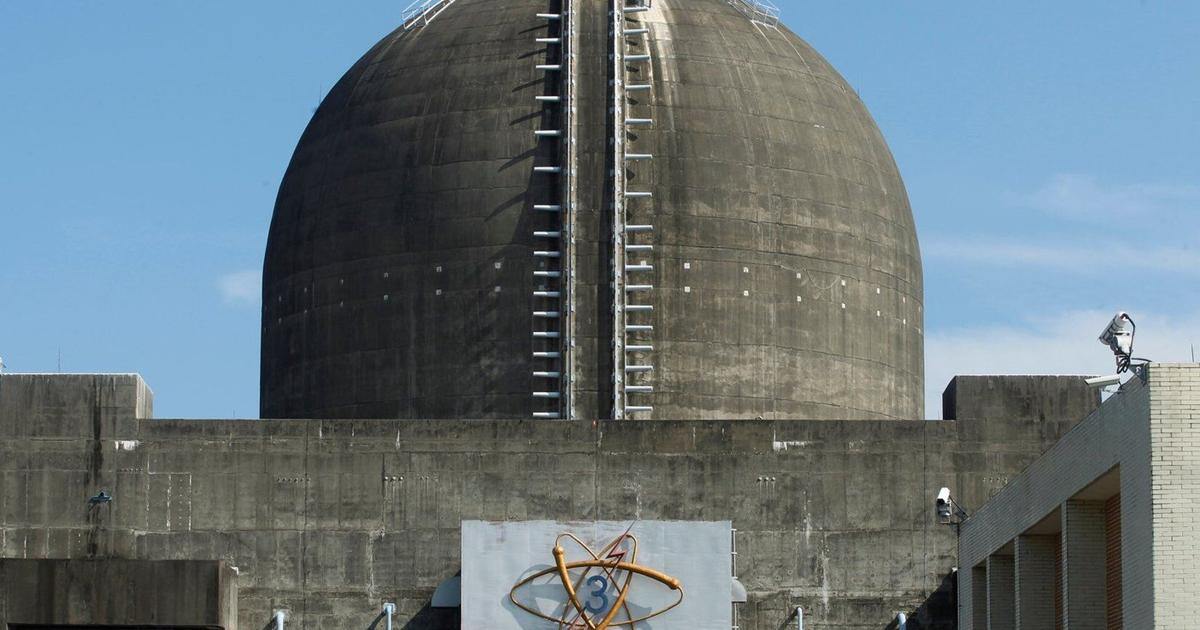
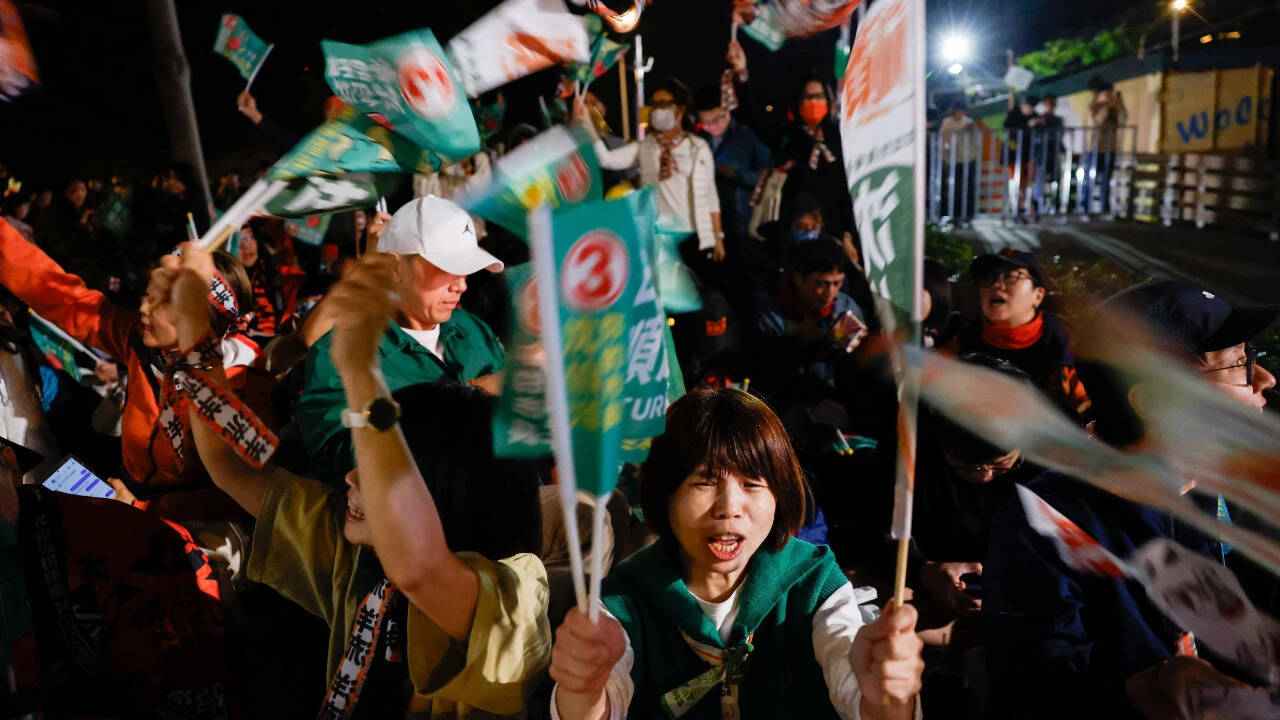
Taiwanese voters have backed a proposal to abandon the island's "nuclear-free homeland" policy, reversing a key plank of the ruling Democratic Progressive Party's energy agenda.
asserted
voters → back → agenda
The result gives the government a political mandate to reconsider the use of nuclear power.
asserted
result → give → power
The referendum, initiated by the opposition Kuomintang (KMT), was held alongside local elections on Saturday and saw 61.99% of valid votes cast in favour, according to the Central Election Commission.
uncertain
% → initiate → Commission
A total of 7,434,677 voters supported the proposal, compared with 4,557,768 who voted against it.
asserted
who → support → it
Turnout stood at 62.79%, with the referendum meeting the required threshold of at least 5,000,959 affirmative votes, equivalent to one-quarter of Taiwan’s eligible electorate.
asserted
referendum → stand → electorate
The question asked voters whether they supported the government using nuclear power to boost the economy and scrapping the “nuclear-free homeland” energy policy.
asserted
government → ask → policy
The KMT argued that nuclear power could provide a stable and low-carbon electricity supply for Taiwan’s fast-growing artificial intelligence and semiconductor industries, whose energy requirements are increasing.
uncertain
requirements → argue → industries
However, the result does not mean that Taiwan will immediately restart its nuclear plants or build new ones.
asserted
Taiwan → mean → ones
The island’s last operating nuclear power plant was shut down in 2025, although it is undergoing refurbishment and could potentially resume operations in about two years, according to the Associated Press.
uncertain
it → operate → Press
Nuclear power is not legally prohibited in Taiwan; its use has instead been governed by the government’s energy policy.
asserted
use → prohibit → policy
The referendum therefore removes a major policy barrier to reconsidering nuclear energy, but any decision to bring plants back into operation will involve further assessments and political negotiations.
asserted
decision → remove → assessments
What happens to Taiwan’s nuclear policy now?
asserted
What → happen → policy
The DPP government said it would respect the referendum result but insisted that any return to nuclear power must ensure plant safety, resolve nuclear waste disposal and build public consensus.
asserted
return → say → consensus
Executive Yuan spokesperson Michelle Lee said the Cabinet would continue to accelerate renewable energy development, while President Lai Ching-te has previously said he would not rule out nuclear power.
asserted
he → say → power
KMT leader Cheng Li-wun, meanwhile, called for Taiwan to “restart nuclear energy as quickly as possible”.
asserted
Taiwan → call → energy
The opposition argues that nuclear power could provide stable, low-carbon electricity for the island’s AI and semiconductor industries while strengthening energy security and stabilising prices.
uncertain
power → argue → prices
Safety, waste concerns remain
asserted
concerns → remain → ?
Opponents have questioned whether nuclear power is a suitable solution for Taiwan, given the island’s exposure to earthquakes and the location of nuclear facilities near geological fault lines.
asserted
power → question → lines
Concerns over the earthquake resistance of nuclear plants and the long-term disposal of radioactive waste remain unresolved, they argue.
asserted
they → remain → waste
They have also maintained that developing nuclear power plants is expensive and time-consuming, and that investment should instead be directed towards renewable energy to meet the growing electricity needs of the technology sector.
asserted
investment → maintain → sector
The National Nuclear Abolition Action Platform expressed disappointment with the referendum outcome, arguing that the wording of the question presented nuclear power as a means of reviving the economy without establishing a direct link between the two.
asserted
wording → express → two
The group described the proposal as a “push poll” and said its passage did not give the government a blank cheque to pursue nuclear energy without considering the associated risks and costs.
asserted
passage → describe → risks
The referendum also drew scrutiny over how much attention the issue received during the election campaign.
asserted
issue → draw → campaign
Political science professor Wei-hao Huang of National Sun Yat-sen University told the Associated Press that he had seen little public discussion of nuclear power during the campaign, apart from the issue being raised when it was initially introduced in the legislature.
asserted
it → tell → legislature
Huang suggested that the KMT may have used the referendum to mobilise its supporters and increase turnout in the local elections.
uncertain
KMT → suggest → elections
A history of nuclear referendums
Saturday’s vote was Taiwan’s fourth nuclear-related referendum in eight years and the first since the island resumed holding referendums alongside elections.
asserted
island → relate → elections
The practice had been suspended by the DPP-controlled legislature in 2019 and reinstated by the opposition-dominated legislature last year.
asserted
practice → suspend → legislature
This year's referendum recorded a turnout of 62.79%, higher than the 41.09% recorded in 2021 and the 29.53% turnout in 2025.
asserted
referendum → record → 2025
The 2018 vote, which was also held alongside local elections, had recorded a turnout of 54.83%.
asserted
which → hold → %

 The Aporia