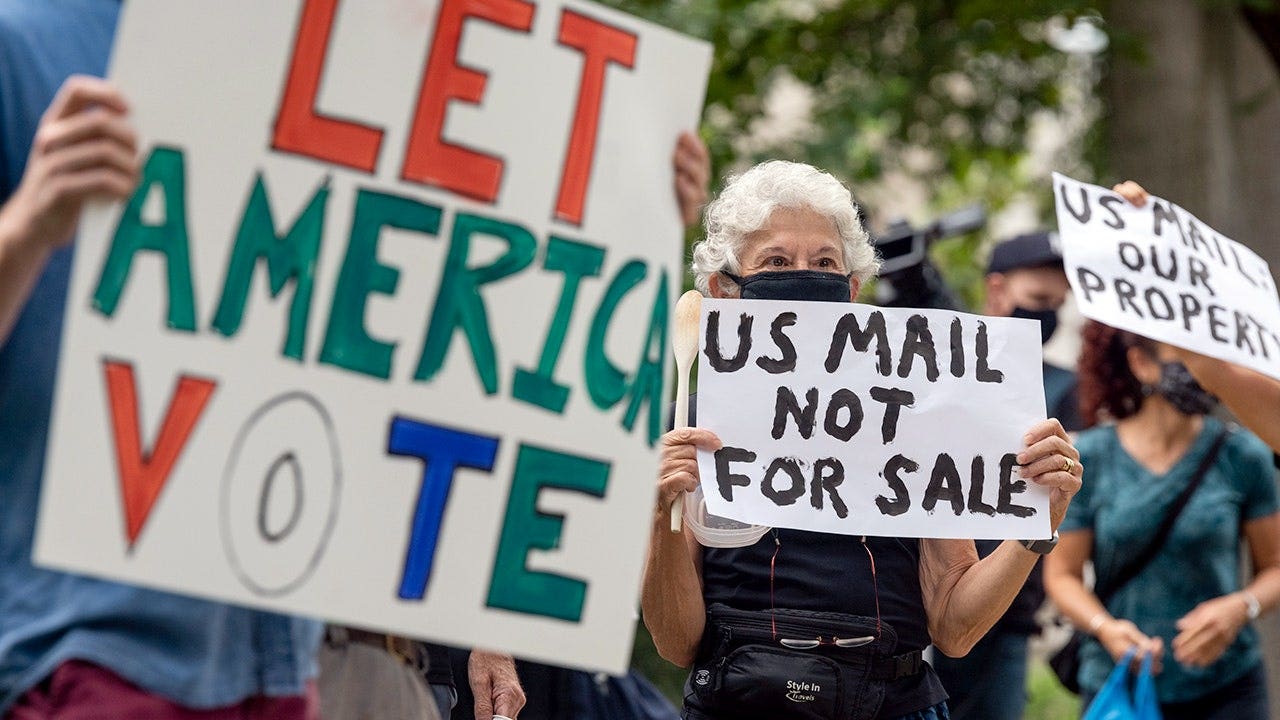
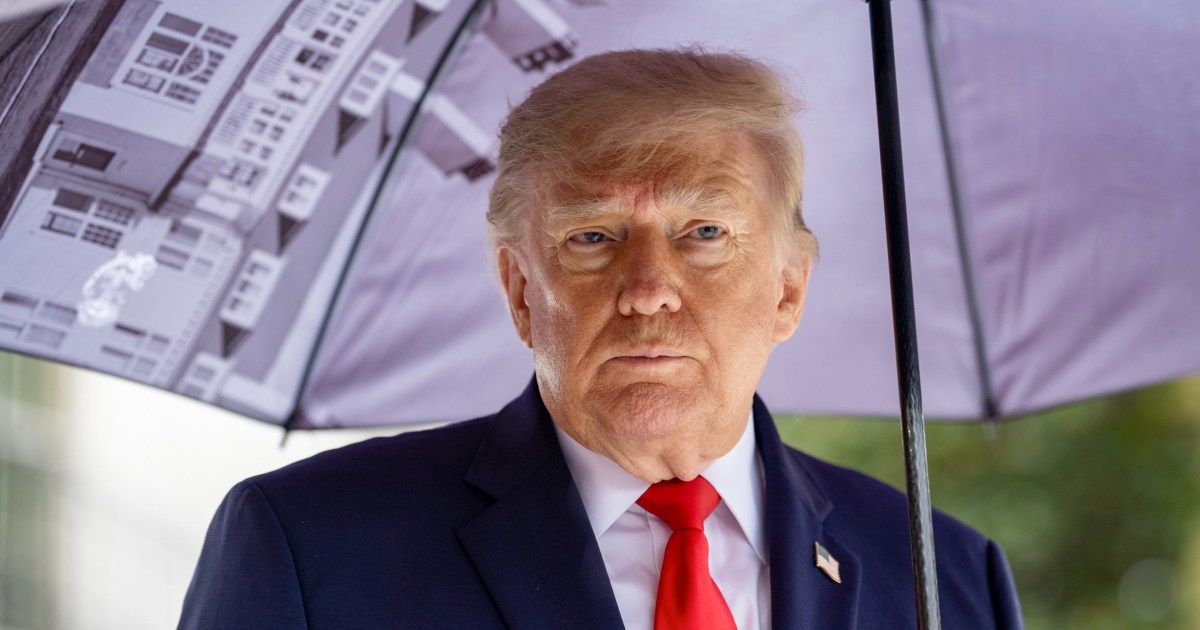
Photo via NBC News

Supreme Court hands preliminary win to Trump on mail-in ballots executive order

Read the original at NBC News ↗
Cite

Hurley, L. (2026, August 25). Supreme Court hands preliminary win to Trump on mail-in ballots executive order. NBC News. https://www.nbcnews.com/politics/supreme-court/supreme-court-hands-preliminary-win-trump-mail-ballots-executive-order-rcna590120

Dated when The Aporia collected the article, usually within hours of publication. Check the original for its exact date and byline.

NBC News · collected 2026-08-25 · by Lawrence Hurley

Quick Summary

The Supreme Court has ruled 6-3 in favor of the Trump administration's executive order limiting mail-in ballots ahead of the 2026 midterm elections, lifting a lower court injunction that blocked key aspects of the order in California and 22 other states. The decision allows the Trump administration to implement parts of the order, but the legal battle is far from over as other provisions remain blocked nationwide. A total of 24 states were affected by the ruling, with Alabama and its 11 allies also granted relief. California Governor Gavin Newsom has vowed to launch a new challenge to the policy on mail-in voting.
Written by AI on 2026-08-25, from this article's own text only (the story summary below draws on all the coverage).
See how they differ ↓

AI analysis

Story summary

The Trump Administration's Efforts to Restrict Mail-In Voting

President Donald Trump's executive order, issued on March 31, aimed to create a federal list of eligible voters and restrict mail-in voting by requiring states to use specific envelopes and barcodes. The US Postal Service (USPS) was instructed to deliver ballots only to those on the approved list.

However, this move was blocked by two court orders in Massachusetts, issued by Judge Indira Talwani on June 25 and August 11. These injunctions prevented the USPS from implementing the new rule before the midterm elections in November.

In response, the Trump administration appealed to the Supreme Court, which initially decided to allow the restriction of mail-in voting to proceed while the case was ongoing. This decision was seen as a preliminary victory for President Trump.

However, the Supreme Court's unsigned opinion did not declare the executive order lawful, and Democratic-led states argued that permitting the administration to push ahead with changes would contribute to pre-election chaos.

In response, California Governor Gavin Newsom announced that his state would sue again to block federal changes to mail voting. The California legislature also proposed two new laws that would make it a crime to interfere with the delivery of mail ballots, punishable by up to four years in prison.

The USPS has submitted a motion to dissolve one of the court injunctions blocking the implementation of the Trump administration's plan, and published new guidelines that could take effect if legal barriers are removed.

Written for “Trump's Mail Voting Restrictions” on 2026-11-20, grounded in this article and the 15 other(s) covering the same event.

How they differ

9 outlets covered “Trump's Mail Voting Restrictions”.

What each outlet says

One AI summary per outlet of its latest article on this story, written from that article alone and checked against it. Open the article for the outlet's own words.

NBC NewsThis outlet25 Aug

The Supreme Court has ruled 6-3 in favor of the Trump administration's executive order limiting mail-in ballots ahead of the 2026 midterm elections, lifting a lower court injunction that blocked key aspects of the order in California and 22 other states. The decision allows the Trump administration to implement parts of the order, but the legal battle is far from over as other provisions remain blocked nationwide. A…

Supreme Court hands preliminary win to Trump on mail-in ballots executive order (this article)3 articles from NBC News on this story
The Guardian28 Aug

Federal Judge Indira Talwani has temporarily blocked Donald Trump's executive order limiting mail voting in midterms for 14 days. The ruling came a week before mail ballots are set to be sent out and follows a recent Supreme Court decision that overturned a previous injunction against the order, but did not rule on its legality. Nearly one-third of Americans vote by mail, and election officials say there is not…

Federal judge again halts Trump’s executive order limiting mail voting in midterms →3 articles from The Guardian on this story
Los Angeles Times27 Aug

California and other Democratic-led states have filed a lawsuit against the U.S. Postal Service's new rules for mail ballots, which were issued in response to an executive order from President Trump in March. The rules require states to submit voter lists to the Postal Service and reject ballots that don't match those lists, and 24 state attorneys general are asking a federal court to halt implementation of these…

California, other states sue again to block new Postal Service rules for mail ballots →2 articles from Los Angeles Times on this story
The Independent28 Aug

US District Judge Indira Talwani issued a temporary restraining order on Thursday blocking key elements of a new US Postal Service policy directed by President Donald Trump that restricts mail-in voting ahead of the November congressional elections. The policy, which took effect on Wednesday, required states to submit lists of mail-in voters to an electronic database and obtain USPS approval for ballot envelopes…

Judge blocks Trump mail ballot rules over ‘overwhelming risk’ to voters →2 articles from The Independent on this story
The Bulwark26 Aug

The article reports on President Trump's efforts to potentially subvert the 2022 midterm elections through various means. Despite a recent Supreme Court decision staying a lower court injunction related to mail-in ballots, the author argues this is not a definitive win for Trump and notes he remains determined to prevent a free and fair election if possible. The article also mentions other attempts by the…

Prepare for Trump to Try to Steal the Midterms →2 articles from The Bulwark on this story
Time24 Aug

The United States Postal Service (USPS) has issued a 95-page final rule that requires employees to verify federal ballot mailings comply with new requirements before accepting them from election officials. The rule was designed to comply with President Donald Trump's executive order from March 31 and would take effect immediately if the government obtains relief from two existing injunctions. Two court orders, one…

What to Know About the USPS’s Rule for Mail-In Ballots →
Show 3 more outlets
Mother Jones25 Aug

The US Supreme Court has temporarily blocked federal court rulings that had blocked President Trump's executive order severely restricting mail-in voting. The unsigned opinion, with dissents from Justices Jackson, Sotomayor, and Kagan, stated that states have not shown how they would be harmed by the order. This decision does not rule on the merits of the executive order but overrules lower court rulings…

SCOTUS Hands Trump a Temporary Win In His Crusade to Restrict Mail Voting →
Fox News28 Aug

A former White House deputy counsel, Gene Hamilton, is saying that following a Supreme Court ruling, federal agencies can now move forward with parts of President Trump's election-integrity order, which includes new ballot-mail standards and efforts involving state citizenship lists. The court's majority rejected a challenge from opposing states who claimed harm could come from the order. Hamilton notes that the…

Mail-voting crackdown moves ahead as Trump court win opens door to federal action →
UPI28 Aug

A federal judge has blocked the Trump administration from enforcing mail-in voting restrictions ahead of November's midterm elections. U.S. District Judge Indira Talwani issued a 14-day temporary restraining order, citing "substantial confusion" and potential disenfranchisement due to time constraints. The rule in question requires the US Postal Service to screen mail-in ballots for compliance with envelope…

Federal judge blocks Trump administration mail-in voting restrictions →

Where they agree and split

The full story: what happened, how it changed, and all 16 articles →

Compared with similar articles

This article reads leans right and hedges 4% of its claims. Each row says how that neighbour differs.
Mother Jones
Leans strongly left further left than this Hedges 7 of 39 claims Outlet record 60/100
TIME
Leans strongly left further left than this Hedges 2 of 31 claims Outlet record 60/100
Los Angeles Times
Leans strongly left further left than this Hedges 4 of 54 claims Outlet record 95/100
The Independent
Leans left further left than this Hedges 4 of 41 claims Outlet record 59/100
The Bulwark
Leans strongly left further left than this Hedges 13 of 58 claims
Fox News
Leans right Hedges 4 of 32 claims Outlet record 66/100
Los Angeles Times
Leans left further left than this Hedges 4 of 38 claims Outlet record 95/100
“Article A describes a court decision on August 25, while Article B mentions a lawsuit to block new USPS rules in response to an executive order from March, indicating different points in time and distinct actions.”

Story

Trump's Mail Voting Restrictions
Politics · 16 article(s) covering the same event. Compare every outlet's account →
How this article was measured signals, leaning charts, publisher record, byline, topics and claims

Signals How these are calculated →

Claims extracted
26
sentences that state something as happening or true
Uncertain
4%
1 of 26 hedged ("reportedly", "may", "according to")
Leaning
Leans right
of the writing, not the subject · beta estimate
Publisher signals
78/100
NBC News's corrections and hedging, across everything collected from it. Not a measure of accuracy.
Outlets on this story
16
Politics
Same framing elsewhere
1
articles that frame the event the way this one does
Analyzed 2026-08-25 · how these are computed

How this is being covered How these are calculated →

Article leaning vs. publisher reliability
Source leaning vs. consistency

Publisher

NBC News · 2703 article(s) · 4 correction(s) detected
Running correction rate · 4 correction(s)

Who wrote this

Lawrence Hurley
15 article(s) here · 1 carrying a prediction
But in a separate part of the case not at issue in the Supreme Court, the appeals court ruled that the plaintiffs would have to file a separate lawsuit in the Court of Federal Claims if they wanted to recoup lost funding.
The court for now sidestepped a chance to define what exactly is a “sensitive place,” a term used in previous rulings to describe locations where guns could be banned.
The Supreme Court’s ruling, due before the end of June, will be the final word on the Trump administration’s sweeping assertion of presidential power over people trying to make asylum claims at the border, notwithstanding federal law enacted by Congress that lays out a procedure to do so.
2026-11-13 · mixed framing · Supreme Court to rule on Trump’s asylum ban
Construction there had been challenged by an environmental group and locals who say it would damage the environment and historic sites.
Although the court may not overturn the Bivens decision itself, it seems likely to nullify a 1980 Supreme Court ruling that expanded on it, called Carlson v. Green.
Tackling the latest in a series of cases that pit LGBTQ and religious rights against each other, the Supreme Court on Tuesday will consider whether Catholic entities should be exempted from the state’s antidiscrimination rules so they can participate in a taxpayer-funded preschool program.
In a loss for President Donald Trump, the Supreme Court on Monday swiftly rejected the administration’s request that California separate out up to 20,000 mail-in ballots that officials allege could be submitted by noncitizens.
The ballot in New Hampshire includes a closely watched Senate race that could play a key role in deciding control of the chamber.
The court order included no explanation, saying only that two conservative justices, Clarence Thomas and Samuel Alito, would have granted it.
The justices will hear arguments and issue a ruling later in the court term, which runs until June.
Also by Lawrence Hurley
Nothing else under this byline is closely related to this article, so these are simply their most recent.
All 15 articles by Lawrence Hurley →

Topics

California Supreme Court The Supreme Court WASHINGTON the U.S. Postal Service

Subjects

Trump PERSON · 7× California GPE · 3× Supreme Court ORG · 2× Alabama GPE · 1× Massachusetts GPE · 1× The Supreme Court ORG · 1× The White House ORG · 1× WASHINGTON GPE · 1× White House ORG · 1× the U.S. Postal Service ORG · 1×

Narrative

The Supreme Court decision is provisional, focusing only on the argument that U.S. District Judge Indira Talwani acted prematurely in preventing the provisions from being implemented in the 23 states before federal agencies had even drawn up plans for how to implement the executive order. “The court’s disposition of this application does not mean that any measure taken by the Government to implement the order will necessarily be lawful.
framing: assertive · carried by 1 article(s) · first seen 2026-08-25
“This Administration will continue to lawfully enact the agenda President Trump was elected on — which includes the safety and security of our elections,” White House spokesperson Lauren Bis said in a statement.

Claims (26 extracted, 1 hedged)

The Supreme Court handed an initial win to the Trump administration Monday in its effort to implement an executive order aimed at limiting who can receive mail-in ballots ahead of the 2026 midterm elections. asserted
who → hand → elections
At issue are provisions that seek to create a federal list of eligible voters and order the U.S. Postal Service to deliver ballots only to those people. asserted
that → seek → people
The justices, divided 6-3 along ideological lines with conservatives in the majority, lifted an injunction a Massachusetts-based judge imposed in June that prevented key aspects of the executive order from going into effect this year in California and 22 other states that had challenged it. asserted
that → divide → it
The court also granted a similar application filed by Alabama and 11 other states. asserted
court → grant → Alabama
The White House praised the court’s ruling, calling the executive order’s provisions “commonsense measures.” asserted
House → praise → provisions
“This Administration will continue to lawfully enact the agenda President Trump was elected on — which includes the safety and security of our elections,” White House spokesperson Lauren Bis said in a statement. asserted
Bis → continue → statement
Parts of the same executive order are blocked nationwide because of a ruling the same judge issued later in a different case, but the Supreme Court decision is likely to apply to that ruling, too. asserted
decision → block → ruling
That means the administration may, at least in the short term, be able to implement the executive order, but the legal battle is far from over. uncertain
battle → mean → order
“This decision is a painful setback, but it will not be the final word,” New York Attorney General Letitia James, who was among those who challenged the proposal, said in a statement. asserted
who → challenge → statement
California Gov. Gavin Newsom, a Democrat, said Monday night that his state will launch a new challenge to the Trump administration’s policy on mail-in voting. “ asserted
state → say → voting
Following today’s SCOTUS ruling, California WILL SUE again to BLOCK Trump’s attack on mail-in voting!” Newsom said on X. “Every eligible voter gets a mail-in ballot here — and we’ll fight to keep it that way.” asserted
we → follow → it
President Donald Trump has frequently railed against the widespread use of mail-in ballots as part of his broader complaints, offered without evidence, that the election system is plagued with fraud. asserted
system → rail → fraud
His efforts to encourage Congress to pass his SAVE America Act legislation that would impose new voting restrictions nationwide, including proof of citizenship to register to vote and voter ID, have so far failed. asserted
that → encourage → citizenship
The Supreme Court decision is provisional, focusing only on the argument that U.S. District Judge Indira Talwani acted prematurely in preventing the provisions from being implemented in the 23 states before federal agencies had even drawn up plans for how to implement the executive order. “The court’s disposition of this application does not mean that any measure taken by the Government to implement the order will necessarily be lawful. asserted
measure → focus → order
On that score, time will tell,” the court said in an unsigned ruling. asserted
court → tell → ruling
The decision leaves the door open to judges’ intervening later, especially with regard to any restrictions imposed for the coming midterm elections. asserted
judges → leave → elections
On Friday, while the case was pending, the Postal Service issued its final regulation that would enforce parts of the executive order. asserted
that → pende → order
“Today’s decision does not address whether the President’s attempts to interfere with states’ administration of the November 2026 elections are lawful. asserted
attempts → address → elections
Nor does it suggest that the Executive Branch has any constitutional or statutory authority to implement the President’s directives. asserted
Branch → suggest → directives
Instead, today’s decision merely postpones adjudication of those challenges,” Justice Sonia Sotomayor wrote. asserted
Sotomayor → postpone → challenges
In a separate dissent, Justice Ketanji Brown Jackson accused the majority of “taking its eye off the ball” by focusing on a technical legal argument instead of what she views as the larger goal of the Trump administration: “to secure our imprimatur for its effort to foment chaos ahead of the November elections.” asserted
she → accuse → elections
The Trump administration told the Supreme Court the new regulations did not go as far as the executive order anticipated, saying the Postal Service “will not refuse to transmit ballots” even if senders are not on a state list of registered voters. asserted
senders → tell → voters
The Supreme Court decision is in line with one in a related case by the U.S. Court of Appeals for the District of Columbia Circuit that rejected a separate attempt by Democrats to block the executive order. asserted
that → reject → order
Lower courts declined to put the Massachusetts ruling on hold, leading the administration to turn to the Supreme Court. asserted
courts → decline → Court
Solicitor General D. John Sauer wrote in the filing that it was premature for courts to rule on the issue, as neither the Postal Service nor other agencies have determined how they will implement the executive order. asserted
they → write → order
It would be a tall order for the chronically underfunded Postal Service, with just months to go before Election Day. asserted
It → go → Day
Give feedback · no sign-in needed

No sign-in needed for now. Your note is sent without a name, so it cannot be answered.

History Support