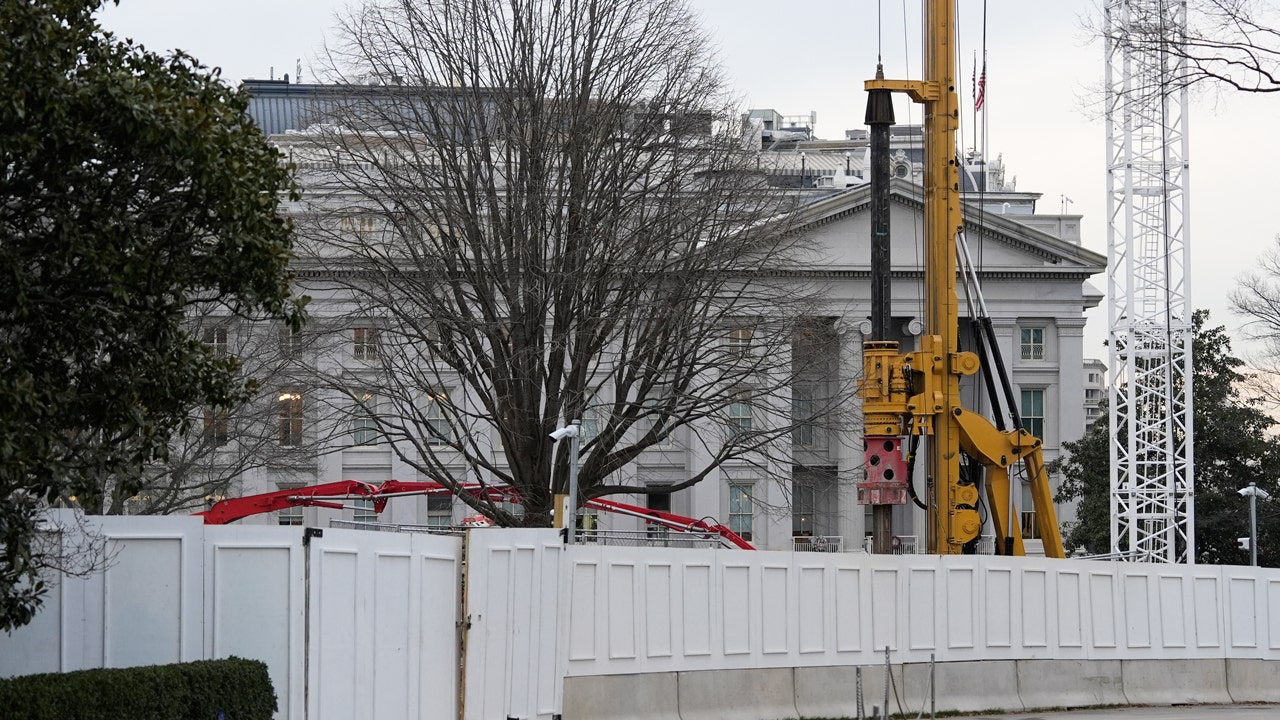
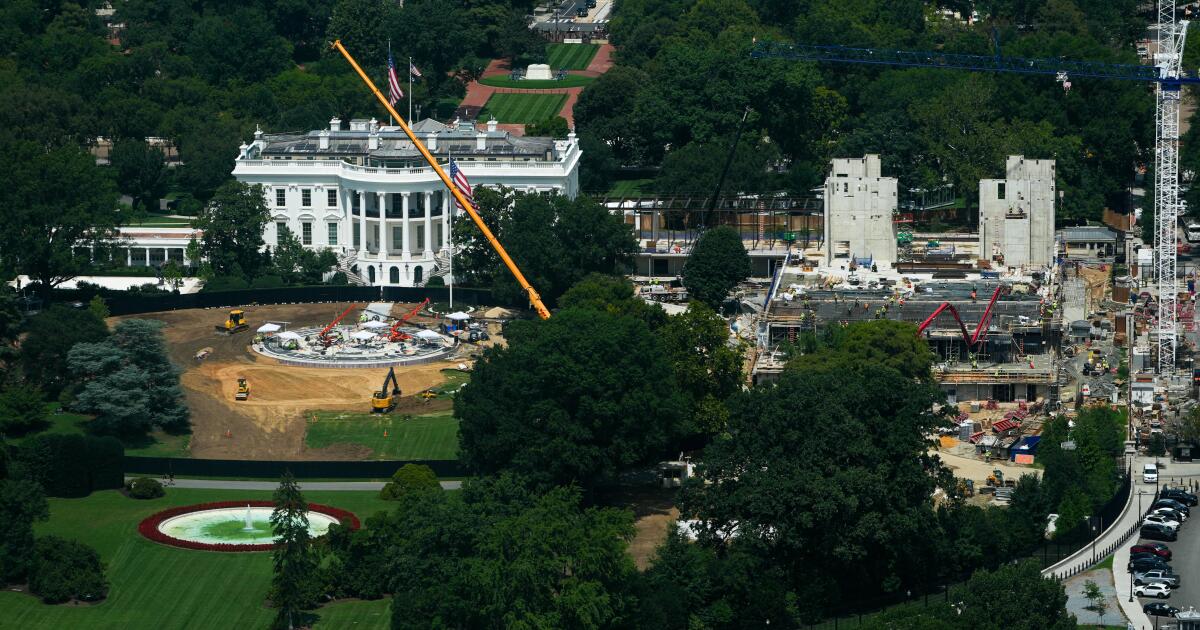
Photo via Los Angeles Times

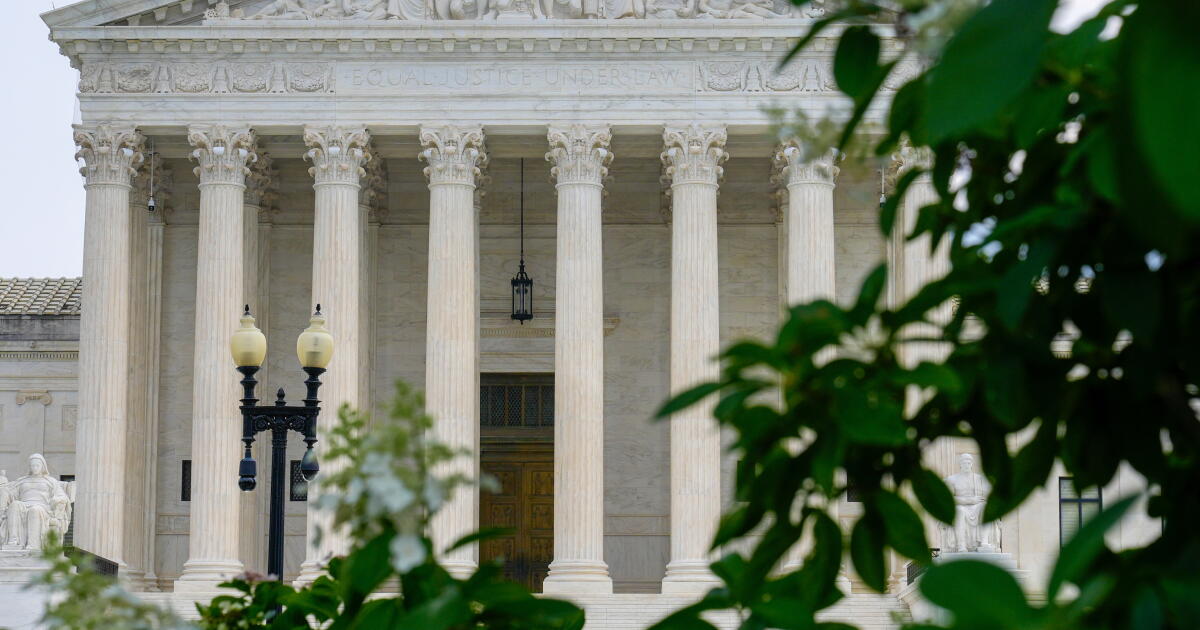
Supreme Court, in 5-4 vote, clears way for Trump's new ballroom

Read the original at Los Angeles Times ↗
Cite

Savage, D. G., & Wilner, M. (2026, September 4). Supreme Court, in 5-4 vote, clears way for Trump's new ballroom. Los Angeles Times. https://www.latimes.com/politics/story/2026-08-31/supreme-court-rules-for-trump-his-ballroom-dismisses-legal-challenge

Dated when The Aporia collected the article, usually within hours of publication. Check the original for its exact date and byline.

Los Angeles Times · collected 2026-09-04 · by David G. Savage, Michael Wilner

Quick Summary

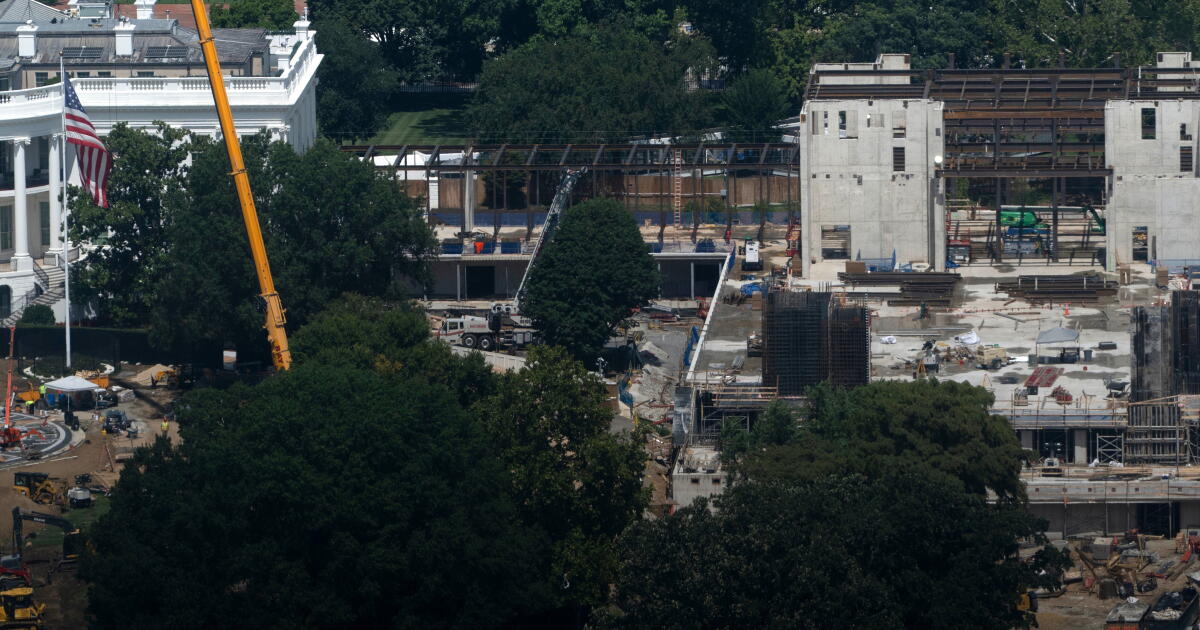
The Supreme Court has cleared the way for President Trump's new $400-million ballroom at the White House by a 5-4 vote, allowing him to finish the project with private funding without congressional approval. The court overturned lower-court rulings that said he needed Congress' approval, citing a lack of standing among preservationists who filed a lawsuit. In dissent, Chief Justice John G. Roberts Jr. wrote that the construction project was "likely unlawful" and should not be allowed to continue. The project is expected to be completed in 2028 and will be one of the largest structures on the White House grounds.
Written by AI on 2026-09-05, from this article's own text only (the story summary below draws on all the coverage).
See how they differ ↓

AI analysis

Story summary

President Trump's White House ballroom construction project has been allowed to continue despite concerns about its legality. A 5-4 Supreme Court decision cleared the way for the project, which is estimated to cost over $900 million and will be privately funded. Chief Justice John Roberts, in dissent, stated that the project is "likely unlawful" and should not be allowed to continue.

The White House ballroom is just one of several construction projects in Washington D.C. where Trump is hoping to leave his mark on the nation's capital. The projects include renovating golf courses, constructing a new military installation, and renaming landmarks after himself.

Trump has admitted that he is slapping his name on these projects because he knows nobody else will do it once he's gone. "That's true," Trump said, "Nobody will do it once I'm gone. When I leave here, nobody will." The president's comments follow an unprecedented blitz across Washington D.C. to put his name or leave a Trump-like imprint on buildings and landmarks.

The decision by the Supreme Court has sparked concerns about the unitary executive theory, which allows the president to take action without congressional approval. This has been criticized as an abuse of power, and some have raised questions about the independence of federal judges.

Written for “Trump Ballroom Dispute at Scotus” on 2026-11-20, grounded in this article and the 10 other(s) covering the same event.

How they differ

9 outlets covered “Trump Ballroom Dispute at Scotus”.

What each outlet says

One AI summary per outlet of its latest article on this story, written from that article alone and checked against it. Open the article for the outlet's own words.

Los Angeles TimesThis outlet4 Sep

The Supreme Court has cleared the way for President Trump's new $400-million ballroom at the White House by a 5-4 vote, allowing him to finish the project with private funding without congressional approval. The court overturned lower-court rulings that said he needed Congress' approval, citing a lack of standing among preservationists who filed a lawsuit. In dissent, Chief Justice John G. Roberts Jr. wrote that the…

Supreme Court, in 5-4 vote, clears way for Trump's new ballroom (this article)3 articles from Los Angeles Times on this story
Washington Examiner3 Sep

Washington Examiner executive editor Bob Cusack said in an interview on CNN that President Donald Trump's focus on his own projects and issues, such as the Iran war and NFL kickoff rules, is not resonating with voters who are concerned about affordability. According to Cusack, most Americans do not think the economy is in a good place, and the ongoing war in Iran is likely to remain a top concern for voters. The…

Trump is doing ‘too much’ and people are struggling: Bob Cusack →
The Dispatch3 Sep

The article reports on a 5-4 decision by the Supreme Court's majority regarding a white house ballroom issue, with Chief Justice John Roberts leading the dissenters. No specific details are provided about the decision or its implications. The discussion is part of a podcast called Advisory Opinions, which covers politics and policy from a non-partisan conservative perspective.

SCOTUS Majority Rules White House Ballroom Is A Go →
Letters from an American3 Sep

The US Supreme Court has allowed Donald Trump to continue building his White House ballroom by a vote of 5-4. The majority opinion, written by Chief Justice John Roberts, ruled that the National Trust for Historic Preservation lacked legal standing to sue and that national security considerations favored construction. Roberts himself dissented from the decision, calling the project "likely unlawful" and warning that…

September 1, 2026 →
Mother Jones3 Sep

The US Supreme Court has given Donald Trump's White House ballroom renovation a boost with a 5-4 ruling, clearing a path forward at an estimated cost of $900 million. However, many of Trump's other DC projects are stalled or in limbo due to construction issues and legal challenges, including the Kennedy Center, which remains closed despite efforts to renovate it for $15 million. The Justice Department has…

We Toured Trump’s DC Vanity Projects. It’s a Mess. →
Reason.com3 Sep

The Supreme Court's Chief Justice John Roberts has been criticized for his handling of a case involving President Trump's plans to build a ballroom in the White House. Despite previously using his judicial authority to block Trump's tariffs and birthright citizenship executive order, Roberts dissented from a decision that allowed construction on the ballroom to proceed without congressional approval. The court's…

John Roberts Overruled Trump's Tariffs. But He Can't Seem To Stop Trump's Ballroom. →
Show 3 more outlets
The Independent4 Sep

President Donald Trump has admitted in an interview with New York Magazine that he is putting his name on various projects across Washington, D.C., because he knows no one else will do so after he leaves office. He stated "That's true... Nobody will do it once I'm gone." The president is involved in several high-profile construction projects, including a $90,000-square-foot ballroom and military installation at the…

Trump admits he is putting his name on everything because nobody will after he’s ‘gone’ →
The Bulwark5 Sep

John Roberts, the Supreme Court Chief Justice, allowed Donald Trump's construction on his ballroom to continue. George Conway discusses this development with Sarah Longwell on a podcast episode of The Focus Group. Conway believes the administration's new USPS system will likely lose in court when it gets back to the Supreme Court. The discussion also touches on other legal issues related to mail-in voting and the…

John Roberts Sounded the Alarm on Trump’s Illegal Ballroom (w/ George Conway) →
Fox News6 Sep

Columnist Mike Davis argues that the Supreme Court's 5-4 decision on August 31 to allow President Trump to build a secure underground military facility and ballroom near the White House highlights the need for more "rock-solid constitutionalists" in the federal judiciary. The court's decision came after a lawsuit filed by Alison Hoagland, a member of the National Trust for Historic Preservation, was rejected. Davis…

MIKE DAVIS: Trump's ballroom win highlights need for serious judicial nominees →

Where they agree and split

Framing

How the first headlines put it

Stated as fact5
The headlines (5)

Trump is doing ‘too much’ and people are struggling: Bob Cusack Washington Examiner · stated as fact

SCOTUS Majority Rules White House Ballroom Is A Go The Dispatch · stated as fact

September 1, 2026 Letters from an American · stated as fact

We Toured Trump’s DC Vanity Projects. It’s a Mess. Mother Jones · stated as fact

John Roberts Overruled Trump's Tariffs. But He Can't Seem To Stop Trump's Ballroom. Reason.com · stated as fact

Words to watch (1)

Trump admits he is putting his name on everything because nobody will after he’s ‘gone’ The Independent

The full story: what happened, how it changed, and all 11 articles →

Compared with similar articles

This article reads leans left and hedges 7% of its claims. Each row says how that neighbour differs.
The Dispatch
Leans left Hedges 0 of 14 claims Outlet record 61/100
September 1, 2026 Same event
Letters from an American
Leans strongly left further left than this Hedges 3 of 42 claims
Mother Jones
Leans left Hedges 3 of 42 claims Outlet record 60/100
Reason
Leans left Hedges 1 of 25 claims Outlet record 94/100
Fox News
Leans strongly right further right than this Hedges 2 of 54 claims Outlet record 67/100
The Bulwark
Hedges 1 of 9 claims
Los Angeles Times
Hedges 11 of 46 claims Outlet record 95/100
Los Angeles Times
Leans right further right than this Hedges 1 of 25 claims Outlet record 95/100
“Article A reports a 5-4 Supreme Court vote clearing the way for Trump's new ballroom, while Article B discusses an ongoing case where the Supreme Court is being urged to block construction of the ballroom”

Story

Trump Ballroom Dispute at Scotus
Politics · 11 article(s) covering the same event. Compare every outlet's account →
How this article was measured signals, leaning charts, publisher record, byline, topics and claims

Signals How these are calculated →

Claims extracted
41
sentences that state something as happening or true
Uncertain
7%
3 of 41 hedged ("reportedly", "may", "according to")
Leaning
Leans left
of the writing, not the subject · beta estimate
Publisher signals
95/100
Los Angeles Times's corrections and hedging, across everything collected from it. Not a measure of accuracy.
Outlets on this story
11
Politics
Same framing elsewhere
1
articles that frame the event the way this one does
Analyzed 2026-09-05 · how these are computed

How this is being covered How these are calculated →

Article leaning vs. publisher reliability
Source leaning vs. consistency

Publisher

Los Angeles Times · 336 article(s) · 0 correction(s) detected
No corrections detected for this publisher. That may mean careful reporting, or simply that nothing has been checked.

Who wrote this

David G. Savage
15 article(s) here · 1 carrying a prediction
- At issue in the appeal was whether the administration’s plan could cut off about $150 million in UC research grants.
The ACLU and immigration rights advocates said the right of individuals to seek asylum was recognized in U.S. law and could not be abolished.
- U.S. Customs and Border Protection said it does not plan to build a border wall in Big Bend National Park, but would add new patrol roads and vehicle barriers.
In its latest chapter on religion in schools, the Supreme Court debated Tuesday whether Colorado may fund private preschools for 4-year-olds but exclude Catholic schools that refuse to serve same-sex parents and their children.
- - The court cases have put a spotlight on the state vs. federal divide in election law. - The National Voter Registration Act of 1993 said voters may fill out a registration form by attesting under oath they are citizens.
- Click here to listen to this article - - The Supreme Court gave political parties and their fundraising committees lower rates for broadcast campaign ads. - Justices Sonia Sotomayor and Ketanji Brown Jackson voted to deny the administration’s appeal.
Supreme Court sounds wary of state-based climate change suits against oil producers - Click here to listen to this article - - Several justices suggested that local and state claims against oil companies may be blocked by the federal Clean Air Act. -
In its new term, the court will also hear major cases on immigration and guns.
“At this late date, ordering reversion to the 2025 map in the midst of an ongoing election would usher in electoral chaos,” the justices wrote.
- The decision will aid states that seek to scrub their voter rolls and remove those who are not citizens.
Also by David G. Savage
Nothing else under this byline is closely related to this article, so these are simply their most recent.
All 15 articles by David G. Savage →
Michael Wilner
29 article(s) here · 1 carrying a prediction
The competing agendas could make the summit little more than a spectacle, yet still produce images that harken back to the famous Yalta conference of 1945. But if any substantive understandings were reached behind closed doors, none of them were released to the public. The summit’s pageantry fit a familiar pattern for Trump, who has repeatedly staged headline-grabbing encounters with controversial leaders only to walk away empty-handed.
President Trump has begun an extraordinary visit to Shenzhen, where he is set to join the leaders of Russia and China — two of Washington’s principal geopolitical rivals — for an unprecedented trilateral summit on Thursday.
A divided Trump team closes ranks ahead of AI talks with China - - Trump has repeatedly sidestepped confrontation with Xi over the intensifying AI race in their two previous meetings this year - Trump is not expected to raise the Nvidia matter directly with Xi.
Allies and aides will urge Trump to push back against Beijing -
He would go on to visit Beijing several times under a banner of friendship.
Trump, Putin and Xi will meet in China
Congressional Republicans have called on Huang himself to provide an update, warning the incident raised “significant national security concerns” that could have compromised cutting-edge American technology at a critical moment in the race with China for supremacy in artificial intelligence.
Nonessential foreign service and intelligence personnel across the Middle East were ordered home, while senior officials at the Pentagon debated the strategic objectives renewed hostilities could realistically achieve, two U.S. officials told The Times.
How large their House majority would be remained to be seen as states continued counting votes.
- - Trump suggests he is expecting a wave, telling the New York Post he will ‘become Mr. Veto’ if Democrats sweep control. - Democratic congressional leaders may face internal party calls to pursue a third impeachment of the president.
2026-11-02 · mixed framing · Trump's aura of invincibility faces one more test
Also by Michael Wilner
Nothing else under this byline is closely related to this article, so these are simply their most recent.
All 29 articles by Michael Wilner →

Topics

Congress Supreme Court The White House WASHINGTON the National Trust for Historic Preservation’s

Subjects

Trump PERSON · 9× Supreme Court ORG · 3× WASHINGTON GPE · 3× John G. Roberts Jr. PERSON · 2× Roberts PERSON · 2× Congress ORG · 1× The White House ORG · 1× Winston Churchill PERSON · 1× the National Trust for Historic Preservation’s ORG · 1× the People’s House ORG · 1×

Narrative

“When completed in the Summer of 2028, the magnificent Ballroom and Military Complex will be something that the entire Country is very proud of.” The massive new structure, set to dwarf the historic White House mansion, is the president’s singular vision — one of a string of aesthetic projects Trump has pursued in a feverish effort to cement his legacy by putting his personal stamp on the nation’s capital.
framing: assertive · carried by 1 article(s) · first seen 2026-09-05
By a 5-4 vote, the justices granted an emergency appeal from Trump and his lawyers on Monday, setting aside a judge’s order that would stop the construction.
2026-09-05 · Los Angeles Times
Supreme Court, in 5-4 vote, clears way for Trump's new ballroom · assertive framing

Claims (41 extracted, 3 hedged)

Supreme Court, in 5-4 vote, clears way for Trump’s new ballroom - asserted
Court → clear → ballroom
Click here to listen to this article - - Supreme Court, 5-4, clears way for Trump to finish a privately funded $400-million White House ballroom, overturning lower-court rulings that said he needed congressional approval. asserted
he → click → approval
- Conservative majority tossed the National Trust for Historic Preservation’s lawsuit on standing grounds, saying preservationists weren’t personally harmed. - In a dissent, Chief Justice John G. Roberts Jr. said the construction project was ‘likely unlawful’ and should not be allowed to continue. asserted
project → toss → dissent
A divided Supreme Court has cleared the way for President Trump to finish building his new White House ballroom with mostly private money and without approval from Congress. asserted
Trump → clear → Congress
By a 5-4 vote, the justices granted an emergency appeal from Trump and his lawyers on Monday, setting aside a judge’s order that would stop the construction. asserted
that → grant → construction
But Chief Justice John G. Roberts Jr. dissented, along with the court’s three liberals. asserted
Jr. → dissent → liberals
Roberts said the construction project was “likely unlawful” and should not be allowed to continue. “The White House is not just any building ... when it comes to historic preservation,” Roberts wrote. asserted
Roberts → say → preservation
“Winston Churchill once remarked that ‘[w]e shape our buildings, and afterwards our buildings shape us.’ asserted
buildings → remark → us
All the more reason to ensure that those responsible follow the rules in deciding what to tear down and what to build up at the People’s House.” asserted
those → ensure → House
The outcome turned on the standing of the plaintiffs, the National Trust for Historic Preservation and its members. asserted
outcome → turn → Preservation
The conservative majority pointed to Alison Hoagland, one of its members, who said she lives in Washington, walks by the White House about once a month and said she found the “scale,” “height” and “massing” of the huge ballroom to be distasteful. asserted
scale → point → ballroom
“This court has not found standing in circumstances like these before. asserted
court → find → these
To the contrary, we have repeatedly held that mere offense, disagreement, or distaste does not qualify as a concrete and particularized injury,” the unsigned order said. asserted
order → hold → injury
Trump has responded to growing legal and political obstacles to his ballroom, arch and other projects by attempting to force approvals through faster than opponents can challenge them. asserted
opponents → respond → them
It is a major victory for Trump, whose ballroom project has become a signature effort of his second term and a political lightning rod in Washington, where Republicans have refused to fund it with public money. asserted
Republicans → become → money
Trump celebrated the victory with a post on social media, declaring the venue would now be built “without any further contingency, doubt, or threat.” “We are living in the Golden Age of America, and this Building will be one of the Greatest ever constructed in Washington, D.C.,” Trump wrote. asserted
Trump → celebrate → Washington
“When completed in the Summer of 2028, the magnificent Ballroom and Military Complex will be something that the entire Country is very proud of.” The massive new structure, set to dwarf the historic White House mansion, is the president’s singular vision — one of a string of aesthetic projects Trump has pursued in a feverish effort to cement his legacy by putting his personal stamp on the nation’s capital. asserted
Trump → complete → capital
But preservationists and architects have criticized the proposed ballroom as a garish, rushed project that ignored the input of experts. asserted
that → criticize → experts
The president has personally overruled his own chosen architects after being told the building would overwhelm the executive complex. asserted
building → overrule → complex
Democrats have seized on the president’s fixation on the ballroom as a symbol of vanity and detachment from the concerns of everyday Americans heading into November’s midterm elections. asserted
Democrats → seize → elections
According to recent polls, a bipartisan majority of voters disapprove of the president’s handling of the economy and say the country is facing an affordability crisis. uncertain
country → accord → crisis
The ballroom is projected to cost more than $400 million, excluding the undisclosed cost of underground security upgrades. asserted
ballroom → project → upgrades
Trump’s three appointees — Justices Neil M. Gorsuch, Brett M. Kavanaugh and Amy Coney Barrett — joined conservative Justices Clarence Thomas and Samuel A. Alito in an unsigned opinion ruling for the president. asserted
appointees → join → president
The conservative majority also said Trump and his appointees had stressed the new ballroom was needed for national security and said the lower courts judges should not have interfered. asserted
judges → say → security
California officials stressed that the court’s ruling does not allow final implementation of the new rules requested by Trump. asserted
ruling → stress → Trump
Administration officials have argued that an underground “integrated military complex” was the heart of the project and that the ballroom would merely be sit top of the facility “vitally required by national security.” asserted
ballroom → argue → security
The decision is not a final ruling, but it gives a green light to Trump’s go-it-alone approach, which is in keeping with his history as a hotel builder. asserted
which → give → builder
He believed the White House needed a grand ballroom that could seat hundreds of dignitaries. uncertain
that → believe → dignitaries
Acting on his own, he ordered the East Wing torn down in October to make room of his larger ballroom. asserted
Wing → act → ballroom
He also said most of the project would be paid for by private donations. asserted
most → say → donations
But the Constitution gave Congress the power to manage property belonging to the United States. asserted
Constitution → give → States
A 1912 law says new buildings “shall not erected ... on public grounds within the District of Columbia without express authority of Congress.” asserted
buildings → say → Congress
Trump chose to ignore the law and did not seek approval from Congress, which is led by Republicans. asserted
which → choose → Republicans
The Republican president’s lawyers had asked the justices to reconsider their refusal to hear his appeal. asserted
lawyers → ask → appeal
The court denied Trump’s petition along with several others. asserted
court → deny → others
The National Trust for Historic Preservation sued in December, contending Trump was a “temporary tenant, not the owner” of the White House. asserted
Trump → sue → House
U.S. District Judge Richard Leon ruled Trump had no authority to build a ballroom on the White House grounds without the approval of Congress, and he ordered a halt to the above-ground construction. asserted
he → rule → construction
The District of Columbia Circuit Court affirmed his decision by a 2-1 vote. asserted
Court → affirm → vote
“Congress has not ceded unfettered authority to the Executive Branch to dramatically redesign, reshape, and reconstruct the White House — the People’s House — to fit a particular President’s desires,” wrote Judge Patricia Millett for the appeals court. asserted
Millett → cede → court
Trump’s lawyers sent a fast-track appeal to the Supreme Court on Aug. 14. asserted
lawyers → send → Aug.
…and 1 more, not listed.
Give feedback · no sign-in needed

No sign-in needed for now. Your note is sent without a name, so it cannot be answered.

History Support