Photo via Reason

Do You Have the Right To Possess an AR-15? The Supreme Court Will Soon Decide.

Read the original at Reason ↗
Cite

Sullum, J. (2026, September 6). Do You Have the Right To Possess an AR-15? The Supreme Court Will Soon Decide. Reason. https://reason.com/2026/09/06/scotus-takes-up-assault-weapon-bans/

Dated when The Aporia collected the article, usually within hours of publication. Check the original for its exact date and byline.

Reason · collected 2026-09-06 · by Jacob Sullum

Quick Summary

The US Supreme Court has agreed to hear two cases involving bans on assault-style rifles imposed by Connecticut and Cook County, Illinois. The question of whether these laws are consistent with the Second Amendment is at issue, specifically whether the right to possess AR-15s and similar semi-automatic rifles is protected. The plaintiffs argue that the targeted rifles are in common use for lawful purposes such as self-defense, hunting, and target shooting, and therefore should be allowed under the Second Amendment. Four justices have indicated they may view "assault weapon" bans as unconstitutional.
Written by AI on 2026-09-06, from this article's own text only (the story summary below draws on all the coverage).

AI analysis

Story summary

The Supreme Court has agreed to hear two cases involving rifle restrictions imposed by Connecticut and Cook County, Illinois, which could have significant implications for gun ownership in the United States. The court will consider whether the Second Amendment guarantees the right to possess AR-15s and similar semi-automatic rifles, which are banned in several states, including those with laws passed by 12 states. These laws typically prohibit a long list of popular guns, including semi-automatic rifles that accept detachable magazines and have certain features such as folding stocks or barrel shrouds. The Supreme Court's decision could affect the ability of individuals to own these types of firearms in various states. The court will consider two cases, one from Connecticut and another from Cook County, Illinois.

Written for “Second Amendment Rights Under Fire” on 2026-11-21, grounded in this article and the 0 other(s) covering the same event.

Compared with similar articles

This article reads unscored and hedges 11% of its claims. Each row says how that neighbour differs.
The Guardian
Leans left Hedges 6 of 85 claims Outlet record 64/100
“Article A describes a personal story about a family's experience in Virginia in 1990, while Article B discusses an upcoming Supreme Court case regarding gun laws and 'assault weapon' bans”
Reason
Hedges 9 of 54 claims Outlet record 67/100
“Article A discusses a future Supreme Court decision on 'assault weapon' bans, while Article B refers to a past 7th Circuit decision and its implications for SCOTUS”

Story

Second Amendment Rights Under Fire
Politics · 1 article(s) covering the same event.
How this article was measured signals, leaning charts, publisher record, byline, topics and claims

Signals How these are calculated →

Claims extracted
18
sentences that state something as happening or true
Uncertain
11%
2 of 18 hedged ("reportedly", "may", "according to")
Leaning
withheld
no quote in the article backed the model's score
Publisher signals
67/100
Reason's corrections and hedging, across everything collected from it. Not a measure of accuracy.
Outlets on this story
1
Politics
Same framing elsewhere
1
articles that frame the event the way this one does
Analyzed 2026-09-06 · how these are computed

How this is being covered How these are calculated →

Article leaning vs. publisher reliability
Source leaning vs. consistency

Publisher

Reason · 1464 article(s) · 4 correction(s) detected
Running correction rate · 4 correction(s)

Who wrote this

Jacob Sullum
45 article(s) here · 1 carrying a prediction
Contrary to the implication of that label, the initiative affected many people who had no criminal convictions that would justify revoking their visas.
Trump also averred that his projects do not involve much money, although the ballroom alone is expected to cost around $600 million, half of which will be covered by taxpayers.
Last week, the city of Delray Beach, Florida, announced that it will not organize or sponsor next year's St. Patrick's Day parade, citing a state law that takes effect on January 1.
That means SSJC members cannot even legally transport their guns to the vicinity of the synagogue on those occasions, since they would pass within 300 feet of parks, schools, and other houses of worship while walking there.
In a 60 Minutes interview that aired on Sunday night, President Donald Trump conceded that his mass deportation campaign may have contributed to the Republican rout in last week's midterm elections because "a lot of people think it's too tough."
2026-11-11 · assertive framing · Trump Debates Mass Deportation With Himself
They say Hegseth is flouting the law, undermining basic principles of justice, and perverting the mission of the U.S. military by treating civilians as combatants who can be killed at will, from a distance and in cold blood, without any semblance of due process.
Attorney General Todd Blanche nevertheless seemed to reinforce Trump's threat during an interview on CNN's State of the Union yesterday, saying members of the House Oversight Committee, which will be chaired by Rep. Robert Garcia (D–Calif.) in the next congressional session, should "be very worried."
President Donald Trump today announced that Stephen Miller will replace Susie Wiles as White House chief of staff.
Like many other police officers in New Mexico, Paul Jessen Jr., a Bernalillo County sheriff's deputy, was willing to accept bribes from Albuquerque defense attorney Thomas J. Clear III in exchange for compromising DWI cases against Clear's clients.
These results might be dismissed as anomalous, the product of anger at the party of an unpopular president whose war, tariff, and deportation policies, combined with his constant self-aggrandizement and presidential profiteering, alienated Americans who otherwise might have voted for Republicans.
Also by Jacob Sullum
Nothing else under this byline is closely related to this article, so these are simply their most recent.
All 45 articles by Jacob Sullum →

Topics

Connecticut Cook County the Second Amendment the Supreme Court the United States

Subjects

Cook County GPE · 7× Connecticut GPE · 4× the Supreme Court ORG · 4× Heller PERSON · 3× Bruen PERSON · 2× Americans NORP · 1× District of Columbia GPE · 1× Illinois GPE · 1× the Supreme Court's ORG · 1× the United States GPE · 1×

Narrative

Under the constitutional test established by the Supreme Court's 2022 ruling in New York State Rifle & Pistol Association v. Bruen, Connecticut and Cook County have the burden of showing their laws are "consistent with this Nation's historical tradition of firearm regulation."
framing: assertive · carried by 1 article(s) · first seen 2026-09-06
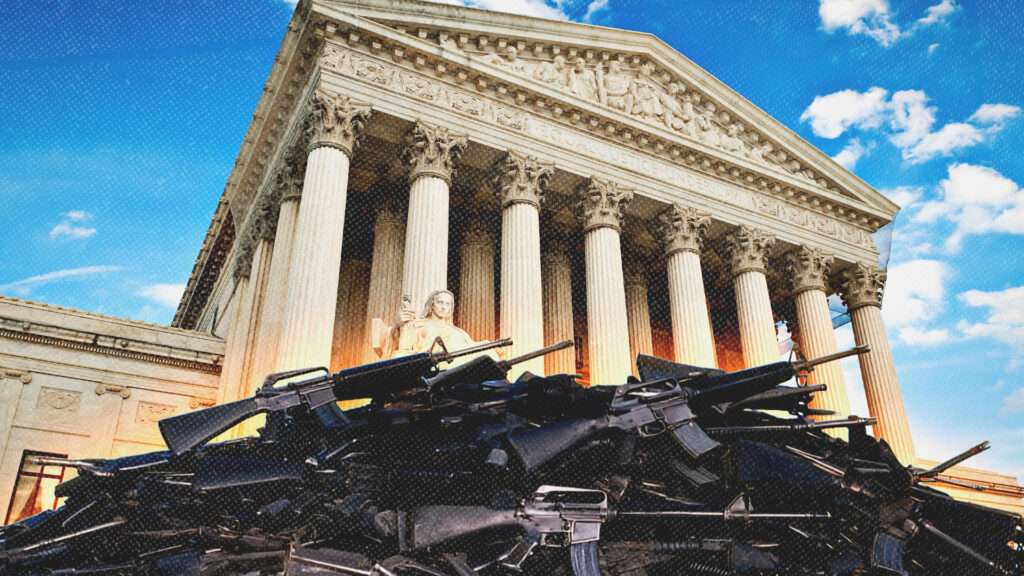
During its next term, the Supreme Court will address the long-simmering question of whether "assault weapon" bans are consistent with the Second Amendment.

Claims (18 extracted, 2 hedged)

During its next term, the Supreme Court will address the long-simmering question of whether "assault weapon" bans are consistent with the Second Amendment. asserted
bans → address → Amendment
The answer could have broad implications for other state limits on the arms that residents are allowed to purchase and possess. uncertain
residents → have → that
A dozen states have enacted bans on firearms that legislators tendentiously describe as "assault weapons," which supposedly are good for nothing but mass murder. asserted
which → enact → murder
These laws typically ban a long list of gun models, along with firearms that meet specified criteria, including semi-automatic rifles that accept detachable magazines and have arbitrarily disfavored features such as folding stocks, pistol grips, and barrel shrouds. asserted
that → ban → stocks
The bans encompass some of the most popular guns sold in the United States, including AR-15-style rifles. asserted
bans → encompass → rifles
The Supreme Court has agreed to hear a pair of cases involving rifle restrictions imposed by Connecticut and Cook County, Illinois. asserted
Court → agree → Connecticut
The question presented is whether the Second Amendment guarantees "the right to possess" AR-15s and "similar semiautomatic rifles." asserted
Amendment → present → AR-15s
As the plaintiffs see it, the answer is clear. asserted
answer → see → it
In the landmark 2008 case District of Columbia v. Heller, the Supreme Court said the Second Amendment applies to "bearable arms" that are "in common use" for "lawful purposes like self-defense." asserted
that → say → defense
The rifles targeted by Connecticut and Cook County plainly fall into that category, since Americans own more than 30 million of them, which they commonly report using for lawful purposes such as self-defense, hunting, and target shooting. asserted
they → target → defense
Under the constitutional test established by the Supreme Court's 2022 ruling in New York State Rifle & Pistol Association v. Bruen, Connecticut and Cook County have the burden of showing their laws are "consistent with this Nation's historical tradition of firearm regulation." asserted
laws → establish → regulation
To pass that test, they will need to cite historical analogs that are "relevantly similar" in motivation and scope. asserted
that → pass → motivation
That will be hard to do. asserted
That → do → ?
Cook County, for example, invokes "strict historical regulations on gunpowder"—fire-prevention measures that have nothing to do with banning rifle features such as adjustable stocks and muzzle compensators, both of which Cook County has deemed intolerable. asserted
County → invoke → which
And while Heller recognized a "historical tradition" of prohibiting "dangerous and unusual weapons," the Cook County plaintiffs say, "history demonstrates that only arms that are both dangerous and unusual may be banned." uncertain
that → recognize → weapons
Four justices have indicated they are inclined to view "assault weapon" bans as unconstitutional, while two others are at least willing to question political judgments about the sort of danger that justifies gun restrictions. asserted
that → indicate → restrictions
When you combine those clues with the seemingly straightforward implications of Heller and Bruen, it looks like Connecticut and Cook County will be fighting an uphill battle at the Supreme Court. asserted
Connecticut → combine → Court
This article originally appeared in print under the headline "SCOTUS Takes Up 'Assault Weapon' Bans." asserted
SCOTUS → appear → Bans

Give feedback · no sign-in needed

No sign-in needed for now. Your note is sent without a name, so it cannot be answered.

History Support