Photo via The Guardian

Nobel prize in medicine 2026 awarded for research into mysteries of brain

Read the original at The Guardian ↗
Cite

correspondent, N. D. S. (2026, October 5). Nobel prize in medicine 2026 awarded for research into mysteries of brain. The Guardian. https://www.theguardian.com/science/2026/oct/05/nobel-prize-medicine-2026-winner

Dated when The Aporia collected the article, usually within hours of publication. Check the original for its exact date and byline.

The Guardian · collected 2026-10-05 · by Nicola Davis Science correspondent

Quick Summary

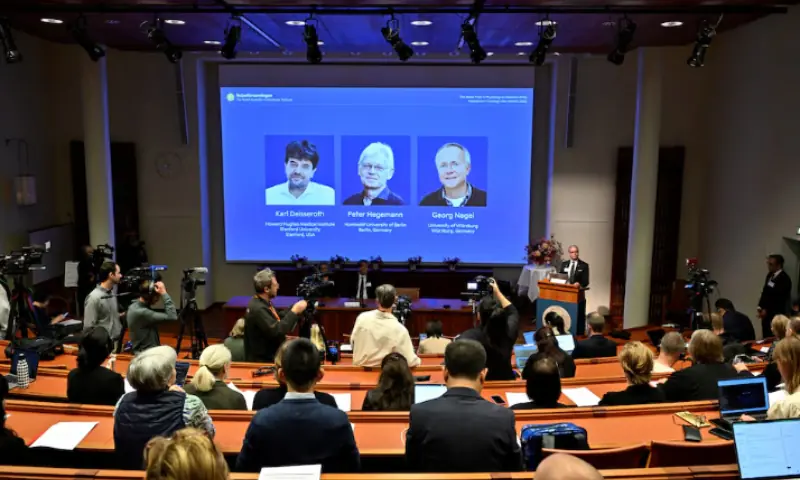
The Nobel prize in physiology or medicine for 2026 was awarded to Karl Deisseroth, Peter Hegemann, and Georg Nagel for their groundbreaking work on light-gated ion channels and optogenetics. The scientists will share a prize of approximately £901,500, which was announced by the Nobel assembly at the Karolinska Institute in Stockholm on Monday. This is the 117th time the prize has been awarded, with only 14 women among the 235 laureates to date.
Written by AI on 2026-10-05, from this article's own text only (the story summary below draws on all the coverage).
See how they differ ↓

AI analysis

Story summary

On October 5, 2026, the Nobel Prize in Physiology or Medicine was awarded to Karl Deisseroth of Stanford University, Peter Hegemann of Humboldt University in Berlin, and Georg Nagel of the University of Würzburg. The trio received the prize "for their discoveries concerning light-gated ion channels and optogenetics," which allows scientists to control individual nerve cells using light. This method is now widely used globally to study brain activity and understand neurological disorders. Each winner will share a prize of 12 million Swedish kronor (about $1.2 million). The award kicked off Nobel Week, with subsequent prizes for physics, chemistry, literature, peace, and economics to be announced from October 6-12.

Written for “Nobel Prize Brain Research” on 2026-11-21, grounded in this article and the 14 other(s) covering the same event.

How they differ

13 outlets covered “Nobel Prize Brain Research”.

What each outlet says

One AI summary per outlet of its latest article on this story, written from that article alone and checked against it. Open the article for the outlet's own words.

The GuardianThis outlet5 Oct

The Nobel prize in physiology or medicine for 2026 was awarded to Karl Deisseroth, Peter Hegemann, and Georg Nagel for their groundbreaking work on light-gated ion channels and optogenetics. The scientists will share a prize of approximately £901,500, which was announced by the Nobel assembly at the Karolinska Institute in Stockholm on Monday. This is the 117th time the prize has been awarded, with only 14 women…

Nobel prize in medicine 2026 awarded for research into mysteries of brain (this article)
Dawn5 Oct

Karl Deisseroth from the United States and Germans Peter Hegemann and Georg Nagel were awarded the 2026 Nobel Prize in Physiology or Medicine for their work on light-gated ion channels and optogenetics. Their discoveries have enabled researchers to control individual nerve cells in living brains using light, a method now widely used globally to study brain functions. The trio will share a prize sum of 12 million…

German, US scientists win Nobel prize for work that has helped understand how the brain works →2 articles from Dawn on this story
CBS News6 Oct

On October 5th, the Nobel Prize in Physiology or Medicine was awarded to both an American and a German researcher for their contributions to medical science. The article does not provide further details about the specific research or the names of the recipients.

10/5: CBS Evening News →2 articles from CBS News on this story
The Straits Times5 Oct

The article discusses potential recipients of the Nobel Prize in Physiology or Medicine for their work on hormones and appetite regulation, which has led to developments like weight-loss drugs such as Ozempic and Mounjaro. Notable researchers being considered include Daniel Drucker, Jens Juul Holst, and Svetlana Mojsov. The prize announcement is scheduled for October 5, with other potential areas of focus including…

Research into weight-loss drugs tipped for Nobel as award week opens →
ABC News (US)5 Oct

This year's Nobel Prize week begins in Stockholm with the awarding of the medicine prize at the Karolinska Institute on Monday. The prize money for each category is 12 million Swedish kronor, equivalent to about $1.2 million. Following the medicine prize, other categories including physics, chemistry, literature, and peace will be announced throughout the week, with the Nobel Memorial Prize in Economic Sciences…

The Nobel Prize week is kicking off in Stockholm with the medicine award →
BBC5 Oct

Karl Deisseroth, Peter Hegemann, and Georg Nagel were awarded this year's Nobel Prize in Physiology or Medicine for their development of optogenetics, a technique that uses light to control nerve cells in living tissue. Their work has enabled scientists to better understand neural circuits involved in memories, feelings, and behaviors related to neurological and psychiatric disorders. Clinically, optogenetics is…

Nobel Prize awarded for showing how nerve cells shape feelings →
Show 7 more outlets
NPR5 Oct

The Nobel Prize in medicine was awarded to Karl Deisseroth, Peter Hegemann, and Georg Nagel for their work on optogenetics and light-gated ion channels, which helps explain how the brain activates nerve cells. The scientists are affiliated with universities in Germany and the United States; specifically, Deisseroth is at Stanford University, while Hegemann is at Humboldt University in Berlin and Nagel at the…

Nobel medicine prize goes to 3 scientists for research into brain activity →
ABC News (AU)5 Oct

Three scientists received the Nobel Prize in Medicine for their research on how the brain controls the activity of individual nerve cells. The awardees include two German researchers and one from the United States. This recognition marks the beginning of Nobel Week, with upcoming awards including physics, chemistry, literature, peace, and economics prizes.

Nobel medicine prize awarded to scientists for brain activity research →
New York Post5 Oct

The Nobel Prize in medicine was awarded to Karl Deisseroth, Peter Hegemann, and Georg Nagel for their work on optogenetics, a technique that uses light to control the activity of nerve cells in the brain. The researchers, based at universities in Germany and the United States, discovered how to use specific proteins to make neurons sensitive to light, enabling precise study of neural circuits. Their groundbreaking…

Nobel medicine prize goes to 3 scientists for research into brain activity →
The Globe and Mail5 Oct

Three scientists—Karl Deisseroth from Stanford University, and Peter Hegemann and Georg Nagel from Germany—have been awarded this year's Nobel Prize in Physiology or Medicine for their work developing optogenetics, a technique that uses light to control brain cells. Their research originated with the study of algae proteins sensitive to light, leading to methods where channelrhodopsin genes are inserted into…

Nobel prize awarded to researchers who learned how to light up the brain →
The Independent5 Oct

Three researchers, Karl Deisseroth, Peter Hegemann, and Georg Nagel, were awarded the 2026 Nobel Prize in Physiology or Medicine for their work on light-gated ion channels and optogenetics, which allows for precise control of individual nerve cells in living brains. The prize is worth 12 million Swedish crowns ($1.2 million) and recognizes discoveries that have advanced understanding of brain functions globally.

Nobel prize in medicine awarded to scientists studying mysteries of the brain →
Al Jazeera5 Oct

Karl Deisseroth from Stanford University and Germans Peter Hegemann and Georg Nagel won the 2026 Nobel Prize in Physiology or Medicine for their work on optogenetics. The trio were recognized "for their discovery of a molecular switch for nerve cells" that allows researchers to control neural activity using light, advancing understanding of brain functions related to learning, fear, addiction, and movement. Each…

Nobel medicine prize honours US and German scientists for optogenetics work →
Toronto Star5 Oct

On October 5, 2026, Karl Deisseroth from Stanford University in the USA, Peter Hegemann from Humboldt University of Berlin, and Georg Nagel from the University of Würzburg were awarded the Nobel Prize in Physiology or Medicine for their pioneering work on optogenetics. The prize honors their contributions to developing light-gated ion channels that enable precise control of cellular activity using light, with…

Three Researchers Awarded 2026 Nobel Prize in Physiology or Medicine for Their Pioneering Contributions to Optogenetics →

Where they agree and split

Agreed

AI · cited, from two or more outlets

  • Karl Deisseroth, Peter Hegemann, and Georg Nagel were the recipients of the prize for their work on optogenetics.42
Quoted from the coverage (1)

“This method is now being used in laboratories around the world to reveal the brain’s mysteries,” Perlmann said.

4 outlets

Framing

How the first headlines put it

  • The Straits Times focused on potential weight-loss drug research as a contender, while other outlets highlighted the actual winners' work in brain activity and optogenetics.14
Stated as fact12
The headlines (12)

Research into weight-loss drugs tipped for Nobel as award week opens The Straits Times · stated as fact

The Nobel Prize week is kicking off in Stockholm with the medicine award ABC News · stated as fact

Nobel prize in medicine 2026 awarded for research into mysteries of brain The Guardian · stated as fact

Nobel Prize awarded for showing how nerve cells shape feelings BBC · stated as fact

Nobel medicine prize goes to 3 scientists for research into brain activity NPR · stated as fact

Nobel medicine prize awarded to scientists for brain activity research ABC News (Australia) · stated as fact

Nobel medicine prize goes to 3 scientists for research into brain activity New York Post · stated as fact

Nobel prize awarded to researchers who learned how to light up the brain The Globe and Mail · stated as fact

Nobel prize in medicine awarded to scientists studying mysteries of the brain The Independent · stated as fact

German and US scientists win Nobel medicine prize for work that has helped understand how the brain works Dawn · stated as fact

Nobel medicine prize honours US and German scientists for optogenetics work Al Jazeera · stated as fact

Three Researchers Awarded 2026 Nobel Prize in Physiology or Medicine for Their Pioneering Contributions to Optogenetics Toronto Star · stated as fact


The full story: what happened, how it changed, and all 15 articles →

Compared with similar articles

This article reads unscored and hedges 0% of its claims. Each row says how that neighbour differs.
The Independent
Hedges 0 of 11 claims Outlet record 59/100
NPR
Hedges 0 of 11 claims Outlet record 60/100
ABC News (US)
Hedges 0 of 8 claims Outlet record 66/100
BBC News
Hedges 0 of 4 claims Outlet record 65/100
ABC News (AU)
Hedges 0 of 3 claims Outlet record 67/100
New York Post
Hedges 0 of 17 claims Outlet record 66/100
The Globe and Mail
Hedges 2 of 16 claims Outlet record 51/100
Al Jazeera
Hedges 3 of 14 claims Outlet record 60/100

Story

Nobel Prize Brain Research
Science · 15 article(s) covering the same event. Compare every outlet's account →
How this article was measured signals, leaning charts, publisher record, byline, topics and claims

Signals How these are calculated →

Claims extracted
6
sentences that state something as happening or true
Uncertain
0%
0 of 6 hedged ("reportedly", "may", "according to")
Leaning
not political
takes no side on a contested political question
Publisher signals
64/100
The Guardian's corrections and hedging, across everything collected from it. Not a measure of accuracy.
Outlets on this story
15
Science
Same framing elsewhere
1
articles that frame the event the way this one does
Analyzed 2026-10-05 · how these are computed

How this is being covered How these are calculated →

Article leaning vs. publisher reliability
Source leaning vs. consistency

Publisher

The Guardian · 3744 article(s) · 8 correction(s) detected
Running correction rate · 8 correction(s)

Who wrote this

Nicola Davis Science correspondent
12 article(s) here · 1 carrying a prediction
In May, NHS England revealed almost 6,500 children have since been referred to such clinics, including more than 400 younger than four.
But if campaigners get their way, this could be the last blast for bangers in the back yard.
However “a level below 50 might be a pointer of iron deficiency,” said Sue Pavord, professor of practice in medical haematology at Oxford University hospitals.
Cartmill said the preference could be rooted in the sound of laughter putting the orangutans in a more positive emotional state when they learned to associate the substance with food.
“Nobody of lower rank would have been buried in anything like that,” he said, adding that the lid was another clue.
Livestreaming an execution could cause post-traumatic stress disorder in the viewing public, mental health experts have said after the US confirmed plans to broadcast the death by firing squad of a man who shot dead 13 unarmed soldiers.
They will share a prize of 12m Swedish kronor (about £901,500).
Court officials and craftspeople serving early Egyptian kings may have been sacrificed when their ruler died, according to research that found fractures in several ancient skulls.
But such woes could soon be a thing of the past, with gene-edited bananas that keep their freshly peeled colour now one step closer to reaching British shoppers.
Drones could help cut the time it takes to get a defibrillator to people experiencing cardiac arrests when not in hospital, researchers have suggested.
Also by Nicola Davis Science correspondent
Nothing else under this byline is closely related to this article, so these are simply their most recent.
All 12 articles by Nicola Davis Science correspondent →

Topics

Howard Hughes Medical Institute Stanford University the Humboldt University of Berlin the Karolinska Institute the University of Würzburg

Subjects

Georg Nagel PERSON · 1× Howard Hughes Medical Institute ORG · 1× Karl Deisseroth PERSON · 1× Nobel ORG · 1× Peter Hegemann PERSON · 1× Stanford University ORG · 1× Stockholm GPE · 1× the Humboldt University of Berlin ORG · 1× the Karolinska Institute ORG · 1× the University of Würzburg ORG · 1×

Narrative

Karl Deisseroth of both Howard Hughes Medical Institute and Stanford University, Peter Hegemann of the Humboldt University of Berlin, and Georg Nagel of the University of Würzburg have been awarded the prize “for their discoveries concerning light-gated ion channels and optogenetics.”.
framing: assertive · carried by 1 article(s) · first seen 2026-10-05
They will share a prize of 12m Swedish kronor (about £901,500).
2026-10-05 · The Guardian
Nobel prize in medicine 2026 awarded for research into mysteries of brain · assertive framing

Claims (6 extracted, 0 hedged)

The Nobel prize in physiology or medicine 2026 has been awarded to three scientists for their work on investigating the mysteries of the brain. asserted
prize → award → brain
Karl Deisseroth of both Howard Hughes Medical Institute and Stanford University, Peter Hegemann of the Humboldt University of Berlin, and Georg Nagel of the University of Würzburg have been awarded the prize “for their discoveries concerning light-gated ion channels and optogenetics.”. asserted
Deisseroth → award → channels
The Nobel assembly at the Karolinska Institute in Stockholm, Sweden, announced the winners on Monday. asserted
assembly → announce → Monday
They will share a prize of 12m Swedish kronor (about £901,500). asserted
They → share → kronor
The 2026 award is the 117th time the prize has been given. asserted
prize → give → ?
Out of the 235 laureates – including the latest winners – only 14 have been women. asserted
14 → include → winners
Give feedback · no sign-in needed

No sign-in needed for now. Your note is sent without a name, so it cannot be answered.

History Support