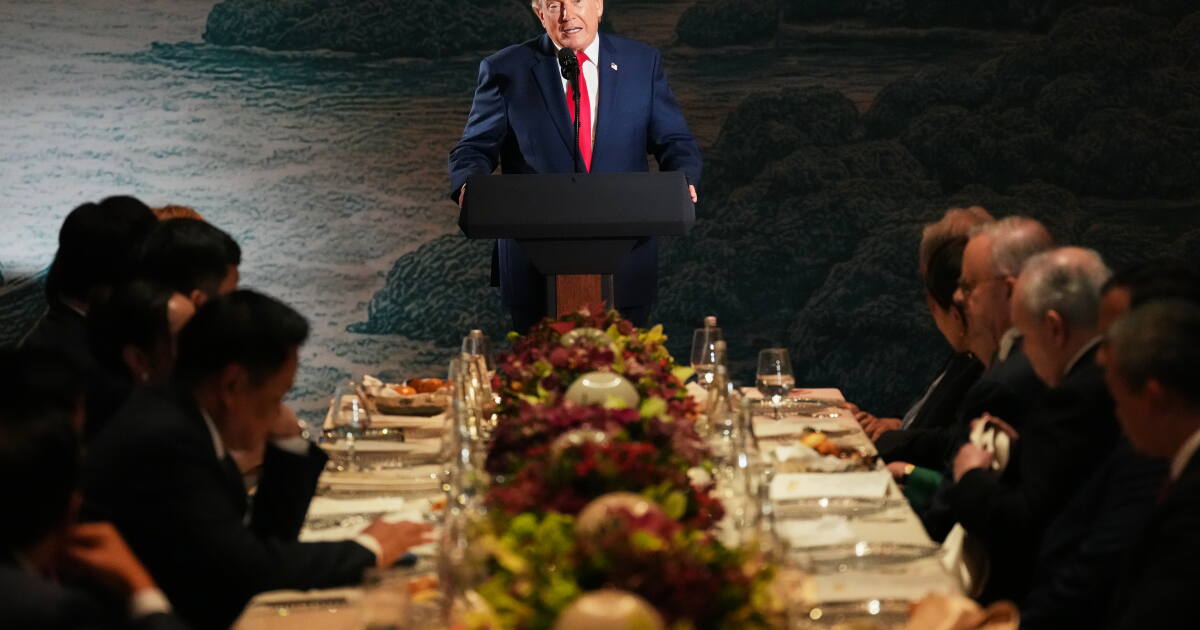
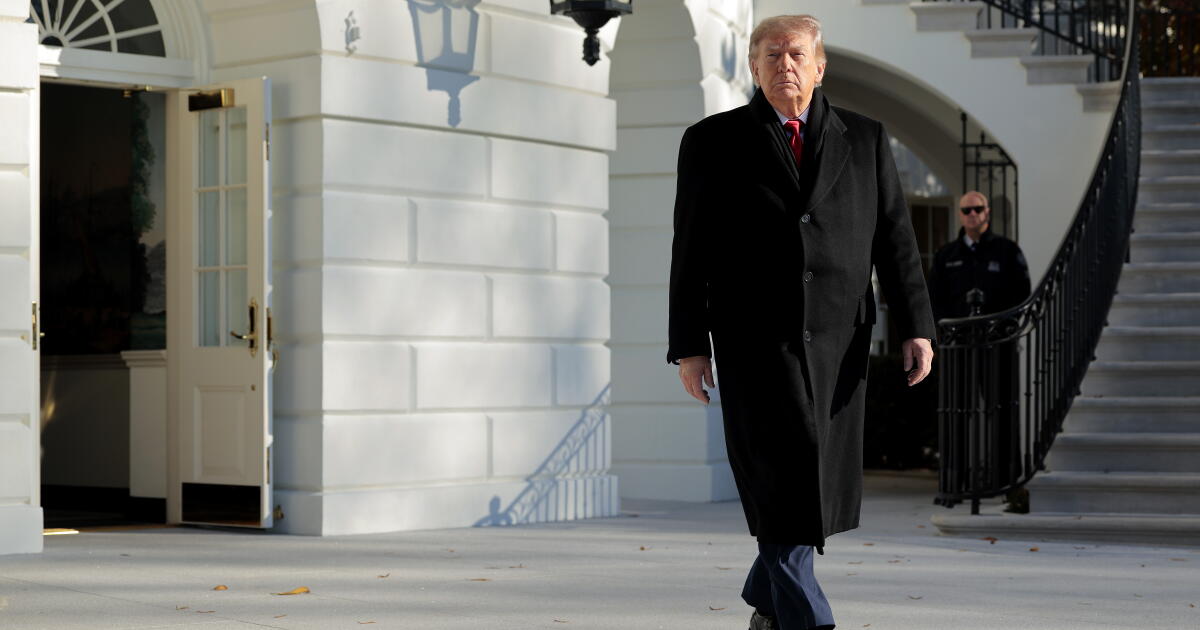
Photo via Los Angeles Times

Anxiety grips Pacific allies as Trump pulls back

Read the original at Los Angeles Times ↗
Cite

Wilner, M. (2026, September 6). Anxiety grips Pacific allies as Trump pulls back. Los Angeles Times. https://www.latimes.com/politics/story/2026-08-19/anxiety-grips-pacific-allies-as-trump-pulls-back

Dated when The Aporia collected the article, usually within hours of publication. Check the original for its exact date and byline.

Los Angeles Times · collected 2026-09-06 · by Michael Wilner

Quick Summary

US President Trump has unexpectedly pulled back US participation from annual military drills with South Korea, citing a need to avoid provoking North Korea's Kim Jong Un. This decision has fueled anxiety among Pacific allies, including South Korea, where president Lee Jae Myung has expressed alarm and preparedness for worst-case scenarios. The move is part of a broader drawdown of American military assets in the region, with over 40% of the Pentagon's THAAD interceptor inventory reportedly consumed by the Iran conflict. Trump also blamed South Korea for not participating in his war against Iran and claimed he couldn't protect all countries without their help.
Written by AI on 2026-09-07, from this article's own text only (the story summary below draws on all the coverage).

AI analysis

Story summary

President Trump has decided to pull back US involvement in annual military drills with South Korea, saying it will help avoid provoking North Korea's leader, Kim Jong Un. However, this move has caused alarm among Pacific allies, including South Korea's president, who are concerned about the potential consequences of a reduced US military presence in the region. The decision is seen as part of a broader trend of the US drawing down its military assets across the Pacific, with the last remaining US aircraft carrier leaving Asia and heading to the Middle East. This has sparked anxiety among allies such as Japan, whose defense minister, Shinjiro Koizumi, warned that cooperation between the US, Japan, and South Korea is crucial for maintaining peace and stability in the region. The drills were scheduled to take place this year, but the US has now withdrawn its participation, leading to concerns about a potential power vacuum in the Pacific.

Written for “Trump's Asia Pivot Backlash” on 2026-11-20, grounded in this article and the 0 other(s) covering the same event.

Compared with similar articles

This article reads leans left and hedges 7% of its claims. Each row says how that neighbour differs.
The Hindu
Leans left Hedges 0 of 7 claims Outlet record 60/100
“Article A mentions U.S. attacks on Iranian tankers, while Article B discusses Trump's decision to pull back from military drills with North Korea”
Al Jazeera
Hedges 2 of 15 claims Outlet record 60/100
“Article A mentions Trump pulling back from military drills with North Korea, while Article B focuses on Philippines' warning about China's potential reassertion in the Asia Pacific due to US-South Korea drill cuts”
Toronto Star
Hedges 2 of 26 claims Outlet record 64/100
“Article A describes Trump's decision to pull back from military drills, while Article B mentions a trilateral military exercise between US, South Korea and Japan, but it's unclear if this is the same specific drill”
Deutsche Welle
Hedges 4 of 42 claims Outlet record 95/100
“Article A mentions Trump's decision to pull back involvement in military drills last week, while Article B discusses the overall situation and North Korea's response, without specifying a particular incident”

Story

Trump's Asia Pivot Backlash
Politics · 1 article(s) covering the same event.
How this article was measured signals, leaning charts, publisher record, byline, topics and claims

Signals How these are calculated →

Claims extracted
27
sentences that state something as happening or true
Uncertain
7%
2 of 27 hedged ("reportedly", "may", "according to")
Leaning
Leans left
of the writing, not the subject · beta estimate
Publisher signals
95/100
Los Angeles Times's corrections and hedging, across everything collected from it. Not a measure of accuracy.
Outlets on this story
1
Politics
Same framing elsewhere
1
articles that frame the event the way this one does
Analyzed 2026-09-07 · how these are computed

How this is being covered How these are calculated →

Article leaning vs. publisher reliability
Source leaning vs. consistency

Publisher

Los Angeles Times · 337 article(s) · 0 correction(s) detected
No corrections detected for this publisher. That may mean careful reporting, or simply that nothing has been checked.

Who wrote this

Michael Wilner
29 article(s) here · 1 carrying a prediction
The competing agendas could make the summit little more than a spectacle, yet still produce images that harken back to the famous Yalta conference of 1945. But if any substantive understandings were reached behind closed doors, none of them were released to the public. The summit’s pageantry fit a familiar pattern for Trump, who has repeatedly staged headline-grabbing encounters with controversial leaders only to walk away empty-handed.
President Trump has begun an extraordinary visit to Shenzhen, where he is set to join the leaders of Russia and China — two of Washington’s principal geopolitical rivals — for an unprecedented trilateral summit on Thursday.
A divided Trump team closes ranks ahead of AI talks with China - - Trump has repeatedly sidestepped confrontation with Xi over the intensifying AI race in their two previous meetings this year - Trump is not expected to raise the Nvidia matter directly with Xi.
Allies and aides will urge Trump to push back against Beijing -
He would go on to visit Beijing several times under a banner of friendship.
Trump, Putin and Xi will meet in China
Congressional Republicans have called on Huang himself to provide an update, warning the incident raised “significant national security concerns” that could have compromised cutting-edge American technology at a critical moment in the race with China for supremacy in artificial intelligence.
Nonessential foreign service and intelligence personnel across the Middle East were ordered home, while senior officials at the Pentagon debated the strategic objectives renewed hostilities could realistically achieve, two U.S. officials told The Times.
How large their House majority would be remained to be seen as states continued counting votes.
- - Trump suggests he is expecting a wave, telling the New York Post he will ‘become Mr. Veto’ if Democrats sweep control. - Democratic congressional leaders may face internal party calls to pursue a third impeachment of the president.
2026-11-02 · mixed framing · Trump's aura of invincibility faces one more test
Also by Michael Wilner
Nothing else under this byline is closely related to this article, so these are simply their most recent.
All 29 articles by Michael Wilner →

Topics

Iran North Korea’s South Korea’s U.S. WASHINGTON

Subjects

Trump PERSON · 10× Kim Jong Un PERSON · 4× U.S. GPE · 4× Iran GPE · 3× Japan GPE · 3× North Korea’s GPE · 3× South Korea’s GPE · 3× WASHINGTON GPE · 3× American NORP · 2× South Korea GPE · 2×

Narrative

The Australian government said it remained “deeply concerned” with North Korea’s nuclear weapons and ballistic missile programs, while Japan’s defense minister, Shinjiro Koizumi, warned of historic stakes. “As Japan faces the most severe and complicated security environment in the post-war era, the cooperation among Japan, the United States and South Korea is critical to the peace and stability of the region,” Koizumi said in a statement.
framing: assertive · carried by 1 article(s) · first seen 2026-09-07
Anxiety grips Pacific allies as Trump pulls back - Click here to listen to this article - - Trump said the annual military drills would needlessly provoke North Korea’s dictator, Kim Jong Un. - South Korea’s president responded to Trump’s last-minute decision to pull back involvement in the drills with a degree of alarm.
2026-09-07 · Los Angeles Times
Anxiety grips Pacific allies as Trump pulls back · assertive framing

Claims (27 extracted, 2 hedged)

Anxiety grips Pacific allies as Trump pulls back - Click here to listen to this article - - Trump said the annual military drills would needlessly provoke North Korea’s dictator, Kim Jong Un. - South Korea’s president responded to Trump’s last-minute decision to pull back involvement in the drills with a degree of alarm. asserted
president → grip → alarm
The only remaining U.S. aircraft carrier patrolling the Pacific departed Asia through Singapore last week en route to the Middle East, marking the latest step in a steady drawdown of American military assets across the region. asserted
carrier → remain → region
An armada of naval forces, alongside a constellation of air-defense and missile capabilities, has been removed from a theater the Trump administration said just last year would be the battleground of the coming century. asserted
administration → remove → century
And now, President Trump’s surprise decision this week to curtail military exercises with South Korea has further fueled anxiety across Asia, where Washington’s closest allies fear violent consequences from a vacuum of American power. asserted
allies → curtail → power
Trump said his decision to withdraw U.S. participation from the annual military drills was de-escalatory, claiming they would needlessly provoke North Korea’s dictator, Kim Jong Un, with whom he has recently been in touch. But he also blamed Seoul for its decision to not take part in his war with Iran. asserted
he → say → Iran
The U.S.-Israel campaign against Iran was billed as the final blow to Tehran’s ‘Axis of Resistance,’ but the alliance though bloodied is unexpectedly resilient. asserted
alliance → bill → Resistance
“I said, ‘Would you like to give us a little hand?’ ” Trump told reporters. asserted
Trump → say → reporters
“He said, ‘No thanks,’ and I said, ‘Wait a minute — we have 39,000 soldiers over there, guarding you from Kim Jong Un, your next-door neighbor, and you’re not going to help us.’ asserted
you → say → us
” “That’s strange,” Trump added. asserted
Trump → ’ → ?
“We can’t go around and protect all of these countries, especially when they’re not there to help us.” asserted
they → go → us
South Korea’s president, Lee Jae Myung, responded to Trump’s last-minute decision to pull back from the drills with a degree of alarm. asserted
president → respond → alarm
“From now on, we must prepare measures with even the worst-case scenario in mind,” Lee said, “on the premise that the Middle East situation may be prolonged.” uncertain
situation → prepare → premise
It was the latest jolt to South Korea’s confidence in an alliance that has formed a cornerstone of Washington’s defense strategy in Asia since the end of World War II. asserted
that → form → II
The Pentagon has kept its THAAD missile-defense batteries on the Korean peninsula. asserted
Pentagon → keep → peninsula
But in March, it moved some of the system’s radars and forward-positioned interceptors toward the Middle East, as the Iran war strained U.S. missile-defense stocks. asserted
war → move → stocks
Analysts estimate the conflict has consumed more than 40% of the Pentagon’s THAAD interceptor inventory. asserted
conflict → estimate → inventory
The diversion was accompanied by the redeployment of dozens of combat and dry-cargo ships, mine countermeasure vessels, and guided-missile destroyers out of the region, ahead of the departure of the strike group centered on the nuclear-powered USS George Washington, which is now on its way to the Middle East. asserted
which → accompany → East
Other U.S. allies in the region reacted swiftly to Trump’s pullback from the Korean exercises. asserted
allies → react → exercises
The Australian government said it remained “deeply concerned” with North Korea’s nuclear weapons and ballistic missile programs, while Japan’s defense minister, Shinjiro Koizumi, warned of historic stakes. “As Japan faces the most severe and complicated security environment in the post-war era, the cooperation among Japan, the United States and South Korea is critical to the peace and stability of the region,” Koizumi said in a statement. asserted
Koizumi → say → statement
Trump cited his good relationship with North Korean leader Kim Jong Un for the decision, a likely bid to reengage with Kim, who views U.S.-South Korean military exercises as invasion rehearsals. asserted
who → cite → rehearsals
And Beijing has been quick to capitalize on the vacuum. asserted
Beijing → capitalize → vacuum
China’s Foreign Ministry mocked that the United States “has become addicted to quitting groups and scrapping treaties,” while its military began installing permanent infrastructure in Taiwan’s exclusive economic zone within days of the George Washington’s departure. “The current international landscape has once again proven that only by ensuring the effective operation of the multilateral system can we prevent the spread of the law of the jungle,” said Mao Ning, a spokesman for the Chinese Foreign Ministry, “and keep the international order from being dominated by the logic that ‘might makes right and force represents justice.’” uncertain
force → mock → justice
Speaking with journalists in the Oval Office on Monday, Trump said that his communication with Kim was “making things safer” in the region. asserted
things → speak → region
He did not offer details on their conversations. asserted
He → offer → conversations
“Kim Jong Un has always treated me with great respect,” Trump said, confirming that the North Korean leader had replied to his overtures. asserted
leader → treat → overtures
“I understand him,” Trump added. asserted
Trump → understand → him
“He understands me.” asserted
He → understand → me

Give feedback · no sign-in needed

No sign-in needed for now. Your note is sent without a name, so it cannot be answered.

History Support