Photo via The Guardian

Nobel Prize for economics awarded to Hall and Woodford for work on ‘smoothing’ crises

Read the original at The Guardian ↗
Cite

Wearden, G. (2026, October 12). Nobel Prize for economics awarded to Hall and Woodford for work on ‘smoothing’ crises. The Guardian. https://www.theguardian.com/world/2026/oct/12/nobel-prize-for-economics-hall-woodford-new-keynesian-models

Dated when The Aporia collected the article, usually within hours of publication. Check the original for its exact date and byline.

The Guardian · collected 2026-10-12 · by Graeme Wearden

Quick Summary

Robert Hall and Michael Woodford have been awarded the 2026 Nobel Prize in economics for their work on New Keynesian models, which help central bankers manage economic crises more effectively. The prize recognizes their development of microeconomic foundations that improve upon traditional macroeconomic stabilization methods, providing tools to better predict and mitigate recessions and inflation. Awarded by the Royal Swedish Academy of Sciences, the prize includes a combined $1.2 million (£900,000) in prize money, acknowledging Hall's focus on forward-looking consumer behavior and Woodford’s creation of comprehensive New Keynesian models used widely post-2008 financial crisis to prevent economic downturns.
Written by AI on 2026-10-12, from this article's own text only (the story summary below draws on all the coverage).
See how they differ ↓

AI analysis

Story summary

Robert Hall from Stanford University and Michael Woodford from Columbia University have been awarded the 2026 Nobel Prize in Economics "for microeconomic foundations of macroeconomic stabilisation," announced by the Royal Swedish Academy of Sciences on October 12, 2026. The prize recognizes their work on developing new models that improve policymakers' ability to manage economic shocks and reduce peaks and troughs in economies. Each laureate received $1.2 million (12 million Swedish crowns), making it the final Nobel Prize for this year. Hall’s affiliation with Stanford University, California, and Woodford's connection to Columbia University, New York, underscores their contributions to economic theory and practice globally. The award highlights the advancement of stabilisation policies over traditional models that struggled during historical crises like the 1970s oil shock.

Written for “Nobel Economics Prize 2026” on 2026-11-21, grounded in this article and the 10 other(s) covering the same event.

How they differ

10 outlets covered “Nobel Economics Prize 2026”.

What each outlet says

One AI summary per outlet of its latest article on this story, written from that article alone and checked against it. Open the article for the outlet's own words.

The GuardianThis outlet12 Oct

Robert Hall and Michael Woodford have been awarded the 2026 Nobel Prize in economics for their work on New Keynesian models, which help central bankers manage economic crises more effectively. The prize recognizes their development of microeconomic foundations that improve upon traditional macroeconomic stabilization methods, providing tools to better predict and mitigate recessions and inflation. Awarded by the…

Nobel Prize for economics awarded to Hall and Woodford for work on ‘smoothing’ crises (this article)
Toronto Star12 Oct

This year’s Nobel Prize winners were announced across various categories including medicine, physics, chemistry, literature, and peace. In medicine, three scientists received recognition for their work on optogenetics. The physics prize went to Francis Halzen for his contributions to detecting neutrinos in Antarctica. Chemists Henri B. Kagan and Kenso Soai won for their research on molecular mirror images. Anne…

A list of this year’s Nobel Prize winners →2 articles from Toronto Star on this story
South China Morning Post12 Oct

Robert Hall and Michael Woodford have been awarded the 2026 Nobel Prize in Economics for their work on "microeconomic foundations of macroeconomic stabilisation." Both economists are affiliated with US universities: Hall with Stanford University in California, and Woodford with Columbia University in New York. The award announcement was made by the Royal Swedish Academy of Sciences in Stockholm, Sweden.

⁠Robert ⁠Hall, Michael Woodford win 2026 Nobel Prize in economics →
The Hindu12 Oct

Robert E. Hall and Michael Woodford were awarded the Economics Nobel on October 12, 2026, for their work on microeconomic foundations of macroeconomic stabilization. The Royal Swedish Academy highlighted their development of new models that enhance the effectiveness of fiscal and monetary policy measures. Each laureate receives a prize worth approximately $1.2 million.

Americans Robert E. Hall, Michael Woodford win Economics Nobel 2026 →
The Straits Times12 Oct

Robert Hall and Michael Woodford from the United States received the 2026 Nobel economics prize for their contributions to macroeconomic stabilization through microeconomic foundations. They developed models that enhance fiscal and monetary policy effectiveness in mitigating economic fluctuations. The award, valued at 12 million Swedish crowns ($1.2 million), recognizes the practical applications of their theories…

Americans Hall and Woodford win Nobel economics prize for work on stabilisation →
Show 4 more outlets
CBS News12 Oct

American economists Robert E. Hall and Michael Woodford received the Nobel memorial prize in economics on Monday for their work developing models that aid governments and central banks in managing economic shocks. The Royal Swedish Academy of Sciences awarded them for providing a theoretical foundation for stabilization measures during economic crises. Each laureate will receive 12 million Swedish kronor, equivalent…

Nobel prize in economics goes to 2 Americans →
The Independent12 Oct

Robert E. Hall and Michael Woodford were awarded the Nobel memorial prize in economics for developing models that help governments and central banks manage economic shocks such as energy crises and inflation. The Royal Swedish Academy of Sciences announced their win, citing their work's significant impact on economic policies during recent global crises. Both economists are associated with prestigious U.S…

Meet Robert E. Hall and Michael Woodford: The Nobel Prize-winning economists →
Al Jazeera12 Oct

Robert Hall and Michael Woodford received the 2026 Nobel Prize in Economic Sciences for their work on macroeconomic models that help stabilize economic fluctuations through effective fiscal and monetary policies. Announced by the Royal Swedish Academy of Sciences, their research provides a theoretical foundation for central banks and governments to better manage shocks like energy crises or sudden changes in…

Nobel economics prize awarded to Robert Hall and Michael ⁠Woodford →
Noahpinion13 Oct

The article discusses the awarding of the Nobel Prize in Economics to Bob Hall and Michael Woodford for their contributions to New Keynesian macroeconomics, a field that explains how economic policies affect inflation and employment through microeconomic foundations. The author notes this recognition was long overdue and provides context on the historical development of modern macroeconomics, highlighting the shift…

A Nobel for New Keynesian macro, at last! →

Where they agree and split

Framing

How the first headlines put it

  • Headlines vary in focus, with some emphasizing the winners' names and others highlighting their work on economic stabilisation.2347
Stated as fact9
The headlines (9)

Nobel memorial prize in economics to be awarded in Stockholm Toronto Star · stated as fact

⁠Robert ⁠Hall, Michael Woodford win 2026 Nobel Prize in economics South China Morning Post · stated as fact

Americans Robert E. Hall, Michael Woodford win Economics Nobel 2026 The Hindu · stated as fact

Two Americans win Nobel Prize in Economics for work on boom-bust cycles NPR · stated as fact

Americans Hall and Woodford win Nobel economics prize for work on stabilisation The Straits Times · stated as fact

Nobel prize in economics goes to 2 Americans CBS News · stated as fact

Meet Robert E. Hall and Michael Woodford: The Nobel Prize-winning economists The Independent · stated as fact

Nobel economics prize awarded to Robert Hall and Michael ⁠Woodford Al Jazeera · stated as fact

Nobel Prize for economics awarded to Hall and Woodford for work on ‘smoothing’ crises The Guardian · stated as fact

The full story: what happened, how it changed, and all 11 articles →

Compared with similar articles

This article reads unscored and hedges 5% of its claims. Each row says how that neighbour differs.
The Straits Times
Hedges 0 of 10 claims Outlet record 64/100
The Hindu
Hedges 0 of 15 claims Outlet record 78/100
Toronto Star
Hedges 0 of 1 claims Outlet record 64/100
South China Morning Post
Hedges 0 of 6 claims Outlet record 62/100
NPR
Hedges 0 of 2 claims Outlet record 60/100
CBS News
Hedges 0 of 11 claims Outlet record 66/100
The Independent
Hedges 0 of 29 claims Outlet record 59/100
Al Jazeera
Hedges 2 of 15 claims Outlet record 60/100
Noahpinion
Hedges 12 of 133 claims
Toronto Star
Hedges 0 of 20 claims Outlet record 64/100

Story

Nobel Economics Prize 2026
Economy/Business · 11 article(s) covering the same event. Compare every outlet's account →
How this article was measured signals, leaning charts, publisher record, byline, topics and claims

Signals How these are calculated →

Claims extracted
22
sentences that state something as happening or true
Uncertain
5%
1 of 22 hedged ("reportedly", "may", "according to")
Leaning
not political
takes no side on a contested political question
Publisher signals
64/100
The Guardian's corrections and hedging, across everything collected from it. Not a measure of accuracy.
Outlets on this story
11
Economy/Business
Same framing elsewhere
1
articles that frame the event the way this one does
Analyzed 2026-10-12 · how these are computed

How this is being covered How these are calculated →

Article leaning vs. publisher reliability
Source leaning vs. consistency

Publisher

The Guardian · 3744 article(s) · 8 correction(s) detected
Running correction rate · 8 correction(s)

Who wrote this

Graeme Wearden
13 article(s) here · 1 carrying a prediction
The $4.1tn (£3tn) chipmaker has hired New York-based Wachtell, Lipton, Rosen & Katz for the investigation, which will be led by the Wachtell partner Joon Kim.
Other big fallers included IAG, the owner of British Airways and Iberia, which fell 1.5%, after it missed profit forecasts in a trading update, and the miners Antofagasta and Anglo American.
The tech-heavy US Nasdaq share index is on track for its worst day in 18 months after slumping by up to 5% on Thursday amid growing signs that the artificial intelligence industry will face tougher regulation after this week’s midterm elections.
The pound has also benefited from expectations that the Bank will raise interest rates for the first time in more than three years at midday on Thursday, which would make it more lucrative for investors to hold funds in sterling.
Over the weekend, Qatari officials tried to negotiate the release of more than $6bn (£4.5bn) in Iranian assets, so that Tehran might allow the strait of Hormuz to reopen.
The European Central Bank announced on Thursday morning that Lagarde would step down as its president on 7 February 2027; her term was scheduled to run until the end of October next year.
Financial markets are wrong to predict the Bank of England will raise UK interest rates by a full percentage point or more by next summer, City economists believe.
These models improved on John Maynard Keynes’s stabilisation models, which struggled to handle the impact of the oil shock in the 1970s, when countries suffered high inflation, weak growth and high unemployment at the same time.
The threat of a renewed round of inflation from the persistently high cost of oil has spooked investors, who believe central banks will be forced to raise rates in the coming months to prevent price increases from becoming embedded.
Powered by the AI revolution, the US stock market had rallied to a fresh all-time high, as investors bet the multitrillion-dollar investment spree would overshadow the hit from the Iran war.
2026-09-20 · assertive framing · Are global stock markets heading for a crash?
Also by Graeme Wearden
Nothing else under this byline is closely related to this article, so these are simply their most recent.
All 13 articles by Graeme Wearden →

Topics

California Columbia University New York Stanford University The Royal Swedish Academy of Sciences

Subjects

Hall PERSON · 4× Woodford GPE · 3× California GPE · 1× Columbia University ORG · 1× John Maynard Keynes’s PERSON · 1× Michael Woodford PERSON · 1× New York GPE · 1× Robert Hall PERSON · 1× Stanford University ORG · 1× The Royal Swedish Academy of Sciences ORG · 1×

Narrative

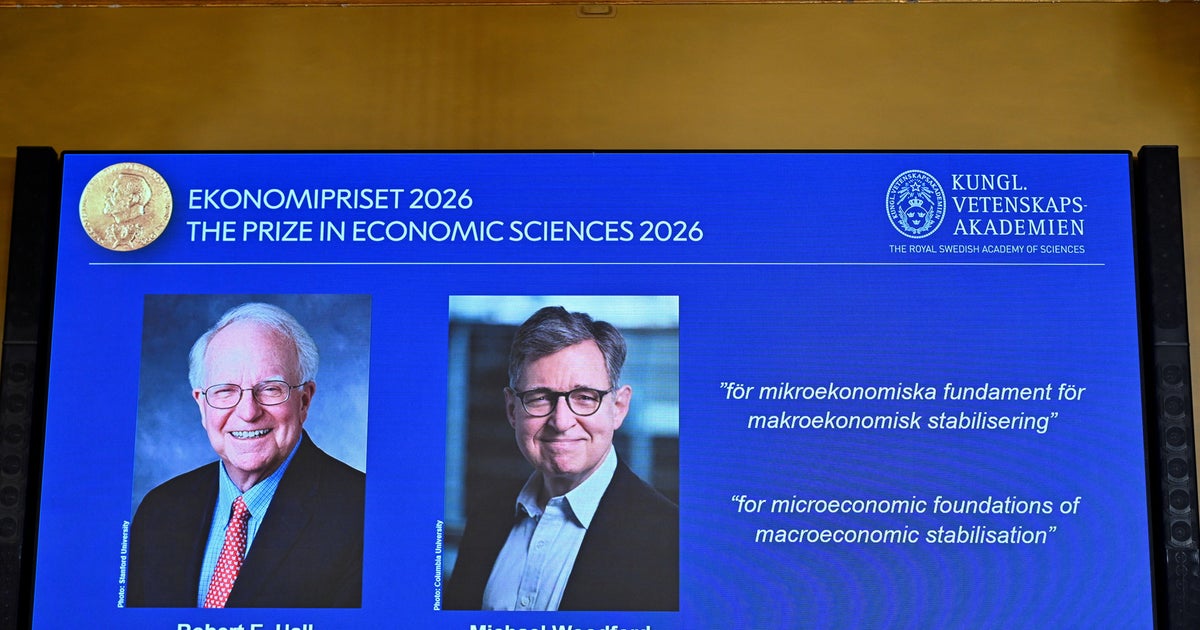
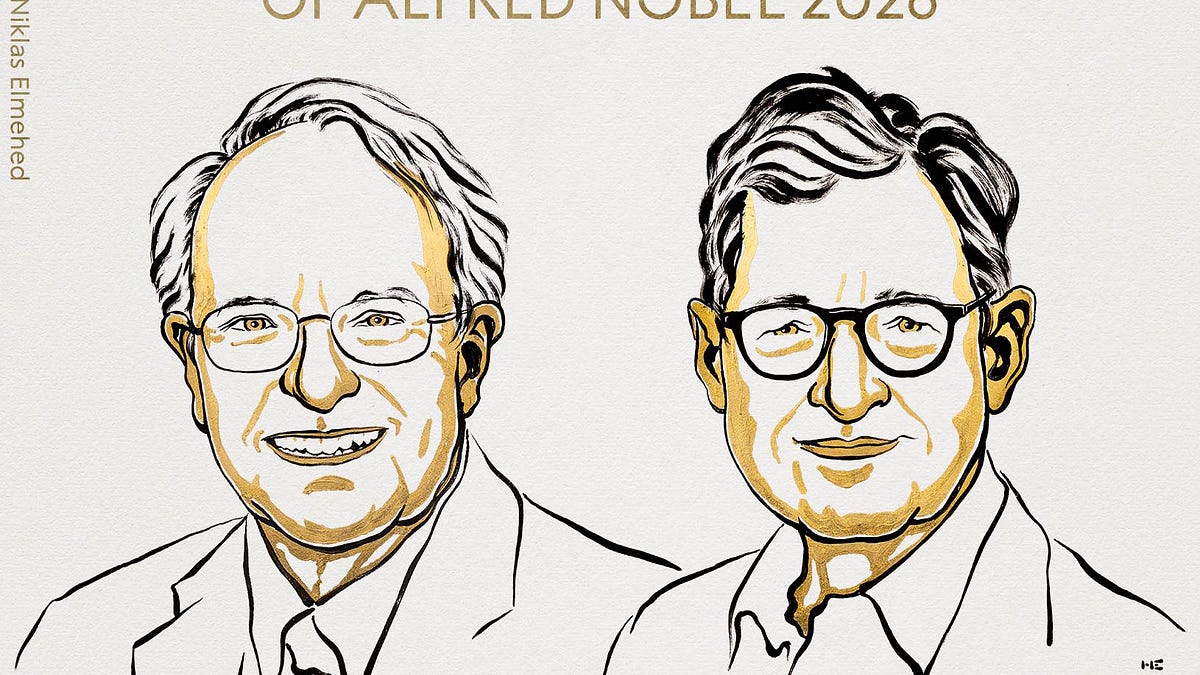
Robert Hall of Stanford University, California, and Michael Woodford of Columbia University, New York, were recognised for developing the “microeconomic foundations of macroeconomic stabilisation”, giving policymakers better tools to smooth out the peaks and troughs of their economies.
framing: assertive · carried by 1 article(s) · first seen 2026-10-12
These models improved on John Maynard Keynes’s stabilisation models, which struggled to handle the impact of the oil shock in the 1970s, when countries suffered high inflation, weak growth and high unemployment at the same time.

Claims (22 extracted, 1 hedged)

Two US economists have won the 2026 Nobel economics prize for their work developing models that help central bankers and finance ministers to stabilise their countries, avoiding long recessions and runaway inflation. asserted
bankers → win → recessions
Robert Hall of Stanford University, California, and Michael Woodford of Columbia University, New York, were recognised for developing the “microeconomic foundations of macroeconomic stabilisation”, giving policymakers better tools to smooth out the peaks and troughs of their economies. asserted
Hall → recognise → economies
The Royal Swedish Academy of Sciences said it was recognising the pair for generating “a paradigm shift in stabilisation policy”, awarding them the prize worth a combined $1.2m (£900,000). asserted
it → say → prize
“New Keynesian models, a result of their research, allow us to explain and quantify how stabilisation policy affects business cycles and are now used by central banks and finance ministries around the world,” the academy said. asserted
academy → allow → world
These models improved on John Maynard Keynes’s stabilisation models, which struggled to handle the impact of the oil shock in the 1970s, when countries suffered high inflation, weak growth and high unemployment at the same time. asserted
countries → improve → time
Hall and Woodford demonstrated how traditional models could be reconstructed, based on how individual households and businesses collectively affect an economy through their actions. uncertain
households → demonstrate → actions
Hall’s work was based on forward-looking consumer behaviour rather than the more mechanical rules of thumb used by Keynes, which linked key variables such as inflation, unemployment and gross domestic product (GDP). asserted
which → base → inflation
Woodfood built on this work to create the New Keynesian model, a full macroeconomic stabilisation framework that is the main tool for policymakers now. asserted
that → build → policymakers
This model was used after the 2008 financial crisis by policymakers as they steered the global economy away from the risk of a second great depression. asserted
they → use → depression
“The laureates’ work has provided us with a stable theoretical foundation for the models that are now used by central banks and governments around the world. asserted
that → provide → world
With them, we are better equipped to deal with shocks in the economy, such as energy crises or sudden changes in how much households consume,” John Hassler, the chair of the committee for the economics prize, said. asserted
Hassler → equip → prize
Hall and Woodford’s work also led to the development of forward guidance, where central bankers communicate where they expect interest rates to be in the future. asserted
rates → lead → future
That became an important tool after the 2008 financial crisis, and the Covid pandemic, when interest rates were cut to record lows. asserted
rates → become → lows
Forward guidance has had its critics, though – the current chair of the US Federal Reserve, Kevin Warsh, has argued it should only have a “limited and circumscribed” role in normal times, to avoid “creating ambiguity in the name of clarity”. asserted
it → have → clarity
And in 2014, the then Bank of England governor, Mark Carney, was labelled an “unreliable boyfriend” for dropping hints over interest rate rises that never came to pass. asserted
that → label → pass
Woodford said he was “elated”. asserted
he → say → ?
“It’s a tremendous honour. asserted
It → ’ → ?
It’s a surprise but I’m feeling very good about it,” he told reporters in Stockholm by phone after receiving the news. asserted
he → ’ → news
Hall is also known for coining the idea that US economists can be divided into fresh water and salt water varieties. asserted
economists → know → varieties
The fresh water group, who tend to be based at inland universities located near the Great Lakes, such as the University of Chicago, believe in free markets, neoclassical price theory, rational expectations and monetarism. asserted
who → tend → markets
Salt water economists, though, cluster at coastal universities, such as Harvard, MIT, UC Berkeley, Yale, Princeton, UCLA and Columbia. asserted
economists → cluster → Harvard
They tend to be Keynesians and New Keynesians, believing that governments and central banks can affect demand in their economies. asserted
governments → tend → economies
Give feedback · no sign-in needed

No sign-in needed for now. Your note is sent without a name, so it cannot be answered.

History Support