Photo via Euronews

UAE and Iran leaders meet at the BRICS summit for the first time since the war

Read the original at Euronews ↗
Cite

Barabas, P., & Elashi, M. (2026, September 13). UAE and Iran leaders meet at the BRICS summit for the first time since the war. Euronews. https://www.euronews.com/2026/09/13/uae-and-iran-leaders-meet-at-the-brics-summit-for-the-first-time-since-the-war

Dated when The Aporia collected the article, usually within hours of publication. Check the original for its exact date and byline.

Euronews · collected 2026-09-13 · by Peter Barabas, Mohamed Elashi

Quick Summary

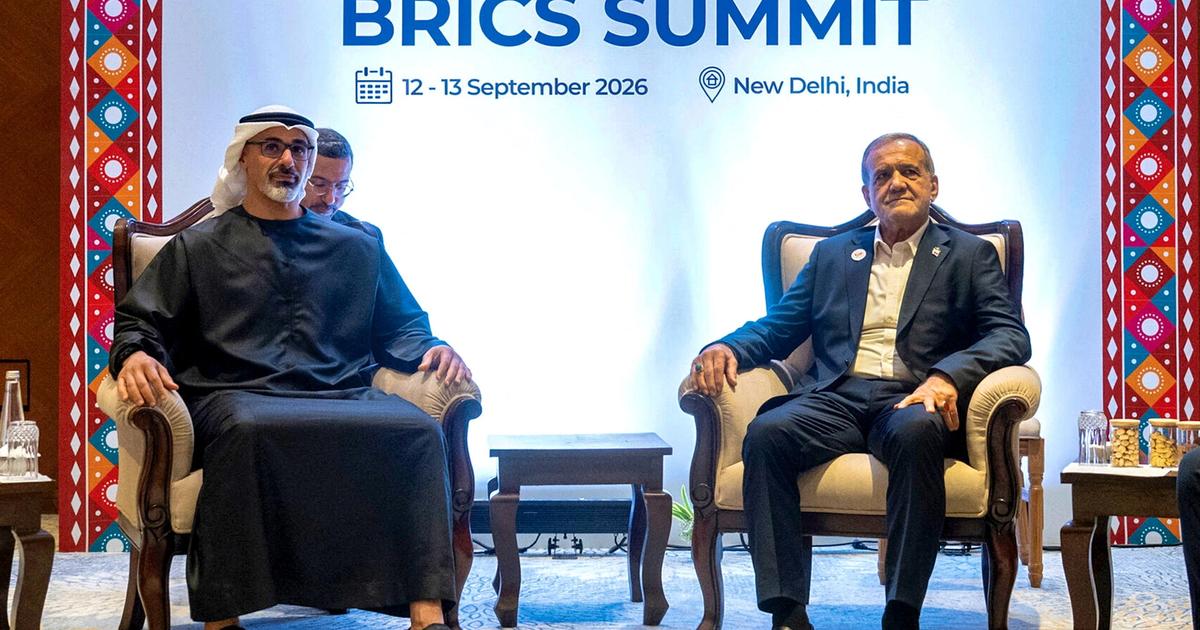
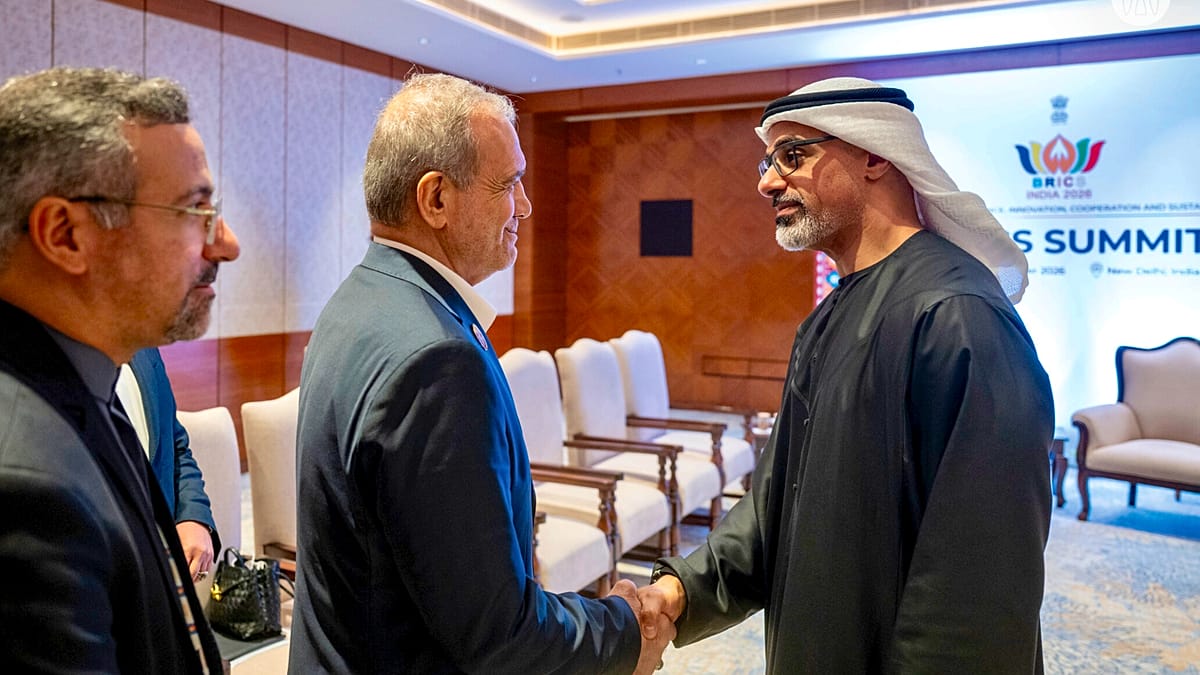
During the BRICS summit in India, Abu Dhabi Crown Prince Sheikh Khaled bin Mohamed bin Zayed Al Nahyan met with Iranian President Masoud Pezeshkian for the first time since the UAE suspended all trade and financial dealings with Iran in August. The meeting marks an effort to reduce tensions and strengthen regional stability, though no immediate changes to sanctions were announced. Analysts suggest that while trust between the two nations remains low, managing relations is crucial for the UAE's strategic interests in preserving trade and energy security.
Written by AI on 2026-09-13, from this article's own text only (the story summary below draws on all the coverage).
See how they differ ↓

AI analysis

Story summary

At the BRICS summit in India, the leaders of UAE and Iran held their first high-level meeting since the start of the US-Israel conflict with Iran. The meeting, involving Abu Dhabi Crown Prince Sheikh Khaled bin Mohamed bin Zayed Al Nahyan and Iranian President Masoud Pezeshkian, came after the UAE suspended trade and financial dealings with Iran in August due to escalating tensions.

Anwar Gargash, a presidential diplomatic adviser, emphasized that rebuilding trust between the two nations would require significant effort and concrete actions rather than just words. Both sides stressed the importance of reducing regional tensions during their discussions. Additionally, the BRICS summit featured a joint statement calling for "maximum restraint," signaling Iran's direct engagement with Gulf states instead of relying on US-Iran negotiations.

Iran also plans to propose a temporary shipping route through the Strait of Hormuz to address maritime concerns in the region. This move underscores both countries' efforts to find common ground and improve relations despite ongoing conflicts and political challenges.

Written for “UAE Iran Meeting BRICS Summit” on 2026-11-21, grounded in this article and the 1 other(s) covering the same event.

How they differ

2 outlets covered “UAE Iran Meeting BRICS Summit”.

What each outlet says

One AI summary per outlet of its latest article on this story, written from that article alone and checked against it. Open the article for the outlet's own words.

EuronewsThis outlet13 Sep

During the BRICS summit in India, Abu Dhabi Crown Prince Sheikh Khaled bin Mohamed bin Zayed Al Nahyan met with Iranian President Masoud Pezeshkian for the first time since the UAE suspended all trade and financial dealings with Iran in August. The meeting marks an effort to reduce tensions and strengthen regional stability, though no immediate changes to sanctions were announced. Analysts suggest that while trust…

UAE and Iran leaders meet at the BRICS summit for the first time since the war (this article)
Semafor15 Sep

Iran and the United Arab Emirates met in New Delhi during the BRICS summit, marking their highest-level encounter since tensions escalated earlier this year. The meeting followed Abu Dhabi’s suspension of trade with Tehran in August after Iranian attacks. Both countries used the opportunity to discuss regional security issues directly, with Iran planning to propose a temporary shipping route through the Strait of…

Iran and the UAE meet in New Delhi →

Compared with similar articles

This article reads unscored and hedges 3% of its claims. Each row says how that neighbour differs.
Al Jazeera
Hedges 0 of 3 claims Outlet record 60/100
“Article A describes a meeting between UAE and Iranian leaders at the BRICS summit, while Article B discusses postponed talks in Oman involving Iran and Gulf Arab states.”
Semafor
Hedges 0 of 5 claims Outlet record 64/100
Times of India
Leans right Hedges 3 of 20 claims Outlet record 59/100
“The articles describe different meetings involving Iran and Gulf countries, with Article A focusing on a UAE-Iran meeting at the BRICS summit in India, while Article B discusses Trump's expected meeting with GCC leaders regarding the war with Iran at the UN general assembly.”
The Straits Times
Hedges 1 of 14 claims Outlet record 64/100
“The articles describe different meetings involving Iran: one at the BRICS summit in India and another related to the UN General Assembly in New York.”
Euronews
Leans left Hedges 1 of 14 claims Outlet record 60/100
“The articles describe different meetings at the BRICS summit: one involving Russian and Chinese leaders arriving in India, while the other is about a meeting between UAE and Iran leaders.”
Semafor
Hedges 1 of 3 claims Outlet record 64/100
“The articles describe different meetings at the BRICS summit: one focuses on Russia and China's leaders visiting India, while the other details a meeting between UAE and Iran leaders.”
Al Jazeera
Leans left Hedges 3 of 62 claims Outlet record 60/100
“While both articles mention Iranian President Masoud Pezeshkian at the BRICS summit in India, Article A focuses on the broader context of tensions and conflicts between Iran and other countries, whereas Article B specifically details a meeting between UAE's Crown Prince and the Iranian president.”
Al Jazeera
Leans left Hedges 7 of 62 claims Outlet record 60/100
“Article A discusses the broader context and challenges facing BRICS countries during their summit, while Article B focuses on a specific meeting between UAE and Iran leaders at the BRICS summit.”
ABC News (AU)
Leans left Hedges 1 of 21 claims Outlet record 67/100
“The articles describe meetings and interactions at the BRICS summit involving different sets of leaders from Iran, Saudi Arabia, UAE, Russia, China, etc., but they do not describe the same specific event or interaction.”
Al Jazeera
Hedges 4 of 50 claims Outlet record 60/100
“Article A focuses on a specific meeting between UAE and Iranian leaders, while Article B provides an overview of key takeaways from the BRICS summit without detailing that particular meeting.”

Story

UAE Iran Meeting BRICS Summit
World · 2 article(s) covering the same event. See how they differ ↑
How this article was measured signals, leaning charts, publisher record, byline, topics and claims

Signals How these are calculated →

Claims extracted
30
sentences that state something as happening or true
Uncertain
3%
1 of 30 hedged ("reportedly", "may", "according to")
Leaning
withheld
no quote in the article backed the model's score
Publisher signals
60/100
Euronews's corrections and hedging, across everything collected from it. Not a measure of accuracy.
Outlets on this story
2
World
Same framing elsewhere
1
articles that frame the event the way this one does
Analyzed 2026-09-13 · how these are computed

How this is being covered How these are calculated →

Article leaning vs. publisher reliability
Source leaning vs. consistency

Publisher

Euronews · 1552 article(s) · 1 correction(s) detected
Running correction rate · 1 correction(s)

Who wrote this

Peter Barabas
22 article(s) here · 1 carrying a prediction
At the start of the summit, Putin said that Russia’s war in Ukraine would be part of the talks, stating that “we have shared interests in Ukraine.”
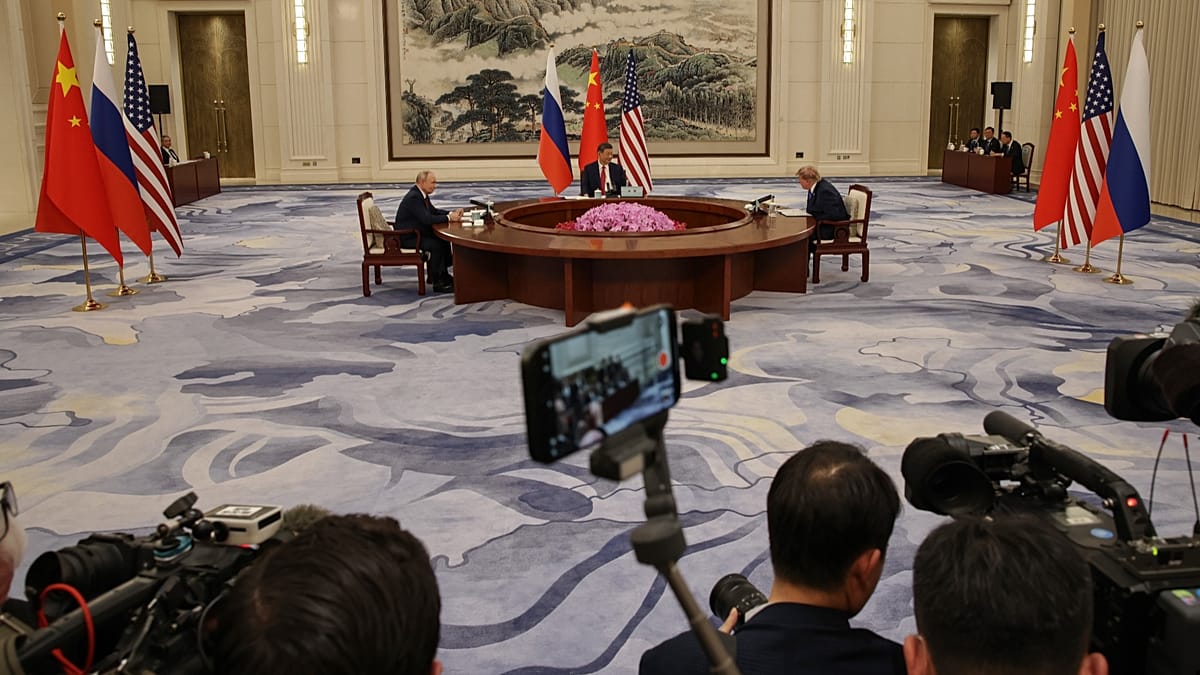
Chinese President Xi Jinping welcomed US President Donald Trump in Shenzhen on Wednesday for a high-stakes Asia-Pacific Economic Cooperation (APEC) summit, which will culminate on Thursday with a crucial trilateral encounter between Trump, Russia's Vladimir Putin and Xi — the first such summit between three global powers.
The Iranian regime has continued its threats against renewed US wide-scale attacks, with military officials telling Iranian Tabnak News on Sunday that "Iran's new offensive military doctrine means that the country will no longer be limited to calculated retaliation and will break the cycle of escalation," and threatening US bases in Europe too.
Both countries said that their agreement underlines their shared vision of a more secure and stable regional order, with Erdogan’s office stating that it will “add a new dimension to the brotherly ties between the two countries."
“They built a little bit of an anti-aircraft device and we knocked it out in about 15 minutes, maybe five," Trump said.
It comes as urgent diplomatic efforts continue to avoid a new all-out Iran war, which would have devastating consequences for the Middle East and beyond.
Against the backdrop of growing speculation over the last weeks that the US and Israel may launch a new attack against Iran before or after the mid-term elections in the US and next week’s elections in Israel, a new US Department of State travel alert issued on Wednesday evening was relayed by news agencies and wider media as an urgent signal as to the imminence of war restarting, with the Gulf nations bearing the brunt of a potentially larger conflict.
French President Emmanuel Macron issued a stern warning on Wednesday in Doha about the Gulf's fragile security situation, urging “extreme caution” to avoid escalating tensions that could reignite conflict, after talks with Qatar’s Emir Sheikh Tamim bin Hamad Al Thani.
Qatar will soon announce a new defence partnership, Deputy Prime Minister Sheikh Saoud bin Abdulrahman Al Thani said on Monday, while also calling for talks and closer economic ties with Iran to prevent further conflict.
“Iran and groups supportive of Iran may target other US interests overseas or at locations associated with the United States and Americans throughout the world, including US businesses and other institutions,” the alert said.
Also by Peter Barabas
Nothing else under this byline is closely related to this article, so these are simply their most recent.
All 22 articles by Peter Barabas →
Mohamed Elashi
15 article(s) here · 1 carrying a prediction
Qatar warned on Tuesday that the ongoing escalation in the Gulf poses a “grave danger” to the chances of a deal between the US and Iran, as it announced a meeting with Iranian officials later in the day. Dr. Majed Al Ansari, spokesperson for Qatar’s foreign ministry, said the risks extended “not only to freedom of navigation and the global economy, but also to the chances of reaching an agreement”. Speaking at a weekly briefing in Doha, he urged all sides to exercise restraint and avoid further escalation that could undermine negotiations.
He said he would do so for now but keep the US naval blockade in place.
“If there were no hope, there would be no negotiations,” Qatar’s foreign ministry spokesperson Majed Al Ansari said at a weekly briefing in Doha.
Qatar urged Iran on Tuesday to “show goodwill” by stopping threats against countries in the region and reopening the Strait of Hormuz, as efforts to broker a deal with the United States continued. "We have heard positive statements from the Iranian side on this issue, but they still need to show goodwill,” Ibrahim bin Sultan Al Hashmi, director of the foreign ministry’s Media and Communication Department, told a weekly briefing in Doha.
Parliament’s statement did not specify what assistance Egypt would provide or announce that troops were being sent.
Qatar will soon announce a new defence partnership, Deputy Prime Minister Sheikh Saoud bin Abdulrahman Al Thani said on Monday, while also calling for talks and closer economic ties with Iran to prevent further conflict.
France also said on Sunday it would continue supporting the Gulf kingdom in defending its territory and infrastructure.
Momeni said a technical delegation would hold further meetings on the issue following the talks in Doha, Iranian state broadcaster IRIB reported on Tuesday.
He would not say how far the negotiations had progressed.
Such a system could have prevented the current Iran war and without it, he warned, vital facilities could be attacked and important waterways closed. Any lasting agreement with Tehran should protect the whole region, including Iran, Sheikh Tamim said.
Also by Mohamed Elashi
Nothing else under this byline is closely related to this article, so these are simply their most recent.
All 15 articles by Mohamed Elashi →

Topics

Abu Dhabi BRICS Iran Tehran UAE

Subjects

UAE GPE · 9× Iran GPE · 6× BRICS NORP · 4× Tehran GPE · 4× Abu Dhabi GPE · 2× Anwar Gargash PERSON · 2× China GPE · 2× India GPE · 2× Iranian NORP · 2× Israel GPE · 2×

Narrative

The talks mark the countries’ highest-level meeting since the start of the US-Israel war with Iran, as the UAE has been making it clear through presidential diplomatic adviser Anwar Gargash that "trust is the mountain we will have to climb," as "geography leaves us no alternative to engagement," but that those relations will need to be judged by actions and not words to rebuild the shattered trust.
framing: assertive · carried by 1 article(s) · first seen 2026-09-13
The talks mark the countries’ highest-level meeting since the start of the US-Israel war with Iran, as the UAE has been making it clear through presidential diplomatic adviser Anwar Gargash that "trust is the mountain we will have to climb," as "geography leaves us no alternative to engagement," but that those relations will need to be judged by actions and not words to rebuild the shattered trust.

Claims (30 extracted, 1 hedged)

The talks follow the UAE’s suspension of trade and financial dealings with Iran in August and follow UAE's firm position that trust with Iran "is a mountain to climb" after Iran's attacks on the Gulf countries. asserted
trust → follow → countries
Abu Dhabi Crown Prince Sheikh Khaled bin Mohamed bin Zayed Al Nahyan met Iranian president Masoud Pezeshkian on Sunday during the BRICS summit in India, weeks after the UAE announced a suspension of trade and financial dealings with Tehran. asserted
UAE → meet → Tehran
The talks mark the countries’ highest-level meeting since the start of the US-Israel war with Iran, as the UAE has been making it clear through presidential diplomatic adviser Anwar Gargash that "trust is the mountain we will have to climb," as "geography leaves us no alternative to engagement," but that those relations will need to be judged by actions and not words to rebuild the shattered trust. asserted
relations → mark → trust
The Abu Dhabi Media Office said the two leaders stressed the importance of supporting efforts to reduce tensions and strengthen regional stability. asserted
leaders → say → stability
On 19 August, the UAE’s foreign ministry announced that it had halted all trade and financial transactions with Iran until further notice, citing regional escalation. asserted
it → announce → escalation
The same statement reaffirmed the UAE’s commitment to dialogue and regional cooperation. asserted
statement → reaffirm → dialogue
Saturday’s account of the meeting did not announce a change to the trade restrictions or a specific agreement between the two countries. asserted
account → announce → countries
Former head of Israel’s military intelligence research department Danny Citrinowicz explained in a post on X that "despite all the bad blood between Abu Dhabi and Tehran, the emerging Gulf approach, and particularly the UAE’s, is increasingly clear: manage the Iranian risk rather than push Tehran into a corner." "This does not mean trust. asserted
This → explain → trust
Rebuilding even a basic level of confidence between the two sides will take years. asserted
Rebuilding → rebuild → years
But from Abu Dhabi’s perspective, maintaining channels with Tehran is itself a form of strategic hedging. asserted
maintaining → maintain → hedging
The UAE has little interest in becoming a frontline state in another regional war," the Israeli security analyst said. asserted
analyst → have → war
Calls to protect trade and energy Both countries are members of BRICS, the group of emerging economies that includes Brazil, Russia, India, China and South Africa. asserted
that → protect → Brazil
They backed the summit’s New Delhi Declaration, adopted on Saturday, which expressed concern over escalating tensions in the Middle East and called for “maximum restraint”. asserted
which → back → restraint
The declaration urged the protection of civilians and civilian infrastructure, respect for national sovereignty and a lasting settlement through diplomacy. asserted
declaration → urge → diplomacy
Leaders also called for cooperation to keep global trade, supply chains and energy moving, in line with international law. asserted
Leaders → call → law
Chinese President Xi Jinping urged BRICS to help bring peace to the region, saying China would work with other members towards that goal. asserted
China → urge → goal
The declaration also criticised unilateral tariffs and sanctions and supported further work on international payments and trade using members’ own currencies. asserted
declaration → criticise → currencies
Speaking on Sunday at the BRICS Plus outreach session, which brings members together with other invited countries, Pezeshkian said attacks on a country’s economic and energy infrastructure had consequences beyond its borders. asserted
attacks → speak → borders
He said unilateral sanctions affected food security and people’s welfare, and called for greater use of national currencies and a stronger role for the New Development Bank, the lender established by BRICS countries. asserted
sanctions → say → countries
Hormuz talks planned in Oman asserted
talks → plan → Oman
Separately, Pezeshkian said Arab foreign ministers were due to meet in Muscat on Monday to sign an agreement establishing a joint Iran-Oman shipping route through the Strait of Hormuz, disregarding the Gulf countries' united position that the strait must be open to free international navigation. asserted
strait → say → navigation
The UAE president's diplomatic advisor Anwar Gargash underlined days ago the country's firm position that it would not accept a single state's control of the strategic Strait of Hormuz and that it was unacceptable for oil tankers to be threatened and attacked while attempting to transit the key waterway. asserted
tankers → underline → waterway
“Our energy exports will not be held hostage, nor will our trade and economic activity,” Gargash said. asserted
Gargash → hold → ?
In an interview published on Saturday, Pezeshkian said the International Maritime Organisation would then be informed of the agreement. asserted
Organisation → publish → agreement
Iran had already announced on 5 August that it had agreed the location of a proposed shipping route with Oman. asserted
it → announce → Oman
At the time, Iranian foreign ministry spokesman Esmaeil Baghaei said the arrangement alone could not guarantee safe navigation while the US naval blockade and other actions against Iran continued. uncertain
blockade → say → Iran
Pezeshkian also said in Saturday’s interview that Iran would reopen the strait when the United States ended its blockade and attacks. asserted
States → say → blockade
His remarks did not set a date for reopening the waterway. asserted
remarks → set → waterway
On Sunday, Qeshm governor Amir Teymouri said one person had been killed after a merchant vessel was struck near Iran's Hengam and Qeshm islands. asserted
vessel → say → islands
He did not identify the source of the strike. asserted
He → identify → strike
Give feedback · no sign-in needed

No sign-in needed for now. Your note is sent without a name, so it cannot be answered.

History Support