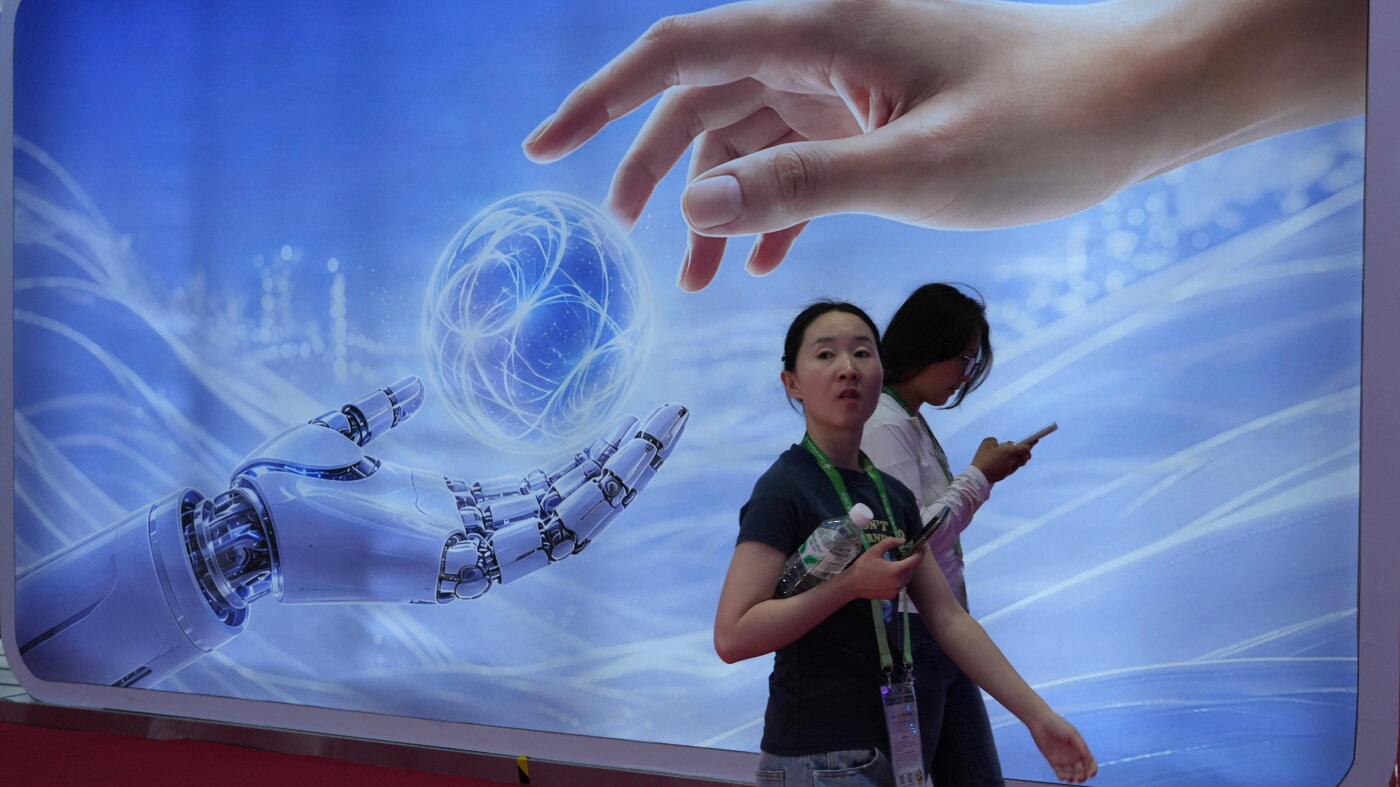
Photo via Semafor

Beijing issues AI warnings but rejects US calls to slow development

Read the original at Semafor ↗
Cite

Rao, P. (2026, September 14). Beijing issues AI warnings but rejects US calls to slow development. Semafor. https://www.semafor.com/article/09/14/2026/beijing-issues-ai-warnings-but-rejects-us-calls-to-slow-development

Dated when The Aporia collected the article, usually within hours of publication. Check the original for its exact date and byline.

Semafor · collected 2026-09-14 · by Prashant Rao

Quick Summary

China’s minister of state security warned about six principal risks posed by AI, including threats to political stability and national defense. Despite these concerns, Beijing rejected US calls to slow AI development, with a state-backed outlet calling for such measures “out of the Cold War playbook.” Some Chinese analysts advocate for international cooperation to maintain influence over global AI regulations and market access.
Written by AI on 2026-09-14, from this article's own text only (the story summary below draws on all the coverage).
See how they differ ↓

AI analysis

Story summary

Minister Chen Yixin, head of China’s State Security, warned that artificial intelligence (AI) poses significant national security threats to China, including risks to political and ideological stability. Published on September 13, 2026, Chen accused foreign entities of using generative AI technologies to spread harmful information against China. He also noted that AI is now the main battleground for global technological competition between major powers.

Chinese officials are dismissing calls from U.S. tech leaders like Dario Amodei (CEO of Anthropic) and Sam Altman (CEO of OpenAI) to slow down AI development due to safety concerns, describing these as "fearmongering" and part of a Cold War playbook aimed at containing China. Chinese leader Xi Jinping is scheduled to meet with U.S. President Donald Trump in Washington later that month, where AI governance and safety will be key topics for discussion.

The Global Times, a state-backed newspaper, criticized Amodei's call for slowing AI development as an attempt to hinder China’s progress. Meanwhile, the Ministry of Foreign Affairs urged international cooperation on AI rather than engaging in confrontation or malicious competition.

Written for “China AI Rivalry Usa” on 2026-11-20, grounded in this article and the 9 other(s) covering the same event.

How they differ

9 outlets covered “China AI Rivalry Usa”.

What each outlet says

One AI summary per outlet of its latest article on this story, written from that article alone and checked against it. Open the article for the outlet's own words.

SemaforThis outlet14 Sep

China’s minister of state security warned about six principal risks posed by AI, including threats to political stability and national defense. Despite these concerns, Beijing rejected US calls to slow AI development, with a state-backed outlet calling for such measures “out of the Cold War playbook.” Some Chinese analysts advocate for international cooperation to maintain influence over global AI regulations and…

Beijing issues AI warnings but rejects US calls to slow development (this article)

Al Jazeera14 Sep

Anthropic CEO Dario Amodei has called for slowing down the development of powerful AI systems due to potential risks and proposed restricting China's access to advanced technology. This move prompted a response from China, which accused the US of using AI safety concerns as a guise to maintain technological dominance over China. The dispute highlights the growing competition between the US and China in artificial…

‘Silent Cold War’: Why calls to slow AI have sparked new US–China frontier →2 articles from Al Jazeera on this story
BBC14 Sep

China’s foreign ministry spokesperson criticized narratives of threat and competition in artificial intelligence (AI) development, particularly responding to calls for slowing down AI advancement that could disadvantage China. This comes after warnings from US industry insiders about potential dangers posed by rapid AI progress and amid tensions between the United States and China over who will lead in this…

China criticises idea it is in 'malicious competition' over AI →
NPR14 Sep

China’s Ministry of Foreign Affairs criticized Anthropic CEO Dario Amodei's recent essay calling for U.S. restrictions on sales to China of advanced AI technology. On Monday, spokesperson Guo Jiakun said that Amodei's warnings about Chinese technological leadership were counterproductive and urged cooperation instead of confrontation. The article also notes similar concerns from Chinese officials regarding foreign…

Beijing hits back at Anthropic CEO's call to curb China's AI development →
ABC News (US)14 Sep

China's Ministry of Foreign Affairs responded critically to Anthropic CEO Dario Amodei’s call for the U.S. to curb China’s artificial intelligence (AI) development, arguing that fearmongering and competition are harmful to global AI governance. The ministry stressed cooperation over confrontation, while dismissing Amodei’s essay as a veiled attempt to contain China. President Donald Trump, meanwhile, downplayed…

Beijing hits back at Anthropic CEO’s call to curb China's AI development →
NBC News14 Sep

China has dismissed warnings from U.S. tech leaders to slow down artificial intelligence development, calling their concerns "fearmongering" and part of a Cold War strategy aimed at hindering China’s technological advancement. On Monday, Chinese Foreign Ministry spokesperson Guo Jiakun told reporters that such interventions disrupt global AI governance efforts and serve no one's interests. Meanwhile, U.S. President…

China dismisses AI slowdown calls and blasts ‘fearmongering’ from U.S. tech leaders →
Show 3 more outlets
The Hindu14 Sep

China’s Minister of State Security, Chen Yixin, warned on September 13, 2026, that artificial intelligence poses significant national security risks to the country. He cited concerns over foreign entities using AI to spread misinformation and conduct cyber espionage against China. Chen also highlighted the potential military applications of AI demonstrated in the U.S.-Iran conflict, emphasizing the need for China to…

China’s spy chief warns of national security risks from AI →
Daily Mail15 Sep

China's spy chief, Minister of State Security Chen Yixin, has warned that artificial intelligence poses significant risks to national security and could threaten the rule of the Communist Party. In an article published in the state-run magazine China Cyberspace, Chen cited concerns over foreign intelligence agencies using advanced AI technologies like web crawlers and data mining to collect sensitive information. He…

China's spy chief warns AI could bring an end to Communist party rule →
ABC News (AU)16 Sep

US tech leaders warn that China's lead in artificial intelligence could pose significant dangers to the United States and the world, advocating for restrictions on technology sales to Beijing. In response, Chinese officials through state media accuse these US executives of "fearmongering" and criticize the calls for a slowdown as counterproductive to global AI governance. However, behind this rhetoric, China’s own…

Behind China's 'fearmongering' claim is a fundamental fear about AI →

Where they agree and split

Framing

How the first headlines put it

Stated as fact7
The headlines (7)

China criticises idea it is in 'malicious competition' over AI BBC · stated as fact

Beijing hits back at Anthropic CEO's call to curb China's AI development NPR · stated as fact

Beijing hits back at Anthropic CEO’s call to curb China's AI development ABC News · stated as fact

Beijing issues AI warnings but rejects US calls to slow development Semafor · stated as fact

China dismisses AI slowdown calls and blasts ‘fearmongering’ from U.S. tech leaders NBC News · stated as fact

China rejects AI ‘threat narratives’, urges global cooperation Al Jazeera · stated as fact

China’s spy chief warns of national security risks from AI The Hindu · stated as fact

Words to watch (1)

China dismisses AI slowdown calls and blasts ‘fearmongering’ from U.S. tech leaders NBC News

The full story: what happened, how it changed, and all 10 articles →

Compared with similar articles

This article reads leans right and hedges 0% of its claims. Each row says how that neighbour differs.
Al Jazeera
Leans left further left than this Hedges 1 of 2 claims Outlet record 60/100
NBC News
Leans right Hedges 6 of 37 claims Outlet record 78/100
NPR
Hedges 6 of 26 claims Outlet record 60/100
ABC News (US)
Hedges 3 of 23 claims Outlet record 67/100
BBC News
Hedges 2 of 29 claims Outlet record 65/100
South China Morning Post
Leans strongly left further left than this Hedges 2 of 7 claims Outlet record 62/100
“Article A discusses China's warning about Japan's AI satellite plans, while Article B focuses on China rejecting US calls to slow AI development and addresses internal concerns about AI risks.”
NBC News
Outlet record 78/100
“The articles discuss different aspects and perspectives on AI risks; one focuses on warnings from researchers about AI's threat to humanity in general, while the other reports on Beijing's response to US calls for slowing AI development.”
CBC News
Hedges 4 of 34 claims Outlet record 60/100
“The articles discuss different perspectives on AI from Chinese officials and US President Trump, but describe separate events occurring in distinct contexts.”
New York Post
Hedges 12 of 37 claims Outlet record 66/100
“The articles discuss different perspectives on AI warnings but describe distinct statements and reactions from China and US tech leaders.”
Washington Examiner
Leans left further left than this Hedges 10 of 37 claims Outlet record 67/100
“The articles cover different topics related to AI regulation but describe distinct events and perspectives from Chinese officials and US political figures.”

Story

China AI Rivalry Usa
Politics · 10 article(s) covering the same event. Compare every outlet's account →
How this article was measured signals, leaning charts, publisher record, byline, topics and claims

Signals How these are calculated →

Claims extracted
4
sentences that state something as happening or true
Uncertain
0%
0 of 4 hedged ("reportedly", "may", "according to")
Leaning
Leans right
of the writing, not the subject · beta estimate
Publisher signals
64/100
Semafor's corrections and hedging, across everything collected from it. Not a measure of accuracy.
Outlets on this story
10
Politics
Same framing elsewhere
1
articles that frame the event the way this one does
Analyzed 2026-09-14 · how these are computed

How this is being covered How these are calculated →

Article leaning vs. publisher reliability
Source leaning vs. consistency

Publisher

Semafor · 1913 article(s) · 7 correction(s) detected
Running correction rate · 7 correction(s)

Who wrote this

Prashant Rao
142 article(s) here · 0 carrying a prediction
The trio argued their 80 minute meeting would help undergird global stability, but few tangible steps were taken and the talks were hampered by the leaders’ domestic constraints and geopolitical disputes. On AI, US President Donald Trump voiced opposition to “globalist regulation,” whereas Chinese leader Xi Jinping had previously advocated strong rules; on nuclear nonproliferation, Beijing has opposed controls pushed by Washington; China and Russia have maintained ties with Iran throughout the US war on the Middle East nation; and Moscow has long struggled to get Beijing to agree a gas-purchase deal.
2026-11-19 · assertive framing · Trump, Xi and Putin hold landmark talks in Shenzhen
In particular, it has huge financial commitments to buy chips and build data centers, and must assuage customers who fear it will compete with them in sectors far beyond tech and AI.
2026-11-19 · assertive framing · Anthropic raises record sums in IPO
The forecast-beating figures from Japan came days after official Chinese data pointed to a deepening slowdown, with one notable exception: AI-related production “is not only leading manufacturing output, but is the only part of China’s vast manufacturing machine experiencing [investment] growth,” Trivium analysts noted.
2026-11-18 · assertive framing · AI hardware demand lifts Asian exports to record highs
Beijing wants to build up its nuclear arsenal, while a longrunning treaty between Washington and Moscow limiting their weapons stockpiles expired this year, The Wall Street Journal noted, setting up a “three-body problem” that could result in “an unprecedented era of instability around the world’s most dangerous weapons.”
Nvidia’s chair declared the chip giant would look elsewhere for a new CEO, though some members of its board favor a return of former leader Jensen Huang, throwing into doubt the future of a company at the center of the AI boom.
Former UK Prime Minister Rishi Sunak largely concurred with Paulson, adding that while regulatory efforts thus far — such as the EU’s AI Act — were “not the right approach … that doesn’t mean we do nothing.” “The worst thing would be if we had some type of catastrophic accident … then we will have, as we all know, an overreaction on the other side.”
Ousted Nvidia chief Jensen Huang said Tuesday that he would be ‘honored’ to return as CEO, in his first public remarks since resigning from the US chip giant after revelations of extramarital affairs.
Kress’ reported reluctance to support Huang’s strategy to backstop and invest in many of the companies driving the technology will also be of particular focus: Any sign Nvidia is pulling back will have huge ramifications for the sector, and the global economy.
2026-11-17 · assertive framing · Nvidia’s earnings overshadowed by succession dilemma
US President Donald Trump said he would proceed “a bit more civilly” as part of an American focus on economic pressure; a powerful Iranian politician, meanwhile, said a path remained for a deal between the two countries to end the war.
2026-11-16 · mixed framing · Oil up on renewed hostilities in the Middle East
A growing consensus in Washington towards tightening restrictions on China’s access to cutting-edge chip technology will have a negative, long-term impact on the AI sector and the US itself, a leading outlet warned.
2026-11-13 · assertive framing · Chip curbs may have long-term negative impacts on AI
Also by Prashant Rao
Nothing else under this byline is closely related to this article, so these are simply their most recent.
All 142 articles by Prashant Rao →

Topics

Anthropic Beijing China Cold War The Global Times

Subjects

Beijing GPE · 2× China GPE · 2× Anthropic ORG · 1× Chinese NORP · 1× The Global Times ORG · 1×

Narrative

China’s minister of state security wrote in a weekend essay that AI posed six principal risks from his perspective, including threatening the security of the country’s political regime, digital infrastructure, public order, and national defense.
framing: assertive · carried by 1 article(s) · first seen 2026-09-14
2026-09-14 · Semafor
Beijing issues AI warnings but rejects US calls to slow development · assertive framing

Claims (4 extracted, 0 hedged)

Beijing warned that AI advancements threatened China’s political, economic, and social stability even as it dismissed US calls to slow the technology’s development. asserted
it → warn → development
China’s minister of state security wrote in a weekend essay that AI posed six principal risks from his perspective, including threatening the security of the country’s political regime, digital infrastructure, public order, and national defense. asserted
AI → write → regime
The Global Times, a state-backed outlet, nevertheless characterized a recent essay by Anthropic’s CEO calling for slowing AI’s advance as out of the “Cold War playbook.” asserted
Times → back → playbook
Still, some Chinese analysts have argued that Beijing should push for a superpower compact on AI, opting to “advance through concessions” in order to retain some sway over global regulation and access to key international markets. asserted
Beijing → argue → markets
Give feedback · no sign-in needed

No sign-in needed for now. Your note is sent without a name, so it cannot be answered.

History Support