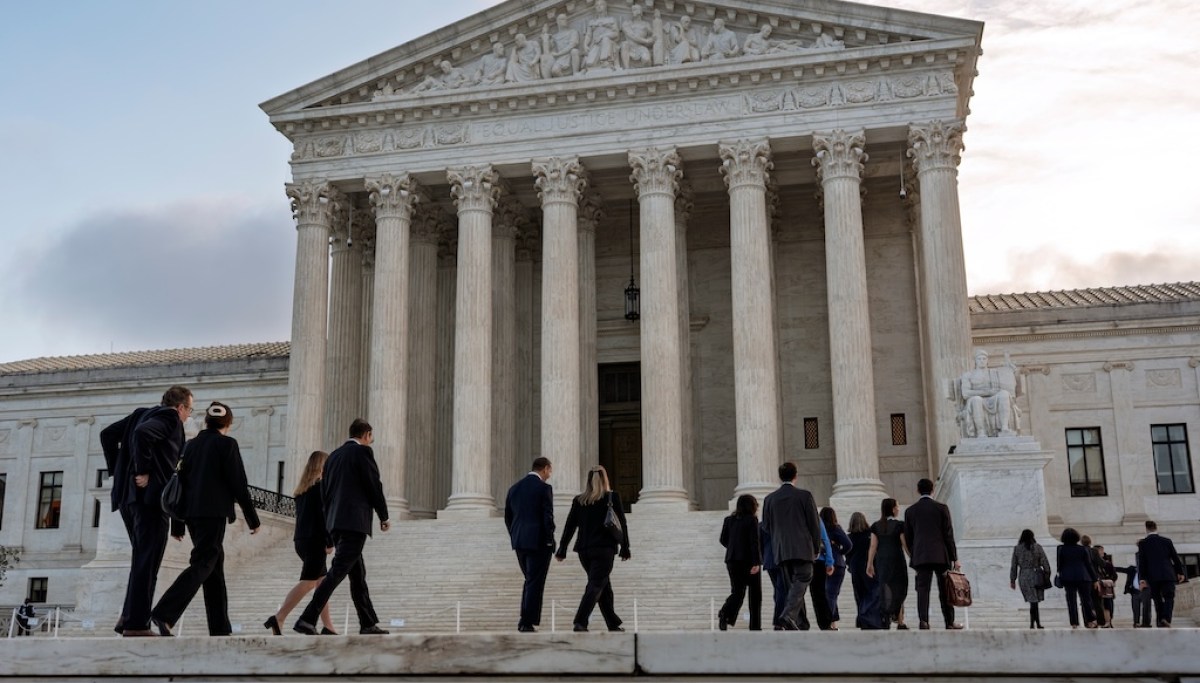
Photo via Washington Examiner

One ad, one price. Congress should say so

Read the original at Washington Examiner ↗
Cite

Rogers, J. (2026, October 18). One ad, one price. Congress should say so. Washington Examiner. https://www.washingtonexaminer.com/op-eds/4767361/fcc-political-ad-rates-congress-section-315/

Dated from the outlet's own feed. Check the original for its byline.

Washington Examiner · collected 2026-10-18 · by Jay Rogers

Quick Summary

The Supreme Court has removed a deadline that would have required the Federal Communications Commission to rule on a Democratic challenge to its political advertising policy before November’s midterm elections. This policy allows party committees to receive discounted rates similar to those enjoyed by candidates for television advertisements. The author argues that while rate parity between candidates and their parties is fair, it should be established through congressional action rather than agency regulation. Currently, during the 60 days leading up to a general election, candidates are charged no more than what stations charge their most favored commercial advertisers for advertising slots.
Written by AI on 2026-10-18, from this article's own text only (the story summary below draws on all the coverage).
See how they differ ↓

AI analysis

Story summary

The Supreme Court ruled 7-2 on October 14, 2026, to halt a lower court ruling by the U.S. Court of Appeals for the 4th Circuit, which would have forced the FCC to issue a final ruling on revised rules allowing political parties and joint fundraising committees access to more favorable television advertisement rates typically reserved for individual candidates. This decision benefits Republicans in the run-up to midterm elections as it allows them to purchase campaign ads at lower rates than previously restricted by federal law. The case was brought forward by Democratic congressional candidates aiming to maintain their funding advantage over individual candidates, while Republicans sought to leverage their significant cash advantages at the party level. Justices Sonia Sotomayor and Ketanji Brown Jackson were among the dissenting votes against the decision.

Written for “Supreme Court Rules On FCC Ad Rates” on 2026-11-21, grounded in this article and the 2 other(s) covering the same event.

How they differ

2 outlets covered “Supreme Court Rules On FCC Ad Rates”.

What each outlet says

One AI summary per outlet of its latest article on this story, written from that article alone and checked against it. Open the article for the outlet's own words.

Washington ExaminerThis outlet18 Oct

The Supreme Court has removed a deadline that would have required the Federal Communications Commission to rule on a Democratic challenge to its political advertising policy before November’s midterm elections. This policy allows party committees to receive discounted rates similar to those enjoyed by candidates for television advertisements. The author argues that while rate parity between candidates and their…

One ad, one price. Congress should say so (this article)2 articles from Washington Examiner on this story

Los Angeles Times14 Oct

The Supreme Court ruled in favor of Republicans, allowing political parties and their fundraising committees to receive lower rates for broadcast campaign ads during the midterm election period. Justices Sotomayor and Jackson dissented, while the decision was based on a FCC ruling made under Republican control that did not provide public explanation or debate. This outcome is seen as providing an advantage to…

Supreme Court sides with Republicans in dispute over cost of campaign ads →

Compared with similar articles

This article reads leans left and hedges 0% of its claims. Each row says how that neighbour differs.
Washington Examiner
Hedges 1 of 17 claims Outlet record 67/100
Reason
Hedges 5 of 40 claims Outlet record 67/100
“The articles discuss different topics: one about Supreme Court instructions to the FCC regarding political ad rates, and another about Republican advertising spending in Ohio.”

Story

Supreme Court Rules On FCC Ad Rates
Politics · 3 article(s) covering the same event. See how they differ ↑
How this article was measured signals, leaning charts, publisher record, byline, topics and claims

Signals How these are calculated →

Claims extracted
10
sentences that state something as happening or true
Uncertain
0%
0 of 10 hedged ("reportedly", "may", "according to")
Leaning
Leans left
of the writing, not the subject · beta estimate
Publisher signals
67/100
Washington Examiner's corrections and hedging, across everything collected from it. Not a measure of accuracy.
Outlets on this story
3
Politics
Same framing elsewhere
1
articles that frame the event the way this one does
Analyzed 2026-10-18 · how these are computed

How this is being covered How these are calculated →

Article leaning vs. publisher reliability
Source leaning vs. consistency

Publisher

Washington Examiner · 5254 article(s) · 11 correction(s) detected
Running correction rate · 11 correction(s)

Who wrote this

Jay Rogers
24 article(s) here · 1 carrying a prediction
Then-President Joe Biden told reporters in June 2024, “I will not pardon him.”
2026-11-16 · assertive framing · Pardon me, are you a lobbyist?
The checks are small, and U.S. citizens may give from abroad.
2026-11-14 · assertive framing · Pay no attention to the man in Shanghai
I wasn’t in that control room, and Diawara may have a perfectly good explanation.
Hollywood would call it a heist hoax film.
2026-10-30 · assertive framing · Fake robberies, real bills
This week, the justices lifted a court-ordered deadline that would have forced the agency to rule on a Democratic challenge to its political advertising policy before Nov. 3.
2026-10-18 · assertive framing · One ad, one price. Congress should say so
The 6-3 order is temporary, and the justices will hear arguments on Dec. 9.
If you entered illegally, a judge ordered you out, and your homeland won’t take you, America can send you somewhere that will.
Whatever you do, never submit to the extended, adversarial questioning that might reveal what millions of Americans were forced to confront after the June 2024 debate: that the 46th president’s cognitive capacity had been degrading in the most powerful office on Earth.
That timing placed the release squarely inside the window the DOJ’s own election-sensitivity guidance identifies as the highest-risk period for any government action that could appear to influence a vote.
Texas redistricting cost him his primary in May, so this was his last lap.
Also by Jay Rogers
Pardon me, are you a lobbyist?
2026-11-16 · Washington Examiner
Pay no attention to the man in Shanghai
2026-11-14 · Washington Examiner
Fake robberies, real bills
2026-10-30 · Washington Examiner
Nothing else under this byline is closely related to this article, so these are simply their most recent.
All 24 articles by Jay Rogers →

Topics

Congress Democratic FCC the Federal Communications Commission the Supreme Court

Subjects

Congress ORG · 1× Democratic NORP · 1× FCC ORG · 1× the Federal Communications Commission ORG · 1× the Supreme Court ORG · 1×

Narrative

On March 30, the FCC’s media bureau extended that treatment to ads coordinated between a party and a federal candidate, and to authorized committees, including joint fundraising committees.
framing: assertive · carried by 1 article(s) · first seen 2026-10-18
This week, the justices lifted a court-ordered deadline that would have forced the agency to rule on a Democratic challenge to its political advertising policy before Nov. 3.
2026-10-18 · Washington Examiner
One ad, one price. Congress should say so · assertive framing

Claims (10 extracted, 0 hedged)

Less than three weeks before the midterm elections, the Supreme Court told the Federal Communications Commission to take its time. asserted
Court → tell → time
This week, the justices lifted a court-ordered deadline that would have forced the agency to rule on a Democratic challenge to its political advertising policy before Nov. 3. asserted
that → lift → Nov.
That policy gives party committees the discounted rates candidates have long enjoyed. asserted
candidates → give → rates
I think rate parity between a candidate and his own party is sound policy. asserted
parity → think → candidate
I doubt an agency notice is the right vehicle for it, and Congress should step in. asserted
Congress → doubt → it
During the 60 days before a general election, a candidate can’t be charged more than the station’s most favored commercial advertiser. asserted
candidate → charge → advertiser
On March 30, the FCC’s media bureau extended that treatment to ads coordinated between a party and a federal candidate, and to authorized committees, including joint fundraising committees. asserted
bureau → extend → committees
Independent party spending still pays full freight. asserted
spending → pay → freight
Say a station sells its most favored advertiser a 30-second primetime spot for $1,000. asserted
station → say → 1,000
A candidate in that window pays no more than $1,000. asserted
candidate → pay → 1,000
Give feedback · no sign-in needed

No sign-in needed for now. Your note is sent without a name, so it cannot be answered.

History Support