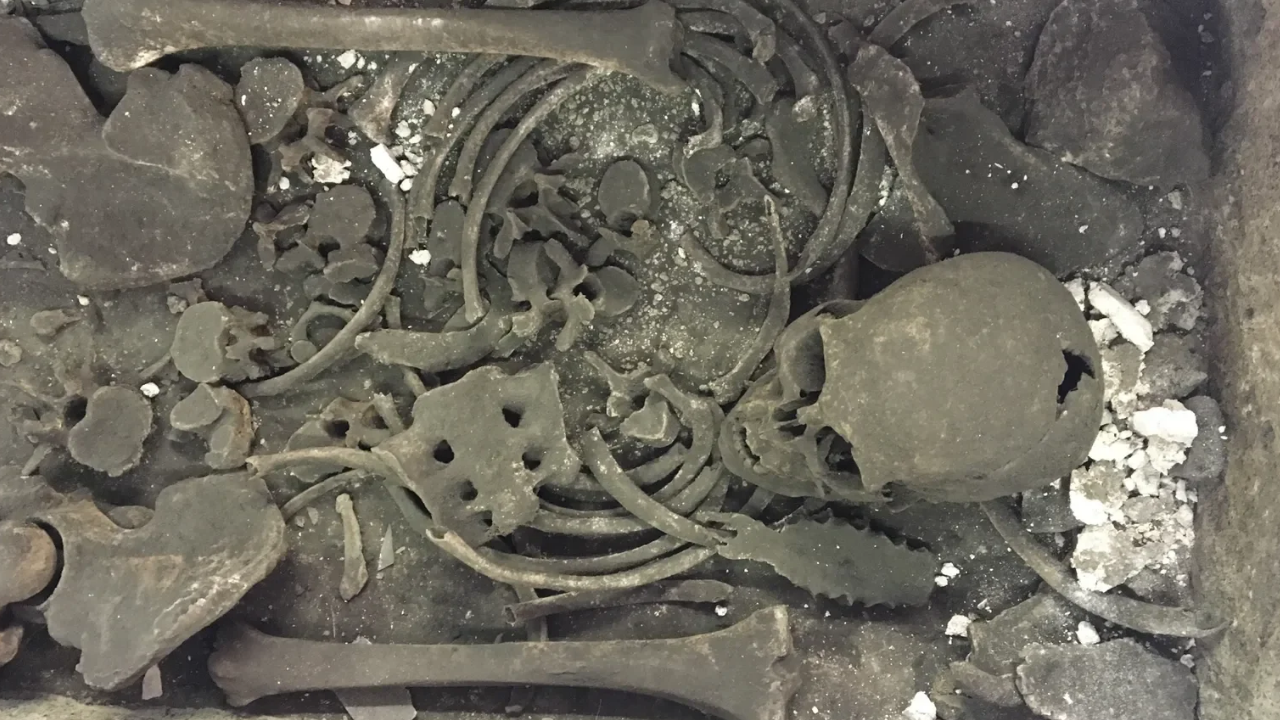
Photo via Times of India

New Study Of Westminster Sarcophagus: Roman coffin holds medieval abbot; identity still debated

Read the original at Times of India ↗
Cite

TOI Science Desk. (2026, October 23). New Study Of Westminster Sarcophagus: Roman coffin holds medieval abbot; identity still debated. Times of India. https://timesofindia.indiatimes.com/science/archaeology/in-1869-a-roman-sarcophagus-at-westminster-abbey-puzzled-archaeologists-with-a-medieval-cross-on-its-lid-157-years-later-dating-of-the-skeleton-points-to-an-11th-century-abbot-not-the-roman-named-on-the-tomb/articleshow/135106750.cms

Dated from the outlet's own feed. Check the original for its byline.

Times of India · collected 2026-10-23 · by TOI Science Desk

Quick Summary

Archaeologists at Westminster Abbey have re-examined a Roman sarcophagus that was officially excavated in 1869 but possibly discovered earlier during building work. Inside, they found a nearly complete skeleton of a man who lived between AD 987 and 1052, contradicting the coffin's original inscription for a fourth-century Roman named Valerius Amandinus. The new study by Warwick Rodwell identifies signs of osteoarthritis, gout, and healed rib fractures in the bones, along with evidence suggesting that a wooden coffin was placed inside the stone sarcophagus before it decayed. This finding supports the theory that the sarcophagus was reused for a medieval abbot, two possible candidates being identified but not conclusively determined.
Written by AI on 2026-10-23, from this article's own text only (the story summary below draws on all the coverage).

AI analysis

Story summary

Prof Warwick Rodwell, a consultant archaeologist at Westminster Abbey, has claimed to solve the mystery of a skeleton found inside a Roman sarcophagus discovered in 1820 and officially excavated in 1869. The limestone coffin, bearing an inscription for Valerius Amandinus, was initially thought to date back to around 300-400 AD, but carbon dating of a bone sample now suggests the remains belonged to a high-ranking medieval monk or possibly an abbot who lived around 1000 years ago. The sarcophagus, currently on public display in the Queen’s Diamond Jubilee Galleries at Westminster Abbey, was originally likely housed in the wall recess of a mausoleum and reused centuries later when it was buried in the sacristy courtyard near Henry III's yard. This discovery challenges earlier theories about the identity of the remains inside, with experts now leaning towards a medieval abbot rather than Valerius Amandinus, due to the presence of a Christian cross carved into the lid dating from the 10th or 11th centuries.

Written for “Westminster Abbey Sarcophagus Mystery” on 2026-11-04, grounded in this article and the 2 other(s) covering the same event.

Story

📰 Westminster Abbey Sarcophagus Mystery
Politics · 3 article(s) covering the same event. Compare every outlet's account →

Compared with similar articles

This article reads unscored and hedges 25% of its claims. Each row says how that neighbour differs.
Evening Standard
Hedges 5 of 22 claims Outlet record 64/100
The Guardian
Hedges 6 of 23 claims Outlet record 66/100
How this article was measured signals, leaning charts, publisher record, byline, topics and claims

Signals How these are calculated →

Claims extracted
32
sentences that state something as happening or true
Uncertain
25%
8 of 32 hedged ("reportedly", "may", "according to")
Leaning
not political
takes no side on a contested political question
Publisher signals
59/100
Times of India's corrections and hedging, across everything collected from it. Not a measure of accuracy.
Outlets on this story
3
Politics
Same framing elsewhere
1
articles that frame the event the way this one does
Analyzed 2026-10-23 · how these are computed

How this is being covered How these are calculated →

Article leaning vs. publisher reliability
Source leaning vs. consistency

Publisher

Times of India · 4073 article(s) · 4 correction(s) detected
Running correction rate · 4 correction(s)

Who wrote this

TOI Science Desk
308 article(s) here · 1 carrying a prediction
🔮 Researchers are continuing to examine daily measurements to determine whether temperatures will climb further.
🔮 According to Reuters reporting by Will Dunham, a new study published in the journal Spixiana documents more than 90 Bangka slow lorises identified between 2015 and 2025.
🔮 “Normally, my job is quite monotonous, so I wanted to create something that would entertain people, turning my ‘serious’ job into something fun,” he said in a Guinness World Records news release.
🔮 The subsequent collision between the two galaxy clusters may then have compressed the cloud or re-energised its particles, causing it to shine more brightly in radio wavelengths once again.
🔮 The mathematicians at the University of California, Davis, argue that the answer may already lie within Einstein’s own equations and that an invisible form of energy may not be needed at all.
🔮 The work will be carried out by the West Tennessee River Basin Authority, which is preparing a plan to restore the river and the land around it.
🔮 Cornell University scientists have developed genetically engineered tomato plants that turn red-purple when nitrogen becomes scarce, giving farmers a visible warning that crops may need fertiliser.
🔮 By studying these crystals and other mineral grains, scientists could establish the meteorite's age and identify later changes caused by water.
🔮 Centuries later, bronze objects found in Scandinavia would preserve chemical signatures consistent with the metals produced at this Spanish site, offering evidence of connections that may have crossed much of Europe.
🔮 Deposited impurities and staining may also have contributed, while low temperatures and humidity could cause the fabric to crack.
Wire or desk byline, not an individual reporter.
Also by TOI Science Desk
Nothing else under this byline is closely related to this article, so these are simply their most recent.
All 308 articles by TOI Science Desk →

Topics

Briton Live Science London Roman The Guardian

Subjects

Roman NORP · 5× Wulfnoth PERSON · 3× Ælfwig PERSON · 3× Rodwell PERSON · 2× Westminster ORG · 2× Briton NORP · 1× Live Science ORG · 1× London GPE · 1× The Guardian ORG · 1× Valerius Amandinus PERSON · 1×

Narrative

Although the identity of the man remains uncertain, the new research provides a clearer picture of his likely place in history: a high-ranking religious figure buried in an ancient stone coffin that had already survived several centuries before it was reused.
framing: mixed · carried by 1 article(s) · first seen 2026-10-23
🔮 A centuries-old archaeological puzzle at Westminster Abbey in London may finally be nearing a resolution, with new research suggesting that a skeleton discovered inside a Roman stone coffin belonged to a medieval abbot rather than the Roman-era man named on its inscription.

Claims (32 extracted, 8 hedged)

A centuries-old archaeological puzzle at Westminster Abbey in London may finally be nearing a resolution, with new research suggesting that a skeleton discovered inside a Roman stone coffin belonged to a medieval abbot rather than the Roman-era man named on its inscription. uncertain
skeleton → near → inscription
According to an announcement by Westminster Abbey and reports by The Guardian and Live Science published on October 21, 2026, archaeologists have identified two possible candidates for the burial, with one emerging as the likelier match. uncertain
one → accord → match
The limestone sarcophagus was officially excavated in 1869, although it had reportedly been uncovered during building work decades earlier. uncertain
it → excavate → work
Its inscription commemorates Valerius Amandinus, a wealthy Briton who lived during the fourth century. asserted
who → commemorate → century
However, a large Christian cross carved into the lid belongs to a much later period, raising questions about when the coffin was reused and who was eventually buried inside it. asserted
who → carve → it
A Roman coffin with a medieval secret The contrast between the inscription and the cross provided an early clue that the sarcophagus had served more than one purpose. asserted
sarcophagus → provide → purpose
While its original construction dates to the Roman period, the cross was carved during the late Anglo-Saxon era, around the 10th or 11th century. asserted
cross → date → century
The coffin had also suffered damage and was reportedly looted before its contents could be properly investigated. uncertain
contents → suffer → damage
For years, researchers believed the skeleton might no longer survive. uncertain
skeleton → believe → years
That assumption changed in 2016, when the sarcophagus was opened at a conservation studio and an almost complete human skeleton was discovered inside. asserted
skeleton → change → studio
The remains were subsequently examined by specialists, including human bone expert James Young Langthorne of Pre-Construct Archaeology. asserted
remains → examine → Archaeology
Their findings, discussed in a new study by Westminster Abbey’s consulting archaeologist, Warwick Rodwell, have helped establish the burial’s likely date and the status of the individual. asserted
findings → discuss → individual
What the skeleton revealed Analysis indicated that the remains belonged to a man who was approximately 35 to 49 years old and around 5 feet 9 inches tall. asserted
feet → reveal → man
Examination of the bones also identified signs of osteoarthritis, gout and two healed rib fractures. asserted
Examination → identify → osteoarthritis
Radiocarbon dating placed the man’s remains between AD 987 and 1052, firmly establishing that he lived centuries after the Roman sarcophagus was made. asserted
sarcophagus → place → AD
The results support the conclusion that the coffin was repurposed during the late Anglo-Saxon period. asserted
coffin → support → period
Researchers also identified traces of a rectangular structure inside the stone coffin, marked by a white residue associated with lime. asserted
Researchers → identify → lime
Rodwell’s analysis suggests that the deceased was originally placed in a wooden coffin inside the much older stone sarcophagus. uncertain
deceased → suggest → sarcophagus
The wooden structure eventually decayed, leaving behind evidence of its former outline. asserted
structure → decay → outline
The reuse of an elaborate Roman burial container for a medieval religious figure may also help explain why the individual received such a substantial burial. uncertain
individual → help → burial
Two abbots emerge as possible identities asserted
abbots → emerge → identities
In his study, published in the Journal of the British Archaeological Association, Rodwell narrowed the possible identities to two former leaders of Westminster’s Benedictine monastery: Ælfwig and his successor, Wulfnoth. asserted
Rodwell → publish → monastery
Ælfwig served as abbot from 993 to around 1020, while Wulfnoth held the position from approximately 1020 until 1049. asserted
Wulfnoth → serve → 1049
Both lived within the period indicated by the radiocarbon results and are considered plausible candidates for the burial. asserted
Both → live → burial
Ælfwig is regarded as the stronger possibility because he was already a monk at Westminster before becoming abbot. asserted
he → regard → Westminster
However, the available archaeological evidence does not establish the deceased’s identity beyond doubt, and Wulfnoth remains a viable alternative. asserted
Wulfnoth → establish → doubt
The lack of surviving grave goods makes a definitive identification more difficult. asserted
identification → survive → goods
Any objects that might once have accompanied the burial may have disappeared during the earlier disturbance of the tomb. uncertain
that → accompany → tomb
A mystery preserved at Westminster Abbey The findings add another chapter to the history of a sarcophagus that has survived repeated discoveries, damage and conservation work. asserted
that → preserve → discoveries
Investigations into the abbey’s former sacristy area, including archaeological work undertaken by Pre-Construct Archaeology, have helped researchers reconstruct the circumstances surrounding its burial and eventual rediscovery. asserted
researchers → include → burial
Today, the sarcophagus is displayed in Westminster Abbey’s Queen’s Diamond Jubilee Galleries, where visitors can see the Roman inscription and the medieval cross that helped trigger the investigation. asserted
that → display → investigation
Although the identity of the man remains uncertain, the new research provides a clearer picture of his likely place in history: a high-ranking religious figure buried in an ancient stone coffin that had already survived several centuries before it was reused. asserted
it → remain → coffin

💬Give feedback
🕘History 🎫Support