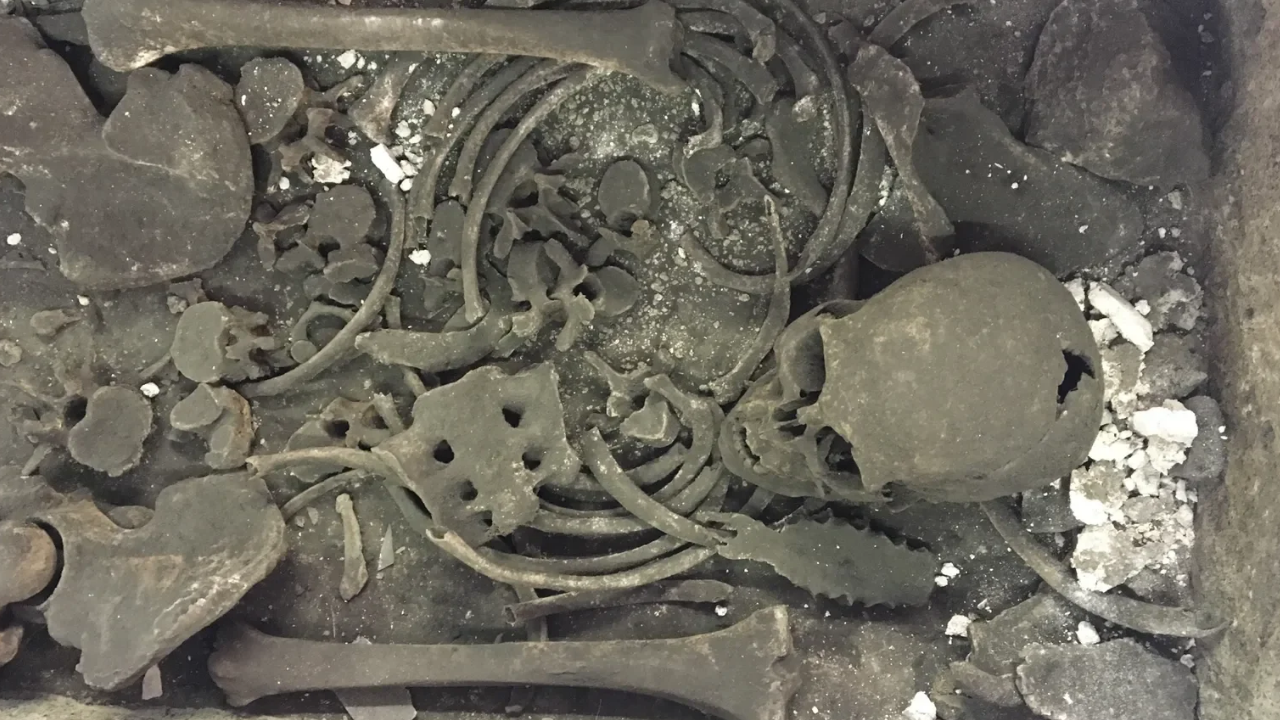
Photo via Evening Standard

Mystery of Westminster Abbey skeleton 'solved'

Read the original at Evening Standard ↗
Cite

Place, T. (2026, October 21). Mystery of Westminster Abbey skeleton 'solved'. Evening Standard. https://www.standard.co.uk/news/london/westminster-abbey-skeleton-roman-sarcophagus-abbot-archaeology-b1301771.html

Dated from the outlet's own feed. Check the original for its byline.

Evening Standard · collected 2026-10-21 · by Tom Place

Quick Summary

A mystery surrounding a skeleton found inside a Roman sarcophagus at Westminster Abbey may have been solved after carbon dating revealed it dates back to around 1000 AD. Initially believed to belong to Valerius Amandinus, a wealthy Briton from the late Roman period, experts now suggest the remains are those of a high-ranking medieval monk or abbot who lived between 987 and 1052 AD. Professor Warwick Rodwell proposes that the skeleton could be either Abbot Aelfwig (served 993-1020) or his successor Wulfnoth, given their approximate lifespans matching the carbon-dated period. The presence of a Latin cross atop the sarcophagus further supports the theory that it housed an important religious figure from the medieval era.
Written by AI on 2026-10-21, from this article's own text only (the story summary below draws on all the coverage).

AI analysis

Story summary

Prof Warwick Rodwell, a consultant archaeologist at Westminster Abbey, has claimed to solve the mystery of a skeleton found inside a Roman sarcophagus discovered in 1820 and officially excavated in 1869. The limestone coffin, bearing an inscription for Valerius Amandinus, was initially thought to date back to around 300-400 AD, but carbon dating of a bone sample now suggests the remains belonged to a high-ranking medieval monk or possibly an abbot who lived around 1000 years ago. The sarcophagus, currently on public display in the Queen’s Diamond Jubilee Galleries at Westminster Abbey, was originally likely housed in the wall recess of a mausoleum and reused centuries later when it was buried in the sacristy courtyard near Henry III's yard. This discovery challenges earlier theories about the identity of the remains inside, with experts now leaning towards a medieval abbot rather than Valerius Amandinus, due to the presence of a Christian cross carved into the lid dating from the 10th or 11th centuries.

Written for “Westminster Abbey Sarcophagus Mystery” on 2026-11-01, grounded in this article and the 2 other(s) covering the same event.

Story

📰 Westminster Abbey Sarcophagus Mystery
Politics · 3 article(s) covering the same event. Compare every outlet's account →

Compared with similar articles

This article reads unscored and hedges 23% of its claims. Each row says how that neighbour differs.
Times of India
Hedges 8 of 32 claims Outlet record 59/100
The Guardian
Hedges 6 of 23 claims Outlet record 66/100
How this article was measured signals, leaning charts, publisher record, byline, topics and claims

Signals How these are calculated →

Claims extracted
22
sentences that state something as happening or true
Uncertain
23%
5 of 22 hedged ("reportedly", "may", "according to")
Leaning
not political
takes no side on a contested political question
Publisher signals
65/100
Evening Standard's corrections and hedging, across everything collected from it. Not a measure of accuracy.
Outlets on this story
3
Politics
Same framing elsewhere
1
articles that frame the event the way this one does
Analyzed 2026-10-21 · how these are computed

How this is being covered How these are calculated →

Article leaning vs. publisher reliability
Source leaning vs. consistency

Publisher

Evening Standard · 8012 article(s) · 68 correction(s) detected
Running correction rate · 68 correction(s)

Who wrote this

Tom Place
149 article(s) here · 1 carrying a prediction
🔮 Manson, whose real name is Brian Hugh Warner, is set to face a jury trial after the proposed event amid ongoing allegations of sexual misconduct and abuse made by multiple women.
🔮 Footage released by the force on Thursday showed vehicles reversing into the shop’s display windows and robbers rushing inside to grab as much goods as they could carry before fleeing.
🔮 The Labour leader responded, saying both Labour and the Conservative councillors could gauge concern through “many emails” and in-person conversations with Jewish residents and leaders of Jewish organisations. Cllr Rawlings also claimed that support for The Green Party policy essentially amounted to telling Jewish people to “disown their communities to participate in British politics”. Before the final vote, Barnet’s sole Green councillor Charli Thompson said there was “highly inaccurate” information in Cllr Rawlings’ claims, adding: “I would argue that we need to be voting on motions with accurate information in them – not falsehoods”.
🔮 “I couldn’t just go, ‘guys it’s me, vote for me, but that’s all I can do really’.
🔮 The Labour leader responded, saying both Labour and the Conservative councillors could gauge concern through “many emails” and in-person conversations with Jewish residents and leaders of Jewish organisations. Cllr Rawlings also claimed that support for The Green Party policy essentially amounted to telling Jewish people to “disown their communities to participate in British politics”. Before the final vote, Barnet’s sole Green councillor Charli Thompson said there was “highly inaccurate” information in Cllr Rawlings’ claims, adding: “I would argue that we need to be voting on motions with accurate information in them – not falsehoods”.
🔮 This is a breaking news story and will be updated.
2026-10-29 · assertive framing · Legendary actor Sir Patrick Stewart dies aged 86
🔮 No friends would give evidence in his defence
🔮 Making the uplift in mileage rates permanent will make a real difference to public service workers.
🔮 The full impact of John Healey’s first Budget on London may only become clear in coming days.
2026-10-28 · mixed framing · Budget 2026: Biggest winners and losers in London
🔮 The first is that homes with a gross internal area of less than 130sqm will not be permitted to be converted into HMOs.
Also by Tom Place
Nothing else under this byline is closely related to this article, so these are simply their most recent.
All 149 articles by Tom Place →

Topics

Briton Latin London Londoners Roman

Subjects

Rodwell PERSON · 4× Roman NORP · 3× Aelfwig PERSON · 2× Briton NORP · 1× Latin NORP · 1× London GPE · 1× Londoners NORP · 1× PCA ORG · 1× Pre-Construct Archaeology ORG · 1× Valerius Amandinus PERSON · 1×

Narrative

Prof Rodwell said: "Although no physical traces of that feature remained, it can only have been a timber coffin, which has completely decayed over the course of the seven centuries that the sarcophagus was buried in the sacristy courtyard." The sarcophagus is now on public display in the Queen’s Diamond Jubilee Galleries at Westminster Abbey.
framing: mixed · carried by 1 article(s) · first seen 2026-10-21
🔮 A longstanding mystery over the identity of a skeleton discovered inside a Roman sarcophagus in Westminster Abbey may have been settled at last.
2026-10-21 · Evening Standard
Mystery of Westminster Abbey skeleton 'solved' · mixed framing

Claims (22 extracted, 5 hedged)

A longstanding mystery over the identity of a skeleton discovered inside a Roman sarcophagus in Westminster Abbey may have been settled at last. uncertain
mystery → discover → Abbey
For generations, historians have hotly debated the identity of the remains found inside the limestone tomb, which was first unearthed more than 200 years ago. asserted
which → debate → tomb
The sarcophagus bore an inscription for ‘Valerius Amandinus’, a wealthy Briton who lived in Roman London in around 300AD to 400AD, leading some to think this could be one of the earliest Londoners. However, the Roman theory was thrown into doubt by a Latin cross carved into the lid of the sarcophagus. uncertain
theory → bear → sarcophagus
Experts dated the cross to the 10th or 11th centuries - some 700 years after the tomb was constructed. asserted
tomb → date → centuries
Now, carbon dating of a bone sample seems to have finally cracked the case. asserted
dating → seem → case
Archaeologists now believe the remains belong to a high-ranking medieval monk, possibly an abbot, who lived around 1,000 years ago - in line with the dating of the cross. uncertain
who → believe → cross
An excavation of the sacristy was completed last year by Pre-Construct Archaeology (PCA), and analysis of the skeleton found it to have belonged to a man who was 5ft 9in tall and aged between 35 and 49. asserted
who → complete → 35
And it turns out we may even have a name for this ancient monk. uncertain
we → turn → monk
Professor Warwick Rodwell, a consultant archaeologist at Westminster Abbey, concludes that the most likely occupant is Aelfwig, an abbot who served from 993 to around 1020. asserted
who → conclude → 1020
The other potential occupant is his successor Wulfnoth, who died in about 1049. asserted
who → die → 1049
Prof Rodwell said: "We have two viable contenders for the occupant of the sarcophagus. asserted
We → say → sarcophagus
We do not know the date of birth of either. asserted
We → know → either
"But either would fit equally well if we assume the Abbot was in his early twenties when the appointment was made and close to 50 when he died. " asserted
he → fit → twenties
The fact Aelfwig was already a monk of Westminster might favour him." Prof Rodwell published his verdict in the Journal of the British Archaeological Association, and noted that the identity cannot be answered with certainty, as any identifying jewellery or artefacts that may once have adorned the tomb were probably stolen. Read More However, he goes on to say: “The fact that he was honoured with a fine sarcophagus, topped with a lid displaying a 1.8m high Latin cross, should imply that he was almost certainly an abbot.” uncertain
he → favour → cross
“Nobody of lower rank would have been buried in anything like that. asserted
Nobody → bury → that
The Latin cross again points to a major ecclesiastic.” asserted
cross → point → ecclesiastic
A bone sample sent to the Scottish Universities Environmental Research Centre for carbon dating found the date of death to have been between 987 and 1052 AD. asserted
date → send → death
Prof Rodwell added: "This confirms that the reuse of the sarcophagus, and the associated remodelling of its cover, occurred in the late Saxon period." The sarcophagus and skeleton itself have long been the subject of study and debate. asserted
sarcophagus → add → study
The sarcophagus was first uncovered by workmen in 1820, who researchers believe accidentally smashed the lid while looking for precious artefacts. asserted
researchers → uncover → artefacts
It was rediscovered in 1869, and the attempts were made to repair the broken lid and to glue back together fragments of the skull. asserted
attempts → rediscover → skull
When the inside of the sarcophagus was cleaned in 2016, experts identified a rectangular outline inside the sarcophagus, marked by a white lime residue, once used in traditional burials. asserted
experts → clean → burials
Prof Rodwell said: "Although no physical traces of that feature remained, it can only have been a timber coffin, which has completely decayed over the course of the seven centuries that the sarcophagus was buried in the sacristy courtyard." The sarcophagus is now on public display in the Queen’s Diamond Jubilee Galleries at Westminster Abbey. asserted
sarcophagus → say → Abbey

💬Give feedback
🕘History 🎫Support