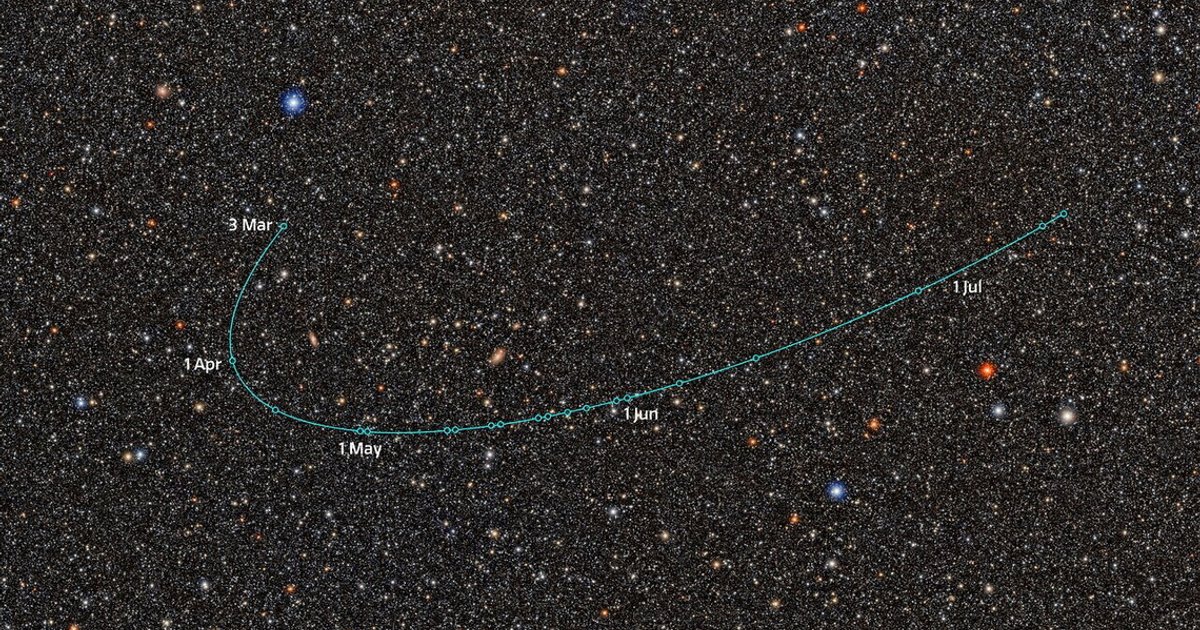
Photo via The Straits Times

Possible new dwarf planet identified orbiting beyond Pluto

Read the original at The Straits Times ↗
Cite

The Straits Times. (2026, October 28). Possible new dwarf planet identified orbiting beyond Pluto. The Straits Times. https://www.straitstimes.com/world/possible-new-dwarf-planet-identified-orbiting-beyond-pluto

Dated from the outlet's own feed. Check the original for its byline.

The Straits Times · collected 2026-10-28 · by The Straits Times

Quick Summary

Scientists using a Chile-based Vera C. Rubin Observatory have identified a new icy object orbiting beyond Pluto that could potentially become the seventh recognized dwarf planet in our solar system. Named 2026 ED138, this candidate has an estimated diameter between 370 and 930 miles and orbits at about 46 times Earth's distance from the sun. Further observations are needed to confirm its status as a dwarf planet based on its mass and shape.
Written by AI on 2026-10-29, from this article's own text only (the story summary below draws on all the coverage).

AI analysis

Story summary

Scientists using a Chile-based telescope have identified an icy object orbiting beyond Pluto that may be classified as a new dwarf planet. The candidate, named 2026 ED138, was first spotted by astrophysicist Matt Holman of the Center for Astrophysics, Harvard & Smithsonian on October 13, 2026. Estimated to have a diameter between roughly 600 and 1,500 kilometers and orbiting about 46 times farther from the sun than Earth, 2026 ED138 could potentially join five other recognized dwarf planets if confirmed.

The object was detected using the Vera C. Rubin Observatory in Chile, a joint initiative of the US National Science Foundation and Department of Energy. This discovery highlights the ongoing exploration and potential for new findings in our solar system's outer regions. Further observations are necessary to officially classify 2026 ED138 as a dwarf planet by the International Astronomical Union.

Written for “New Dwarf Planet Discovery” on 2026-11-05, grounded in this article and the 2 other(s) covering the same event.

Story

📰 New Dwarf Planet Discovery
Science · 3 article(s) covering the same event. See how they differ ↓

Compared with similar articles

This article reads unscored and hedges 6% of its claims. Each row says how that neighbour differs.
CBC News
Hedges 1 of 21 claims Outlet record 60/100
New York Post
Hedges 3 of 26 claims Outlet record 66/100
How this article was measured signals, leaning charts, publisher record, byline, topics and claims

Signals How these are calculated →

Claims extracted
17
sentences that state something as happening or true
Uncertain
6%
1 of 17 hedged ("reportedly", "may", "according to")
Leaning
not political
takes no side on a contested political question
Publisher signals
66/100
The Straits Times's corrections and hedging, across everything collected from it. Not a measure of accuracy.
Outlets on this story
3
Science
Same framing elsewhere
1
articles that frame the event the way this one does
Analyzed 2026-10-29 · how these are computed

How this is being covered How these are calculated →

Article leaning vs. publisher reliability
Source leaning vs. consistency

Publisher

The Straits Times · 4470 article(s) · 5 correction(s) detected
Running correction rate · 5 correction(s)

Who wrote this

The Straits Times
2957 article(s) here · 1 carrying a prediction
🔮 With the US midterms over, Democrats are turning to what could become one of their most crowded and unpredictable presidential primaries in decades, a 2028 contest likely to expose the party's divide over how to win back the White House.
🔮 And while Eisenkot, like Netanyahu, has so far ruled out forming a government with Israel's two Arab-led parties, one of them endorsed Eisenkot on Thursday and the other was expected to do so later in the day. '
🔮 Her message to Latino Texans would be the same as to non-Latinos — she would just say it in Spanish, she told Reuters in January.
🔮 Will Trump take a tougher stance on China after his election setback?
2026-11-05 · mixed framing · Midterms results: What’s next for East Asia?
🔮 The AI lab on Nov 5 laid out policies – in the works since August – intended to help the company build more trust with local communities and convince them that data centres will benefit them.
🔮 Ukraine’s President Volodymyr Zelensky has said he hoped the Democrat triumph in the US midterm elections would boost support for Kyiv and help end the war with Russia.
🔮 An ultra-Orthodox Jewish party long aligned with Benjamin Netanyahu declined on Nov 5 to recommend him to stay as Israel’s prime minister, as signs grew that rival Gadi Eisenkot will have the first chance to form a government.
🔮 Russia's Dmitriev in Washington for first US contact since Trump's midterm setback MOSCOW, Nov 5 - Russian President Vladimir Putin’s special envoy Kirill Dmitriev will attend a White House event hosted by US first lady Melania Trump on Thursday, and also meet with US administration officials, two people familiar with his plans said.
🔮 Failure of the proposed billionaire tax measure would represent a blow to the left wing of the Democratic Party, even as Democrats swept Republicans nationally on election day in a rebuke of President Donald Trump and his policies.
🔮 • A cargo vessel at sea 52 km southwest of the Black Sea port of Odesa was attacked • Reuters could not independently verify the battlefield reports REUTERS
Also by The Straits Times
Nothing else under this byline is closely related to this article, so these are simply their most recent.
All 2957 articles by The Straits Times →

Topics

Chile Department of Energy National Science Foundation WASHINGTON the International Astronomical Union

Subjects

Chile GPE · 3× Holman PERSON · 2× WASHINGTON GPE · 2× the International Astronomical Union ORG · 2× Department of Energy ORG · 1× Harvard ORG · 1× Matt Holman PERSON · 1× National Science Foundation ORG · 1× Smithsonian ORG · 1× the Center for Astrophysics, ORG · 1×

Narrative

Based on the current data, 2026 ED138 would be among the largest of the dwarf planets. "For me, what this demonstrates is that many exciting discoveries remain to be made with the Rubin Observatory and other telescopes," said astrophysicist Matt Holman of the Center for Astrophysics, Harvard & Smithsonian, who first spotted 2026 ED138.
framing: assertive · carried by 1 article(s) · first seen 2026-10-29
🔮 Possible new dwarf planet identified orbiting beyond Pluto WASHINGTON, Oct 28 - Scientists using a Chile-based telescope have identified an icy object orbiting beyond Pluto that may join our solar system's small roster of dwarf planets.
2026-10-29 · The Straits Times
Possible new dwarf planet identified orbiting beyond Pluto · assertive framing

Claims (17 extracted, 1 hedged)

Possible new dwarf planet identified orbiting beyond Pluto WASHINGTON, Oct 28 - Scientists using a Chile-based telescope have identified an icy object orbiting beyond Pluto that may join our solar system's small roster of dwarf planets. uncertain
that → identify → planets
Researchers said the candidate, named 2026 ED138, has a diameter estimated at between roughly 370 and 930 miles (600 and 1,500 km) and is orbiting about 46 times farther from the sun than Earth. asserted
candidate → say → Earth
By way of comparison, Pluto orbits at an average of about 40 times farther from the sun than Earth. asserted
Pluto → orbit → Earth
The object was spotted using the new Vera C. Rubin Observatory, on the summit of the Cerro Pachón mountain in central Chile. asserted
object → spot → Chile
Further observations are needed to confirm that the object is a dwarf planet. asserted
object → need → ?
If confirmed, 2026 ED138 would join five other dwarf planets recognized by the International Astronomical Union, the global authority on classifying celestial bodies. asserted
ED138 → confirm → bodies
Those are Pluto, Eris, Haumea and Makemake, all of which orbit beyond the outermost planet Neptune, and Ceres, located in the main asteroid belt between Mars and Jupiter. asserted
all → locate → Mars
Based on the current data, 2026 ED138 would be among the largest of the dwarf planets. "For me, what this demonstrates is that many exciting discoveries remain to be made with the Rubin Observatory and other telescopes," said astrophysicist Matt Holman of the Center for Astrophysics, Harvard & Smithsonian, who first spotted 2026 ED138. asserted
who → base → ED138
Pluto long was considered the solar system's ninth and outermost planet, but was reclassified by the International Astronomical Union as a dwarf planet in 2006 because it did not meet the organization's formal definition of a planet. asserted
it → consider → planet
Pluto and the new dwarf planet candidate reside in a frigid region of the solar system populated by various icy bodies. asserted
Pluto → reside → bodies
To be considered a dwarf planet, an object must possess sufficient mass for its own gravity to pull it into a round shape. asserted
gravity → consider → shape
2026 ED138 appears to have sufficient mass for that, but more observations are needed. asserted
observations → appear → that
"The main thing we need to do is to establish the physical size of 2026 ED138," Holman said. "When we observe with Rubin, we are seeing the sun's light reflected from the object," Holman said. asserted
Holman → need → object
"A smaller, more reflective object would show the same amount of light as a larger, less reflective object. asserted
object → show → object
Fortunately, by looking at longer wavelengths, with an observatory like ALMA, we can detect the light emitted by the object itself," which is helpful in measuring an object's size. asserted
which → look → size
ALMA, or the Atacama Large Millimeter/submillimeter Array, is a powerful telescope also based in Chile. asserted
ALMA → base → Chile
The discovery was announced at a scientific meeting in Spokane, Washington. asserted
discovery → announce → Spokane

💬Give feedback · no sign-in needed

No sign-in needed for now. Your note is sent without a name, so it cannot be answered.

🕘History 🎫Support