Photo via Reason

Israeli Jews Vote by Economic Status, Even Though Elections Turn on Other Issues

Read the original at Reason ↗
Cite

Bernstein, D. (2026, October 29). Israeli Jews Vote by Economic Status, Even Though Elections Turn on Other Issues. Reason. https://reason.com/volokh/2026/10/29/israeli-jews-vote-by-economic-status-even-though-elections-turn-on-other-issues/

Dated from the outlet's own feed. Check the original for its byline.

Reason · collected 2026-10-29 · by David Bernstein

Quick Summary

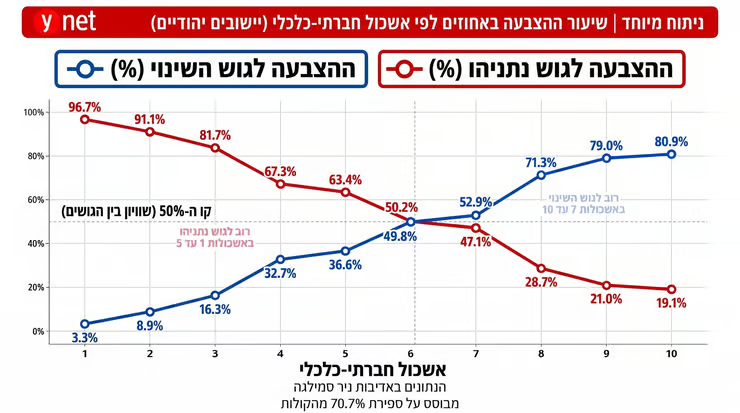
Yedioth Aharanot reports on the voting patterns of Israeli Jews in their recent election, showing that 96.7% of those polled as being in the bottom 10% economically supported Netanyahu's Likud and allied parties, while 80.9% of those in the top 10% voted for opposition groups. Despite the election focusing on non-economic issues like conscription of Haredi Jews and military conflicts, economic status heavily influenced voting behavior, reflecting cultural divides rather than direct policy concerns.
Written by AI on 2026-10-29, from this article's own text only (the story summary below draws on all the coverage).

AI analysis

Story summary

On October 27, 2026, Israelis voted in parliamentary elections after three years marked by war and conflict. The main contest was between incumbent Prime Minister Benjamin Netanyahu's right-wing coalition, which won 53 seats, and the opposition bloc led by Gadi Eisenkot’s Yashar party, projected to win 20 of 120 seats. Arab-majority lists could play a decisive role as kingmakers due to their potential support for either side under certain conditions. Despite Netanyahu's victory in terms of seat count, forming a government remains challenging because neither bloc has achieved the required majority. President Isaac Herzog will consult with party leaders on November 8 to decide who should form the next government.


Written for “Israel Election Deadlock Netenyahu Future Uncertain” on 2026-11-04, grounded in this article and the 233 other(s) covering the same event.

Story

📰 Israel Election Deadlock Netenyahu Future Uncertain
Politics · 234 article(s) covering the same event. Compare every outlet's account →

Compared with similar articles

This article reads leans left and hedges 0% of its claims. Each row says how that neighbour differs.
Al Jazeera
⚖️ Leans left Hedges 12 of 38 claims Outlet record 60/100
“The articles discuss different aspects of the Israeli election: Article A covers the overall political situation and coalition prospects, while Article B focuses on voting patterns by socio-economic status.”
Toronto Star
⚖️ Leans left Hedges 6 of 45 claims Outlet record 64/100
“The articles discuss different aspects of the Israeli election; Article A focuses on the campaign issues and context surrounding Netanyahu's leadership, while Article B provides a breakdown of how different socio-economic groups voted in the actual election.”
Al Jazeera
⚖️ Leans strongly left further left than this Hedges 6 of 46 claims Outlet record 60/100
“The articles discuss different aspects of the Israeli election and do not focus on the same specific incident or outcome.”
South China Morning Post
Hedges 1 of 5 claims Outlet record 62/100
“The articles describe different aspects of the election process: Article A covers the voting day and political context, while Article B discusses a voting breakdown by socio-economic status after the vote.”
Euronews
⚖️ Leans right further right than this Hedges 3 of 19 claims Outlet record 60/100
“While both articles discuss the Israeli election of 2026, they describe different aspects and outcomes related to the voting patterns rather than the same specific incident.”
Daily Mail
⚖️ Leans right further right than this Hedges 3 of 43 claims Outlet record 69/100
“While both articles discuss the Israeli election held in late October 2026, Article A focuses on Netanyahu's leadership and the overall political landscape, while Article B specifically addresses voting patterns based on socio-economic status.”
Fox News
Hedges 8 of 29 claims Outlet record 68/100
Zeteo
⚖️ Leans strongly left further left than this Hedges 1 of 41 claims
“The articles discuss different aspects of Israel's election and do not describe the same specific incident.”
BBC News
⚖️ Leans left Hedges 6 of 42 claims Outlet record 66/100
Al Jazeera
⚖️ Leans left Hedges 0 of 1 claims Outlet record 60/100
“The articles discuss different aspects of the Israeli election but do not describe the same specific incident or outcome.”
How this article was measured signals, leaning charts, publisher record, byline, topics and claims

Signals How these are calculated →

Claims extracted
10
sentences that state something as happening or true
Uncertain
0%
0 of 10 hedged ("reportedly", "may", "according to")
Leaning
Leans left
of the writing, not the subject · beta estimate
Publisher signals
67/100
Reason's corrections and hedging, across everything collected from it. Not a measure of accuracy.
Outlets on this story
234
Politics
Same framing elsewhere
1
articles that frame the event the way this one does
Analyzed 2026-10-29 · how these are computed

How this is being covered How these are calculated →

Article leaning vs. publisher reliability
Source leaning vs. consistency

Publisher

Reason · 1111 article(s) · 4 correction(s) detected
Running correction rate · 4 correction(s)

Who wrote this

David Bernstein
6 article(s) here · 1 carrying a prediction
🔮 What makes this particularly interesting is that the election turned almost entirely on issues that are not economic in the ordinary sense, such as conscripting Haredi Jews, which factions would best resist outside pressure for a Palestinian state, who is best-positioned to finish the wars in Gaza, Lebanon, and Iran, and who is to blame for 10/7.
🔮 They couldn’t get them.
🔮 Secretary of State James Blaine expressed the hope that this would end the dispute and restore friendly relations between the two countries.
2026-10-12 · assertive framing · The Forgotten Origins of Columbus Day
🔮 Mostly law professors | Sometimes contrarian | Often libertarian | Always independent Perhaps the most wrongheaded analysis in the Report is this: Because the government may not "conscript private institutions to act as censors by dangling the threat of civil liability for a hostile environment," the First Amendment "'demands substantial deference to a college's decision not to take action against' students who engage in expressive activity on matters of public concern."
🔮 Protesters also targeted a Columbia class dealing with Israel, distributing flyers bearing such slogans as "The enemy will not see tomorrow" and "Burn Zionism to the Ground."
Also by David Bernstein
Nothing else under this byline is closely related to this article, so these are simply their most recent.
All 6 articles by David Bernstein →

Topics

Ashkenazi Israel Israeli Jewish Yedioth Aharanot

Subjects

Israeli NORP · 4× Netanyahu PERSON · 4× Ashkenazi NORP · 2× Israel GPE · 2× Gaza GPE · 1× Haredi Jews NORP · 1× Jewish NORP · 1× Likud ORG · 1× Palestinian NORP · 1× Yedioth Aharanot ORG · 1×

Narrative

Netanyahu and his allies represent voters who are more religiously traditional, less-educated, live on "the periphery," poorer, and, importantly, of recent North African or Middle Eastern descent--Israelis who were treated as outsiders by the Ashkenazi socialists who ran the country until Menahem Begin broke their stranglehold on election in 1977.
framing: assertive · carried by 1 article(s) · first seen 2026-10-29
🔮 What makes this particularly interesting is that the election turned almost entirely on issues that are not economic in the ordinary sense, such as conscripting Haredi Jews, which factions would best resist outside pressure for a Palestinian state, who is best-positioned to finish the wars in Gaza, Lebanon, and Iran, and who is to blame for 10/7.

Claims (10 extracted, 0 hedged)

A fascinating chart from Yedioth Aharanot newspaper show the voting breakdown in the Israeli election of the Jewish electorate. asserted
chart → show → electorate
People the pollsters deem to be in the bottom 10% in socio-economic status voted 96.7% for Netanyahu's Likud and parties aligned with it. asserted
pollsters → deem → it
Those in the top 10% voted 80.9% for opposition parties. asserted
Those → vote → parties
What makes this particularly interesting is that the election turned almost entirely on issues that are not economic in the ordinary sense, such as conscripting Haredi Jews, which factions would best resist outside pressure for a Palestinian state, who is best-positioned to finish the wars in Gaza, Lebanon, and Iran, and who is to blame for 10/7. asserted
who → make → 10/7
Many voters expressed concern to pollsters about the cost of living, but none of the major parties talked much about it. asserted
none → express → it
Netanyahu and his allies represent voters who are more religiously traditional, less-educated, live on "the periphery," poorer, and, importantly, of recent North African or Middle Eastern descent--Israelis who were treated as outsiders by the Ashkenazi socialists who ran the country until Menahem Begin broke their stranglehold on election in 1977. asserted
Begin → represent → 1977
Netanyahu's opponents rely on voters who are disproportionately Ashkenazi, better-educated, wealthier, live in Tel Aviv or Haifa, and more secular-minded. asserted
who → rely → Aviv
Another interesting aspect of this is that while the religious/secular divide comes up in politicking all the time, Israeli politics mostly avoid explicit ethnic or wealth-based appeals. asserted
politics → come → appeals
The de facto leader of the opposition, Gadi Eisenkot, is the son of Moroccan immigrants, who are a huge part of Netanyahu's base, but this barely played a role in the campaign, and he did not try to give it one. asserted
he → play → one
I will leave it to those more expert than I on Israeli politics to analyze this further, but it sure seems like a big factor in the election was a visceral fear among groups that feel historically marginalized in Israel that victory by the anti-Netanyahu faction would amount to a loss in status. asserted
victory → leave → status
💬Give feedback
🕘History 🎫Support