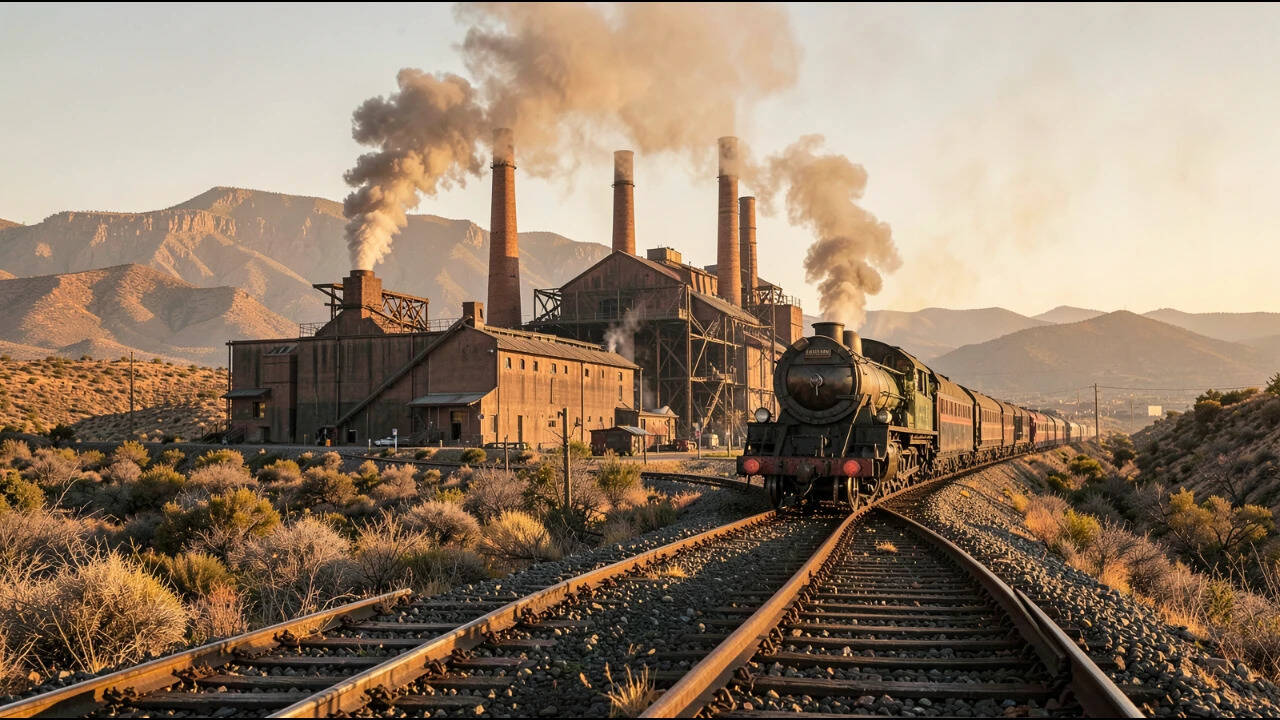
Kuridala, about 65–70 km south of Cloncurry in Queensland, grew into an important copper-mining settlement before and during World War I.
asserted
Kuridala → grow → I.
Its development was closely tied to the Hampden Smelter and a railway connection that helped transport ore from the surrounding mining district.
asserted
that → tie → district
But the town’s prosperity depended on the copper industry, leaving it exposed to changing prices, operational disruptions and financial pressures.
asserted
prosperity → depend → prices
Queensland Places records Kuridala’s population at about 1,500 in 1913 before reporting 774 by 1921.
asserted
Places → record → 1921
The Queensland Heritage Register gives different figures, recording a population of 2,000 by 1920 and 800 by 1924.
asserted
Register → give → 1924
How the Hampden Smelter and railway helped build Kuridala
Kuridala developed through several name changes.
asserted
helped → help → changes
The Queensland Heritage Register records that the settlement was surveyed as Hampden in 1910 and known as Friezland by 1912 before officially becoming Kuridala in October 1916.
asserted
settlement → record → October
Queensland Places gives an earlier sequence that begins with Gulatten, followed by Friezland and Kuridala.
asserted
that → give → Friezland
According to the Heritage Register, the final name was intended to avoid confusion with another Queensland settlement, although anti-German sentiment has also been suggested as a possible factor during the war.
uncertain
sentiment → accord → war
The railway reached Cloncurry in 1908, with an extension serving the Hampden area opening in 1910.
asserted
extension → reach → 1910
The Hampden Smelter began operating in March 1911 and continued until 1920, allowing copper ore from nearby mines to be processed locally. The smelter helped support a substantial settlement, with businesses and public services developing around the mining industry.
asserted
businesses → operate → industry
By 1913, Kuridala had about 1,500 residents, according to Queensland Places.
uncertain
Kuridala → have → Places
The town had hotels, shops, an ice works, a printery, a hospital, churches and a school.
asserted
town → have → hotels
These facilities reflected the needs of a community whose employment and commercial activity were closely connected to mining and smelting.
asserted
employment → reflect → mining
World War I sustained the region’s prosperity rather than initiating Kuridala’s growth.
asserted
I → sustain → growth
The Queensland Heritage Register describes the conflict as bringing four years of prosperity to the Cloncurry district and notes that the period was particularly prosperous for the company operating the smelter.
asserted
period → describe → smelter
Queensland Places identifies 1918 as a high point for the settlement.
asserted
Places → identify → settlement
It records a daily school attendance of 280 children, while the Heritage Register describes the school as having up to 280 pupils.
asserted
Register → record → pupils
Why Kuridala declined after World War I
Kuridala’s fortunes changed as the conditions supporting copper production weakened.
asserted
conditions → decline → production
British wartime price controls ended in 1918, and the Queensland Heritage Register says the change forced the company into difficulties.
asserted
change → end → difficulties
In December 1918, a cyclone damaged the smelter and its powerhouse.
asserted
cyclone → damage → smelter
Smelting was postponed until September 1919.
asserted
Smelting → postpone → September
The plant processed about 69,598 long tons of ore in 1920, equivalent to approximately 70,715 tonnes, according to the Heritage Register.
uncertain
plant → process → Register
The smelter’s closure was also connected to financial difficulties.
asserted
closure → connect → difficulties
The Heritage Register records that the Commonwealth Bank withdrew funds against copper awaiting export, after which the company halted all operations.
asserted
company → record → operations
Queensland Places also identifies the collapse in copper prices in 1920 as a factor in the town’s decline.
asserted
Places → identify → decline
Population figures from the period differ between the sources.
asserted
figures → differ → sources
Queensland Places reports 774 residents by 1921, while the Heritage Register records 2,000 by 1920 and 800 by 1924.
asserted
Register → report → 1924
As mining and smelting activity contracted, facilities that had supported the settlement were moved elsewhere.
asserted
that → contract → settlement
The hospital, picture theatre and courthouse were relocated to Mount Isa, while the ice works also followed.
asserted
works → relocate → Isa
The Queensland Heritage Register records that the company ceased to exist in 1928, after offering its assets for sale in 1926 and their subsequent purchase by Mount Elliott.
asserted
company → record → Elliott
The Queensland Heritage Register identifies the site as evidence of the copper industry that helped shape the Cloncurry district.
asserted
that → identify → district
Its surviving industrial remains also have research potential for understanding the technology, organisation and operation of early 20th-century copper smelting.
asserted
remains → survive → smelting
Kuridala’s history records the rise of a mining settlement supported by railway access and industrial investment, followed by the contraction of its principal industry.
asserted
history → record → industry
The surviving smelter remains, and historical records document the town’s place in Queensland’s copper-mining history.
asserted
records → survive → history
 The Aporia