Photo via Times of India

Hope Diamond Mailed To Museum: Harry Winston posts $1 million gem; plain parcel reshapes its legacy

Read the original at Times of India ↗
Cite

TOI World Desk. (2026, October 31). Hope Diamond Mailed To Museum: Harry Winston posts $1 million gem; plain parcel reshapes its legacy. Times of India. https://timesofindia.indiatimes.com/world/us/in-1958-jeweller-harry-winston-donated-the-45-52-carat-hope-diamond-to-the-smithsonian-museum-and-sent-it-through-the-us-mail-in-a-plain-brown-package-paying-postage-and-insurance-of-about-145/articleshow/135387342.cms

Dated from the outlet's own feed. Check the original for its byline.

Times of India · collected 2026-10-31 · by TOI World Desk

Quick Summary

In 1958, American jeweler Harry Winston sent the Hope Diamond, valued at $1 million, from New York to Washington, D.C., via regular U.S. postal service for a shipping cost of $145.29. The diamond’s journey, documented by the Smithsonian Institution Archives and National Postal Museum, highlights its rich history spanning centuries, including ownership by French royalty, and its transition into public fascination through stories of misfortune and alleged curses.
Written by AI on 2026-11-01, from this article's own text only (the story summary below draws on all the coverage).

AI analysis

Story summary

In 1958, Harry Winston, an American jeweller, decided to send the Hope Diamond from New York to Washington, DC, via registered mail through the US postal service rather than using a high-security operation. The shipment cost $145.29 and included insurance worth $1 million, reflecting the diamond's estimated value at that time. Weighing 45.52 carats, the Hope Diamond has a storied history dating back to its discovery in India before 1668 and later ownership by European royalty, including King Louis XIV of France. The unassuming brown-paper parcel carried one of the world's most famous gemstones, now part of the Smithsonian Institution collection.

Written for “Hope Diamond Mailed To Museum” on 2026-11-03, grounded in this article and the 0 other(s) covering the same event.

Story

📰 Hope Diamond Mailed To Museum
Entertainment · 1 article(s) covering the same event.

Compared with similar articles

Nothing to compare against. No article is close enough to this one for the pipeline to have linked or judged the pair.
How this article was measured signals, leaning charts, publisher record, byline, topics and claims

Signals How these are calculated →

Claims extracted
33
sentences that state something as happening or true
Uncertain
6%
2 of 33 hedged ("reportedly", "may", "according to")
Leaning
not political
takes no side on a contested political question
Publisher signals
59/100
Times of India's corrections and hedging, across everything collected from it. Not a measure of accuracy.
Outlets on this story
1
Entertainment
Same framing elsewhere
1
articles that frame the event the way this one does
Analyzed 2026-11-01 · how these are computed

How this is being covered How these are calculated →

Article leaning vs. publisher reliability
Source leaning vs. consistency

Publisher

Times of India · 3982 article(s) · 3 correction(s) detected
Running correction rate · 3 correction(s)

Who wrote this

TOI World Desk
1379 article(s) here · 1 carrying a prediction
🔮 Origins of the emergency relief campaign The project started in early 2020 when Dozier realised that federal emergency support money could take months to reach low-income workers who were at immediate risk of losing their homes.
🔮 Before that, visitors could participate in organised activities such as guided hikes, birdwatching, educational programmes and public hunts.
🔮 While their decision to buy an abandoned French hamlet might appear like an unexpected adventure, Yip and Paul's official website reveals that their story together began decades earlier.
🔮 Hundreds of polar bears are expected to gather near the Canadian town of Churchill in Manitoba as temperatures fall and the animals wait for Hudson Bay to freeze.
🔮 Together they would support the reforestation of Mutuba trees in Uganda for three years.
🔮 In the letter, he apologised for forgetting to send his greetings earlier and expressed hope that they would meet the following year again.
🔮 Meeker told Signal Akron that the sculpture contained details that people could continue discovering over time.
🔮 The possibility that the farm could eventually reach another generation now seems less remote.
🔮 According to his plea agreement, he repeatedly gave investors false information about how their money would be used.
🔮 The couple challenged the move in court, and a judge subsequently ordered that the fence could not be removed or relocated while the legal dispute continued.
Wire or desk byline, not an individual reporter.
Also by TOI World Desk
Nothing else under this byline is closely related to this article, so these are simply their most recent.
All 1379 articles by TOI World Desk →

Topics

American French New York Smithsonian the Smithsonian Institution

Subjects

French NORP · 3× Smithsonian ORG · 3× American NORP · 2× Harry Winston PERSON · 2× Washington GPE · 2× Indian NORP · 1× National Postal Museum ORG · 1× New York GPE · 1× Smithsonian Institution Archives ORG · 1× the Smithsonian Institution ORG · 1×

Narrative

Rather than arranging an elaborate security operation, American jeweller Harry Winston entrusted the 45.52-carat Hope Diamond to the US postal service, sending it from New York to Washington, DC, through registered mail.
framing: assertive · carried by 1 article(s) · first seen 2026-11-01
🔮 A priceless gemstone travelling across the country in an ordinary-looking parcel might sound like the plot of a film.

Claims (33 extracted, 2 hedged)

A priceless gemstone travelling across the country in an ordinary-looking parcel might sound like the plot of a film. uncertain
gemstone → travel → film
But that is precisely how one of the world's most famous diamonds reached the Smithsonian Institution in 1958. asserted
one → reach → 1958
Rather than arranging an elaborate security operation, American jeweller Harry Winston entrusted the 45.52-carat Hope Diamond to the US postal service, sending it from New York to Washington, DC, through registered mail. asserted
Winston → arrange → mail
According to records from the Smithsonian's National Postal Museum and Smithsonian Institution Archives, the shipment cost $145.29, including insurance covering the diamond's estimated $1 million value. uncertain
shipment → accord → value
The package contained a gemstone with a history spanning centuries, royal ownership, extraordinary wealth and persistent rumours of a curse. asserted
package → contain → curse
Its unassuming brown-paper exterior offered little indication of what was inside. asserted
what → offer → indication
From Indian mines to European royalty The diamond's documented history can be traced to India, where it was discovered before 1668. asserted
it → document → 1668
It entered the French royal collection after being purchased by King Louis XIV. asserted
It → enter → XIV
At the time, the stone weighed approximately 112 carats and was known as the French Blue. asserted
stone → weigh → Blue
During the French Revolution, the diamond disappeared along with other royal treasures. asserted
diamond → disappear → treasures
It resurfaced in London in the early 19th century, having been recut into a smaller stone. asserted
It → resurface → stone
By 1830, it belonged to British banker and gem collector Henry Philip Hope, whose family name eventually became associated with the diamond. asserted
name → belong → diamond
After passing through several owners, the stone was purchased by American socialite Evalyn Walsh McLean in 1912. asserted
stone → pass → 1912
Her ownership helped turn it into a subject of public fascination, with stories about misfortune and a supposed curse becoming closely associated with the jewel. asserted
stories → help → jewel
However, these accounts have never been established as fact. asserted
accounts → establish → fact
Jeweller Harry Winston acquired the diamond from McLean's estate in 1949, several years after her death. asserted
Winston → acquire → death
Nearly a decade later, he decided to donate it to the Smithsonian, hoping to help establish a national collection of precious gemstones. asserted
he → decide → gemstones
Why the diamond is so unusual Beyond its remarkable history, the Hope Diamond is considered exceptional for its size, colour and unusual physical properties. asserted
Diamond → consider → size
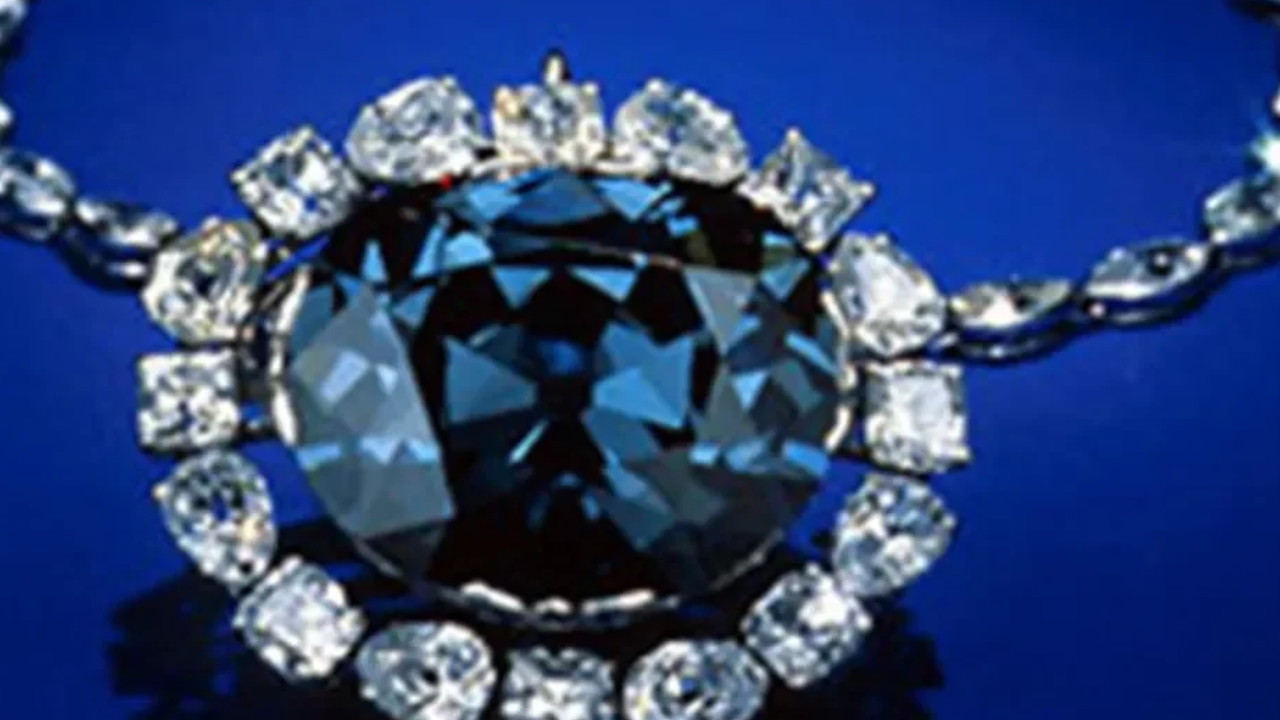
Weighing 45.52 carats, it is widely recognised as the largest known fancy deep-blue diamond. asserted
it → weigh → diamond
Its distinctive colour comes from trace amounts of boron within its crystal structure. asserted
colour → come → structure
The gemstone belongs to the rare Type IIb category of diamonds, which have semiconductor properties. asserted
which → belong → properties
It also displays an unusual optical effect. asserted
It → display → effect
When exposed to short-wave ultraviolet light, the diamond emits a vivid red glow that can remain visible for several seconds after the light source is removed. asserted
source → expose → seconds
This phenomenon, known as phosphorescence, adds to its scientific interest. asserted
phenomenon → know → interest
The stone is displayed in a setting designed by French jeweller Pierre Cartier. asserted
stone → display → Cartier
It is surrounded by 16 white diamonds, featuring alternating pear-shaped and cushion-cut stones, while its necklace chain incorporates another 45 diamonds. asserted
chain → surround → diamonds
A journey that became part of its legacy The Hope Diamond's arrival at the Smithsonian marked a new chapter in its long history. asserted
arrival → become → history
The institution placed it in its National Gem Collection, where it became one of the most recognisable attractions at the National Museum of Natural History in Washington, DC. asserted
it → place → Washington
Its journey also left behind an unusual historical artefact. asserted
journey → leave → artefact
The National Postal Museum preserves the original brown-paper mailing wrapper used to transport the diamond, offering a glimpse into how an object of extraordinary value was handled through an everyday postal service. asserted
object → preserve → service
Today, the Hope Diamond remains on display at the National Museum of Natural History. asserted
Diamond → remain → History
Once associated with royal courts and wealthy collectors, it now belongs to a public institution, where visitors can see both its remarkable craftsmanship and the centuries of history behind it. asserted
visitors → associate → it
The story of its delivery remains one of the most unusual episodes in the history of precious gemstones: a world-famous diamond, worth a fortune, travelling to its permanent home in a modest postal package. asserted
story → remain → package

💬Give feedback
🕘History 🎫Support