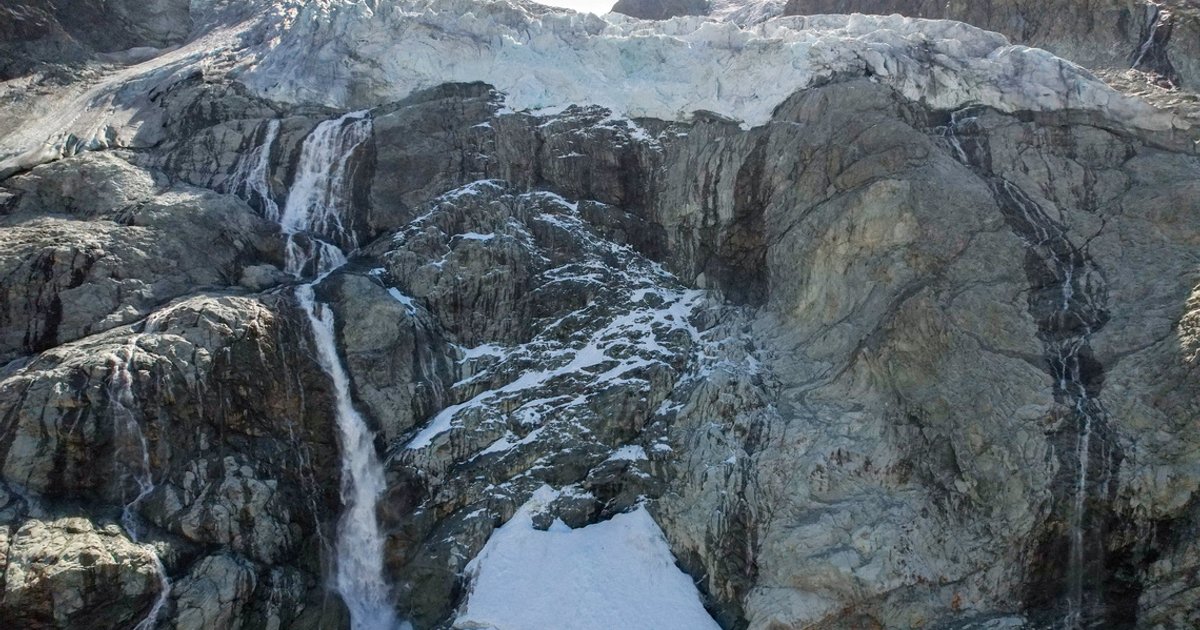
Photo via Dawn

UN reports warn of large-scale damage to Earth’s ice from climate change

Read the original at Dawn ↗
Cite

AFP. (2026, November 3). UN reports warn of large-scale damage to Earth’s ice from climate change. Dawn. https://www.dawn.com/news/2041761/un-reports-warn-of-large-scale-damage-to-earths-ice-from-climate-change

Dated from the outlet's own feed. Check the original for its byline.

Dawn · collected 2026-11-03 · by AFP

Quick Summary

Two UN reports issued on Monday warn that surpassing 1.5°C of global warming will cause irreversible damage to Earth’s ice, including glaciers and sea ice. The studies highlight current warming at 1.37°C above pre-industrial levels, with temperatures likely exceeding the 1.5°C threshold by around 2030 according to European Copernicus data. Scientists stress that even if temperatures later drop below this limit, recovery for affected regions like polar and mountain glaciers could take decades or centuries, emphasizing the need for immediate action to mitigate further ice loss.
Written by AI on 2026-11-03, from this article's own text only (the story summary below draws on all the coverage).

AI analysis

Story summary

On November 2, 2026, two UN reports issued in PARIS warned that exceeding 1.5°C of global warming will have irreversible consequences for glaciers, sea ice, and the Earth’s frozen regions. The landmark 2015 Paris Agreement aims to limit global warming to well below 2°C, with efforts to pursue a more ambitious target of 1.5°C to avoid climate change's worst impacts. However, current levels of warming are already unsafe for the Arctic, Antarctic, mountain glaciers, and polar oceans. Some effects of rising temperatures are already visible, such as a 20% loss in glacial mass in Switzerland. Even if returning to 1.5°C slows ice loss, a truly safe temperature is now thought to be closer to 1°C or even lower, emphasizing the urgent need for action.

Written for “UN Reports Warn Of Ice Damage” on 2026-11-04, grounded in this article and the 1 other(s) covering the same event.

Story

📰 UN Reports Warn Of Ice Damage
Environment · 2 article(s) covering the same event. See how they differ ↓

Compared with similar articles

This article reads leans left and hedges 22% of its claims. Each row says how that neighbour differs.
The Straits Times
Hedges 3 of 16 claims Outlet record 66/100
How this article was measured signals, leaning charts, publisher record, byline, topics and claims

Signals How these are calculated →

Claims extracted
18
sentences that state something as happening or true
Uncertain
22%
4 of 18 hedged ("reportedly", "may", "according to")
Leaning
Leans left
of the writing, not the subject · beta estimate
Publisher signals
72/100
Dawn's corrections and hedging, across everything collected from it. Not a measure of accuracy.
Outlets on this story
2
Environment
Same framing elsewhere
1
articles that frame the event the way this one does
Analyzed 2026-11-03 · how these are computed

How this is being covered How these are calculated →

Article leaning vs. publisher reliability
Source leaning vs. consistency

Publisher

Dawn · 2693 article(s) · 3 correction(s) detected
Running correction rate · 3 correction(s)

Who wrote this

AFP
946 article(s) here · 1 carrying a prediction
🔮 A South Korean appeals court on Wednesday (November 4, 2026) upheld former President Yoon Suk Yeol’s 18-month suspended sentence for spreading disinformation on the campaign trail, a ruling that could force the opposition to repay nearly $30 million.
🔮 Democrats seized control of the US Congress on Wednesday, capturing the Senate and House of Representatives in a stunning, nationwide rejection of Donald Trump set to put the brakes on the final two years of his presidency.
🔮 Israeli electoral authorities on Wednesday rejected allegations promoted by Prime Minister Benjamin Netanyahu of fraud by Arab parties, who could hold the key to removing him from power after a divisive vote.
🔮 ‘Swear me in’ Republicans ran a scorched-earth campaign to paint Democrats as communists and branded El-Sayed a terrorist who would endanger Americans.
🔮 Texas also went blue for the first time in decades, with Talarico scoring a massive upset to flip a Senate seat in the Lone Star State for the first time since 1988 — the year before Talarico was born.
🔮 Trump struck a conciliatory note despite his history of questioning election results, telling The New York Times: “I am absolutely willing to accept those results” and promising to “work with the Democrats”.
🔮 Emboldened by victories deep in traditional Republican territory, the party is promising swift action on living costs and the war in Iran, while signalling that investigations of alleged abuses and corruption will be a major priority. House Democratic leader Hakeem Jeffries, who is in line to become the first Black speaker when the new Congress takes office in January, vowed to go after what he described as “unprecedented corruption” in the government. “Because if you have people in high office who are so focused on enriching themselves, their family members, their friends, or their donors, then they’re not focused on making life better for the American people,” he said.
2026-11-04 · assertive framing · Democratic takeover of US Congress: What happens next
🔮 Democrat Abdul El-Sayed said early on Wednesday (November 4, 2026) that he had won a US Senate seat in Michigan over former Republican lawmaker Mike Rogers, which would make him the first Muslim elected to the upper chamber of Congress.
🔮 Democrat James Talarico, a former schoolteacher and Presbyterian seminarian who campaigned on a “politics of love,” on Tuesday won the US Senate race in Texas, dealing a historic blow to Republicans that could reshape American politics.
🔮 Israel's President Isaac Herzog is known for his unassuming and mild manner, but all eyes will be on him as he decides whom to task with forming the next coalition government.
Wire or desk byline, not an individual reporter.
Also by AFP
Nothing else under this byline is closely related to this article, so these are simply their most recent.
All 946 articles by AFP →

Topics

European Copernicus PARIS Paris Agreement Switzerland the University of New South Wales

Subjects

Australia GPE · 1× Dawn ORG · 1× European Copernicus ORG · 1× James Kirkham PERSON · 1× Kirkham PERSON · 1× Matthew England PERSON · 1× PARIS GPE · 1× Switzerland GPE · 1× the United States GPE · 1× the University of New South Wales ORG · 1×

Narrative

But even if the 1.5C target remains relevant, it is already too high for the cryosphere, as current levels of warming were “already unsafe” for the Arctic, Antarctic, mountain glaciers and polar oceans, the UN warned.
framing: mixed · carried by 1 article(s) · first seen 2026-11-03
🔮 PARIS: Exceeding 1.5C of global warming will have “irreversible” consequences for glaciers, sea ice and the Earth’s frozen regions, two UN reports warned on Monday, calling for urgent action.

Claims (18 extracted, 4 hedged)

PARIS: Exceeding 1.5C of global warming will have “irreversible” consequences for glaciers, sea ice and the Earth’s frozen regions, two UN reports warned on Monday, calling for urgent action. asserted
reports → exceed → action
The landmark 2015 Paris Agreement commits the world to limiting warming to well below 2C and pursuing efforts to hold it at 1.5C to try to avoid the worst effects of climate change. asserted
Agreement → commit → change
One of the reports said overshooting the 1.5C target “will bring large-scale and in many cases irreversible impacts” for the cryosphere — Earth’s ice in all its forms. asserted
overshooting → say → forms
Melting of glaciers and sea ice, the thawing of permafrost and the accelerating rise in sea levels, will have widespread repercussions, from flooding to water shortages. asserted
Melting → accelerate → shortages
But even if the 1.5C target remains relevant, it is already too high for the cryosphere, as current levels of warming were “already unsafe” for the Arctic, Antarctic, mountain glaciers and polar oceans, the UN warned. asserted
UN → remain → Arctic
“Although returning to 1.5 C will slow ice loss, a truly ‘safe’ temperature for Earth’s ice is now thought to be closer to 1C or even below over the coming centuries,” it added. asserted
it → return → centuries
Global warming has already reached 1.37C above pre-industrial levels and according to the European Copernicus network, the 1.5C threshold could be exceeded around 2030. uncertain
threshold → reach → 2030
“There are no good outcomes in exceeding 1.5C,” said glaciologist James Kirkham, lead author of one of the reports, entitled “Overshoot and the Cryosphere”, which was written with 80 scientists. asserted
which → be → scientists
“To contain the global fallout and damage from ice loss in the world’s polar and mountain regions, overshoot needs to be kept to the absolute minimum,” he said. asserted
he → contain → minimum
“Every extra fraction of a degree and every year spent in overshoot means more devastating impacts.” asserted
fraction → spend → impacts
Scientists warn in particular about the risks of crossing certain tipping points and say that, even if temperatures were to return to below the 1.5C threshold, recovery would be very slow. asserted
recovery → warn → threshold
Reducing warming to under 1.5C and even 1C could see some glaciers partially regenerate, while there could also be benefits for sea ice. uncertain
glaciers → reduce → ice
But Matthew England, an oceanographer and climatologist at the University of New South Wales in Australia, said recovery could take “decades to centuries”. uncertain
recovery → say → centuries
The second report — “State of the Cryosphere 2026. The Cost of Overshoot” — shows that exceeding 2.8C into the next century would have significant consequences. asserted
exceeding → show → consequences
Sea levels could rise by up to five centimetres a year by 2150, compared to the current 0.45 centimetres while the thawing of permafrost could release as much carbon dioxide each year as the United States, the world’s second-largest polluter. uncertain
thawing → rise → States
A worst-case but not-so-improbable scenario is that the world is heading towards warming of 2.6C by 2100 even if countries meet their climate commitments. asserted
countries → head → commitments
“Temporarily exceeding 1.5C does not mean that the goals of the Paris Agreement are irrelevant but instead makes them more urgent,” argued Kirkham. asserted
Kirkham → exceed → Agreement
“Returning to 1.5C or below by 2100 remains possible with sufficient political ambition and urgency, specifically by speeding the transition away from fossil fuel use to reach net zero by mid-century,” he said. asserted
he → return → century

💬Give feedback · no sign-in needed

No sign-in needed for now. Your note is sent without a name, so it cannot be answered.

🕘History 🎫Support