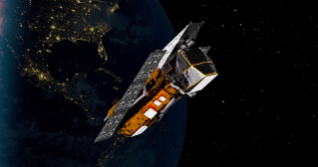
Photo via The Guardian

Nasa telescope launched in 2004 to plunge back to Earth after failed rescue mission

Read the original at The Guardian ↗
Cite

Helmore, E. (2026, November 3). Nasa telescope launched in 2004 to plunge back to Earth after failed rescue mission. The Guardian. https://www.theguardian.com/science/2026/nov/03/nasa-telescope-neil-gehrels-swift-observatory

Dated from the outlet's own feed. Check the original for its byline.

The Guardian · collected 2026-11-03 · by Edward Helmore

Quick Summary

No summary of this article yet; the story summary below covers the event.

AI analysis

Story summary

As of now, NASA's Neil Gehrels Swift Observatory, launched in 2004, is predicted to re-enter Earth’s atmosphere on or around November 4, 2026. The U.S. Space Force expects the spacecraft to come crashing down at approximately 3:30 a.m. EST (10:30 a.m. AEDT) on that day, give or take several hours due to uncertainties in predicting its exact re-entry time and location.

The Swift Observatory, which weighs about 1.5 tons and is the size of a minibus with solar-panel wings, has been used to study gamma-ray bursts and other cosmic phenomena for over two decades. NASA chief scientist Brad Cenko states that most of the telescope will burn up upon re-entry into Earth’s atmosphere; however, some denser parts made from tungsten (denser than lead) and mirror sections may survive.

The debris is likely to fall into the ocean, but if it reaches land, impacted areas could include swaths of Africa, Australia, India, Southeast Asia, and Central and South America. The failure of a rescue mission earlier this year led to its rapid descent due to increased solar activity dragging it down faster than expected.

Written for “NASA Swift Telescope Plunging Back To Earth” on 2026-11-04, grounded in this article and the 6 other(s) covering the same event.
Why this leaning score
This article does not take a side on a contested political question, so it has no leaning score. That is an answer rather than a gap: a match report or a rescue can be warmly or critically written without being left or right, and scoring it anyway is how approval of a subject gets recorded as a political position.
No political leaning scored for article 126571 · logged 2026-11-03

Story

📰 NASA Swift Telescope Plunging Back To Earth
Science · 7 article(s) covering the same event. Compare every outlet's account →

Compared with similar articles

This article reads unscored and hedges 10% of its claims. Each row says how that neighbour differs.
The Independent
Hedges 2 of 15 claims Outlet record 59/100
CBS News
Hedges 1 of 26 claims Outlet record 65/100
Global News
Hedges 1 of 21 claims Outlet record 63/100
ABC News (AU)
Hedges 7 of 39 claims Outlet record 67/100
Toronto Star
Hedges 1 of 21 claims Outlet record 64/100
CBC News
Hedges 1 of 21 claims Outlet record 60/100
How this article was measured signals, leaning charts, publisher record, byline, topics and claims

Signals How these are calculated →

Claims extracted
21
sentences that state something as happening or true
Uncertain
10%
2 of 21 hedged ("reportedly", "may", "according to")
Leaning
not political
takes no side on a contested political question
Publisher signals
66/100
The Guardian's corrections and hedging, across everything collected from it. Not a measure of accuracy.
Outlets on this story
7
Science
Same framing elsewhere
1
articles that frame the event the way this one does
Analyzed 2026-11-03 · how these are computed

How this is being covered How these are calculated →

Article leaning vs. publisher reliability
Source leaning vs. consistency

Publisher

The Guardian · 2929 article(s) · 6 correction(s) detected
Running correction rate · 6 correction(s)

Who wrote this

Edward Helmore
21 article(s) here · 1 carrying a prediction
🔮 The official said the plane wouldn’t have been able to pull up from its nose dive without the tail intact, and he was not sure it would have been effective even if it was complete because of the aircraft’s extreme rate of descent.
🔮 Nasa’s Neil Gehrels Swift Observatory, which has spent two decades studying the most powerful explosions in the cosmos, is expected to re-enter the Earth’s atmosphere on Wednesday, burning up in the process.
🔮 Cleveland Meredith, from North Carolina, was arrested on Monday over a Facebook post in April that allegedly read: “ALL J6 Federal JUDGES will be EXECUTED!”
🔮 The US supreme court will hear arguments on Tuesday over a challenge brought by two Catholic preschools in Colorado, arguing that they should be admitted to the state’s free education system despite their rejection of children with LGBTQ+ parents.
🔮 KTLA quoted the manager of Nobu Malibu as saying the “family of staffers” there were doing what they could to support Uchimiya’s family.
🔮 “But I’m glad I never did, and I’m glad I couldn’t.
🔮 “They were asking for everything up front with a promise that they would then talk,” Waltz said on State of the Union.
🔮 It’s what any political hopeful might do, but with a twist: Macy carries her reporter’s notebook and jots down the good stories she’s been told.
🔮 Patrick Clancy and his wife Rachel Danis are set to describe their experiences of the Massachusetts triple-murder trial of his former wife Lindsay Clancy, with Clancy telling 60 Minutes: “I live with it every day, but I think I did the best I could.”
🔮 said its journalists were denied access to the White House grounds on Saturday morning, a day after Donald Trump said he would ban the news channel and two other news outlets, CNN and Politico, from the executive branch complex.
Also by Edward Helmore
Nothing else under this byline is closely related to this article, so these are simply their most recent.
All 21 articles by Edward Helmore →

Topics

Midex Nasa Space Force Swift The US Space Force

Subjects

Nasa ORG · 8× Goddard Space Flight Center ORG · 1× Greenbelt GPE · 1× Maryland GPE · 1× Robert Stein PERSON · 1× Space Force ORG · 1× Stein PERSON · 1× The Astrophysical Journal Letters ORG · 1× The US Space Force ORG · 1× the University of Maryland, College Park ORG · 1×

Narrative

“We were looking for these star-shredding events as a way to find otherwise invisible supermassive black holes wandering away from the galactic cores where they usually reside,” Robert Stein, a research fellow at the University of Maryland, College Park and Nasa’s Goddard Space Flight Center in Greenbelt, Maryland, said at the time.
framing: assertive · carried by 1 article(s) · first seen 2026-11-03
🔮 Nasa’s Neil Gehrels Swift Observatory, which has spent two decades studying the most powerful explosions in the cosmos, is expected to re-enter the Earth’s atmosphere on Wednesday, burning up in the process.

Claims (21 extracted, 2 hedged)

Nasa’s Neil Gehrels Swift Observatory, which has spent two decades studying the most powerful explosions in the cosmos, is expected to re-enter the Earth’s atmosphere on Wednesday, burning up in the process. asserted
which → spend → process
The satellite, which was designed to operate with its three telescopes for just two years, is no longer able to steer or observe, and its re-entry is uncontrolled. asserted
entry → design → years
The US Space Force predicts the 3,200lb spacecraft will hit the atmosphere at about 3.30am EST on 4 November. asserted
spacecraft → predict → November
Nasa says most of the spacecraft is set to burn up, but some components are expected to survive. asserted
components → say → spacecraft
“Re-entry locations of any surviving components can vary from hemisphere to hemisphere and depend on when it re-enters,” the agency said in a blog post, adding that surviving fragments are limited between 20.6 degrees south latitude and 20.6 degrees north latitude. asserted
fragments → survive → latitude
The agency continued: “The risk of harm coming to anyone on Earth is unlikely – approximately 1 in 2,100. asserted
harm → continue → 2,100
NASA and Space Force will continue to monitor the re-entry and update predictions.” asserted
NASA → continue → predictions
The observatory was launched in 2004 to explore the universe’s most powerful explosions, called cosmic gamma-ray bursts, and quickly return its observations of location and strength to Earth. asserted
observatory → launch → Earth
Over the course of its operational life, the observatory detected and tracked more than 2,000 gamma-ray bursts ( GRBs) that are considered the most powerful explosions the universe has seen since the big bang. asserted
universe → detect → bang
Nasa says these bursts of energy occur approximately once per day and are brief, but intense, flashes of gamma radiation and come from all different directions, and can last from a few milliseconds to a few hundred seconds. But scientists do not know what causes them – theorizing that they may be the birth of a black hole in a massive stellar explosion or produced by the collision of two neutron stars, or some other phenomenon. Swift was launched as part of Nasa’s medium explorer, or Midex, program. uncertain
Swift → say → program
In July, it observed a wandering mega black hole shredding star, which occurs when a star passes fatally close to a supermassive black hole. asserted
star → observe → hole
“Crumbs of the splintering star heat up as they swirl around the black hole, creating a glow astronomers can see from far across the cosmos, and the black hole launches a relativistic jet into space,” explained the agency. asserted
agency → splinter → space
The black hole, described as an “orphan”, lit up as it devoured the star on the outskirts of a galaxy, in what scientists call a “tidal disruption event”. asserted
scientists → describe → what
Nearly every galaxy has a supermassive black hole at its center, and a tidal disruption occurs about once every 100,000 years. asserted
disruption → have → center
The star-shedding event occurred 2,600 light-years from the center of the host galaxy, but the Swift team observed one more than 30,000 light-years away. asserted
team → shed → one
“We were looking for these star-shredding events as a way to find otherwise invisible supermassive black holes wandering away from the galactic cores where they usually reside,” Robert Stein, a research fellow at the University of Maryland, College Park and Nasa’s Goddard Space Flight Center in Greenbelt, Maryland, said at the time. asserted
Stein → look → time
A paper describing the results published in The Astrophysical Journal Letters, said “the tidal disruption event outshone its entire host galaxy in ultraviolet wavelengths, temporarily radiating with the light of about 10 billion suns.” Still unknown is how the black hole came to drift so far. asserted
came → describe → suns
Stein said it could have started off in a small galaxy that merged with the big one, but the key question was how common are wandering black holes. uncertain
question → say → holes
Nasa attempted to push Swift into a higher orbit last year using a private space contractor but the mission did not succeed after they failed to rendezvous. asserted
they → attempt → contractor
Last month, Swift was estimated to be orbiting 171 miles above the Earth and it was commanded to end operations to prepare for re-entry. asserted
it → estimate → entry
Nasa said Swift has “broadened our understanding of a wide variety of cosmic objects and events, from active galaxies powered by supermassive black holes and stars undergoing X-ray flares, to supernova explosions and comets and asteroids in our own solar system”. asserted
Swift → say → system

💬Give feedback
🕘History 🎫Support