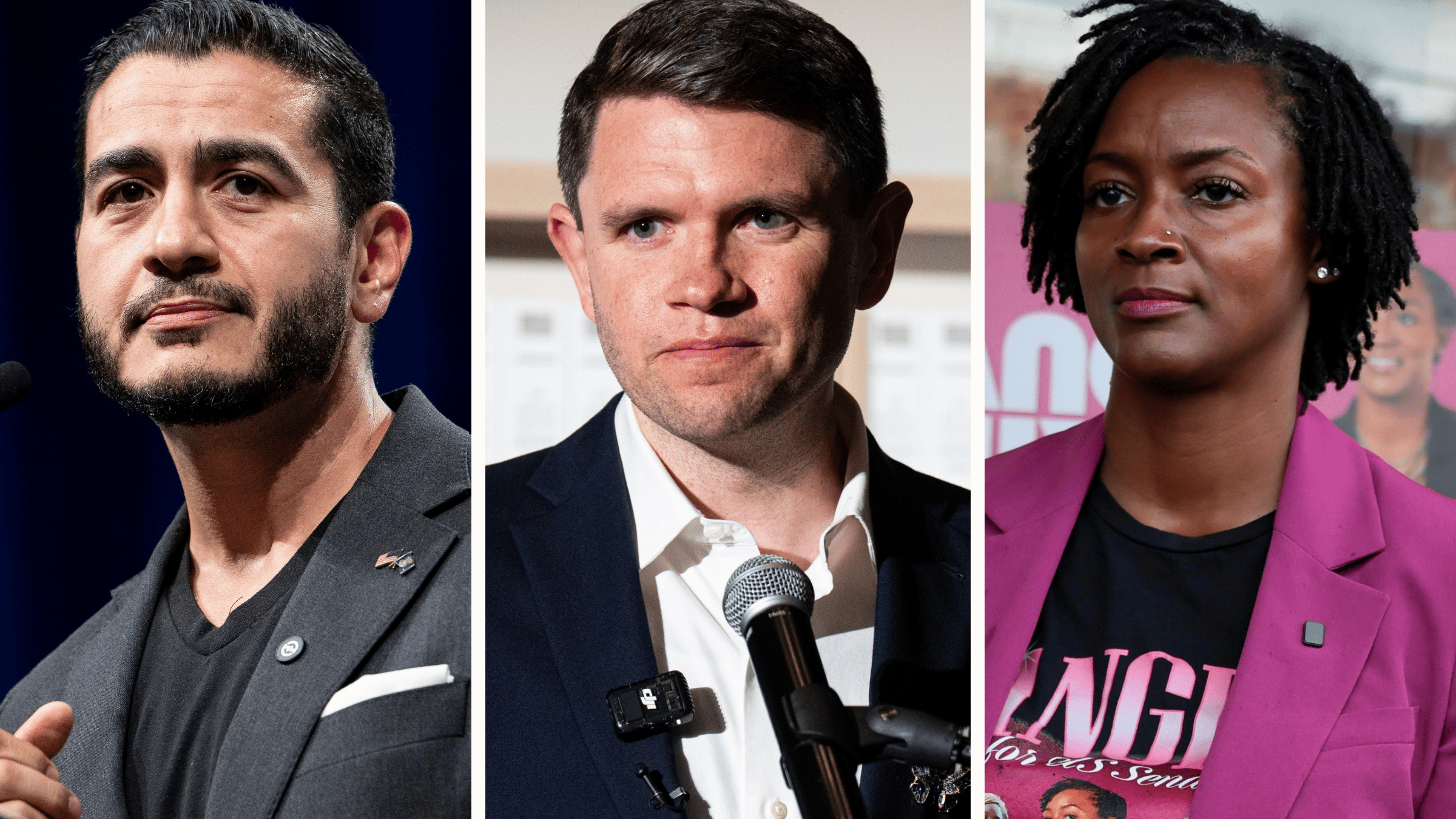
Dr. Abdul El-Sayed, a progressive Democrat with a background in public health, has defeated former Representative Mike Rogers in Michigan’s open Senate race on Tuesday, according to The Associated Press, making him the first Muslim elected to the United States Senate.
uncertain
him → defeat → Senate
His victory keeps the seat in Democratic hands, denying Republicans one of their best opportunities to blunt the Democratic wave that has defined this year’s midterm elections.
asserted
that → keep → elections
The retirement of Senator Gary Peters, a Democrat, at the end of the current Congress had set up one of the country’s most competitive Senate contests in Michigan, a perennial battleground that President Trump carried by two percentage points in 2024.
asserted
Trump → set → 2024
The election of El-Sayed, 42, the son of Egyptian immigrants who was born and raised in suburban Detroit, represents a milestone in American politics and a potentially consequential shift within the Democratic Party.
asserted
who → bear → Party
An outspoken critic of Israel who has championed an ambitious progressive agenda, he joins a growing contingent of left-wing Democrats who have prevailed in elections this year.
asserted
who → champion → elections
But unlike other prominent progressive victories in reliably Democratic districts, El-Sayed’s came in a closely divided statewide race where both parties have spent years competing for the support of working-class voters, suburban moderates, and an increasingly diverse electorate.
asserted
parties → come → voters
His win also offers Democrats a striking counterpoint to the argument, advanced by some of the party’s more moderate figures, that progressive candidates are too politically vulnerable to compete in battleground states.
asserted
candidates → offer → states
El-Sayed, who rejects the socialist label, prevailed despite a bruising campaign that exposed deep divisions among Democrats over Israel, drew millions of dollars in spending from pro-Israel groups, and culminated in an extraordinary rupture with his former primary opponent, Representative Haley Stevens, who endorsed Rogers just two days before the election.
asserted
who → reject → election
A campaign marked by personal attacks
The campaign had turned strikingly ugly in its closing weeks, with Trump and other prominent Republicans invoking Islamophobic stereotypes to portray El-Sayed as a threat to American security.
asserted
Trump → mark → security
He faced considerable heat for campaigning with Hasan Piker, the incendiary anti-Israel streamer who said that “America deserved 9/11” and that the U.S. was responsible for more terror than Al Qaeda.
asserted
U.S. → face → Qaeda
Some Jewish voters accused El-Sayed of trafficking in antisemitic rhetoric through criticism of Israel and his suggestion that American military assistance to the country had come at the expense of domestic priorities.
asserted
assistance → accuse → priorities
(El-Sayed has rejected allegations of antisemitism, arguing that his criticism of the Israeli government should not be conflated with hostility to Jewish people).
asserted
criticism → reject → people
The accusations and counteraccusations reverberated across Michigan’s large Muslim and Jewish communities, turning an election already fraught with national implications into an unusually personal and painful contest.
asserted
accusations → reverberate → contest
At a rally in Michigan nine days before the election, Trump baselessly described El-Sayed as a member of the Muslim Brotherhood—an Islamist political movement—and warned that his election would bring terrorists into the country.
asserted
election → describe → country
“If Abdul and the Democrats win, they will open the floodgates and invite hordes of jihadis to our shores, creating a nightmare of violence and terror until you cannot even have a Christmas,” Trump told thousands of supporters.
asserted
Trump → win → supporters
The President also repeatedly called El-Sayed by his middle name—Mohamed, which critics described as a dog whistle—and told supporters that he wanted El-Sayed to go through a metal detector to enter the Capitol.
asserted
Sayed → call → Capitol
The night before the election, Trump wrote on Truth Social: “Abdul El-Sayed Hates Jews and Hates Blacks.
asserted
Sayed → write → Blacks
Don’t feel bad, he also Hates Whites.”
asserted
he → feel → Whites
The rhetoric underscored the extent to which El-Sayed had become a national target for Republicans this cycle.
asserted
Sayed → underscore → Republicans
Rogers, 63, a former chairman of the House Intelligence Committee, also raised baseless allegations about El-Sayed’s family ties to the Muslim Brotherhood.
asserted
Rogers → raise → Brotherhood
El-Sayed has publicly disavowed the movement and denied allegations that he or his family has ties with itWhen
asserted
he → disavow → ties
Dave Portnoy, the founder of Barstool Sports, called El-Sayed a “terrorist,” Rogers responded on social media that Portnoy was “exactly right.”
asserted
Portnoy → call → media
For El-Sayed, the attacks recalled doubts he had encountered long before entering politics.
asserted
he → recall → politics
In an interview with TIME in May, El-Sayed recounted a conversation with former President Bill Clinton after delivering a student commencement address at the University of Michigan in 2007.
uncertain
Sayed → recount → 2007
Clinton, who had also spoken at the ceremony, suggested that the young graduate might consider running for public office one day.
uncertain
graduate → speak → office
El-Sayed remembered laughing at the idea.
asserted
Sayed → remember → idea
“I don’t know if you saw my name,” he recalled telling Clinton.
asserted
he → know → Clinton
“It’s not going to work out for me.”
asserted
It → go → me
Nearly two decades later, El-Sayed has made history in a state where the political influence of Muslim Americans has grown considerably.
asserted
influence → make → Americans
A graduate of the University of Michigan and a Rhodes Scholar at the University of Oxford, El-Sayed earned his medical degree from Columbia University but did not practice medicine.
asserted
Sayed → earn → medicine
Instead, he became an assistant professor of epidemiology at Columbia before taking leadership positions in public health in Detroit and Wayne County.
asserted
he → become → Detroit
In 2018, he mounted an unsuccessful campaign for governor of Michigan, drawing comparisons to former President Barack Obama with his charismatic public speaking.
asserted
he → mount → speaking
El-Sayed sought to make his election for Senate a referendum on Trump, whose approval rating had fallen sharply in Michigan since his narrow victory there two years earlier.
asserted
rating → seek → victory
A New York Times/Siena University poll conducted in September found that just 34% of likely voters approved of the President’s performance.
asserted
% → conduct → performance
“Michigan knows Trump is on the ballot on Nov. 3,” El-Sayed said in the closing days of the campaign, arguing that voters would reject Rogers as a loyal supporter of the President.
asserted
voters → know → President
Rogers had sought to establish some distance from the Trump Administration on issues that have proved unpopular in Michigan, including tariffs on Canadian goods and the ongoing war with Iran.
asserted
that → seek → Iran
In one campaign advertisement, the Republican declared that “Canada is not our enemy,” a notable departure from the President’s confrontational approach toward the neighboring country, whose economy is closely intertwined with Michigan’s automobile industry.
asserted
economy → declare → industry
But Rogers struggled to escape the broader political environment confronting Republicans.
asserted
Rogers → struggle → Republicans
His defeat suggested that the backlash against Trump had extended into a state that had helped return him to the White House, even as the President devoted considerable attention to the Senate contest.
uncertain
President → suggest → contest
A progressive platform and divisions over Israel
El-Sayed campaigned on an expansive progressive platform that included Medicare for All, higher taxes on the wealthy, and a challenge to the influence of corporate money in American politics.
asserted
that → campaign → politics
…and 27 more, not listed.
 The Aporia