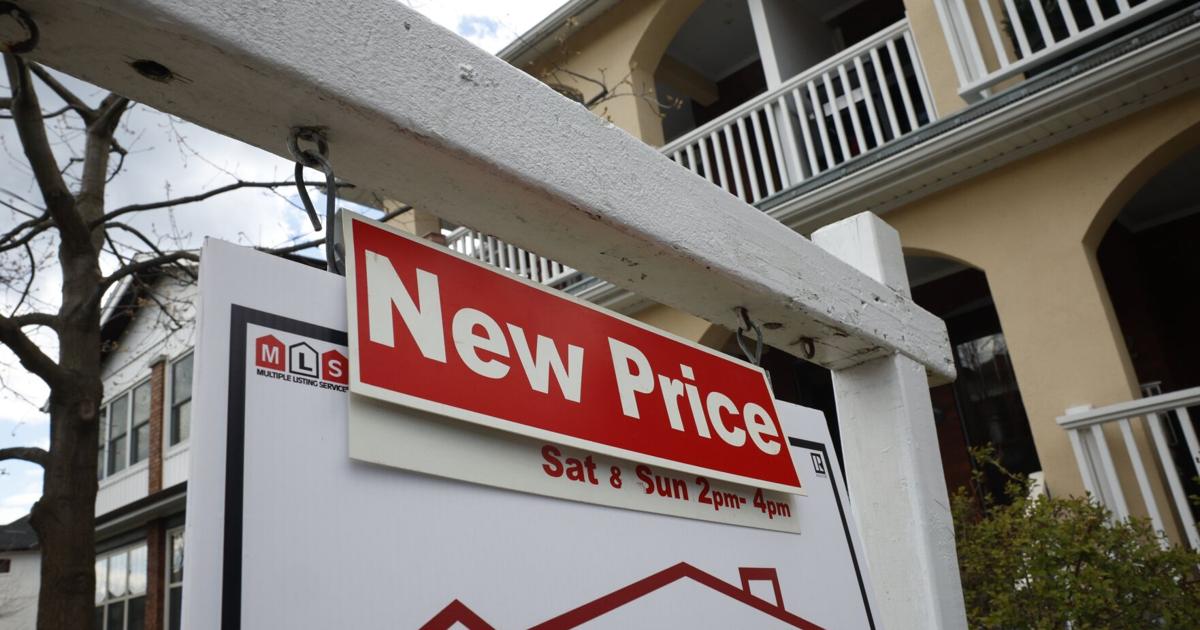
Photo via Toronto Star

Homebuyers stick to the sidelines as sales drop 8 per cent in October

Read the original at Toronto Star ↗
Cite

Blosser, A. (2026, November 4). Homebuyers stick to the sidelines as sales drop 8 per cent in October. Toronto Star. https://www.thestar.com/business/homebuyers-stick-to-the-sidelines-as-sales-drop-8-per-cent-in-october/article_03e4dae6-8cba-4821-b469-b34217aabaf7.html

Dated from the outlet's own feed. Check the original for its byline.

Toronto Star · collected 2026-11-04 · by Anastasia Blosser

Quick Summary

Toronto-area home sales declined by eight percent in October compared to the same period last year, according to the Toronto Regional Real Estate Board's monthly report released Wednesday. The average selling price fell nearly three percent to $1.024 million, with condos experiencing the sharpest decline at six percent to just over $621,000. Economic uncertainty around inflation and borrowing costs is cited as a primary reason for buyers remaining on the sidelines despite improved affordability in some segments of the market.
Written by AI on 2026-11-04, from this article's own text only (the story summary below draws on all the coverage).

AI analysis

Story summary

Home sales in the Greater Toronto Area (GTA) dropped by nearly 8% year-over-year in October 2026, according to the Toronto Regional Real Estate Board (TRREB). The average selling price fell to $1.024 million, a decrease of almost 3% from the previous year. TRREB attributes this decline to homebuyers delaying purchases due to concerns about inflation, rising borrowing costs, and economic uncertainty. In October, 5,603 homes were sold in the GTA, while new listings decreased by 11.9%, indicating a slowdown in supply as well. The total inventory of active listings dropped by 10% compared to October 2025, standing at 25,098 homes for sale. TRREB chief information officer Jason Mercer noted that potential buyers are cautious about their economic prospects and job security despite improved affordability.

Written for “Toronto Home Sales Down” on 2026-11-04, grounded in this article and the 1 other(s) covering the same event.
Why this leaning score
This article does not take a side on a contested political question, so it has no leaning score. That is an answer rather than a gap: a match report or a rescue can be warmly or critically written without being left or right, and scoring it anyway is how approval of a subject gets recorded as a political position.
No political leaning scored for article 128509 · logged 2026-11-04

Story

📰 Toronto Home Sales Down
Economy/Business · 2 article(s) covering the same event. See how they differ ↓

Compared with similar articles

This article reads unscored and hedges 19% of its claims. Each row says how that neighbour differs.
Toronto Star
Hedges 0 of 6 claims Outlet record 64/100
The Sydney Morning Herald
Hedges 1 of 33 claims Outlet record 61/100
“The articles describe different aspects of the housing market situation in distinct geographic locations and time periods.”
How this article was measured signals, leaning charts, publisher record, byline, topics and claims

Signals How these are calculated →

Claims extracted
21
sentences that state something as happening or true
Uncertain
19%
4 of 21 hedged ("reportedly", "may", "according to")
Leaning
not political
takes no side on a contested political question
Publisher signals
64/100
Toronto Star's corrections and hedging, across everything collected from it. Not a measure of accuracy.
Outlets on this story
2
Economy/Business
Same framing elsewhere
1
articles that frame the event the way this one does
Analyzed 2026-11-04 · how these are computed

How this is being covered How these are calculated →

Article leaning vs. publisher reliability
Source leaning vs. consistency

Publisher

Toronto Star · 11561 article(s) · 28 correction(s) detected
Running correction rate · 28 correction(s)
2026-10-26
Correction
2026-10-24
Correction
2026-10-07
Correction
2026-09-24
Correction

Who wrote this

Anastasia Blosser
9 article(s) here · 1 carrying a prediction
🔮 The Toronto Regional Real Estate Board (TRREB) attributed the year-over-year declines to homebuyers holding off amid uncertainty around inflation, borrowing costs and the economy, according to its monthly report released Wednesday. “There are a lot of homebuyers that would like to take advantage of improved affordability, yet at the same time are concerned about their economic prospects moving forward, like the cost of living and their job situation,” said TRREB chief information officer Jason Mercer.
🔮 What the rate hike means for mortgage payments The central bank’s move will push up lenders’ prime rates, directly affecting variable-rate mortgages, but the impact on fixed-rate mortgages is less straightforward.
🔮 That means investment firms can secure prices that individual buyers may struggle to access, tightening the supply, and the lower prices are often not reflected in public listings. Hirsch said developers are looking for ways to move inventory without accepting the deeper discounts that can come with bulk sales.
🔮 The two leading candidates for Toronto’s next mayor are pitching big ideas to solve the housing crisis, but there’s a catch: it’s not always the mayor who makes the rules. Olivia Chow has emphasized public land, non-profit housing, tenant protections and intergovernmental deals.
🔮 Canada’s first high-speed rail line could cost as much as $113 billion to build, according to an analysis published by the Parliamentary Budget Officer (PBO) on Thursday — significantly higher than the federal government’s previous $90-billion estimate.
🔮 The bulk sale is a steep discount to the $1,008 per square foot buyers paid for new condos individually across the Greater Toronto and Hamilton Area in the second quarter, according to market researcher Urbanation, and offers a glimpse into how Toronto’s condo market is being reshaped by weak demand, a growing number of completed units and investors willing to buy large blocks of homes at a discount.
🔮 She had accounted for her ride home from Toronto General Hospital, the various medications she would need as she recovered from a partial liver donation, and any arrangements in case the surgery went awry.
🔮 Sherwood added there is “no chance” that the latest round of tariffs could hike development costs enough to negate the HST rebate.
🔮 Sometimes she brought him to work, where he would watch the IT and cybersecurity teams sit around computers, solving problems.
Also by Anastasia Blosser
Nothing else under this byline is closely related to this article, so these are simply their most recent.
All 9 articles by Anastasia Blosser →

Topics

Mercer QuietMarket TRREB The Toronto Regional Real Estate Board Toronto

Subjects

Toronto GPE · 6× Mercer ORG · 5× TRREB ORG · 3× Canada GPE · 1× Daniel Steinfeld PERSON · 1× GTA GPE · 1× Jason Mercer PERSON · 1× QuietMarket ORG · 1× The Toronto Regional Real Estate Board ORG · 1× the Bank of Canada ORG · 1×

Narrative

As Toronto’s condo crash deepens, QuietMarket lets individual buyers access discounted developer Mercer chalked up the decline to the condo market being “particularly well supplied,” in part because newly completed projects have added more units to both the ownership and rental markets. “There were a lot of projects that were under construction that have now been completed over the last couple of years.
framing: assertive · carried by 1 article(s) · first seen 2026-11-04
🔮 The Toronto Regional Real Estate Board (TRREB) attributed the year-over-year declines to homebuyers holding off amid uncertainty around inflation, borrowing costs and the economy, according to its monthly report released Wednesday. “There are a lot of homebuyers that would like to take advantage of improved affordability, yet at the same time are concerned about their economic prospects moving forward, like the cost of living and their job situation,” said TRREB chief information officer Jason Mercer.
2026-11-04 · Toronto Star
Homebuyers stick to the sidelines as sales drop 8 per cent in October · assertive framing

Claims (21 extracted, 4 hedged)

Toronto-area average home sales were down eight per cent in October, while both prices and sales fell across all major housing types as economic uncertainty continued to keep buyers on the sidelines. asserted
uncertainty → fall → sidelines
The Toronto Regional Real Estate Board (TRREB) attributed the year-over-year declines to homebuyers holding off amid uncertainty around inflation, borrowing costs and the economy, according to its monthly report released Wednesday. “There are a lot of homebuyers that would like to take advantage of improved affordability, yet at the same time are concerned about their economic prospects moving forward, like the cost of living and their job situation,” said TRREB chief information officer Jason Mercer. uncertain
Mercer → attribute → living
The average selling price in the Toronto region fell by nearly three per cent to $1.024 million in October, compared to just over $1.05 million during the same time last year. asserted
price → fall → time
October’s average selling price was higher than in January, when it dipped below $1 million for the first time since 2021, but it was still a drop of more than 26 per cent when compared to the February 2022 peak. asserted
it → dip → peak
Though average prices for all home types in the Toronto area fell in October, condos saw some of the sharpest declines, down six per cent from a year earlier to just over $621,000. asserted
condos → fall → 621,000
As Toronto’s condo crash deepens, QuietMarket lets individual buyers access discounted developer Mercer chalked up the decline to the condo market being “particularly well supplied,” in part because newly completed projects have added more units to both the ownership and rental markets. “There were a lot of projects that were under construction that have now been completed over the last couple of years. asserted
that → deepen → years
We have seen prices dip as a result of that,” he said. asserted
he → see → that
In comparison, the average price of a semi-detached home fell less than one per cent to roughly $1.025 million and the average price of a detached home dropped slightly over three per cent to about $1.311 million. asserted
price → fall → million
The average price of a townhouse fell five per cent to $804,000. asserted
price → fall → 804,000
Mercer said townhouses and semi-detached homes can serve as a transitional option for buyers looking to move out of condominiums and into lowrise housing, helping support prices in those segments. asserted
townhouses → say → segments
Since developers have not built as much of that type of housing, tighter market conditions could help homes sell at higher prices, he added. uncertain
he → build → prices
Townhouses also saw the largest year-over-year decline in sales, with an 11 per cent drop from the same period last year. asserted
Townhouses → see → period
Semi-detached homes and condo apartments also saw sales decline roughly eight per cent and 10 per cent, respectively. asserted
sales → see → ?
The board estimated it would take roughly 4.6 months to sell that many homes at the current rate of demand. asserted
it → estimate → demand
Mercer said buyers continue to have considerable negotiating power in most segments of the GTA market, although declining new listings are beginning to tighten market conditions compared to last year. asserted
listings → say → year
The sales-to-new-listings ratio was about 39.5 per cent, suggesting market conditions remain relatively balanced, though they are beginning to shift slightly in favour of sellers as the number of new listings declines, Mercer said. asserted
Mercer → suggest → listings
Last week, the Bank of Canada raised its key interest rate to 2.5 per cent, its first increase since July 2023. asserted
Bank → raise → July
Fixed mortgage rates have also been rising in recent weeks. asserted
rates → rise → weeks
Mercer said that although borrowing costs have increased following higher inflation, the impact on monthly mortgage payments has been mitigated by lower selling prices, which has helped keep affordability in check. asserted
which → say → check
TRREB president Daniel Steinfeld said a trade deal between Canada and the U.S. could give residents in the Toronto area a clearer picture of the economic outlook. uncertain
deal → say → outlook
“Combined with a resolution to the conflict in the Middle East, this could help ease concerns about inflation and economic uncertainty, strengthen consumer confidence and renew interest in home ownership as we move into 2027,” he said. uncertain
he → combine → 2027

💬Give feedback · no sign-in needed

No sign-in needed for now. Your note is sent without a name, so it cannot be answered.

🕘History 🎫Support