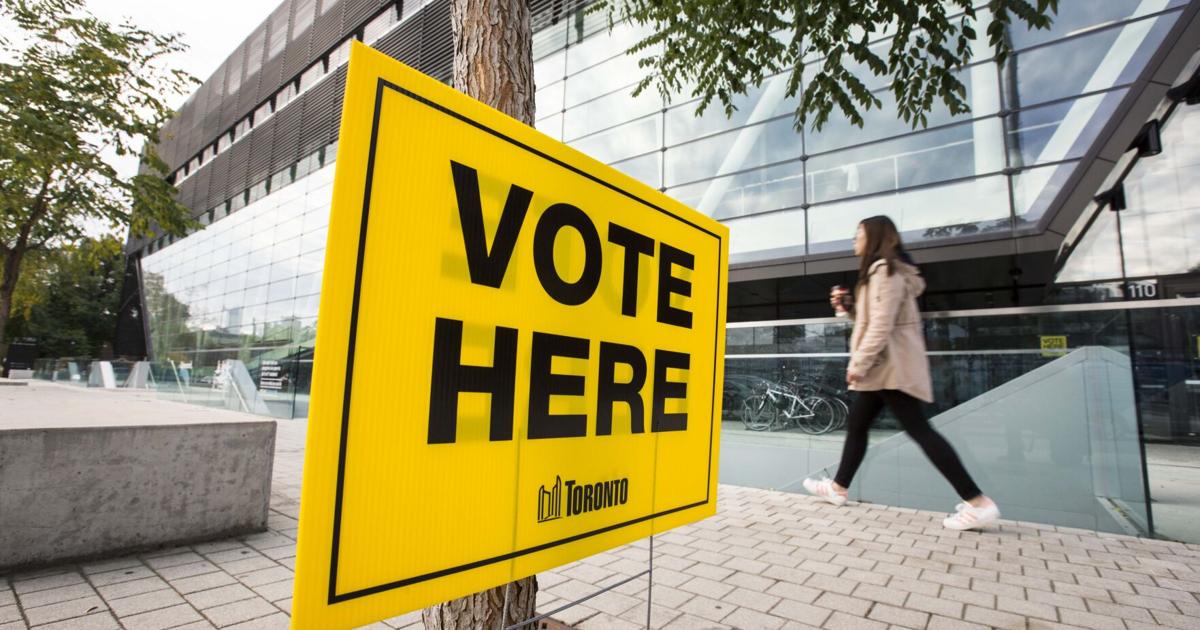
Photo via Toronto Star

Olivia Chow and Brad Bradford have big housing ideas. But in Doug Ford's Ontario, do they have a say?

Read the original at Toronto Star ↗
Cite

Blosser, A. (2026, October 10). Olivia Chow and Brad Bradford have big housing ideas. But in Doug Ford's Ontario, do they have a say? Toronto Star. https://www.thestar.com/real-estate/hos-election-fact-check/article_264d06f1-3c41-4d52-b9db-4b3195ae2615.html

Dated when The Aporia collected the article, usually within hours of publication. Check the original for its exact date and byline.

Toronto Star · collected 2026-10-10 · by Anastasia Blosser

Quick Summary

Olivia Chow and Brad Bradford are presenting plans to address Toronto's housing crisis during their mayoral campaigns. Chow advocates for public land use, non-profit housing initiatives, tenant protections, and intergovernmental cooperation, while Bradford focuses on speeding up private market construction, increasing density, reducing costs for homebuyers, and leveraging development speed. However, both candidates face limitations as much of the power to implement these changes lies with the provincial government under Doug Ford's leadership, which can override municipal decisions through legislation such as the City of Toronto Act and Planning Act.
Written by AI on 2026-10-10, from this article's own text only (the story summary below draws on all the coverage).

AI analysis

Story summary

Olivia Chow and Brad Bradford are proposing solutions to address Toronto's housing crisis, focusing on public land and non-profit housing versus private market construction and reducing development costs. However, their plans face challenges because many decisions affecting housing policy are made by the provincial government under Premier Doug Ford, not just at the city level. According to Frank Clayton, a senior research fellow at Toronto Metropolitan University’s Centre for Urban Research and Land Development, the province has significant influence over local housing initiatives. A recent Ipsos poll conducted for the Toronto Regional Real Estate Board revealed that nearly 70% of voters view housing as a critical issue in this municipal election.

Written for “Ontario Housing Policies Debate” on 2026-10-30, grounded in this article and the 0 other(s) covering the same event.

Story

📰 Ontario Housing Policies Debate
Politics · 1 article(s) covering the same event.

Compared with similar articles

This article reads leans right and hedges 10% of its claims. Each row says how that neighbour differs.
National Post
⚖️ Leans left further left than this Hedges 7 of 33 claims Outlet record 60/100
“The articles discuss different aspects of the Toronto mayoral race without focusing on the same specific incident or time.”
National Post
⚖️ Leans right Hedges 1 of 33 claims Outlet record 60/100
“The articles discuss different aspects of Toronto's political and housing situation, with Article A focusing on mayoral candidates' ideas for solving the housing crisis and Article B discussing voter sentiment in a specific downtown ward.”
Reason
⚖️ Leans strongly right further right than this Hedges 2 of 24 claims Outlet record 67/100
“The articles discuss different approaches and locations for addressing housing issues, with Article A focusing on Olivia Chow and Brad Bradford's campaigns in Toronto and Article B discussing First Nations' land development in Vancouver.”
Toronto Star
Hedges 6 of 104 claims Outlet record 64/100
“The articles discuss different mayoral races (Toronto vs Mississauga) and do not describe the same specific incident.”
Toronto Star
⚖️ Leans left further left than this Hedges 2 of 31 claims Outlet record 64/100
“The articles discuss different aspects of the mayoral campaign and voter priorities, rather than a single specific incident or occurrence.”
Toronto Star
⚖️ Leans strongly left further left than this Hedges 1 of 23 claims Outlet record 64/100
“Article A discusses the campaign ideas of Olivia Chow and Brad Bradford for solving Toronto's housing crisis, while Article B talks about a partnership between The Star and the University of Toronto to pitch big ideas during the municipal election period.”
Toronto Star
Hedges 0 of 2 claims Outlet record 64/100
“The articles discuss different aspects of Olivia Chow and Brad Bradford's campaign promises, with Article A focusing on free school lunches and land transfer tax while Article B focuses on housing solutions and their feasibility.”
Toronto Star
Hedges 3 of 40 claims Outlet record 64/100
“The articles discuss different aspects of the mayoral race in Toronto, with Article A focusing on the candidates' housing ideas and their limitations, while Article B covers voter priorities and poll predictions for the upcoming election.”
Toronto Star
⚖️ Leans left further left than this Hedges 1 of 3 claims Outlet record 64/100
“The articles discuss different aspects of Olivia Chow and Brad Bradford's mayoral campaigns but do not describe the same specific occurrence.”
How this article was measured signals, leaning charts, publisher record, byline, topics and claims

Signals How these are calculated →

Claims extracted
72
sentences that state something as happening or true
Uncertain
10%
7 of 72 hedged ("reportedly", "may", "according to")
Leaning
Leans right
of the writing, not the subject · beta estimate
Publisher signals
64/100
Toronto Star's corrections and hedging, across everything collected from it. Not a measure of accuracy.
Outlets on this story
1
Politics
Same framing elsewhere
1
articles that frame the event the way this one does
Analyzed 2026-10-10 · how these are computed

How this is being covered How these are calculated →

Article leaning vs. publisher reliability
Source leaning vs. consistency

Publisher

Toronto Star · 10538 article(s) · 27 correction(s) detected
Running correction rate · 27 correction(s)
2026-10-26
Correction
2026-10-24
Correction
2026-10-07
Correction
2026-09-24
Correction

Who wrote this

Anastasia Blosser
7 article(s) here · 1 carrying a prediction
🔮 That means investment firms can secure prices that individual buyers may struggle to access, tightening the supply, and the lower prices are often not reflected in public listings. Hirsch said developers are looking for ways to move inventory without accepting the deeper discounts that can come with bulk sales.
🔮 The two leading candidates for Toronto’s next mayor are pitching big ideas to solve the housing crisis, but there’s a catch: it’s not always the mayor who makes the rules. Olivia Chow has emphasized public land, non-profit housing, tenant protections and intergovernmental deals.
🔮 Canada’s first high-speed rail line could cost as much as $113 billion to build, according to an analysis published by the Parliamentary Budget Officer (PBO) on Thursday — significantly higher than the federal government’s previous $90-billion estimate.
🔮 The bulk sale is a steep discount to the $1,008 per square foot buyers paid for new condos individually across the Greater Toronto and Hamilton Area in the second quarter, according to market researcher Urbanation, and offers a glimpse into how Toronto’s condo market is being reshaped by weak demand, a growing number of completed units and investors willing to buy large blocks of homes at a discount.
🔮 She had accounted for her ride home from Toronto General Hospital, the various medications she would need as she recovered from a partial liver donation, and any arrangements in case the surgery went awry.
🔮 Sherwood added there is “no chance” that the latest round of tariffs could hike development costs enough to negate the HST rebate.
🔮 Sometimes she brought him to work, where he would watch the IT and cybersecurity teams sit around computers, solving problems.
Also by Anastasia Blosser
Nothing else under this byline is closely related to this article, so these are simply their most recent.
All 7 articles by Anastasia Blosser →

Topics

Centre for Urban Research and Land Development Ipsos Toronto Toronto Metropolitan University’s the Toronto Regional Real Estate Board

Subjects

Toronto GPE · 14× Lintern PERSON · 5× Ford ORG · 2× Brad Bradford PERSON · 1× Centre for Urban Research and Land Development ORG · 1× Frank Clayton PERSON · 1× Ipsos ORG · 1× Olivia Chow PERSON · 1× Toronto Metropolitan University’s ORG · 1× the Toronto Regional Real Estate Board ORG · 1×

Narrative

She added the province has taken a more active role in decisions that were once largely left to municipalities, and while the province has been pushing for more density and cutting red tape, Keesmaat said some changes have had the countereffect of slowing development. “When the provincial government says, ‘we’re going to rezone things,’ then the development industry essentially sits back on their hands,” Keesmaat said.
framing: assertive · carried by 1 article(s) · first seen 2026-10-10
🔮 The two leading candidates for Toronto’s next mayor are pitching big ideas to solve the housing crisis, but there’s a catch: it’s not always the mayor who makes the rules. Olivia Chow has emphasized public land, non-profit housing, tenant protections and intergovernmental deals.

Claims (72 extracted, 7 hedged)

The two leading candidates for Toronto’s next mayor are pitching big ideas to solve the housing crisis, but there’s a catch: it’s not always the mayor who makes the rules. Olivia Chow has emphasized public land, non-profit housing, tenant protections and intergovernmental deals. asserted
Chow → lead → land
Brad Bradford has focused on private market construction, density, development speed and reducing costs for homebuyers. asserted
Bradford → focus → homebuyers
Between a campaign promise and a set of keys handed to a Toronto resident, there is a long chain of decisions, many of them happening outside City Hall. asserted
many → hand → Hall
“Whatever the city does, it’s through the powers of the province,” said Frank Clayton, a housing consultant and senior research fellow at Toronto Metropolitan University’s Centre for Urban Research and Land Development. asserted
Clayton → do → Research
A poll conducted by Ipsos for the Toronto Regional Real Estate Board (TRREB) found housing is a defining issue for nearly 70 per cent of voters in this municipal election. asserted
housing → conduct → election
The importance of winning over voters outside the core is down to simple electoral math of post-amalgamation Toronto, expert says. asserted
expert → win → Toronto
The importance of winning over voters outside the core is down to simple electoral math of post-amalgamation Toronto, expert says. asserted
expert → win → Toronto
The next mayor will have meaningful powers over how Toronto zones neighbourhoods, which developments it approves, how city-owned land is used and how much the city charges in taxes and development fees. asserted
city → have → taxes
But the province can change the rules those decisions are governed by and the Ford government has used those powers more frequently than previous governments. asserted
government → change → governments
“A local politician may stand up and say they don’t like a decision, but if it’s the direction of the province, our decisions at the city level have to be consistent with provincial policy,” said Gregg Lintern, Toronto’s chief planner from 2017 to 2023. uncertain
Lintern → stand → 2023
The question then becomes: which candidate can deliver on their promises within the powers of the mayor’s office? asserted
candidate → become → office
Queen’s Park in control Toronto operates under the province’s City of Toronto Act and Planning Act, which means Queen’s Park can set and change many of the rules governing how the city grows. asserted
city → operate → rules
Ontario also holds the power over hot-button issues like rent control, and can override Toronto’s zoning through Minister’s Zoning Orders. asserted
Ontario → hold → Orders
It has altered Toronto’s plans for how much can be built in parts of the city, and the affordable-housing requirements the city places on some developments. asserted
city → alter → developments
Lintern said provincial policy has increasingly emphasized allowing the market to drive housing construction, while also being more prescriptive in some areas, such as requiring greater density around major transit stations. asserted
market → say → stations
“When the current government says that there should be more density around transit stations, the city has to follow the path it lays out,” Lintern said. asserted
Lintern → say → path
He said the relationship is not always one where the province moves first and the city follows. asserted
city → say → ?
Sometimes, Toronto has gone further than the province in allowing new housing or the city has addressed Toronto-specific problems, only for Queen’s Park to later change the rules. For example, the province has permitted up to three homes on a single lot, while Toronto went further by allowing four units and a backyard suite in some instances. asserted
Toronto → go → instances
For garden suites, Lintern said the city required angular planes to limit their impact on neighbours — but the province removed the city’s ability to impose it. asserted
province → say → it
“It reached right into the nuance of the zoning,” Lintern said. asserted
Lintern → reach → zoning
He also pointed to Toronto’s green-roof bylaw. asserted
He → point → bylaw
The city obtained provincial authority under former premier Dalton McGuinty to create the bylaw and then developed its own requirements, which Lintern said reflected Toronto’s particular concerns around stormwater and the urban heat island effect. asserted
Lintern → obtain → stormwater
But then, 15 years later, Ford’s government removed the city’s authority to require green roofs. asserted
government → remove → roofs
In 2019, the province also overhauled the city’s plans for Midtown and the downtown core. asserted
province → overhaul → Midtown
The city had limited heights in order to shape growth, protect the character of surrounding neighbourhoods and ensure new development was supported by adequate infrastructure. asserted
development → limit → infrastructure
Its planning rules also placed greater emphasis on living conditions inside new buildings, including access to natural light. asserted
rules → place → light
But the province modified the plan, allowing taller and denser buildings. asserted
province → modify → buildings
In parts of Midtown, the province’s changes more than doubled the maximum building heights. asserted
changes → double → heights
Lintern recalled the province made “hundreds of modifications” to plans for Yonge and Eglinton and the downtown core, without consulting the city. asserted
province → recall → city
“In my experience, the collaboration ebbs and flows. asserted
collaboration → ebb → experience
I would say that it’s gotten more constrained over the course of time,” Lintern said. asserted
Lintern → say → time
Lintern said the back-and-forth between the two levels of government is not necessarily unusual, but the effectiveness of the system depends in part on how well they work together. asserted
they → say → part
Jennifer Keesmaat, Toronto’s chief planner from 2012 to 2017 and founder of an urban planning consulting firm, said provincial and federal decisions can affect Toronto’s housing market without City Hall having control over them, such as provincial planning rules and federal immigration policy. asserted
Hall → say → rules
“Municipal politicians are the recipient of those decisions that deeply impact the outcomes that you see in cities,” she said. asserted
she → impact → cities
She added the province has taken a more active role in decisions that were once largely left to municipalities, and while the province has been pushing for more density and cutting red tape, Keesmaat said some changes have had the countereffect of slowing development. “When the provincial government says, ‘we’re going to rezone things,’ then the development industry essentially sits back on their hands,” Keesmaat said. asserted
Keesmaat → add → hands
“They’re not going to spend two years and $7 million going through a rezoning process if the province is about to change it.” asserted
province → go → it
She emphasized the city controls a number of important levers. asserted
city → emphasize → levers
It can change zoning, approve development applications, put city-owned land toward housing, set municipal taxes and development charges, and fund affordable housing and homelessness programs. asserted
It → change → housing
But having the power to change those things does not mean the city can guarantee that housing will be built. asserted
housing → have → things
“The biggest lever that the city has is working with other orders of government,” Keesmaat said. asserted
Keesmaat → have → government
…and 32 more, not listed.

💬Give feedback
🕘History 🎫Support