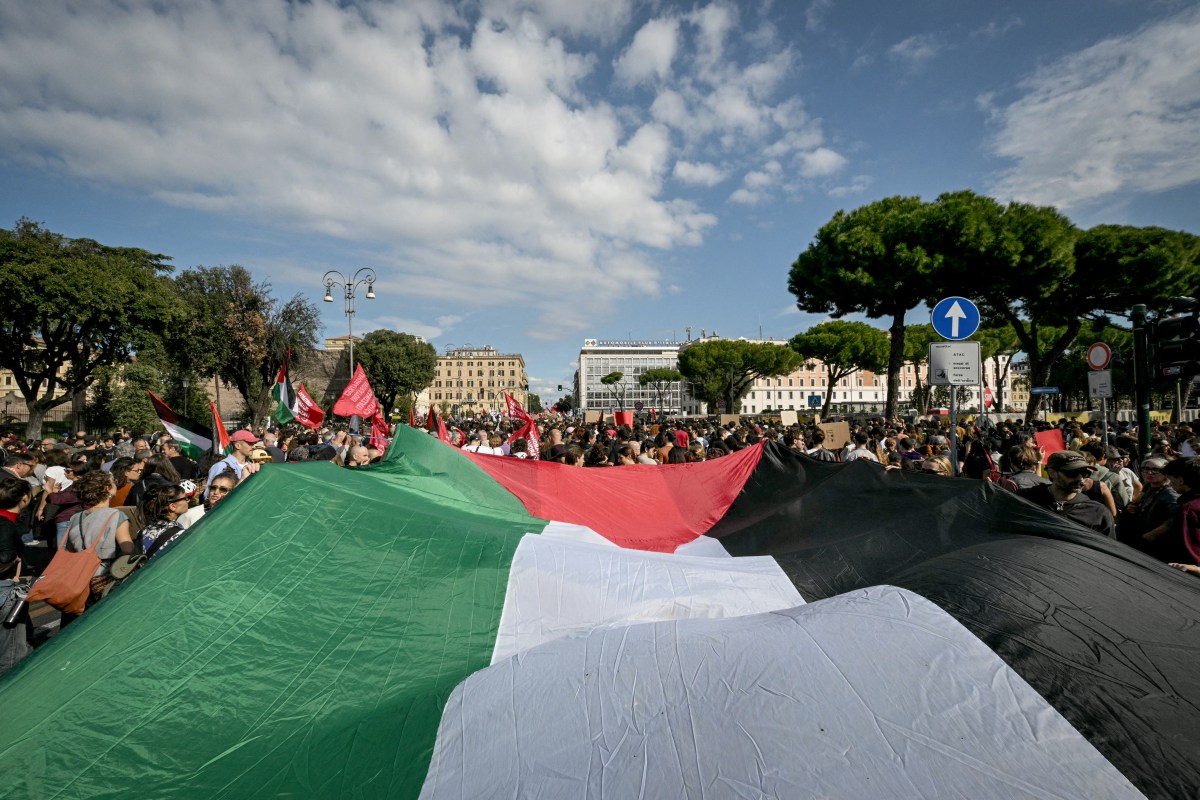
The world today, when it comes to Palestine, stands at the crossroads: meaningful support for liberation and decolonization, or the normalization of colonial expansion and erasure.
asserted
it → come → expansion
Since the 2021 “Manifesto of Dignity and Hope” and the unified call of Palestinians to confront Zionism, the Israeli political sphere has only continued to sustain and entrench its fascist trajectory and its racist laws.
asserted
sphere → unify → trajectory
After 2023, Israeli settler colonialism and domination escalated into all-out destruction and elimination.
asserted
colonialism → escalate → destruction
Palestinians who had been enduring suffocating apartheid and siege for far too long were now subjected to genocidal assault.
asserted
who → endure → assault
Though the context on the ground shifted, the urgent need for a better understanding and challenge to Zionism on political, legal, structural, and ideological grounds remained.
asserted
need → shift → grounds
It was a new generation of Palestinian activists who produced the Manifesto of Dignity and Hope, but their text was shaped by the legacy and spirit of Palestinian revolutionaries and anti-colonial thinkers from earlier periods.
asserted
text → produce → periods
Common language echoes through the generations.
asserted
language → echo → generations
A quarter-century ago, Palestinian intellectual Edward Said wrote the core of the issue of Palestine “is intellectual truth and the need to combat any sort of apartheid.
asserted
core → write → apartheid
We should concentrate our resistance on … fully confronting the apartheid provisions inherent in Zionism.”
asserted
We → concentrate → Zionism
And as diplomat Fayez Sayegh captured it in 1965: Racism is not an acquired or incidental or passing feature of the Israeli state; it is “inherent in the very ideology of Zionism.”
asserted
it → capture → Zionism
Today, we can draw inspiration from these intergenerational reverberations across Palestinian theory and activism, in their consonant commitments to confronting Zionism.
asserted
we → draw → Zionism
Part of our own task as anti-colonial legal scholars is to expand our analysis of the limitations of narrow liberal legal readings of apartheid and inequality, and to highlight how a radical critique of Israeli apartheid is essential to dismantling Israel’s apartheid regime.
asserted
critique → expand → regime
This requires scrutiny not only of Zionism and Israeli settler colonialism, but also of the concept of apartheid itself.
asserted
This → require → apartheid
Apartheid was previously understood in the context of the African anti-apartheid struggle, in a formulation originally coined by the South African Communist Party, as “colonialism of a special type.”
asserted
Apartheid → understand → type
By the late 1990s, however, apartheid had been stripped in mainstream understandings of its global character and colonial essence, and effectively reframed as “racial discrimination of a special type.”
asserted
apartheid → strip → type
One factor in this analytical shift was the domestication of racism in international law, which has obscured its relationship to global capitalism and transformed racism into a problem for individual countries to resolve through juridical reform or diversity, equity, and inclusion programs.
asserted
countries → obscure → reform
Racism is not merely abhorrent because people’s feelings are hurt or one feels unseen, however, but because it is entangled with power and economic structures, and because materially, the continuum of racist violence culminates in genocide, which is squarely understood as a global phenomenon.
asserted
which → hurt → phenomenon
Martin Luther King Jr. pointed to this in 1967 when he said: “In the final analysis, racism is evil because its ultimate logic is genocide. …
asserted
logic → point → analysis
If one says that I am not good enough to eat at a lunch counter, or to have a good, decent job, or to go to school with him merely because of my race, he is saying consciously or unconsciously that I do not deserve to exist.”
asserted
I → say → race
International law attempts to capture this continuum.
asserted
law → attempt → continuum
Three of the specific acts conducted to maintain apartheid are identical to the acts conducted to commit genocide under their respective legal definitions.
asserted
Three → conduct → definitions
In the former, they are done with the intent to dominate; in the latter, with the intent to destroy.
asserted
they → do → intent
These are not mutually exclusive, but rather interact with each other: Colonialism, apartheid, and genocide combine under the Zionist project in Palestine to produce a system of oppression based on conquest, structural racism, dispossession, and elimination.
asserted
Colonialism → interact → conquest
The colonial origins and early legal mechanics of Zionist settler colonialism and Israel’s apartheid regime reveal how Zionism functioned both as a colonial initiative and a racializing project.
asserted
Zionism → reveal → initiative
This manifested in colonial institutions even before the state was established in 1948, after which they were enshrined in racist legal regimes.
asserted
they → manifest → regimes
A broad structural analysis of the institutional and economic processes of land and capital accumulation that have occurred under settler colonialism in Palestine is necessary to understand the machinery of conquest and dispossession — and the role that racism has played in driving it forward.
asserted
racism → occur → it
Drawing on the anti-colonial Palestinian intellectual tradition, we can see that an antiracist analysis has been organic to the Palestinian liberation struggle and is precisely what shaped U.N. initiatives in the 1960s and 1970s that condemned Zionism as a form of racism and racial discrimination alongside apartheid and colonialism.
asserted
that → draw → apartheid
Despite all the analysis of Israeli state racism and colonial violence since 1948 and all of the mass popular mobilizations and legal advocacy against Israeli apartheid, nothing substantive was done at an international, political, or institutional level to address or redress it.
asserted
nothing → do → it
This inaction and the impunity afforded to Israel inevitably culminated in the situation that the world found itself in after October 2023: unsanctioned apartheid accelerating into unadulterated genocide — and given the green light by those who had the power to stop it.
asserted
who → afford → it
But Palestinian scholars and international lawyers who had warned of a “prelude to genocide” or “slow-motion” genocide over the years were largely ignored, and in some cases castigated.
asserted
who → warn → cases
The United States actively funded, armed, and cheer-led the butchery in Gaza.
asserted
States → fund → Gaza
European Union leaders chose to “stand with Israel” as it announced its starvation policy and war of annihilation.
asserted
it → choose → annihilation
We would not have ended up in this present moment if the critiques of Zionism as colonialism and racism and the reality of Israel as an apartheid regime had been taken seriously.
asserted
critiques → end → regime
In 1975, the U.N., led by a Third World majority, declared “international co-operation and peace require the achievement of national liberation and independence, the elimination of colonialism and neocolonialism, foreign occupation, zionism, apartheid and racial discrimination in all its forms, as well as the recognition of the dignity of peoples and their right to self-determination.”
asserted
operation → lead → determination
Against this, the Western world, led by the United States, has worked to normalize Israeli apartheid.
asserted
world → lead → apartheid
We see part of our task now as one of continuing to build on the recent “mainstreaming” of condemnations of Israeli apartheid and genocide, but in a way that decisively resists the drift toward narrower, liberal articulations and insists on the importance of radical, anti-colonial, and anti-imperial analysis and praxis.
asserted
that → see → analysis
In our work as critical legal scholars, we situate apartheid and the shape it has taken as a category in international law, and we explore the limits and potential of legal tactics, arguments, and institutions to dismantle Israeli apartheid and end the genocide in Gaza.
asserted
we → situate → Gaza
We argue that while legal actions should be pursued in the service of political and social movements, legal logic is insufficient in itself — and can risk narrowing or distorting the horizon of Palestinian liberation.
asserted
logic → argue → liberation
In our view, the proliferating condemnations of Israel by major human rights organizations and mainstream figures in recent years have belatedly reflected the popular consensus and a political reality that Palestinian activism had made undeniable.
asserted
activism → proliferate → consensus
They also fit, to varying degrees, within a wider pattern of containment.
asserted
They → fit → containment
…and 41 more, not listed.
 The Aporia