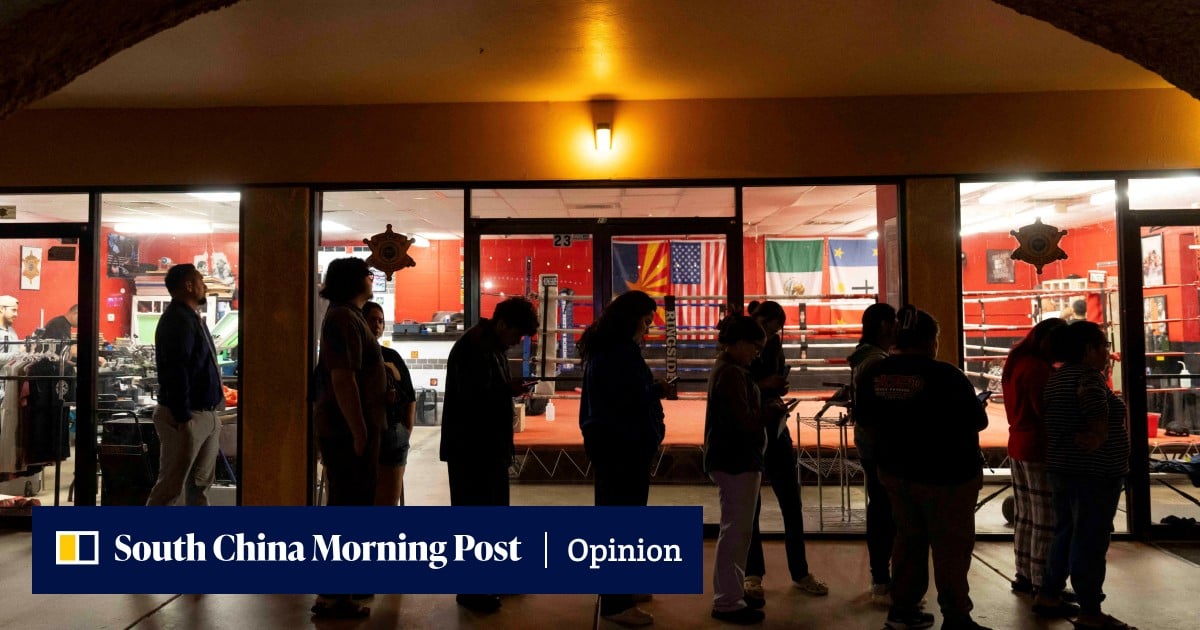
Photo via South China Morning Post

Midterm swing won’t change trajectory of US-China rivalry

Read the original at South China Morning Post ↗
Cite

Sheng, A. (2026, November 6). Midterm swing won’t change trajectory of US-China rivalry. South China Morning Post. https://www.scmp.com/opinion/china-opinion/article/3373304/midterm-swing-wont-change-trajectory-us-china-rivalry

Dated from the outlet's own feed. Check the original for its byline.

South China Morning Post · collected 2026-11-06 · by Andrew Sheng

Quick Summary

Foreign Affairs argues in its latest issue that the outcome of recent US midterm elections won’t alter the long-term trajectory of tensions between the United States and China. The article "The Limits of American Power" emphasizes that despite America's significant military, technological, and economic strengths, its ability to effectively counter China is constrained by factors such as political leadership quality and reluctance to engage militarily overseas.
Written by AI on 2026-11-06, from this article's own text only (the story summary below draws on all the coverage).

AI analysis

Story summary

Despite the recent midterm election results in the United States, South China Morning Post reported on November 6, 2026, that the trajectory of US-China geopolitical rivalry will remain unchanged for decades to come. According to Andrew Sheng’s analysis, even with the strongest military, technology, and financial prowess, American power is limited by factors such as the hesitancy to deploy troops abroad, time constraints, and leadership quality. The article emphasizes that institutional capital accumulation rather than partisan politics or technological advancements will continue to shape the dynamics between the two superpowers, increasing the likelihood of further escalation in their rivalry.

Written for “UsChina Rivalry Continues” on 2026-11-06, grounded in this article and the 0 other(s) covering the same event.

Story

📰 UsChina Rivalry Continues
Politics · 1 article(s) covering the same event.

Compared with similar articles

This article reads leans left and hedges 0% of its claims. Each row says how that neighbour differs.
South China Morning Post
Hedges 3 of 4 claims Outlet record 62/100
“The articles discuss different aspects of US-China relations and potential outcomes of midterms, but do not describe the same specific incident or occurrence.”
The Straits Times
⚖️ Leans left Hedges 10 of 47 claims Outlet record 66/100
“The articles discuss different aspects related to post-midterm election scenarios but do not describe the same specific incident or occurrence.”
The Hindu
Hedges 0 of 5 claims Outlet record 78/100
“The articles discuss different aspects of the U.S. midterm elections' implications for India-U.S. relations and U.S.-China rivalry, respectively.”
Times of India
⚖️ Leans left Hedges 26 of 56 claims Outlet record 59/100
“The articles discuss different aspects of how US midterm election results might affect foreign policy, but they do not describe the same specific incident or occurrence.”
Dawn
⚖️ Leans left Hedges 18 of 50 claims Outlet record 72/100
“The articles discuss different aspects of the midterm elections' implications—one focuses on the impact on Trump's foreign policy and Middle East conflicts, while the other discusses the long-term trajectory of US-China relations regardless of election results.”
Dawn
⚖️ Leans left Hedges 7 of 24 claims Outlet record 72/100
“The articles discuss different aspects of the implications of US midterm elections on relations with China and do not describe the same specific incident.”
The Straits Times
⚖️ Leans left Hedges 5 of 19 claims Outlet record 66/100
“The articles discuss similar topics related to US-China relations post-midterm elections but describe different perspectives and analyses rather than a single specific incident.”
South China Morning Post
⚖️ Centre further right than this Hedges 2 of 3 claims Outlet record 62/100
“The articles discuss different aspects of US foreign policy related to Asia but do not describe the same specific incident or occurrence.”
How this article was measured signals, leaning charts, publisher record, byline, topics and claims

Signals How these are calculated →

Claims extracted
4
sentences that state something as happening or true
Uncertain
0%
0 of 4 hedged ("reportedly", "may", "according to")
Leaning
Leans left
of the writing, not the subject · beta estimate
Publisher signals
62/100
South China Morning Post's corrections and hedging, across everything collected from it. Not a measure of accuracy.
Outlets on this story
1
Politics
Same framing elsewhere
1
articles that frame the event the way this one does
Analyzed 2026-11-06 · how these are computed

How this is being covered How these are calculated →

Article leaning vs. publisher reliability
Source leaning vs. consistency

Publisher

South China Morning Post · 3912 article(s) · 8 correction(s) detected
Running correction rate · 8 correction(s)

Who wrote this

Andrew Sheng
1 article(s) here · 1 carrying a prediction
🔮 It’s really about how each institutionalises its capital Despite this, the trajectory of US-China geopolitical rivalry will remain unchanged for decades, with every chance of escalation.
The only article under this byline in the corpus.

Topics

American China Democrats Foreign Affairs Republicans

Subjects

China GPE · 2× American NORP · 1× Democrats NORP · 1× Foreign Affairs ORG · 1× Republicans NORP · 1×

Narrative

The lead article, “The Limits of American Power”, concludes that even with the strongest military, technology and financial prowess, American power will be limited by the will of its enemies, hesitancy to put troops on the ground, time and the quality of its leadership, both political and military.
framing: assertive · carried by 1 article(s) · first seen 2026-11-06
🔮 It’s really about how each institutionalises its capital Despite this, the trajectory of US-China geopolitical rivalry will remain unchanged for decades, with every chance of escalation.
2026-11-06 · South China Morning Post
Midterm swing won’t change trajectory of US-China rivalry · assertive framing

Claims (4 extracted, 0 hedged)

Midterm swing won’t change trajectory of US-China rivalry asserted
swing → change → rivalry
It’s really about how each institutionalises its capital Despite this, the trajectory of US-China geopolitical rivalry will remain unchanged for decades, with every chance of escalation. asserted
trajectory → ’ → escalation
Foreign Affairs re-examines “The Delusions of American Power” in its latest issue. asserted
Affairs → re → issue
The lead article, “The Limits of American Power”, concludes that even with the strongest military, technology and financial prowess, American power will be limited by the will of its enemies, hesitancy to put troops on the ground, time and the quality of its leadership, both political and military. asserted
power → conclude → leadership
💬Give feedback · no sign-in needed

No sign-in needed for now. Your note is sent without a name, so it cannot be answered.

🕘History 🎫Support