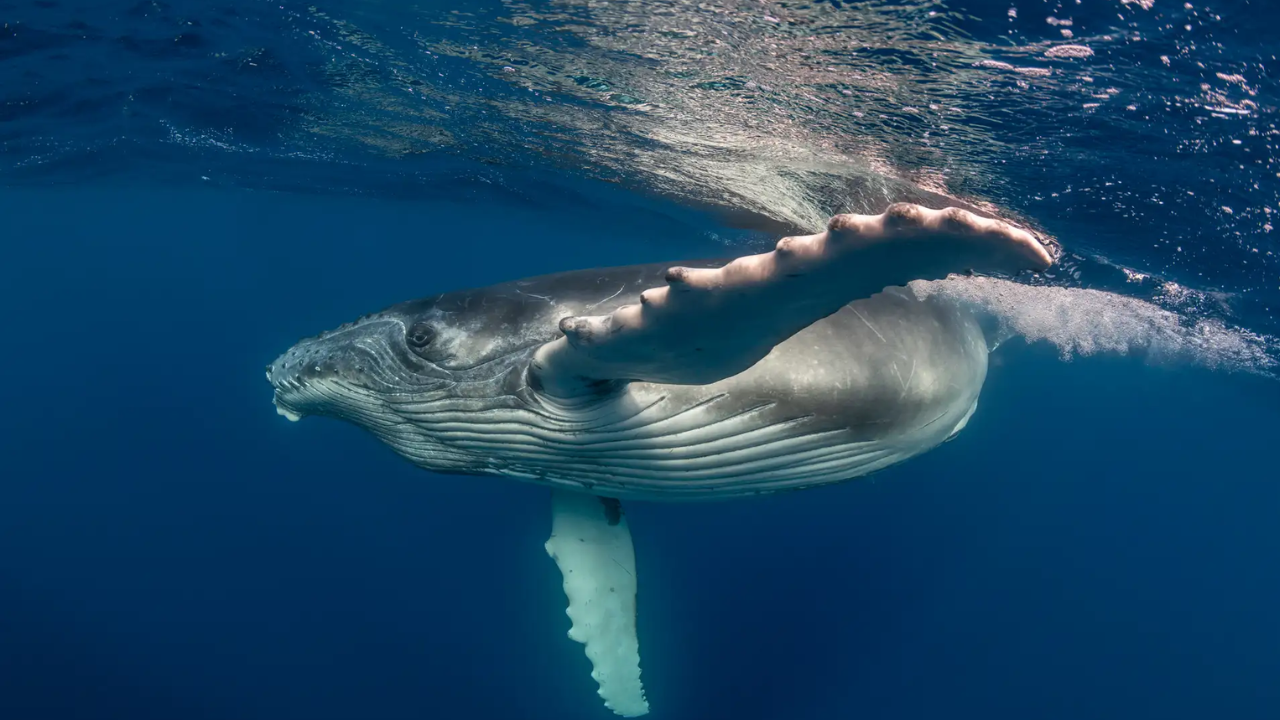
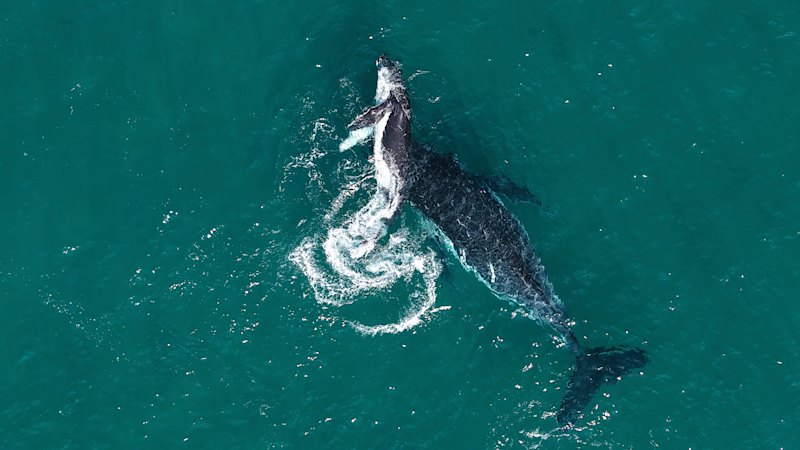
Photo via ABC News (AU)

'Pretty emotional': Rare video shows humpback whale with stillborn calf

Read the original at ABC News (AU) ↗
Cite

Johnson, E. (2026, September 16). 'Pretty emotional': Rare video shows humpback whale with stillborn calf. ABC News (AU). https://www.abc.net.au/news/2026-09-17/humpback-whale-video-with-calf-reveals-grieving-behaviour/107156326

Dated when The Aporia collected the article, usually within hours of publication. Check the original for its exact date and byline.

ABC News (AU) · collected 2026-09-16 · by Emma Johnson

Quick Summary

A video captured off the Gold Coast in July last year shows a humpback whale mother interacting with her stillborn calf, an extremely rare instance of apparent grieving behavior in the species. The footage, filmed by SeaWorld Foundation rescue boat captain Andrew Mulville, lasted at least two hours and depicts the mother touching the calf multiple times before lying beside it. Dr. Olaf Meynecke from Griffith University’s Whales and Climate Research Program notes that such post-mortem attentive behavior is uncommon in humpback whales but highlights a strong emotional bond between mothers and calves. Researchers emphasize the need for further documentation to better understand whale responses to death and stress.
Written by AI on 2026-09-17, from this article's own text only (the story summary below draws on all the coverage).

AI analysis

Story summary

In July 2025, off Palm Beach Reef on Australia’s Gold Coast, a female humpback whale was filmed displaying what researchers believe is grief over her stillborn calf. The footage, captured by Andrew Mulville from Sea World, shows the mother repeatedly touching and observing the calf for at least two hours. Dr Olaf Meynecke of Griffith University described this behavior as post-mortem attentive, noting that it had not been observed before in humpback whales. This discovery is significant because it may indicate complex emotional responses in marine mammals, though more research is needed to understand these behaviors fully. The study, published in Discover Animals, highlights the importance of further observations to better comprehend how humpbacks respond to death and stress.

Written for “Whale Grief Behavior” on 2026-11-01, grounded in this article and the 3 other(s) covering the same event.

Story

📰 Whale Grief Behavior
Science · 4 article(s) covering the same event. Compare every outlet's account →

Compared with similar articles

This article reads unscored and hedges 11% of its claims. Each row says how that neighbour differs.
Times of India
Hedges 9 of 35 claims Outlet record 59/100
The Sydney Morning Herald
Hedges 7 of 32 claims Outlet record 61/100
BBC News
Hedges 1 of 3 claims Outlet record 68/100
How this article was measured signals, leaning charts, publisher record, byline, topics and claims

Signals How these are calculated →

Claims extracted
27
sentences that state something as happening or true
Uncertain
11%
3 of 27 hedged ("reportedly", "may", "according to")
Leaning
not political
takes no side on a contested political question
Publisher signals
68/100
ABC News (AU)'s corrections and hedging, across everything collected from it. Not a measure of accuracy.
Outlets on this story
4
Science
Same framing elsewhere
1
articles that frame the event the way this one does
Analyzed 2026-09-17 · how these are computed

How this is being covered How these are calculated →

Article leaning vs. publisher reliability
Source leaning vs. consistency

Publisher

ABC News (AU) · 4547 article(s) · 10 correction(s) detected
Running correction rate · 10 correction(s)

Who wrote this

Emma Johnson
10 article(s) here · 1 carrying a prediction
🔮 Police declare it a crime scene, and later say that one of the offenders may have suffered burns while setting the car alight.
🔮 Queensland would have felt the biggest impact — it received $1.3 billion under the current framework in 2024-25, the highest proportion in the country.
2026-10-09 · assertive framing · Federal government backtracks on disaster funding split
🔮 Densely populated and polluted with light, major cities like Brisbane may not be the most obvious places to see the stars.
🔮 "Those counselling micro skills that you might need to respond to someone if they are in crisis or if they do become distressed, that's where our music therapists can be really useful in this space," Dr Aitchison said.
🔮 So is the Fitzroy the right call, and will athletes have to compete alongside crocodiles?
🔮 "Having the background knowledge of the strong bond between mother and calf, and then witnessing the response of a female towards a stillborn is obviously a very unique way of observing animal behaviour and understanding what the responses might be when a situation like this occurs," Dr Meynecke said.
🔮 " "As a result, the family limit will be applied differently going forward and retrospectively from 1 March 2026." New guidance issued to fertility clinics today reflects the changes, defining a same-sex couple who both conceive using the same donor as one family. Fertility lawyer Stephen Page said he was "delighted" by the update. "This is a real victory of advocacy," he said.
🔮 The Fair Work Commission has been overseeing the negotiations between QR and several unions since May. What's next? QR remains involved in bargaining for two other enterprise agreements, and says train services will continue to run on a reduced timetable.
2026-08-18 · assertive framing · Queensland Rail reaches deal with train controllers
Also by Emma Johnson
Nothing else under this byline is closely related to this article, so these are simply their most recent.
All 10 articles by Emma Johnson →

Topics

Discover Animals Griffith University's Palm Beach SeaWorld Foundation Whales and Climate Research Program

Subjects

Meynecke PERSON · 4× Pirotta PERSON · 2× Andrew Mulville PERSON · 1× Discover Animals ORG · 1× Griffith University's ORG · 1× Mulville PERSON · 1× Olaf Meynecke PERSON · 1× Palm Beach GPE · 1× SeaWorld Foundation ORG · 1× Whales and Climate Research Program ORG · 1×

Narrative

Dr Olaf Meynecke, a marine scientist at Griffith University's Whales and Climate Research Program, said the "post-mortem attentive behaviour", sometimes referred to as grieving behaviour, shown towards the calf had not been seen in humpback whales before.
framing: assertive · carried by 1 article(s) · first seen 2026-09-17
🔮 "Having the background knowledge of the strong bond between mother and calf, and then witnessing the response of a female towards a stillborn is obviously a very unique way of observing animal behaviour and understanding what the responses might be when a situation like this occurs," Dr Meynecke said.
2026-09-17 · ABC News (AU)
'Pretty emotional': Rare video shows humpback whale with stillborn calf · assertive framing

Claims (27 extracted, 3 hedged)

In short: A female humpback whale was filmed interacting with its stillborn calf in waters off the Gold Coast last year. asserted
whale → film → Coast
Researchers say the encounter was a rare example of the species showing "grieving behaviour". asserted
species → say → behaviour
Scientists say more documentation is needed to better understand humpback whales' response to death and stress. asserted
documentation → say → death
A video of a female humpback whale and its stillborn calf, taken near the Gold Coast, is a rare glimpse into the species' reaction to death, researchers say. asserted
researchers → take → death
The footage, filmed in waters off Palm Beach in July last year, shows a whale interacting with its deceased calf immediately after giving birth. asserted
whale → film → birth
The mother approaches the calf several times, touching it with its head and fin, then lies still alongside the newborn's body. asserted
mother → approach → body
The female and another "escort" whale remained with the stillborn for at least two hours. asserted
female → remain → hours
Members of the public spotted two adult humpbacks in the same area over the next two days, although it was not confirmed if they were the same animals. asserted
they → spot → days
Dr Olaf Meynecke, a marine scientist at Griffith University's Whales and Climate Research Program, said the "post-mortem attentive behaviour", sometimes referred to as grieving behaviour, shown towards the calf had not been seen in humpback whales before. asserted
behaviour → say → whales
Dr Meynecke co-authored a report of the encounter, published in the Discover Animals journal. asserted
- → co → journal
"Having the background knowledge of the strong bond between mother and calf, and then witnessing the response of a female towards a stillborn is obviously a very unique way of observing animal behaviour and understanding what the responses might be when a situation like this occurs," Dr Meynecke said. uncertain
Meynecke → have → this
"They were not travelling, they were not socialising, and they were staying in the same spot and milling or turning around in the same area. asserted
they → travel → area
"We are seeing something here that suggests at least a strong attachment to this stillborn and clearly a change of behaviour after this event occurred." uncertain
event → see → behaviour
SeaWorld Foundation rescue boat captain Andrew Mulville was on a day off fishing with his son when he was asked to check on the whales, which had been reported as acting strangely. asserted
which → fish → whales
After he realised one of the whales had given birth to a stillborn calf, he decided to film the encounter with an underwater camera. asserted
he → realise → camera
Mr Mulville said after 25 years caring for sick whales, seeing strandings and conducting rescues, he had a good understanding of their typical behaviour. asserted
he → say → behaviour
"That was a huge part of what made me even think to put my head underwater in the first place because it was something I've never seen before," he said. asserted
he → make → place
"It was a pretty powerful moment, but I suppose at the same time it was nature, and pretty emotional underwater with the sounds of both the mother and also a second adult companion animal there. asserted
it → suppose → mother
Grieving behaviour has been more commonly observed among types of toothed whales and dolphins, including instances of Orca whales carrying dead calves for hours or days at a time. asserted
whales → grieve → time
Dr Meynecke said dead humpback calves were much harder to observe, as they are less buoyant and often sink to the bottom of the ocean quickly. asserted
they → say → ocean
He hopes that more people using drones while in the water will make it easier to document similar events in the future. asserted
it → hop → future
"It does help us to understand animals in general much better, also hopefully understand our humpback whales better," Dr Meynecke said. asserted
Meynecke → help → whales
"We can then start thinking about what it means for a whale to actually be entangled in fishing gear or to experience stress, and how long that impact might even last." uncertain
impact → start → stress
Macquarie University whale scientist Dr Vanessa Pirotta, who was not involved in the report, said it was "challenging" to interpret the female whale's behaviour. asserted
it → involve → behaviour
"For a humpback whale to give birth to a calf and it being stillborn, I would say that there would definitely be at least a reflection on potentially what has happened, given that this mother has been carrying this calf," Dr Pirotta said. asserted
Pirotta → give → calf
She noted that while humans and whales can share similarities as mammals, it was important not to "anthropomorphise" the behaviour. asserted
it → note → behaviour
"What we can do is we can learn from observations, and that's exactly what science is about," Dr Pirotta said. asserted
Pirotta → learn → what

💬Give feedback
🕘History 🎫Support