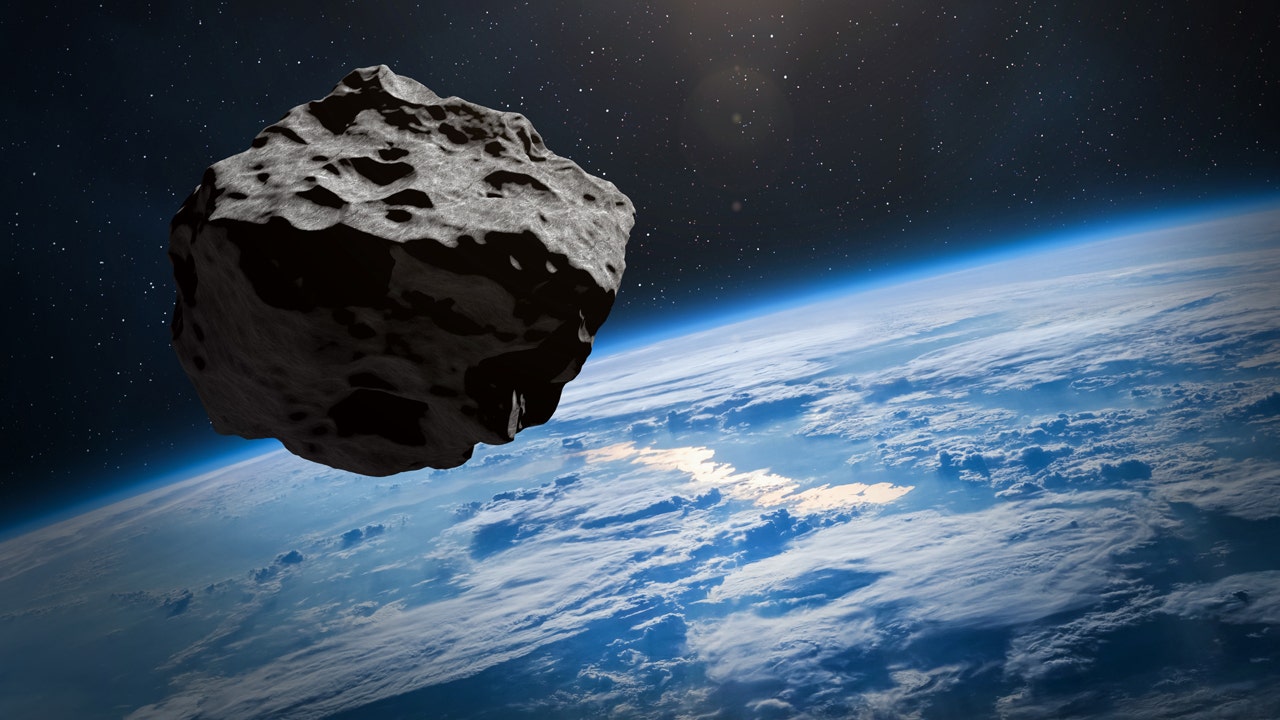
Photo via New York Post

Scientists question what is pushing strange, speeding object through space as new theory grows

Read the original at New York Post ↗
Cite

Fox News. (2026, November 12). Scientists question what is pushing strange, speeding object through space as new theory grows. New York Post. https://nypost.com/2026/11/12/world-news/mysterious-object-moving-through-space-could-be-lost-soviet-probe-as-nasa-weighs-in-on-theory/

Dated from the outlet's own feed. Check the original for its byline.

New York Post · collected 2026-11-12 · by Fox News

Quick Summary

Scientists are investigating the unusual acceleration of an object in space called 1998 KY26, which measures about 36 feet wide and is speeding through the solar system. Researchers have proposed theories ranging from it being a dark comet with buried water ice to a Soviet spacecraft from 1988. However, a new study by Georgia Institute of Technology scientists, published in the journal Icarus, casts doubt on the dark comet theory due to the object’s temperature being too high for buried water ice to survive. Meanwhile, Harvard astrophysicist Avi Loeb and colleagues suggest that 1998 KY26 could be the lost Soviet spacecraft Phobos 1, based on similarities in how sunlight reflects off the object and a model of the spacecraft.
Written by AI on 2026-11-14, from this article's own text only (the story summary below draws on all the coverage).
See how they differ ↓

AI analysis

Story summary

A mysterious object, known as 1998 KY26, is accelerating in a way that cannot be explained by gravity alone, leading some scientists to speculate that it might be a lost Soviet spacecraft. Harvard astrophysicist Avi Loeb challenges NASA Administrator Jared Isaacman's assertion that the object is just an asteroid, arguing that 1998 KY26 exhibits non-gravitational acceleration, suggesting it is influenced by forces other than gravity. The object is approximately 36 feet wide and is currently 189 million miles from Earth, with its closest approach to Earth expected to be within 32 million miles in 2028. Scientists are closely monitoring the object, which was originally thought to be a near-Earth asteroid but now raises questions due to its unusual acceleration pattern.

Written for “Mysterious Object In Space Debate” on 2026-11-18, grounded in this article and the 4 other(s) covering the same event.

How they differ

4 outlets covered “Mysterious Object In Space Debate”.

What each outlet says

One AI summary per outlet of its latest article on this story, written from that article alone and checked against it. Open the article for the outlet's own words.

New York PostThis outlet12 Nov

Scientists are investigating the unusual acceleration of an object in space called 1998 KY26, which measures about 36 feet wide and is speeding through the solar system. Researchers have proposed theories ranging from it being a dark comet with buried water ice to a Soviet spacecraft from 1988. However, a new study by Georgia Institute of Technology scientists, published in the journal Icarus, casts doubt on the…

Scientists question what is pushing strange, speeding object through space as new theory grows (this article)
Fox News15 Nov

Harvard astrophysicist Avi Loeb is challenging NASA Administrator Jared Isaacman's assertion that the mysterious space object 1998 KY26 is an asteroid. Loeb argues that the object's unusual acceleration suggests it is not a typical asteroid but could be the Soviet spacecraft Phobos 1. Isaacman stated during a Fox & Friends appearance that there is no evidence to suggest otherwise, while Loeb, in an interview with…

Harvard scientist pushes back on NASA chief over mystery space object: 'It's not an asteroid' →2 articles from Fox News on this story
Daily Mail12 Nov

Scientists have observed that the near-Earth object 1998 KY26, initially thought to be a simple asteroid, is accelerating at a rate unexplained by gravitational forces alone. This mysterious acceleration has led Harvard Professor Avi Loeb to propose that 1998 KY26 might actually be the lost Soviet spacecraft Phobos 1, which vanished in 1988. The object, approximately 36 feet in length and spinning very rapidly, will…

Object heading toward Earth is mysteriously accelerating as scientist claims it is a long-lost spacecraft →
Euronews15 Nov

An object called "1998 KY26," approximately 11 meters wide, is exhibiting unusual acceleration near Earth, leading scientists to speculate it might be the Soviet spacecraft Phobos 1, which disappeared in 1988. Harvard astrophysicist Avi Loeb and colleagues have proposed this hypothesis after modeling Phobos 1 and finding a match with observations of KY26, including its reflective properties and rotation speed…

Mysterious object in space: Could it be a Soviet probe missing for 40 years? →

Where they agree and split

Framing

How the first headlines put it

A claim to check1
Stated as fact2
The headlines (3)

Object heading toward Earth is mysteriously accelerating as scientist claims it is a long-lost spacecraft Daily Mail · a claim to check

Mysterious object moving through space could be lost Soviet probe as NASA weighs in on theory Fox News · stated as fact

Scientists question what is pushing strange, speeding object through space as new theory grows New York Post · stated as fact

The full story: what happened, how it changed, and all 5 articles →

Compared with similar articles

This article reads unscored and hedges 26% of its claims. Each row says how that neighbour differs.
Fox News
Hedges 7 of 27 claims Outlet record 67/100
Euronews
Hedges 8 of 29 claims Outlet record 60/100
Fox News
Hedges 7 of 29 claims Outlet record 67/100
“While both articles discuss the mysterious object 1998 KY26, they describe different aspects of the ongoing scientific debate and do not cover the same specific incident or time frame.”

Story

Mysterious Object In Space Debate
Science · 5 article(s) covering the same event. Compare every outlet's account →
How this article was measured signals, leaning charts, publisher record, byline, topics and claims

Signals How these are calculated →

Claims extracted
27
sentences that state something as happening or true
Uncertain
26%
7 of 27 hedged ("reportedly", "may", "according to")
Leaning
not political
takes no side on a contested political question
Publisher signals
66/100
New York Post's corrections and hedging, across everything collected from it. Not a measure of accuracy.
Outlets on this story
5
Science
Same framing elsewhere
1
articles that frame the event the way this one does
Analyzed 2026-11-14 · how these are computed

How this is being covered How these are calculated →

Article leaning vs. publisher reliability
Source leaning vs. consistency

Publisher

New York Post · 21075 article(s) · 41 correction(s) detected
Running correction rate · 41 correction(s)

Who wrote this

Fox News
512 article(s) here · 1 carrying a prediction
They also would not say whether anyone else may have been involved.
“These are extremely serious allegations, and our collective response should send a strong message that we will act swiftly and robustly where we suspect this kind of espionage activity taking place,” Taylor said in a statement.
Thomas was joined by Justice Samuel Alito in dissenting from the decision, arguing that allowing the law to stand could have implications reaching far beyond the medical field.
Christian convert could face execution in Egypt as State Department monitors trial
Upon taking office, New York City Mayor Zohran Mamdani signed an executive order limiting city coordination with ICE, and a state law signed by Gov. Kathy Hochul took effect in August barring local authorities from cooperating with federal immigration officials.
Khanna, a frequent critic of President Donald Trump’s war in the Middle East, said the checks would be sent to every American family to reimburse them for the higher gas, food and electricity prices sparked by the conflict and resulting disruptions to oil transport routes.
The developments came days before President Donald Trump is expected to meet Putin and Chinese President Xi Jinping in China, amid renewed US-brokered efforts to end the nearly five-year conflict.
The Ravens will lean on Derrick Henry and a ball-control approach, especially with extra rest and a home crowd behind them.
In a game expected to land in the 30s, 4.5 points is a real cushion.
In a game expected to be low-scoring, 4.5 points is a meaningful cushion.
Wire or desk byline, not an individual reporter.
Also by Fox News
Nothing else under this byline is closely related to this article, so these are simply their most recent.
All 512 articles by Fox News →

Topics

Fox News Georgia Institute of Technology KY26 NASA Soviet

Subjects

Soviet NORP · 2× Fox News ORG · 1× Georgia Institute of Technology ORG · 1× Greg Wehner PERSON · 1× Icarus ORG · 1× Isaacman PERSON · 1× Jared Isaacman PERSON · 1× Korbin Hansen PERSON · 1× Masatoshi Hirabayashi PERSON · 1× NASA ORG · 1×

Narrative

One theory has been that KY26 is a “dark comet” containing buried water that turns to gas and gives the object a push through space, even though astronomers have not detected the cloud or tail normally associated with a comet. But a new peer-reviewed study by Georgia Institute of Technology researchers Korbin Hansen and Masatoshi Hirabayashi casts doubt on that explanation.
framing: mixed · carried by 1 article(s) · first seen 2026-11-14
A mysterious object speeding through the solar system is accelerating in a way gravity alone cannot explain, fueling a theory that it could be a Soviet spacecraft lost nearly four decades ago.

Claims (27 extracted, 7 hedged)

Scientists question what is pushing strange, speeding object through space as new theory grows asserted
theory → question → space
A mysterious object speeding through the solar system is accelerating in a way gravity alone cannot explain, fueling a theory that it could be a Soviet spacecraft lost nearly four decades ago. uncertain
it → speed → theory
Known as 1998 KY26, the roughly 36-foot-wide object is believed to be a near-Earth asteroid, but something other than gravity appears to be affecting its path. asserted
something → know → path
New research has now cast doubt on one explanation for what is pushing it through space. asserted
what → cast → space
NASA Administrator Jared Isaacman weighed in on the growing speculation Thursday morning on “Fox & Friends,” saying some in the UAP community believe the object is making unusual movements, but he has seen no evidence KY26 is anything other than an asteroid. asserted
KY26 → weigh → asteroid
“First of all, nothing is about to hit us, to be very clear on this,” Isaacman said. asserted
Isaacman → hit → this
“I’ve not seen any evidence to suggest this is a threat to our planet or anything other than an asteroid.” asserted
this → see → asteroid
Scientists refer to KY26’s unusual movement as “nongravitational acceleration,” meaning something besides the pull of the sun and planets is affecting its path. asserted
something → refer → path
One theory has been that KY26 is a “dark comet” containing buried water that turns to gas and gives the object a push through space, even though astronomers have not detected the cloud or tail normally associated with a comet. But a new peer-reviewed study by Georgia Institute of Technology researchers Korbin Hansen and Masatoshi Hirabayashi casts doubt on that explanation. asserted
study → contain → explanation
Their study, published in the journal Icarus, found KY26 is likely too warm for buried water ice to survive long enough to account for the unusual movement. asserted
ice → publish → movement
The researchers concluded that calculated water-loss rates “preclude 1998 KY26 being a dark comet at present.” asserted
KY26 → conclude → ?
Previous research found that sunlight hitting KY26 and heat escaping from its surface could produce the extra push without buried water. uncertain
heat → find → water
Another group of researchers, however, has explored a far more unusual possibility. asserted
group → explore → possibility
Harvard astrophysicist Avi Loeb and researchers Adam Hibberd and Adam Crowl have examined whether KY26 could actually be Phobos 1, an unmanned Soviet spacecraft that stopped communicating while traveling to Mars in 1988. uncertain
that → examine → 1988
KY26 is about 36 feet across, reflects roughly 52% of the sunlight that hits it and completes a full rotation every 5.35 minutes. asserted
that → reflect → rotation
The researchers built a simplified model of Phobos 1 and compared the way it would reflect sunlight as it spun with observations of KY26. asserted
it → build → KY26
They found the spacecraft model closely matched eight sets of observations of the object. asserted
model → find → object
They also tested whether sunlight pushing against a cylinder or solar panels could help explain KY26’s movement and found the model better matched hundreds of telescope and radar observations. uncertain
model → test → observations
“Although an investigation of this kind cannot be conclusive,” the researchers wrote, the findings “add strong weight to the Phobos 1 hypothesis.” asserted
findings → write → hypothesis
The researchers stressed, though, that their model does not prove KY26 is the missing spacecraft, describing the theory as “strongly plausible but presently unproven.” Other research points to a more conventional answer. asserted
research → stress → answer
A separate study published this year in Astronomy & Astrophysics examined the light reflected by KY26 and found its makeup appears consistent with a type of rocky asteroid. asserted
makeup → publish → asteroid
Researchers concluded it likely came from the inner part of the asteroid belt. asserted
it → conclude → belt
“I have no reason to believe this is in any way remotely a threat to our planet or anything other than just an asteroid,” he said. asserted
he → have → asteroid
Scientists may eventually get a definitive answer. uncertain
Scientists → get → answer
The Japan Aerospace Exploration Agency’s Hayabusa2 spacecraft is scheduled to rendezvous with KY26 in July 2031, according to a 2025 study published in Nature Communications. uncertain
spacecraft → schedule → Communications
For Loeb, that encounter could provide the ultimate test of the Phobos 1 theory. uncertain
encounter → provide → theory
“Our prediction is that instead of an iceberg, Hayabusa 2’s cameras will reveal the label ‘Made in the U.S.S.R.,'” Loeb wrote. asserted
Loeb → reveal → U.S.S.R.
Give feedback · no sign-in needed

No sign-in needed for now. Your note is sent without a name, so it cannot be answered.

History Support