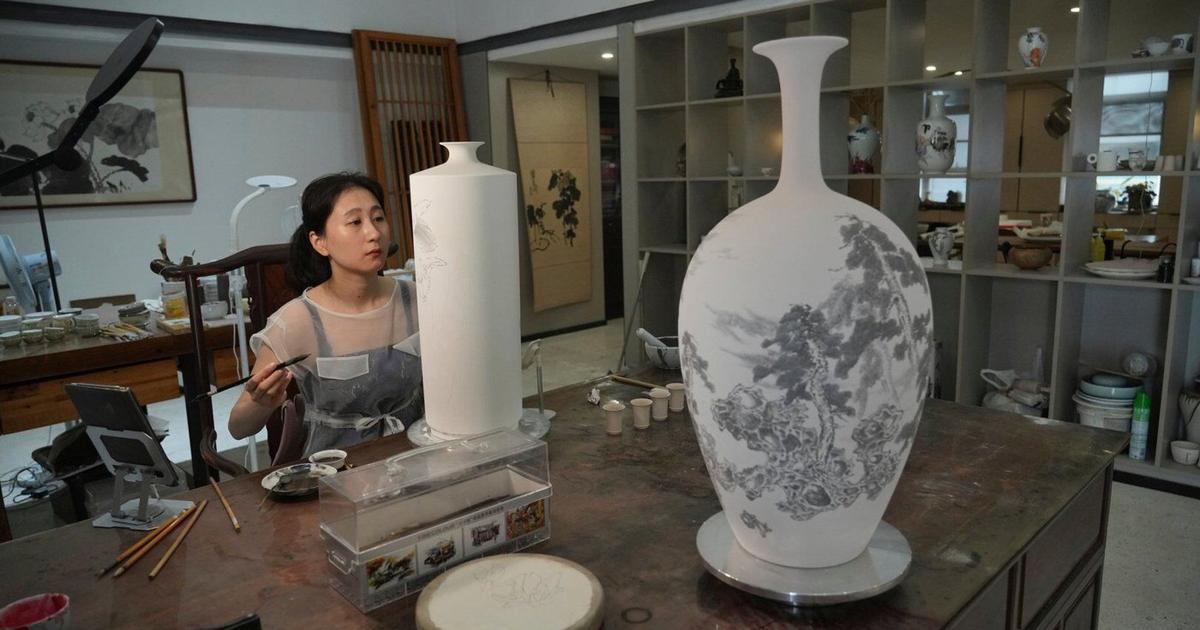
Chinese porcelain artist Chen Qing has a vivid memory of her grandfather.
asserted
Qing → have → grandfather
It was the only time he wrote down the formula for her family’s distinctive red pigment.
asserted
he → write → pigment
He asked her mother to memorize it and burned the paper minutes later.
asserted
He → ask → paper
The secret has since been passed down orally from one generation to the next.
asserted
secret → pass → next
“My mother did not reveal the formula to me until I was over 30,” Chen said.
asserted
Chen → reveal → me
Her family has practiced the craft since around 1860 in Jingdezhen, known as China’s “Porcelain Capital.”
asserted
family → practice → Capital
It is located in Jiangxi province, about 1,180 kilometers (735 miles) southeast of Beijing.
asserted
It → locate → Beijing
Jingdezhen’s pottery-making history spans more than 2,000 years.
asserted
history → span → years
It began during the Han Dynasty and its porcelain sites were inscribed on UNESCO’s World Heritage List in 2026.
asserted
sites → begin → 2026
Small details take years to master
Jingdezhen’s craftsmen have kept alive techniques once used to produce porcelain for the imperial court.
asserted
craftsmen → take → court
That knowledge later spread to private artisans.
asserted
knowledge → spread → artisans
Chen’s ancestors adopted some of those traditions after the fall of the Qing Dynasty in 1912.
asserted
ancestors → adopt → 1912
“The craft is very difficult for an outsider to master,” Chen said.
asserted
Chen → master → ?
“A family might spend nearly a century developing a single technique.”
uncertain
family → spend → technique
Two tables in her studio are covered with brushes, unfinished pieces and pigments.
asserted
tables → cover → brushes
She works in silence, a lamp lighting her strokes.
asserted
lamp → work → strokes
Chen’s fingers never touch the porcelain’s surface.
asserted
fingers → touch → surface
She steadies her hand against its outer edge, holding the brush firmly as she paints delicate, precise strokes.
asserted
she → steady → strokes
Painting a porcelain teacup can take days to complete.
asserted
Painting → paint → days
A single particle of dust or sweat could ruin the piece and require her to start from scratch.
uncertain
particle → ruin → scratch
Landscapes are the most difficult scenes to paint because their boundaries are not clear.
asserted
boundaries → paint → ?
A mountain summit might be emerald green, gradually shifting to brown and other warmer colors farther down the slope.
uncertain
summit → shift → slope
“Mastering a craft is a lifelong process,” Chen said.
asserted
Chen → master → craft
“Few people are willing to spend more than 10 years learning such a painstaking craft.”
asserted
people → spend → craft
Fragments of porcelain reveal a spiritual past
Artists like Chen work alongside archaeological sites and museums to preserve China’s porcelain heritage.
asserted
Artists → reveal → heritage
Jingdezhen’s Imperial Kiln Institute researches and restores ceramics excavated from an adjacent complex, where pieces for emperors were crafted in kilns whose remains are still visible today.
asserted
remains → research → kilns
The institute is incorporating new technologies into its work, including artificial intelligence, to help match and reconstruct ancient porcelain fragments.
asserted
institute → incorporate → fragments
“By the establishment of our ceramic gene bank, we can collect all kinds of information,” said the institute’s president, Weng Yanjun.
asserted
president → collect → information
“We hope that we can retrieve ancient technology with modern science.”
asserted
we → hope → science
That research can also shed light on the culture and beliefs that surrounded porcelain-making centuries ago.
asserted
that → shed → making
Among the tiles made at Jingdezhen’s imperial kilns were those used in the Bao’en Pagoda.
asserted
those → make → Pagoda
It was part of a Buddhist temple complex that was destroyed during a 19th-century rebellion in the city of Nanjing.
asserted
that → destroy → Nanjing
Its exterior walls were covered with porcelain tiles, each bearing an image of the Buddha.
asserted
walls → cover → Buddha
Traces of other religious traditions can also be found in porcelain studied by the institute, Weng said.
asserted
Weng → find → institute
“Islam, Buddhism, Taoism and, later on, European Catholic Christianity harmoniously blend into the porcelain decorations,” he added.
asserted
he → blend → decorations
Porcelain-making was surrounded by its own beliefs
asserted
making → surround → beliefs
Within Jingdezhen’s imperial kiln complex stands a shrine commemorating Tong Bin, the protective spirit of ceramics.
asserted
shrine → stand → ceramics
Known as the “Immortal Master of Wind and Fire” or “Kiln God,” Tong was revered during the Qing dynasty for sacrificing himself in protest against the abuse of kiln workers, according to local tradition.
uncertain
Tong → know → tradition
The shrine remains open today, with a statue honoring Tong inside alongside figures representing other traditional roles in porcelain-making.
“In ancient times, the technology was not as advanced as it is today, so, in many cases, people had to rely on their beliefs — their gods — to help bring good luck and better results,” Weng said.
asserted
Weng → remain → luck
How artisans today honor their craft varies widely
Some Jingdezhen craftsmen say they hold no particular beliefs associated with porcelain-making.
asserted
they → honor → making
…and 21 more, not listed.
 The Aporia