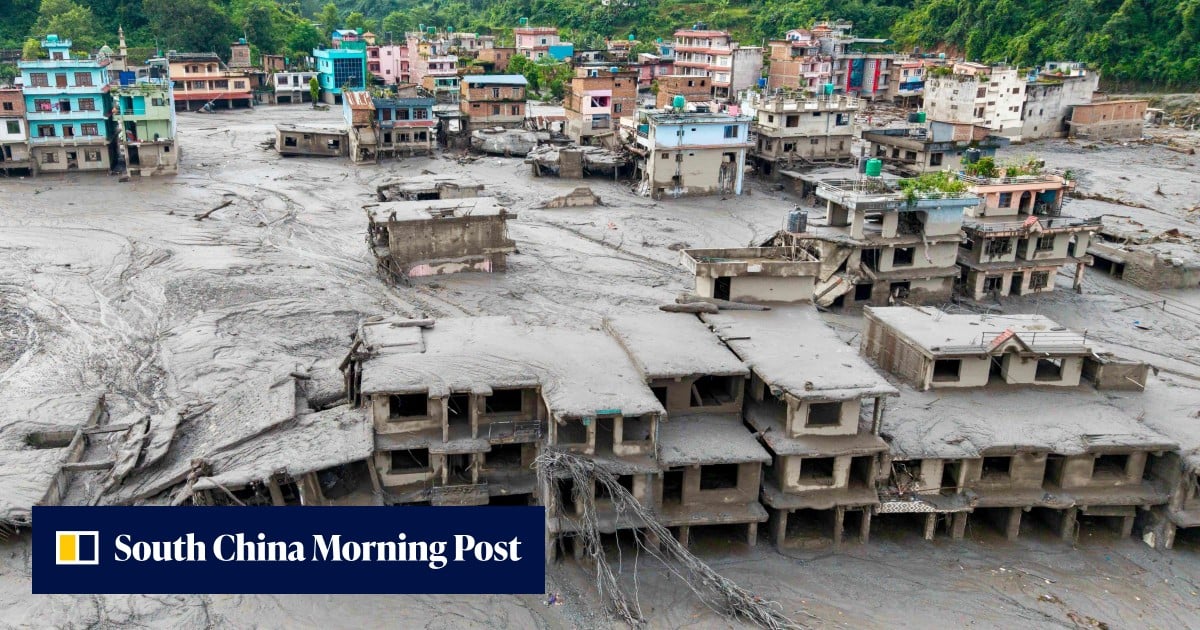
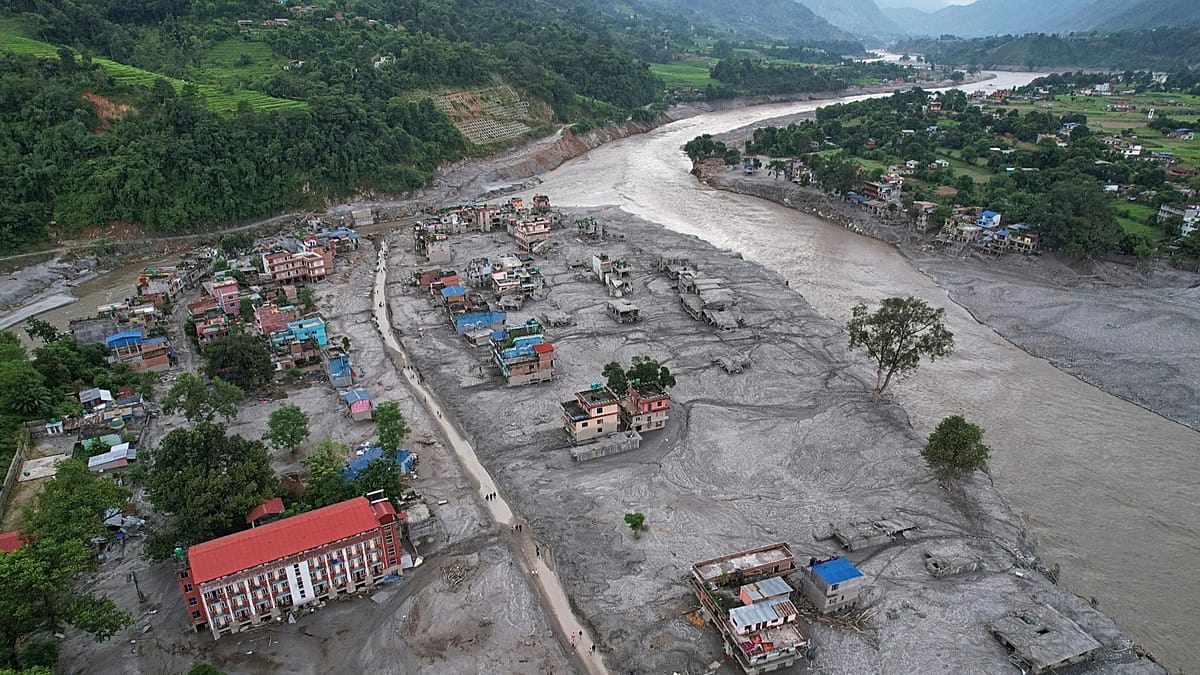
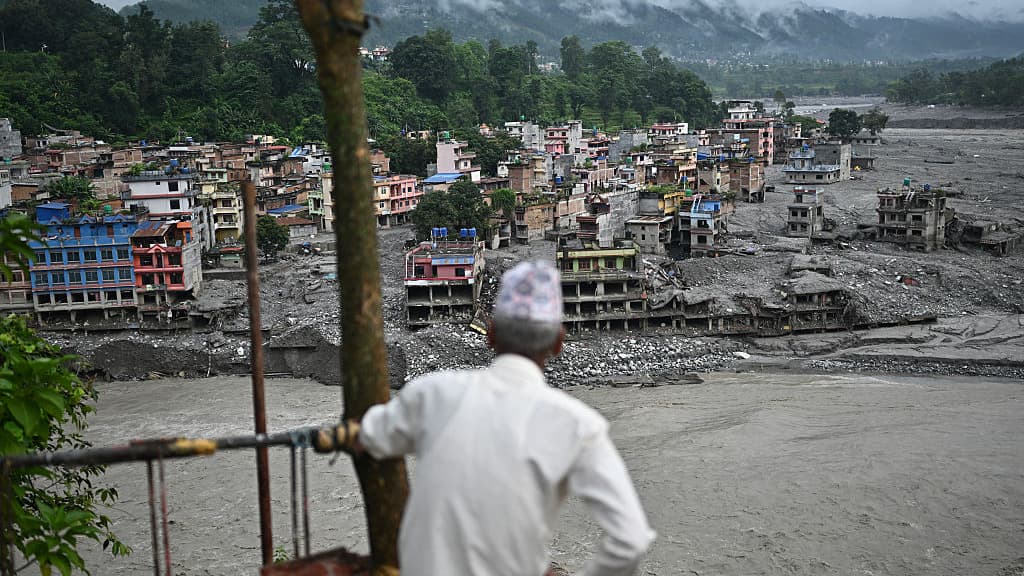
Photo via Daily Mail

Scientists blame climate change for Nepal's devastating flash floods - and warn similar disasters are 'inevitable' as global temperatures continue to rise

Read the original at Daily Mail ↗
Cite

Best, S. (2026, September 17). Scientists blame climate change for Nepal's devastating flash floods - and warn similar disasters are 'inevitable' as global temperatures continue to rise. Daily Mail. https://www.dailymail.com/sciencetech/article-16135633/Scientists-blame-climate-change-Nepal-floods.html?ns_mchannel=rss&ns_campaign=1490&ito=1490

Dated when The Aporia collected the article, usually within hours of publication. Check the original for its exact date and byline.

Daily Mail · collected 2026-09-17 · by Shivali Best

Quick Summary

Scientists attribute Nepal's recent devastating flash floods to climate change, with over 1,300 deaths and more than 5,000 missing. On August 26, a massive section of glacier and rock fell from Lantang Lirung mountain, triggering an enormous flood downstream. The World Weather Attribution experts link the disaster to prolonged permafrost thaw and glacial thinning caused by climate change, warning that similar events will likely occur as global temperatures continue to rise.
Written by AI on 2026-09-17, from this article's own text only (the story summary below draws on all the coverage).

AI analysis

Story summary

In late August 2026, flash floods caused by a glacial collapse near the Nepal-Tibet border devastated central and northern Nepal, leading to over 1,450 deaths as of September 20. The floodwaters swept away homes, vehicles, roads, bridges, and hydropower projects in multiple districts including Chitwan, Rasuwa, and Nawalparasi. With more than 6,000 people still missing, recovery efforts are hampered by severe damage to infrastructure and the decomposed state of many recovered bodies, complicating identification processes.

Prime Minister Balendra Shah has declared an early warning system for natural disasters as a top priority in Nepal, acknowledging that such systems could have saved lives. Meanwhile, international experts suggest climate change likely contributed to the instability of glaciers and permafrost, triggering the devastating avalanche that caused the floods. The disaster highlights the urgent need for global action on climate issues, with scientists noting that without faster transitions towards zero fossil fuel emissions, similar catastrophic events will become more frequent in the future.

Written for “Nepal Flood Disaster” on 2026-10-31, grounded in this article and the 18 other(s) covering the same event.

Story

📰 Nepal Flood Disaster
Environment · 19 article(s) covering the same event. Compare every outlet's account →

Compared with similar articles

This article reads leans left and hedges 20% of its claims. Each row says how that neighbour differs.
BBC News
Hedges 6 of 18 claims Outlet record 68/100
Toronto Star
⚖️ Leans left Hedges 5 of 37 claims Outlet record 64/100
The Hindu
Hedges 3 of 8 claims Outlet record 60/100
The Hindu
Hedges 2 of 37 claims Outlet record 60/100
South China Morning Post
⚖️ Leans left Hedges 0 of 4 claims Outlet record 64/100
The Hindu
Hedges 1 of 15 claims Outlet record 60/100
Al Jazeera
⚖️ Leans strongly left further left than this Hedges 5 of 16 claims Outlet record 60/100
Euronews
⚖️ Leans left Hedges 2 of 25 claims Outlet record 60/100
TIME
⚖️ Leans strongly left further left than this Hedges 5 of 65 claims Outlet record 59/100
How this article was measured signals, leaning charts, publisher record, byline, topics and claims

Signals How these are calculated →

Claims extracted
25
sentences that state something as happening or true
Uncertain
20%
5 of 25 hedged ("reportedly", "may", "according to")
Leaning
Leans left
of the writing, not the subject · beta estimate
Publisher signals
68/100
Daily Mail's corrections and hedging, across everything collected from it. Not a measure of accuracy.
Outlets on this story
19
Environment
Same framing elsewhere
1
articles that frame the event the way this one does
Analyzed 2026-09-17 · how these are computed

How this is being covered How these are calculated →

Article leaning vs. publisher reliability
Source leaning vs. consistency

Publisher

Daily Mail · 8535 article(s) · 20 correction(s) detected
Running correction rate · 20 correction(s)

Who wrote this

Shivali Best
11 article(s) here · 1 carrying a prediction
🔮 Pictured: wildfires in southeastern France on July 28 To understand the role climate change played in these excess heat deaths, the researchers compared the temperatures that occurred in each urban area with those that would have been expected without the addition of greenhouse gases.
🔮 If you make a purchase via links on this page we will earn commission - learn more
🔮 According to the Criminal Bar Association (CBA), the outage has 'hampered' barristers' efforts to clear the court backlogs The outage appears to have caused disruption for a wide range of websites, potentially affecting millions of users Of those affected customers, 36 per cent said they were unable to log in, 31 per cent said they could not use online banking, while a further 25 per cent said they could not use the app.
🔮 He explained: 'Chucking things into the toilet may feel like a quick way to discard items like wet wipes, period products, nail clippings, dead pet goldfish or even those leftover baked beans not eaten at lunchtime, but these items do not break down easily or quickly and are likely to accumulate in your drainage systems.' Experts at Initial Washroom Hygiene have revealed the most unusual items they've recovered from toilets across the UK '
🔮 While the letter would have originally come with a key, this has long been lost – meaning the contents have been a mystery.
🔮 In their study, the team stuck googly eyes on takeaway food boxes to test whether it would affect their appeal to hungry gulls.
🔮 But a new study might make you think twice before choosing certain varieties for your family.
🔮 Worryingly, the scientists say this could just be a taste of what's to come as global temperatures continue to rise.
🔮 A researcher at a leading AI company has quit over concerns that big tech firms are in an 'out of control' race to build systems that could wipe out humanity.
🔮 - READ MORE: Area affected by wildfires in Europe will TRIPLE by 2100 - See more Daily Mail on Google - save us as a Preferred Source Over the summer, devastating wildfires have swept across Europe, displacing thousands of people.
Also by Shivali Best
Nothing else under this byline is closely related to this article, so these are simply their most recent.
All 11 articles by Shivali Best →

Topics

Daily Mail Imperial College London Nepal Utrecht University the World Weather Attribution

Subjects

Nepal GPE · 2× Climate Analytics South Asia ORG · 1× Daily Mail ORG · 1× Friederike Otto PERSON · 1× Himalayan NORP · 1× Imperial College London ORG · 1× Manjeet Dhakal PERSON · 1× Utrecht University ORG · 1× Walter Immerzeel PERSON · 1× the World Weather Attribution ORG · 1×

Narrative

Science must now drive urgency: deeper and faster global emission reductions, greater investment in understanding complex mountain risks, strengthened monitoring and early warning, climate-resilient development, and international climate finance support at the scale and speed that frontline countries like Nepal need.'
framing: assertive · carried by 1 article(s) · first seen 2026-09-17
🔮 Worryingly, the scientists say this could just be a taste of what's to come as global temperatures continue to rise.

Claims (25 extracted, 5 hedged)

- See more Daily Mail on Google - save us as a Preferred Source Scientists have blamed climate change for the devastating floods in Nepal last month. asserted
Scientists → see → Nepal
The catastrophic event, which took place on August 26, saw a massive section of overhanging glacier and rock fall from Lantang Lirung mountain. asserted
section → take → mountain
This caused an enormous flood of water, ice and debris that swept downstream, killing over 1,300 people – with more than 5,000 still missing. asserted
5,000 → cause → people
Now, experts from the World Weather Attribution say that climate change contributed to permafrost thaw and glacial thinning that likely influenced the collapse. asserted
that → say → collapse
Worryingly, the scientists say this could just be a taste of what's to come as global temperatures continue to rise. uncertain
temperatures → say → ?
Professor Friederike Otto, Professor of Climate Science at Imperial College London, said: 'Without much faster action to transition to zero fossil fuel emissions we will inevitably see more disasters of this scale occurring in the years to come.' asserted
disasters → say → years
Rather than a single extreme weather event, they describe the event as a 'compound crisis' with several causal factors asserted
they → describe → factors
The catastrophic event, which took place on 26 August, saw a massive section of overhanging glacier and rock fall from Lantang Lirung mountain. asserted
section → take → mountain
This caused an enormous flood of water, ice and debris that swept downstream, killing over 1,300 people – with more than 5,000 still missing For their analysis, the team looked at the impact climate change had on last month's disaster. asserted
change → cause → disaster
Rather than a single extreme weather event, they describe the event as a 'compound crisis' with several causal factors. asserted
they → describe → factors
Firstly, they highlight the glacier thinning, which they say is a result of decades of atmospheric warming. asserted
they → highlight → warming
This thinning lifted the altitude of the freezing threshold on the high Himalaya by around 100m per decade, according to the experts. uncertain
thinning → lift → experts
In the process, this exposed ice and permafrost deep in the bedrock to higher and longer thaw temperatures, weakening mountain slopes. asserted
this → expose → slopes
Meanwhile, a previous earthquake is 'likely to have also further preconditioned the slope for collapse', according to the team. uncertain
earthquake → precondition → team
They explained: 'Although its specific contribution to this disaster cannot yet be confirmed, a massive 7.8 magnitude earthquake in 2015 may have further contributed to the slope failure alongside other geological and climatic factors.' Looking at the temperatures in the region around the time of the disaster, the researchers found that both July and August were the warmest on record. uncertain
July → explain → record
What's more, high snowfall in October and November last year added large amounts of water in the months preceding the disaster. asserted
snowfall → add → disaster
Professor Walter Immerzeel, Mountain Hydrologist at Utrecht University, said: 'We are witnessing fundamental, irreversible shifts in Himalayan mountain environments. ' asserted
We → say → environments
Climate change from the burning of fossil fuels is pushing the freezing line – the zero–degree isotherm – upward by roughly 100 metres per decade, exposing perennially frozen ground and bedrock to thaw conditions that are longer and warmer than before. asserted
that → push → conditions
'When you combine high–elevation permafrost degradation with glacier retreat and record summer heat, the structural integrity of these mountain walls is compromised. asserted
integrity → combine → walls
The catastrophic impacts of what can then happen are clear for all to see.' asserted
all → happen → ?
Worryingly, even if prevention measures are put in place now, we could see similar events in the near-future, the researchers warn. uncertain
researchers → put → future
That's because past glaciers and high-altitude permafrost respond over decades to temperature rises – meaning past warming is 'already locked in'. asserted
warming → respond → rises
Manjeet Dhakal, Director of Climate Analytics South Asia, added: 'The magnitude of this disaster is testing Nepal's response capacities and the limits of adaptation. ' asserted
magnitude → add → adaptation
Every fraction of a degree of warming matters. asserted
fraction → matter → warming
Science must now drive urgency: deeper and faster global emission reductions, greater investment in understanding complex mountain risks, strengthened monitoring and early warning, climate-resilient development, and international climate finance support at the scale and speed that frontline countries like Nepal need.' asserted
countries → drive → Nepal

💬Give feedback
🕘History 🎫Support