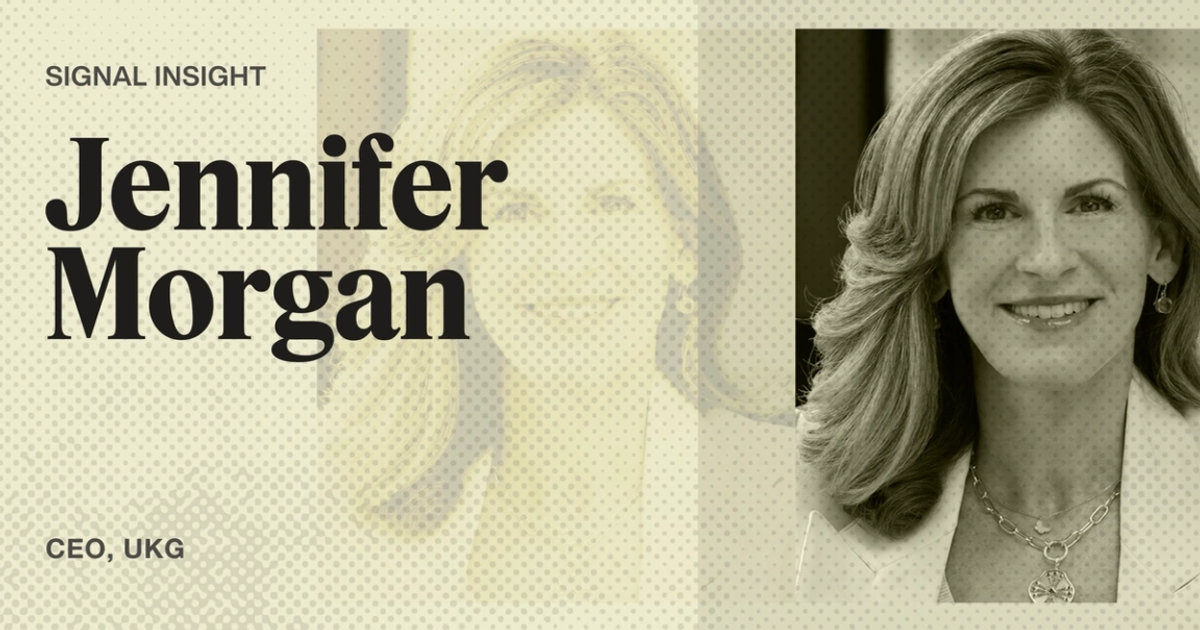
Photo via Semafor

‘I’m in the trenches’: The payroll processor on her own front line

Read the original at Semafor ↗
Cite

Edgecliffe-Johnson, A. (2026, November 13). ‘I’m in the trenches’: The payroll processor on her own front line. Semafor. https://www.semafor.com/article/11/13/2026/im-in-the-trenches-the-payroll-processor-on-her-own-front-line

Dated from the outlet's own feed. Check the original for its byline.

Semafor · collected 2026-11-13 · by Andrew Edgecliffe-Johnson

Quick Summary

This interview features UKG co-CEO Jennifer Morgan, who joined the company in 2024 to oversee a business processing $1 trillion in annual payroll data for 65 million frontline workers. Morgan argues that AI can provide workers with more agency by facilitating real-time schedule planning and early wage access, which she notes can increase retention by 14%. The piece highlights her strategy to transition UKG into a workforce intelligence hub by using shift data to reduce the $1 trillion attrition bill, where replacing a single hourly worker costs an average of $5,000.
Written by AI on 2026-11-13, from this article's own text only (the story summary below draws on all the coverage).

AI analysis

Story summary

Jennifer Morgan, who became the first female leader of a DAX-listed company in 2019 at SAP, now leads UKG, a company formed in 2020 from the merger of Ultimate Software and Kronos. Since joining the firm in 2024 from Blackstone, Morgan oversees a business that processes $1 trillion of payroll data annually for organizations employing 65 million hourly and frontline workers. While she notes that these jobs have not become significantly more vulnerable to AI disruption, she has established partnerships with Anthropic and OpenAI to develop tools that provide workers with more agency over their schedules. Morgan argues that using these tools alongside data-driven insights can reduce the $1 trillion annual attrition bill in corporate America. This is significant because replacing a single hourly worker costs the average employer approximately $5,000, and her strategy aims to cut billions of dollars from those costs. To maintain a direct connection to the market, Morgan spends a quarter of her time working with customers such as Marriott, the Mayo Clinic, PepsiCo, and the Transportation Security Administration.

Written for “Payroll processor experience” on 2026-11-15, grounded in this article and the 0 other(s) covering the same event.

Compared with similar articles

Nothing to compare against. No article is close enough to this one for the pipeline to have linked or judged the pair.

Story

Payroll processor experience
Economy/Business · 1 article(s) covering the same event.
How this article was measured signals, leaning charts, publisher record, byline, topics and claims

Signals How these are calculated →

Claims extracted
68
sentences that state something as happening or true
Uncertain
3%
2 of 68 hedged ("reportedly", "may", "according to")
Leaning
not political
takes no side on a contested political question
Publisher signals
66/100
Semafor's corrections and hedging, across everything collected from it. Not a measure of accuracy.
Outlets on this story
1
Economy/Business
Same framing elsewhere
1
articles that frame the event the way this one does
Analyzed 2026-11-13 · how these are computed

How this is being covered How these are calculated →

Article leaning vs. publisher reliability
Source leaning vs. consistency

Publisher

Semafor · 1750 article(s) · 5 correction(s) detected
Running correction rate · 5 correction(s)

Who wrote this

Andrew Edgecliffe-Johnson
18 article(s) here · 1 carrying a prediction
“We have plan A’s all the way to plan Z’s, from our best-case scenarios to our worst-case scenarios,” Mohamed Khalifa Al Mubarak says, when asked how the culture, tourism, and property groups he leads are preparing for what might happen next in the conflict that has shaken the Middle East.
But she has also tried to stay on her own front line, spending a quarter of her time with customers, which include Marriott, the Mayo Clinic, PepsiCo, and the Transportation Security Administration.
The most bullish analysts think its sales will hit $1 trillion in 2029.
2026-11-09 · assertive framing · Nvidia’s $4.5 trillion test of founder immunity
The complication is that about 95% of the world’s 46,000 McDonald’s restaurants are owned and operated by franchisees — and some have pushed back against a proposal that could require $650,000 to $800,000 of investment per store.
2026-11-06 · assertive framing · Chris Kempczinski's new value menu for McDonald's
Chenault, who was one of the first Black CEOs to lead a Fortune 500 company and ran American Express for 17 years, says people concerned about meddling in Tuesday’s election or damaging disputes over the results have been calling him to ask: “Will business stand up?”
“We should talk to normal people we don’t pay, people who are willing to tell us to F off and tell us why they don’t like us.”
He is now weighing a possible market listing that could value his holding company at $10 billion, even as war in the Middle East sends jet fuel prices higher and economists debate how much longer the boom in global luxury spending can continue.
Beyond the walls of the company’s London headquarters, which is filled with thousands of its plushy pink octopus mascots, Jackson’s empire may look like an unwieldy one.
Brown resolved to spin off the mobility business for which his brand was best known, and says now that “there wouldn’t be a firm” if he had not done so in 2011.
I think there was maybe 20% of that role that was the same.
Also by Andrew Edgecliffe-Johnson
Nothing else under this byline is closely related to this article, so these are simply their most recent.
All 18 articles by Andrew Edgecliffe-Johnson →

Topics

DAX Germany SAP The Signal Insight UKG

Subjects

Morgan PERSON · 3× UKG ORG · 3× Blackstone ORG · 2× Jennifer Morgan PERSON · 2× SAP ORG · 2× DAX ORG · 1× Germany GPE · 1× Kronos ORG · 1× The Signal Insight ORG · 1× Ultimate Software ORG · 1×

Narrative

Having somebody who can unemotionally look at your business and tell you all the opportunities, all the great things, and all the things that you can address to make it even better, as a leader, that’s what you’re looking for: Just take out the filter and give it to me.
framing: assertive · carried by 1 article(s) · first seen 2026-11-13
But she has also tried to stay on her own front line, spending a quarter of her time with customers, which include Marriott, the Mayo Clinic, PepsiCo, and the Transportation Security Administration.

Claims (68 extracted, 2 hedged)

Jennifer Morgan, who became the first female leader of a DAX-listed company when Germany’s SAP named her co-CEO in 2019, now leads a US business processing $1 trillion of payroll data each year. asserted
SAP → become → data
UKG, formed in 2020 from the merger of Ultimate Software and Kronos, provides HR services and workforce management technology to organizations employing 65 million hourly and frontline workers in industries including retail, healthcare, and manufacturing. asserted
UKG → form → retail
Since arriving in 2024 from Blackstone, one of UKG’s private equity owners, Morgan says she has not seen those jobs become much more vulnerable to AI disruption. asserted
jobs → arrive → disruption
But she has struck partnerships with the likes of Anthropic and OpenAI, seeing opportunities to “give the worker agency” with AI-powered tools that let them plan schedules around their childcare, or volunteer for overtime when they need to earn extra money. asserted
they → strike → money
Morgan’s pitch to employers is that pairing these tools with data-driven insights into wages, absenteeism, and inefficiencies in schedules can cut billions of dollars from corporate America’s $1 trillion-a-year attrition bill. asserted
pairing → pair → bill
Replacing just one hourly worker costs the average employer about $5,000, she notes. asserted
she → replace → 5,000
Morgan’s strategy is to reposition UKG from a provider of administrative support tools to a “workforce intelligence hub” that uses shift data to inform operational decisions in real time. asserted
that → reposition → time
She has overhauled the company’s leadership, replacing about 80% of her direct reports and 40% of the tier below them, to bring in more people with experience of operating at the scale and speed this moment demands. asserted
moment → overhaul → scale
But she has also tried to stay on her own front line, spending a quarter of her time with customers, which include Marriott, the Mayo Clinic, PepsiCo, and the Transportation Security Administration. asserted
which → try → Marriott
And she says that sharing their positive and critical feedback with her staff has been equally important. asserted
sharing → say → staff
Here’s how she sees AI bridging the gap between companies and the workers who are often furthest from their headquarters, yet closest to their customers. asserted
who → ’ → customers
This interview has been edited for clarity and brevity. asserted
interview → edit → clarity
What will AI mean for frontline workers? asserted
AI → mean → workers
Think about a world where that frontline worker on their app can say, “I need to make $500 extra between now and the end of the month. asserted
I → think → month
What are the shifts that are available for me to do this? asserted
me → do → this
Oh, and by the way, here’s my school schedule; schedule around this.” asserted
schedule → ’ → this
Or workers who need access to their pay before [their] paycheck arrives; one of our customers [who offered early “earned wage access” saw] the retention for people who took advantage of that was 14% higher. asserted
who → need → that
AI gives the worker agency because AI can be a better advocate for what they need. asserted
they → give → what
That’s what’s been missing. asserted
what → ’ → ?
If you think about the person who’s trying to put the schedule together, they don’t have all that texture, and they definitely don’t have it in real time. asserted
they → think → time
So that’s where the expectation gap gets bigger and bigger, because what the worker needs and what the operation needs are different. asserted
operation → ’ → what
Do you think you have better insight into what’s happening in companies’ workforces than they do? asserted
they → think → workforces
Whether we’re talking to Pepsi or T-Mobile, we can show them what we see happening. asserted
we → talk → them
We can talk to them about their overtime, their wages, absenteeism, and the attrition that’s happening because people don’t get the hours that they want. asserted
they → talk → that
If they get too many [hours], or they don’t get enough, they leave. asserted
they → get → enough
That information is ready in real time, [but] companies look at that after the fact. asserted
companies → look → fact
What does private capital bring to this very expensive and uncertain AI transition? asserted
capital → bring → transition
I remember when I read my first investment memo at Blackstone for a company we were looking at, my first reaction was, “I wish somebody had given this to me when I was the co-CEO of SAP.” asserted
I → remember → SAP
Having somebody who can unemotionally look at your business and tell you all the opportunities, all the great things, and all the things that you can address to make it even better, as a leader, that’s what you’re looking for: Just take out the filter and give it to me. asserted
you → have → me
I love having a board with both investors and operators, because operators understand all the nuance and all of the intended and unintended consequences of what could happen if I do X or if I do Y. uncertain
I → love → X
Investors tend to look at things very unemotionally, factually. asserted
Investors → tend → things
And it helps bring a level of focus. asserted
it → help → focus
Do you ever see tension between that left-brain and right-brain way of looking at the business? asserted
you → see → business
I remember, again, my first investment committee meeting at Blackstone. asserted
I → remember → Blackstone
We were talking about [investing in] this one company and all of a sudden there was this strong intellectual debate. asserted
We → talk → company
I’m thinking to myself, “Oh my goodness, they don’t like this company.” asserted
they → think → company
But it was really about just getting to the right answer. asserted
it → get → answer
It was just that intellectual honesty about what this was, what we could do, what you needed to believe in order to get to where everybody wanted to go. uncertain
everybody → do → what
So that is really positive when you’re able to have those discussions, and make change at a pace that I don’t have to constantly worry about the [next quarterly earnings]. asserted
I → ’re → earnings
Because the amount of change that we’re making to the organization is a lot, and the longer you wait to react, the more you have to catch up, and the change is twice as much and twice as hard. asserted
change → make → organization
…and 28 more, not listed.

Give feedback · no sign-in needed

No sign-in needed for now. Your note is sent without a name, so it cannot be answered.

History Support