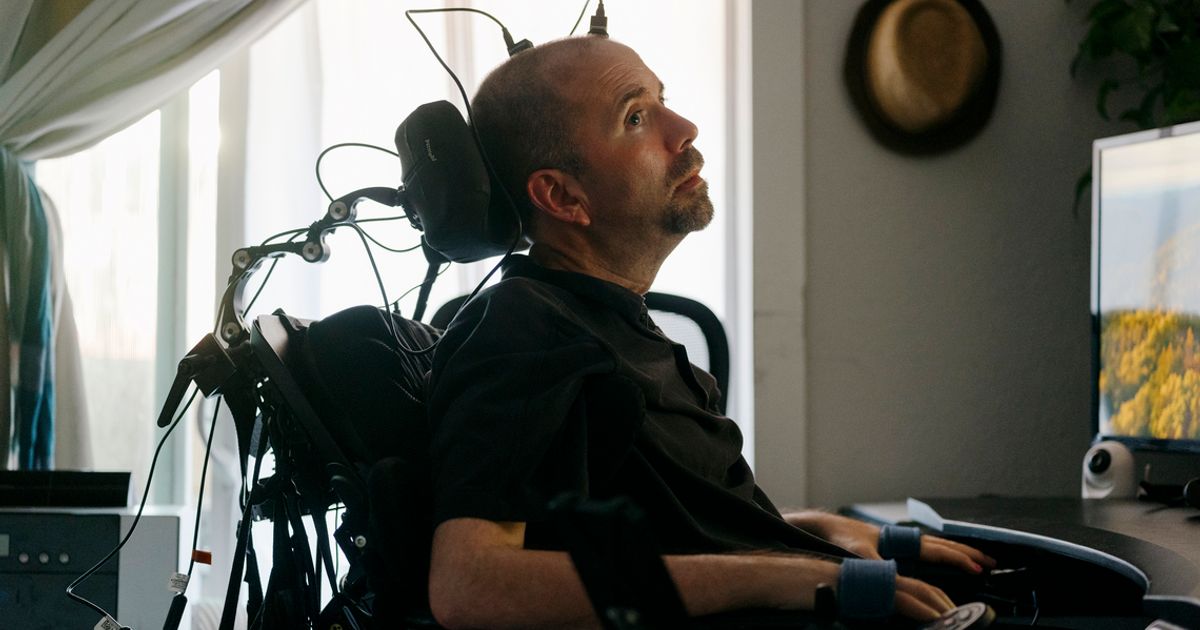
Photo via The Straits Times

Brain implants give ALS patients the voice to speak and sing

Read the original at The Straits Times ↗
Cite

The Straits Times. (2026, November 15). Brain implants give ALS patients the voice to speak and sing. The Straits Times. https://www.straitstimes.com/world/united-states/brain-implants-give-als-patients-the-voice-to-speak-and-sing

Dated from the outlet's own feed. Check the original for its byline.

The Straits Times · collected 2026-11-15 · by The Straits Times

Quick Summary

Researchers at the University of California, Davis, have developed experimental brain implants that allow ALS patients to communicate through speech and singing. A 46-year-old man who lost his voice due to ALS used the implant to produce intelligible speech, while a 58-year-old woman, a trained singer, was able to sing a musical scale despite the disease silencing her voice. These findings, set to be presented at the Society for Neuroscience conference next week, indicate that brain-computer interfaces are advancing from experimental concepts to practical applications.
Written by AI on 2026-11-15, from this article's own text only (the story summary below draws on all the coverage).

AI analysis

Story summary

Researchers at the University of California, Davis, have developed brain implants that allow ALS patients to regain the ability to speak and even sing. The breakthrough, to be presented at the Society for Neuroscience conference in Washington next week, includes a 46-year-old man who can now produce intelligible speech and a 58-year-old woman, a trained singer, who can sing a musical scale despite the disease silencing her voice. This development marks a significant step in the practical application of brain-computer interfaces, moving beyond initial proof-of-concept stages.


Written for “Brain Implants for ALS Patients” on 2026-11-17, grounded in this article and the 0 other(s) covering the same event.

Compared with similar articles

Nothing to compare against. No article is close enough to this one for the pipeline to have linked or judged the pair.

Story

Brain Implants for ALS Patients
Science · 1 article(s) covering the same event.
How this article was measured signals, leaning charts, publisher record, byline, topics and claims

Signals How these are calculated →

Claims extracted
3
sentences that state something as happening or true
Uncertain
0%
0 of 3 hedged ("reportedly", "may", "according to")
Leaning
not political
takes no side on a contested political question
Publisher signals
64/100
The Straits Times's corrections and hedging, across everything collected from it. Not a measure of accuracy.
Outlets on this story
1
Science
Same framing elsewhere
1
articles that frame the event the way this one does
Analyzed 2026-11-15 · how these are computed

How this is being covered How these are calculated →

Article leaning vs. publisher reliability
Source leaning vs. consistency

Publisher

The Straits Times · 5339 article(s) · 7 correction(s) detected
Running correction rate · 7 correction(s)

Who wrote this

The Straits Times
3690 article(s) here · 0 carrying a prediction
Donnelly said the message was deleted within minutes and he could not recall its exact contents, but remembered that it was vaguely worded and had been sent to numerous other schools.
Britain needs a “complete system reset” of welfare and job support for young people to bring down high rates of joblessness, but upfront costs mean the project will take a decade to deliver clear savings, according to a government report released on Nov 17. Alan Milburn, a former minister from Prime Minister Andy Burnham’s Labour Party, is proposing a separate benefits system for Britons aged under 25 with lower cash payments and more mandatory work placements for the long-term unemployed. The government has supported the review and Burnham has spoken of the need to act on its findings. “A whole-system reset is needed,” Milburn said in the report.
President Donald Trump said on Nov 17 that the US was taking seriously the possibility that Iran could be planning an attack involving a so-called dirty bomb in Washington, after being asked about a CNN report citing US intelligence assessments.
Lawyers for Thaci have said they will appeal that ruling.
Reuters could not immediately verify the footage.
Bahrain’s armed forces said they “confronted, intercepted, and destroyed a number of treacherous Iranian aerial attacks today... before they could achieve their objectives”, while Iran’s Revolutionary Guards said they targeted a US-operated radar system.
“I would like to see a greater capacity for dialogue, for building bridges, for reconciliation.
The British government announced on Nov 17 that it would impose sanctions on eight Israeli construction companies involved in building settlements in the occupied West Bank and an activist group that prevents the delivery of aid to Gaza.
Reuters could not immediately verify the footage.
After South America tour, Pope Leo jokes reporters are more tired than him ABOARD THE PAPAL FLIGHT, Nov 17 - Pope Leo on Tuesday laughed off concerns that his 12-day South America tour could have been too physically taxing after undergoing lung cancer surgery last month, saying God had granted him good stamina.
Also by The Straits Times
Nothing else under this byline is closely related to this article, so these are simply their most recent.
All 3690 articles by The Straits Times →

Topics

Society for Neuroscience Washington the University of California, Davis

Subjects

Carolyn Johnson PERSON · 1× Society for Neuroscience ORG · 1× Washington GPE · 1× the University of California, Davis ORG · 1×

Narrative

The new advances from researchers at the University of California, Davis, to be presented next week at the Society for Neuroscience conference in Washington, demonstrate that research into brain-computer interfaces is crossing from proof-of-concept demonstrations into everyday usefulness.
framing: assertive · carried by 1 article(s) · first seen 2026-11-15
2026-11-15 · The Straits Times
Brain implants give ALS patients the voice to speak and sing · assertive framing

Claims (3 extracted, 0 hedged)

Brain implants give ALS patients the voice to speak and sing Carolyn Johnson AI generated Brain signals from a 46-year-old man who lost his voice to ALS were decoded by experimental brain implants and translated directly into intelligible speech. asserted
who → give → speech
A 58-year-old woman, a trained singer, whose voice was gradually silenced by the disease, was able to sing a musical scale. asserted
voice → train → scale
The new advances from researchers at the University of California, Davis, to be presented next week at the Society for Neuroscience conference in Washington, demonstrate that research into brain-computer interfaces is crossing from proof-of-concept demonstrations into everyday usefulness. asserted
research → present → usefulness
Give feedback · no sign-in needed

No sign-in needed for now. Your note is sent without a name, so it cannot be answered.

History Support