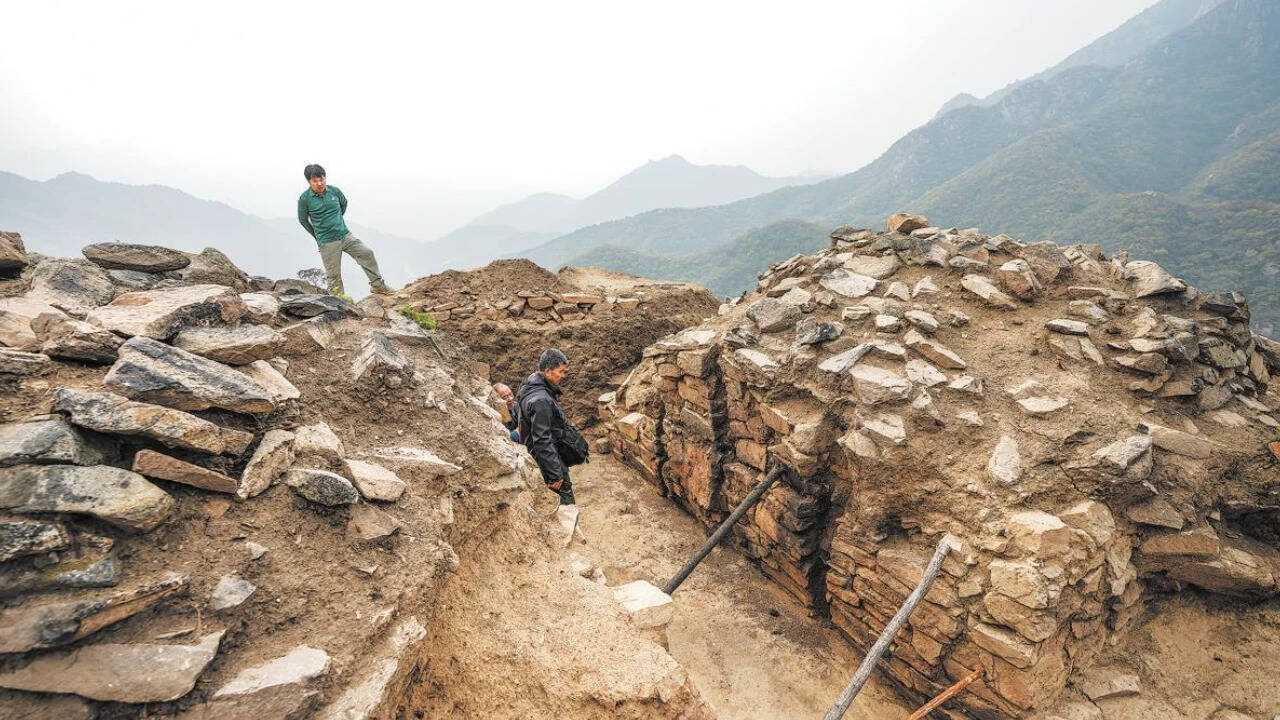
Archaeologists working in Beijing have uncovered the first confirmed remains of a Sui Dynasty section of the Great Wall in the Chinese capital.
asserted
Archaeologists → work → capital
The discovery, made at the Dalinggou site in Changping district, is reshaping what researchers understand about the earliest defences around ancient Beijing.
asserted
researchers → make → Beijing
Alongside it, archaeologists have revealed three wooden boats about 1,800 years old, offering an unusually vivid picture of life, trade and transport in the region long before it became a modern metropolis.
asserted
it → reveal → region
The Great Wall is often imagined as one vast, unbroken barrier.
asserted
Wall → imagine → barrier
In reality, it was a shifting network of walls, watchtowers, garrisons and roads built, repaired and expanded by different states over many centuries.
asserted
it → shift → centuries
The new find matters because it adds a missing piece to that story: evidence that the Sui Dynasty, which ruled from 581 to 618, maintained a military presence on Beijing’s northern edge.
asserted
which → matter → edge
A frontier outpost comes into view
The excavation took place between August and October 2026, covering roughly 800 square-metres at Dalinggou in Changping.
asserted
excavation → come → Changping
Archaeologists from the Beijing Institute of Archaeology uncovered the remains of a military outpost built against an early section of the Great Wall.
asserted
Archaeologists → uncover → Wall
Its northern wall was incorporated into the existing wall structure, while inside the enclosure were traces of buildings and retaining walls.
asserted
traces → incorporate → buildings
The walls were made largely from roughly hewn stones bound and filled with loess, with an earth-and-stone core.
asserted
walls → make → core
It is a very different approach from the polished brickwork and sophisticated masonry associated with the much later Ming Dynasty wall.
asserted
It → associate → wall
These older remains remind us that the Great Wall was a succession of practical frontier systems adapted to the needs and resources of their time.
asserted
Wall → remind → time
More than 60 artefacts were recovered from the site, including pottery, porcelain, metal objects, architectural components, everyday items and weapons.
asserted
artefacts → recover → pottery
Together, they suggest that this was a working military installation, where soldiers, builders and support personnel lived, stored equipment and helped guard a strategically important northern route.
asserted
soldiers → suggest → route
Why the Sui discovery matters
asserted
discovery → matter → ?
Before this excavation, the Dalinggou site had been classified as part of the Great Wall built during the Northern Qi Dynasty, which ruled from 550 to 577.
asserted
which → classify → 577
The new evidence shows that the fortification was also used during the Sui Dynasty, and that parts of it remained in service centuries later, during the Jin Dynasty from 1115 to 1234.
asserted
parts → show → 1234
Two finds were especially important in dating the site.
asserted
finds → date → site
Archaeologists recovered a Sui-era wuzhu coin, a bronze cash coin with clear value for establishing chronology.
asserted
Archaeologists → recover → chronology
They also found a piece of porcelain whose form and manufacturing technique closely resemble known Sui Dynasty ceramics.
asserted
form → find → ceramics
Individually, such objects might seem small; together, they provide strong evidence that the outpost was active during the Sui period.
uncertain
outpost → seem → period
“This is the first discovery of Sui Dynasty Great Wall remains in the Beijing area,” said Shang Heng, an archaeologist at the Beijing Institute of Archaeology.
asserted
Heng → say → Archaeology
He explained that the find is valuable for studying the age, location, direction and military defence system of the early Great Wall around Beijing.
asserted
find → explain → Beijing
It may also help researchers trace Sui-era wall sections in neighbouring Hebei and Shanxi provinces.
uncertain
researchers → help → provinces
It reunited much of China after centuries of division and laid foundations later inherited by the Tang Dynasty.
asserted
It → reunite → Dynasty
Its rulers also invested heavily in securing the northern frontier, where the empire faced pressure from peoples beyond its borders.
asserted
empire → invest → borders
The Beijing find suggests that the Sui did not simply build new defences from nothing; it likely reused and maintained parts of the earlier Northern Qi system.
uncertain
it → suggest → system
A wall with a longer memory
Shang Heng looks at the remains of a Sui Dynasty section.
asserted
Heng → look → section
A fortification first associated with the Northern Qi was later used by the Sui and still showed evidence of activity during the Jin Dynasty.
asserted
fortification → associate → Dynasty
That means the same landscape may have served very different rulers across more than five centuries.
uncertain
landscape → mean → centuries
This challenges the popular image of the Great Wall as a static monument.
asserted
This → challenge → monument
Walls were not only built; they were repaired, redirected, garrisoned, abandoned and sometimes absorbed into newer defensive systems.
asserted
they → build → systems
Dalinggou offers a rare chance to see that process in one place, through its architecture and the objects left behind by the people who used it.
asserted
who → offer → it
The discovery also gives archaeologists a geographical reference point.
asserted
discovery → give → point
Dalinggou lies along the same defensive line as previously identified Sui-era remains in Hebei and Shanxi.
asserted
Dalinggou → lie → Hebei
To the west, an inscription in Kelan County, Shanxi, records construction of the Great Wall in 599.
asserted
inscription → record → 599
To the east, another inscription from 597 was found in Luanping County, Hebei, while a Sui Dynasty beacon tower has been identified in Qianxi County.
asserted
tower → find → County
Put together, these clues suggest a broad frontier network rather than isolated local fortifications.
asserted
clues → Put → fortifications
The Beijing discovery could therefore help scholars map the route of the early wall more accurately and understand how military authority was organised across northern China.
uncertain
authority → help → China
Three boats beneath Beijing
The announcement also included an equally striking discovery from Fengtai district: three ancient wooden boats, buried about seven metres underground in an old river channel.
asserted
announcement → include → channel
…and 17 more, not listed.
 The Aporia