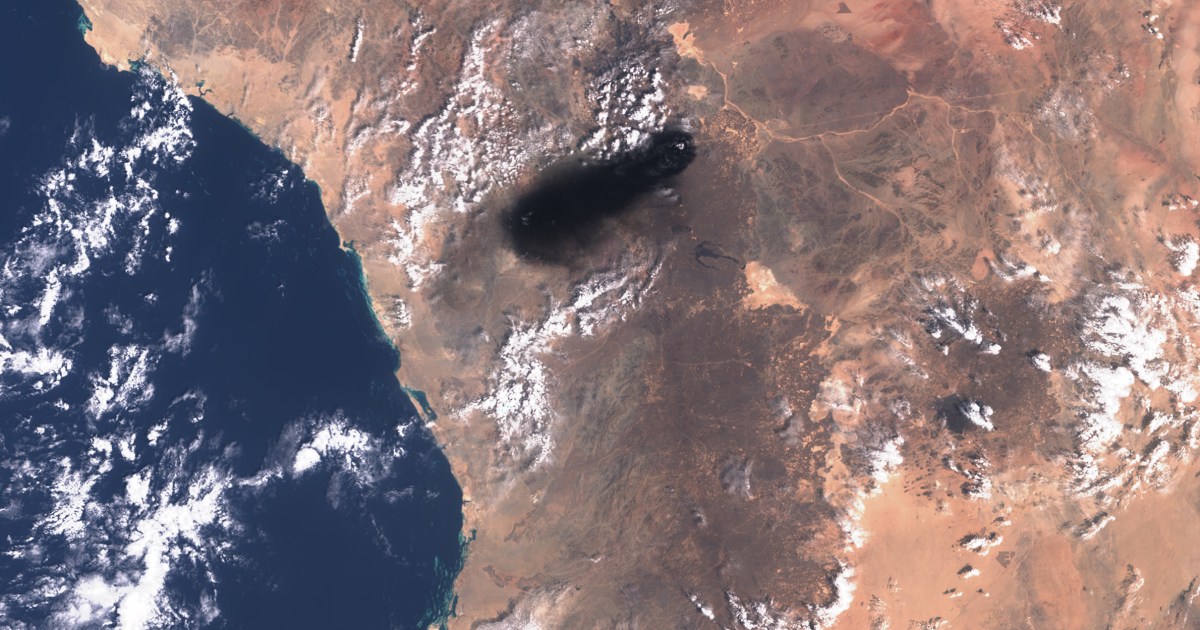
Saudi Arabia’s oil exports took another blow last week when drone attacks knocked out part of the country’s East-West pipeline, halting oil flow and removing 4-5 million barrels per day (bpd) of oil from global supply.
asserted
attacks → take → supply
It is unclear how long repairs will take, although The Associated Press estimates three to five weeks, citing two regional officials.
uncertain
Press → take → officials
The 1,200km (746-mile) pipeline connects the kingdom’s main oil-producing fields in the east of the country with Yanbu port on the Red Sea coast in the west, allowing Saudi crude to bypass the Strait of Hormuz, which has largely remained closed since the United States-Israel war on Iran began on February 28.
asserted
war → connect → February
As the world’s second-largest oil producer, Saudi Arabia’s ability to keep crude flowing has significant consequences for global energy markets.
asserted
ability → keep → markets
Al Jazeera asked experts what alternatives remain, how the disruption could affect buyers worldwide, and what it means for the kingdom’s revenues.
uncertain
it → ask → revenues
Exports down more than 70 percent
Total Saudi crude loadings, which topped 7.5 million bpd in January and February, had fallen to about 2.3 million bpd in August and roughly 2.1 million bpd in the first half of September – a drop of more than 70 percent.
asserted
which → top → percent
Analysts caution the real loadings figure may run somewhat higher, since shuttle tankers crossing Hormuz with tracking switched off aren’t always captured in vessel data.
uncertain
tracking → caution → data
How can Saudi Arabia export its oil?
asserted
Arabia → export → oil
Saudi exports are built around two coastal passages – the Gulf in the east, where crude moves out through the Strait of Hormuz, and the Red Sea in the west, where it can travel either north through the Suez Canal and Sumed Pipeline, or south through the Bab al-Mandeb strait.
asserted
it → build → strait
Before the crisis, most Saudi crude left on ships through the Strait of Hormuz, the 39km (24-mile) shipping choke point connecting the Gulf to the Gulf of Oman, and the open sea beyond.
asserted
crude → leave → Oman
Saudi Arabia was exporting about 7-8 million bpd of oil, with most seaborne volumes loading at the terminals of Ras Tanura and Ras al-Ju’aymah, and the former averaging about 5.4 million bpd in 2025.
asserted
former → export → 2025
The route is the most direct and economical way to reach Asia, which buys the bulk of Saudi crude exports.
asserted
which → reach → exports
Dark ships and ship-to-ship transfers
With the western pipeline route closed and the Red Sea’s southern route hostile, Saudi Arabia has little choice but to push exports back through the Gulf – despite the restrictions, higher costs, and physical risk of attack that come with transiting Hormuz, experts say.
asserted
experts → close → Hormuz
The first is shipping more crude from its Gulf terminals through the Strait of Hormuz, including ship-to-ship transfers outside the strait, such as off Sohar in Oman,” according to Rishi Rajanala, research specialist in Oil Americas at LSEG Data & Analytics.
uncertain
first → ship → Data
“Gulf producers have already been moving part of their exports this way, but volumes depend on tanker availability, insurance and freight costs, and remain well below pre-war levels.
asserted
volumes → move → levels
“The second is drawing on crude already stored on the west coast and at Egypt’s Ain Sukhna and Sidi Kerir terminals, which can continue to supply Europe through the Sumed Pipeline, but only for as long as stored volumes last.
asserted
volumes → draw → Pipeline
The third is a phased restart of the pipeline itself, depending on the extent of the damage.”
asserted
third → phase → damage
Richard Matthews, director of consultancy and research at Gibson Shipbrokers, a London-based shipping services company, said transiting back through Hormuz will “further fuel higher freight costs for Middle East exports and create additional inefficiencies”, adding, “we do not know how long Yanbu loadings will be suspended for, but it doesn’t look to be a quick fix.”
One way to reduce that risk is for tankers to go “dark” by switching off their AIS transponders – used in maritime navigation to identify and track vessels – as they transit Omani coastal waters.
asserted
they → base → waters
“They will transit with transponders off and likely coordinate with the US Navy but still face the risk of attack as everyone else does,” Matthews said.
asserted
Matthews → transit → attack
If the outage extends beyond a few weeks, the balance shifts further: Stored volumes would run down, and any crude that cannot move through the Gulf would have to be stored or left unproduced, adding pressure to production levels already well below pre-war volumes in August.
asserted
that → extend → August
Rahul Choudhary, vice president of Upstream Research at Rystad Energy, an independent energy research company, said Hormuz-route exports increased in September to more than two million bpd in the first two weeks, roughly one million bpd above August.
asserted
exports → say → August
“We expect Strait of Hormuz exports to rise further in the second half of the month, already evident in Aramco offering additional loadings to Asian refiners out of Sohar.
asserted
Aramco → expect → Sohar
Saudi Arabia can lean further on dark tanker activity in the coming days to offset Yanbu losses,” he added.
asserted
he → lean → losses
Route two: The East-West pipeline to Yanbu
Most of Saudi Arabia’s crude is produced in the east, and Aramco’s East-West pipeline links the Ghawar and Abqaiq processing facilities there to Yanbu port on the opposite side of the country.
asserted
pipeline → produce → country
It was built in 1981, during the Iran-Iraq war, precisely to reduce reliance on the Strait of Hormuz in a crisis of the kind Saudi Arabia and other Gulf exporters are now facing.
asserted
Arabia → build → kind
It runs at a maximum capacity of about 7 million bpd.
asserted
It → run → bpd
Crude shipped from Yanbu has two ways to travel onward through the Red Sea – south via Bab al-Mandeb or north via Suez.
asserted
Crude → ship → Suez
South, via Bab al-Mandeb
Shipments heading south to Asia must pass through the Bab al-Mandeb strait – the second-best route after Hormuz.
asserted
Shipments → head → Hormuz
But Iran-backed Houthi forces launched a rapid military offensive in September, seizing the Yemeni port of Mocha, the coastal town of Dhubab, and Mayyun Island, and now control the strait.
asserted
forces → back → strait
They have also declared a maritime embargo on Saudi Arabia, prohibiting vessels from loading or discharging cargo at Saudi ports.
asserted
They → declare → ports
North, via the Suez Canal
With the southern exit blocked, tankers wishing to reach Asia must instead travel north.
asserted
tankers → block → Asia
Oil tankers can pass through the Suez Canal directly, or discharge their cargo at Egypt’s Ain Sokhna terminal on the Red Sea into the Sumed pipeline, which carries it overland across Egypt to a Mediterranean port near Alexandria, where it is reloaded onto tankers bound for Europe.
asserted
it → pass → Europe
Very Large Crude Carriers (VLCCs) are too large to transit the canal at full draft – the maximum safe depth when fully loaded – so they instead partially discharge at Ain Sokhna and reload the remaining volume at the Mediterranean terminal before continuing.
asserted
they → transit → terminal
According to HSBC Global Investment Research, Aramco had planned a similar “shuttling” operation before Yanbu was suspended, using smaller Suezmax tankers to move crude between Yanbu and Ain Sokhna.
uncertain
Yanbu → accord → Yanbu
From there, reaching Asian buyers means sailing west through the Strait of Gibraltar and around the Cape of Good Hope – a journey of about 13,140 nautical miles (equivalent to about 24,335km) that dwarfs the roughly 3,370 nautical miles (6,241km), 10-day journey via Hormuz, adding almost a month to the voyage and making shipping far more expensive while tying up tankers for longer.
But some experts expect the East-West pipeline to resume operations sooner, offering hope that Saudi oil exports could return to more sustainable levels.
uncertain
exports → reach → levels
Choudhary said: “We expect the pipeline to restart within a couple of weeks at a reduced 40-60 percent capacity, flowing around 2.5-3 million bpd.
asserted
pipeline → say → bpd
With Saudi likely to prioritise refinery runs, only about 0.5-1 million bpd would be left for export, meaning Yanbu crude exports fall by 2.5-3 million bpd even after a partial restart.
asserted
exports → prioritise → restart
“Part of that gap can be covered by higher Hormuz liftings and increased dark-fleet activity, bringing the net impact on Saudi crude exports down to roughly 1.5-2 million bpd.”
Why trucking is not a viable option
One option conspicuously absent from Saudi planning is trucking – and the maths explains why.
asserted
maths → cover → planning
The kingdom typically exports 5-7 million bpd.
asserted
kingdom → export → bpd
Replacing even a single day’s volume by road would require roughly 25,000 to 35,000 fully loaded tanker trucks, each carrying about 200 barrels.
asserted
Replacing → replace → barrels
…and 20 more, not listed.
 The Aporia