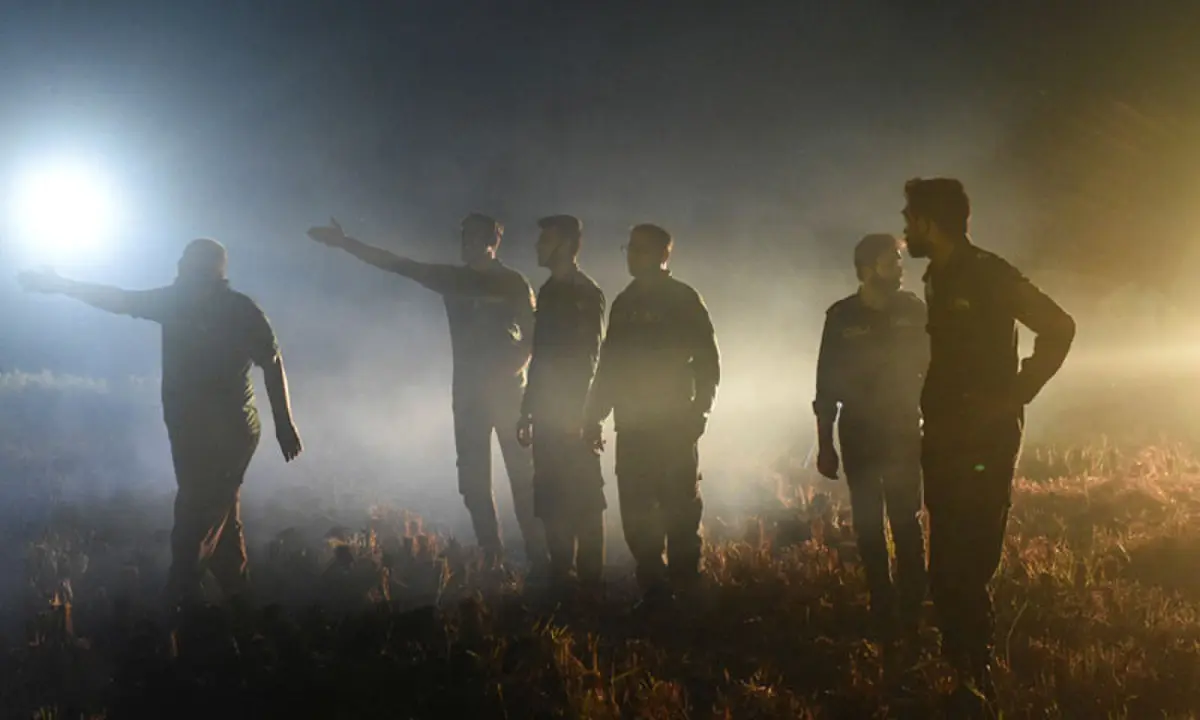
IN EARLY November, as rice harvesting nears its end in Punjab, one can easily spot smoke rising from fields as farmers burn rice residue after harvesting, while travelling along the Lahore-Islamabad Motorway.
asserted
farmers → near → Motorway
Here and there, patches of farmland appear shrouded in smoke, with columns rising above the fields and drifting across the surrounding landscape.
asserted
columns → appear → landscape
The scene is not continuous, but occurs sporadically along different stretches of the motorway during the four-ish hour drive between the two cities.
asserted
scene → occur → cities
For regular travellers, the smouldering fields have become a familiar seasonal sight.
asserted
fields → smoulder → travellers
Yet, these scenes only offer a glimpse into what is a much larger problem.
asserted
what → offer → glimpse
This convenient method of clearing fields for the next crop carries consequences far beyond the farms where it occurs, contributing to deteriorating air quality, public health risks and environmental degradation.
asserted
it → clear → quality
It also raises an important policy question: why does this practice persist despite government restrictions and efforts to promote alternatives?
asserted
practice → raise → alternatives
Stubble burning persists not just because farmers ignore rules, but due to a lack of alternative, cost-effective methods for field clearing
The roots of the problem lie in Punjab’s rice-wheat cropping pattern.
asserted
roots → persist → pattern
Rice is cultivated on approximately 6.8 million acres, second only to wheat.
asserted
Rice → cultivate → wheat
Mechanised harvesting leaves substantial quantities of residue in the fields — some estimates put the amount at 8.5m tonnes.
asserted
estimates → leave → tonnes
Farmers generally have 10 to 15 days between rice harvesting and wheat sowing, leaving little time to collect, transport and process the residue.
asserted
Farmers → have → residue
Doing so also requires labour, machinery and financial resources, making burning an attractive option.
asserted
burning → do → labour
This mismatch between the speed of mechanised harvesting and the limited availability of residue-management options is reflected in satellite monitoring of agricultural fires.
asserted
mismatch → reflect → fires
However, different monitoring systems present widely varying estimates.
asserted
systems → present → estimates
According to the Pakistan Air Quality Initiative (PAQI), satellite data from Oct 1 to Nov 9 recorded 18,825 fire detections across Punjab, of which approximately 16,714 were classified as likely crop-residue fires.
uncertain
16,714 → accord → fires
The highest daily count was recorded on Nov 1, with 1,102 detections.
asserted
count → record → detections
However, the Space and Upper Atmosphere Research Commission (Suparco) reports a considerably lower figure.
asserted
Commission → report → figure
Its data showed 643 fire anomalies between Aug 1 and Nov 10, representing a 21 per cent decline from 817 during the same period in 2025.
asserted
data → show → 2025
Of these, 18 were recorded in August, 12 in September and 613 from Oct 1 onwards.
asserted
18 → record → Oct
The estimated area burnt also declined by 36pc, from 898.5 acres in 2025 to 579 acres in 2026.
asserted
area → burn → 2026
Although the figures differ, both datasets point to the persistence of the problem.
asserted
datasets → differ → problem
But the significance of these fires goes beyond the agricultural landscape.
asserted
significance → go → landscape
The smoke adds to the pollution burden of urban centres, particularly Lahore, which regularly features among the world’s most polluted cities.
asserted
which → add → cities
According to PAQI, average PM2.5 concentrations in Lahore reached 126 micrograms per cubic metre between Oct 1 and Nov 9.
uncertain
concentrations → accord → Oct
This is more than eight times the WHO’s 24-hour guideline of 15 micrograms per cubic metre, although the figures relate to different averaging periods.
asserted
figures → relate → periods
Other urban centres, including Multan, Faisalabad, Bahawalpur and Gujranwala, face similarly serious pollution levels.
asserted
centres → include → levels
Yet, attributing deteriorating urban air quality to stubble burning alone risks overlooking the complexity of the crisis.
asserted
attributing → attribute → crisis
A former director general of the agriculture department cautions against this assumption, saying that this is only one contributor to a much wider problem.
asserted
this → caution → problem
During November and December, lower temperatures, weak winds and atmospheric inversions restrict the dispersion of pollutants.
asserted
temperatures → restrict → pollutants
Smoke from agricultural fires mixes with emissions from vehicles, industries, brick kilns, construction activities and waste burning, as well as urban dust, intensifying the problem.
asserted
Smoke → mix → problem
Cross-border pollution may also affect regional air quality under certain wind conditions.
uncertain
pollution → affect → conditions
The resulting concentration of fine particulate matter poses serious health risks, particularly to children, older people and those suffering from respiratory and cardiovascular diseases.
asserted
concentration → result → diseases
Increased respiratory illnesses and hospital visits can place additional pressure on households and healthcare facilities.
asserted
illnesses → increase → households
Against this backdrop, Punjab has introduced legal, administrative and agricultural measures to discourage burning.
asserted
Punjab → introduce → burning
The Punjab Environmental Protection (Smog Prevention and Control) Rules, 2023, prohibit stubble burning and provide for penalties against violators.
asserted
Rules → prohibit → violators
The Environmental Protection Agency (EPA) conducts inspections and satellite-based monitoring, while district administrations are directed to take action.
asserted
administrations → conduct → action
The scale of enforcement is reflected in the latest EPA figures.
asserted
scale → reflect → figures
Between Aug 1 and Nov 10, 2026, fire-related evidence was found at 423 sites, 80 FIRs were registered and fines amounting to Rs3.08m were imposed, of which Rs2.71m had been collected.
asserted
m → relate → which
 The Aporia