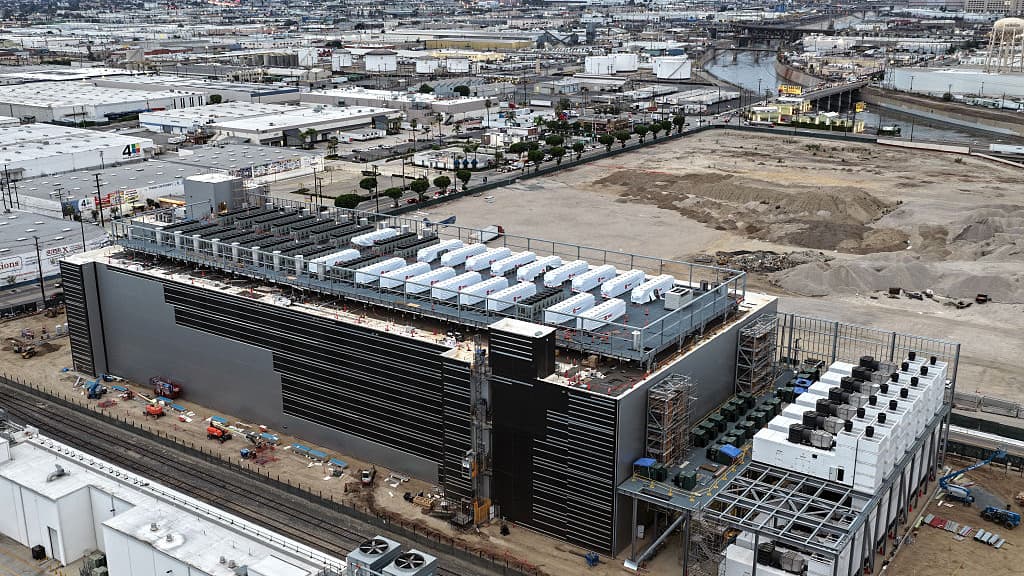
Photo via The Guardian

Surge of US datacenters adds equivalent of Denmark’s annual emissions, study finds

Read the original at The Guardian ↗
Cite

Milman, O. (2026, November 16). Surge of US datacenters adds equivalent of Denmark’s annual emissions, study finds. The Guardian. https://www.theguardian.com/us-news/2026/nov/16/datacenter-emissions-study

Dated from the outlet's own feed. Check the original for its byline.

The Guardian · collected 2026-11-16 · by Oliver Milman

Quick Summary

A new study published in Nature Sustainability reports that the construction of large datacenters in the US, primarily for handling AI growth, has emitted approximately 25.7 million metric tons of carbon dioxide, equivalent to Denmark’s annual emissions. Conducted until April 2025, the research analyzed 403 “hyperscaler” datacenters, which consumed between 68 to 99 terawatt-hours of electricity, with over half coming from fossil fuels. The study highlights that these datacenters now account for about 1.8% of total US electricity consumption and warns that actual emissions could be higher due to the continued rapid expansion since 2025.
Written by AI on 2026-11-16, from this article's own text only (the story summary below draws on all the coverage).
See how they differ ↓

AI analysis

Story summary

A new study published in Nature Sustainability and reported by The Guardian and CBC finds that the largest "hyperscaler" datacenters in the US emitted about 25.7 million metric tons of carbon dioxide in a year, equivalent to Denmark's total annual emissions. This period spans from May 2024 to April 2025, and the study analyzed 403 datacenters. The study indicates that these datacenters account for about 1.8% of total US electricity consumption, primarily driven by fossil fuels. The rapid expansion of datacenters has only increased since the study period, raising significant environmental concerns, particularly as the growth of artificial intelligence accelerates.

Written for “US Datacenters Emit More Than Denmark” on 2026-11-17, grounded in this article and the 2 other(s) covering the same event.

How they differ

3 outlets covered “US Datacenters Emit More Than Denmark”.

What each outlet says

One AI summary per outlet of its latest article on this story, written from that article alone and checked against it. Open the article for the outlet's own words.

The GuardianThis outlet16 Nov

A new study published in Nature Sustainability reports that the construction of large datacenters in the US, primarily for handling AI growth, has emitted approximately 25.7 million metric tons of carbon dioxide, equivalent to Denmark’s annual emissions. Conducted until April 2025, the research analyzed 403 “hyperscaler” datacenters, which consumed between 68 to 99 terawatt-hours of electricity, with over half…

Surge of US datacenters adds equivalent of Denmark’s annual emissions, study finds (this article)
Toronto Star16 Nov

A Harvard University study published in Nature Sustainability estimates that the 400 largest data centers in the United States emitted approximately 28.3 million tons of carbon dioxide in one year, surpassing Denmark's annual emissions and reflecting significant pollution from fossil fuels. This research coincides with the launch of a voluntary pledge at the UN COP31 climate talks in Turkey, encouraging companies…

Study estimates magnitude of US data center pollution as climate talks unveil clean AI pledge →
CBC16 Nov

A Harvard University study reveals that the 400 largest data centers in the U.S. emitted approximately 28.3 million tons of carbon dioxide in a year, more than Denmark's annual emissions. The study highlights that over half of these data centers' electricity usage comes from fossil fuels, contributing significantly to global warming. This report coincides with discussions at COP31, where a pledge was launched to…

Data centres in the U.S. put out more carbon emissions in a year than Denmark, says Harvard study →

Compared with similar articles

This article reads leans left and hedges 23% of its claims. Each row says how that neighbour differs.
CBC News
Hedges 8 of 36 claims Outlet record 60/100
Toronto Star
Leans strongly left further left than this Hedges 8 of 37 claims Outlet record 64/100
NBC News
Outlet record 78/100
“The articles discuss different aspects of data center emissions and buildouts over time, not the same specific incident.”
TIME
Leans left Hedges 3 of 27 claims Outlet record 60/100
“While both articles discuss the environmental impact of datacenters in the US, they focus on different aspects and do not describe the same specific event or incident.”
Al Jazeera
Leans left Hedges 0 of 2 claims Outlet record 60/100
“The articles discuss related issues around AI data centers' environmental impact but describe different aspects and data.”

Story

US Datacenters Emit More Than Denmark
Environment · 3 article(s) covering the same event. See how they differ ↑
How this article was measured signals, leaning charts, publisher record, byline, topics and claims

Signals How these are calculated →

Claims extracted
26
sentences that state something as happening or true
Uncertain
23%
6 of 26 hedged ("reportedly", "may", "according to")
Leaning
Leans left
of the writing, not the subject · beta estimate
Publisher signals
64/100
The Guardian's corrections and hedging, across everything collected from it. Not a measure of accuracy.
Outlets on this story
3
Environment
Same framing elsewhere
1
articles that frame the event the way this one does
Analyzed 2026-11-16 · how these are computed

How this is being covered How these are calculated →

Article leaning vs. publisher reliability
Source leaning vs. consistency

Publisher

The Guardian · 2484 article(s) · 8 correction(s) detected
Running correction rate · 8 correction(s)

Who wrote this

Oliver Milman
19 article(s) here · 1 carrying a prediction
“Sadly, it doesn’t surprise me that the majority of hyperscale datacenters rely on fossil fuels for their power generation despite the profound and lasting climate and health impacts that could be, and should be, avoided,” said Gina McCarthy, a former climate adviser to Joe Biden’s administration who said that the study is an “important step” to assessing the impact of datacenters.
Locals in the nearby towns of Waterloo and Seneca Falls, the latter famed as the birthplace of the women’s rights movement in the US, had hoped the bulging landfill would be closed when its permit expired last year.
Hilda Heine, one of a handful of Pacific Island leaders to make an impassioned speech at Cop31 on Wednesday, told other heads of state that overshooting the 1.5C Paris temperature target would mean waves eating away their shores and floods that destroy towns, schools and hospitals.
Climate scientists confirmed this year that global heating would reach at least 1.8C – beyond the 1.5C temperature goal that countries promised to aim for at talks in Paris in 2015.
The high-stakes meeting begins on Monday, as countries around the world grapple with the strongest El Niño weather system on record, supercharged by fossil fuels, which is set to take hundreds of thousands of lives and cause damage costing trillions of dollars.
There has been a surge of early voting for the US midterm elections, with millions more Americans going to the polls compared with the last such election amid a series of tight contests that will determine control of Congress.
In July, the Federal Communications Commission (FCC) approved Reflect Orbital’s proposal to launch an initial demonstration satellite next year, which will orbit the Earth and, via a 59-foot-diameter mirror, reflect sunlight in 3-mile-wide beams in strengths from moonlight up to the brightness of the sun at noon.
In July, the Federal Communications Commission (FCC) approved Reflect Orbital’s proposal to launch an initial demonstration satellite next year, which will orbit the Earth and, via a 59ft-diameter mirror, reflect sunlight in 3-mile-wide beams in strengths from moonlight up to the brightness of the sun at noon.
“We’re restoring sanity in our approach to energy and rejecting the agenda of the radical green zealots,” he said in a post on the X social media platform when making climate a lower state priority in May 2024.
“We’re restoring sanity in our approach to energy and rejecting the agenda of the radical green zealots,” DeSantis said in a post on the X social media platform when making climate a lower state priority in May 2024.
Also by Oliver Milman
Nothing else under this byline is closely related to this article, so these are simply their most recent.
All 19 articles by Oliver Milman →

Topics

Denmark Nature Sustainability Ohio Oregon Virginia

Subjects

Denmark GPE · 2× Francesca Dominici PERSON · 1× Gianluca Guidi PERSON · 1× Gina McCarthy PERSON · 1× Harvard University ORG · 1× Iowa GPE · 1× Nature Sustainability ORG · 1× Ohio GPE · 1× Oregon GPE · 1× Virginia GPE · 1×

Narrative

“Stratos is a modern-day Trojan horse that would unleash deadly air pollution linked to serious, life-threatening health damages upon Utah communities and millions of people living downwind of this massive datacenter,” said John Walke, director of federal clean air at the Natural Resources Defense Council, which commissioned the report.
framing: mixed · carried by 1 article(s) · first seen 2026-11-16
“Sadly, it doesn’t surprise me that the majority of hyperscale datacenters rely on fossil fuels for their power generation despite the profound and lasting climate and health impacts that could be, and should be, avoided,” said Gina McCarthy, a former climate adviser to Joe Biden’s administration who said that the study is an “important step” to assessing the impact of datacenters.

Claims (26 extracted, 6 hedged)

The frantic buildout of “hyperscaler” datacenters in the US has collectively caused planet-heating emissions of about the same scale as Denmark emits in a year, new research has found. asserted
research → cause → year
In that period 403 “hyperscalers” – the largest datacenters used primarily to handle the growth of artificial intelligence – emitted about 25.7m metric tons of carbon dioxide, according to the study. uncertain
hyperscalers → use → study
The latest research, published in Nature Sustainability, found that these datacenters were responsible for about 1.8% of total US electricity consumption. asserted
datacenters → publish → consumption
Researchers said this vast datacenter energy demand, centered on states such as Virginia, Oregon, Ohio and Iowa, is almost certainly a conservative estimate. asserted
demand → say → Virginia
The study used federal government data to determine emissions from the facilities over a year until April 2025. asserted
study → use → April
Since then, the rapid expansion of datacenters has only accelerated further. asserted
expansion → accelerate → datacenters
“There has been an explosion in these datacenters and the CO2 emissions are pretty substantial,” said Francesca Dominici, a professor of biostatistics at Harvard University and co-author of the study, which was led by Gianluca Guidi. asserted
which → say → Guidi
“Since 2025 there have been many, many more datacenters so we need to think of this level of emissions as a lower bound. asserted
we → need → bound
This is something that needs study and for policymakers to think about how to do this in a responsible way.” asserted
policymakers → need → way
Datacenters use an enormous amount of energy – the new study estimates the hyperscale group consumed 68 to 99 terawatt-hours of electricity over the year – and largely draws upon dirtier sources of power to meet this demand. asserted
group → use → demand
More than half of the generation used by hyperscalers came from the fossil fuels that are dangerously overheating our planet, the research found. asserted
research → use → planet
The growth of AI is being underpinned by a rise in new gas-fired power, sometimes built at the site of the facilities themselves, which is being favored over installed renewables such as solar and wind. asserted
which → underpin → solar
“Sadly, it doesn’t surprise me that the majority of hyperscale datacenters rely on fossil fuels for their power generation despite the profound and lasting climate and health impacts that could be, and should be, avoided,” said Gina McCarthy, a former climate adviser to Joe Biden’s administration who said that the study is an “important step” to assessing the impact of datacenters. uncertain
study → surprise → datacenters
The rise of datacenters has caused alarm among climate groups amid worsening global heating that may surpass previously agreed “safe” levels and cause an acceleration of the sort of deadly events seen this year, such roasting heatwaves in Europe, wildfire smoke in North America and the disastrous landslide on the Nepal-Tibet border. uncertain
that → cause → border
In the US, the epicenter of this AI boom, developers have defended the use of energy and water used by the facilities as marginal when compared with other industries, such as agriculture, and have touted associated jobs and raised local taxes as beneficial for communities. asserted
developers → defend → communities
Donald Trump, a vocal supporter of the AI industry, has said people who oppose the growth of datacenters will end up “backwards and poor”. asserted
who → say → datacenters
But a bipartisan public backlash to datacenters shows little sign of abating in the US. asserted
backlash → show → US
Local opposition has focused on several big developments, such as a cluster of datacenters in the greater Memphis, Tennessee, region that are central to Elon Musk’s AI ambitions but have faced protests and lawsuits over their noise and air pollution. asserted
that → focus → pollution
Musk’s AI company has responded to this by buying the homes of those who live nearby. asserted
who → respond → those
The vast water use of one of the world’s largest planned datacenters in drought-hit Utah, meanwhile, has mobilized grassroots opprobrium. asserted
use → hit → opprobrium
The site, called Stratos, will also emit a large amount of air pollution, a separate study recently found. asserted
study → call → pollution
Stratos could cause health-related economic costs of up to $690m each year if it uses the dirtiest of the fossil fuel options to power itself, this research concluded. uncertain
research → cause → itself
Burning this fuel will release up to 3,140 tons of soot-like particulate matter, linked to an array of cardiovascular and respiratory problems in people, in plumes that will waft across Utah and into Idaho, Wyoming, Colorado and Illinois. asserted
that → burn → Idaho
“Stratos is a modern-day Trojan horse that would unleash deadly air pollution linked to serious, life-threatening health damages upon Utah communities and millions of people living downwind of this massive datacenter,” said John Walke, director of federal clean air at the Natural Resources Defense Council, which commissioned the report. asserted
which → unleash → report
“Pollution from Stratos will contaminate the air and compromise the ability to live a healthy life both around the facility and in states hundreds of miles from the datacenter.” The developers for the Stratos project have been planning to use combined-cycle natural gas but are also reportedly considering using renewables and other options; they have been under political pressure to reduce its scale. uncertain
they → contaminate → scale
Last month the project filed a new water application that reportedly claimed its water demands would be lower than historical agricultural uses at the property, which some environmental critics have questioned. uncertain
critics → file → which
Give feedback · no sign-in needed

No sign-in needed for now. Your note is sent without a name, so it cannot be answered.

History Support