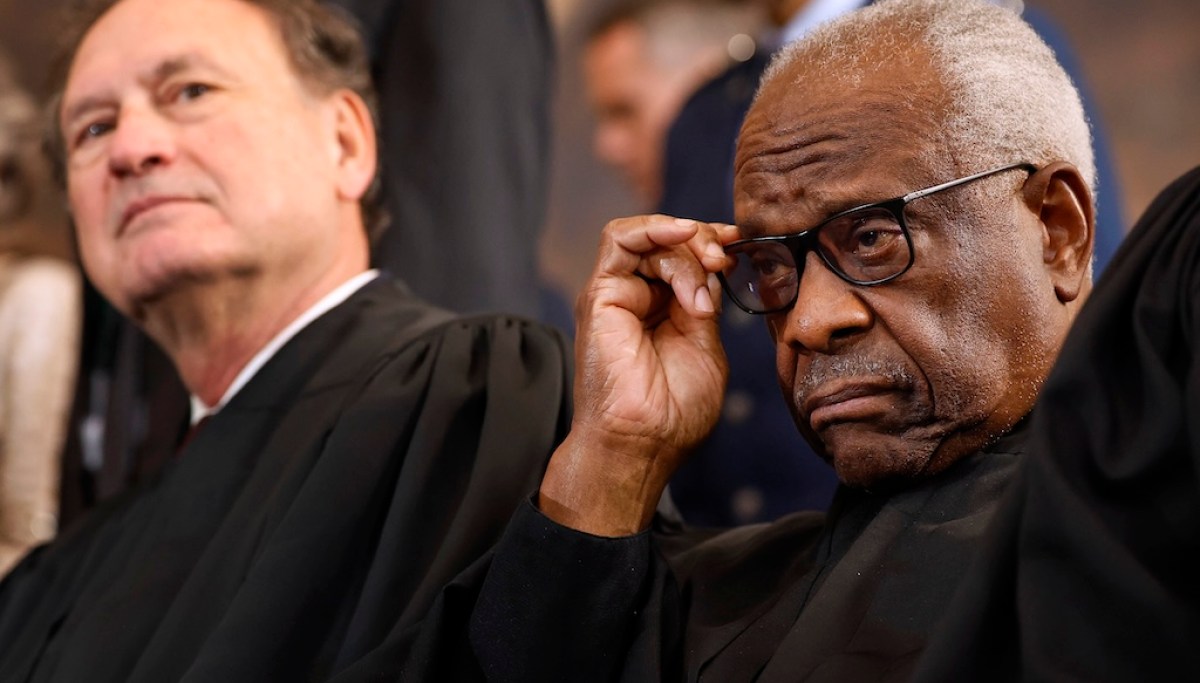
From Justice Thomas's dissent from denial of certiorari today in Khatibi v. Yip, joined by Justice Alito (Justice Gorsuch voted to grant the petition, but didn't sign on to the dissent):
In 2022, California began requiring private instructors in privately run and privately accredited continuing medical education (CME) courses to discuss how so-called implicit bias affects healthcare outcomes.
asserted
bias → join → outcomes
The Ninth Circuit held that First Amendment scrutiny did not apply to this compelled-speech requirement because the breadth of California's CME regulation renders the content of any CME course government speech, not private speech.
asserted
breadth → hold → speech
That logic fundamentally misunderstands this Court's precedents and the Constitution.
asserted
logic → misunderstand → precedents
First Amendment protections do not give way simply because a State heavily regulates speech.
asserted
State → give → speech
I would have granted certiorari to clarify the government-speech doctrine.
asserted
I → grant → doctrine
At a minimum, the Ninth Circuit misapplied Shurtleff v. Boston (2022), which instructs courts to identify government speech by considering (1) "the history of the expression at issue," (2) "the public's likely perception as to who (the government or a private person) is speaking," and (3) "the extent to which the government has actively shaped or controlled the expression."
asserted
government → misapply → expression
The Ninth Circuit collapsed those distinct inquiries, focusing on the breadth of the government's regulatory scheme at each step.
asserted
Circuit → collapse → step
More fundamentally, however, Shurtleff is leading courts astray.
asserted
Shurtleff → lead → courts
I joined Justice ALITO's concurrence in Shurtleff, which warned that the majority's three-factor test could cause courts to conclude that extensive government regulation transforms a private message into government speech exempt from First Amendment scrutiny.
uncertain
regulation → join → scrutiny
As the Ninth Circuit's decision shows, those concerns were prescient.
asserted
concerns → show → ?
This Court should reconsider whether the Shurtleff test is the proper mode of analysis for identifying government speech…
California-licensed physicians are required to complete 50 hours of approved CME every two years. Credit-eligible CME courses are often organized by private entities, certified by private accreditors, and taught by private instructors.
asserted
courses → reconsider → instructors
The State does not preapprove course content but reserves the right to audit courses for compliance with its CME standards.
asserted
State → preapprove → standards
The Medical Board of California "adopt[s] and administer[s] [CME] standards," few of which relate to course content.
asserted
few → adopt[ → content
In addition, the State requires that CME courses broadly relate to the medical profession.
asserted
courses → require → profession
They must "serve to maintain, develop, or increase the knowledge, skills, and professional performance that a physician and surgeon uses to provide care, or to improve the quality of care provided to patients."
asserted
physician → serve → patients
In 2019, however, the California Legislature added a requirement that after January 1, 2022, all CME courses must "contain curriculum that includes the understanding of implicit bias."
asserted
that → add → bias
To satisfy that requirement, CME courses must contain "[e]xamples of how implicit bias affects perceptions and treatment decisions of physicians and surgeons, leading to disparities in health outcomes" or "[s]trategies to address how unintended biases in decisionmaking may contribute to health care disparities.
uncertain
biases → satisfy → disparities
Petitioners Dr. Azadeh Khatibi and Do No Harm do not want to speak California's preferred message on implicit bias, and they challenged § 2190.1(d) as compelling speech in violation of the First Amendment.
asserted
they → Do → Amendment
Dr. Khatibi, a California-licensed ophthalmologist, creates and teaches CME courses.
asserted
Khatibi → license → courses
She "disagrees that implicit bias is the primary factor driving disparities in healthcare" and does not want to devote time to the subject during her courses.
asserted
bias → disagree → courses
At least one of its members teaches CME courses and believes that implicit bias trainings "have not been shown to successfully reduce barriers to healthcare, and instead risk infecting healthcare decisions with divisive and discriminatory ideas."
asserted
trainings → teach → ideas
Yet, California's implicit-bias-training requirement leaves petitioners no choice but to discuss the topic in a way that affirms the State's view that implicit bias causes "disparities in health outcomes…..
asserted
bias → leave → outcomes
The Ninth Circuit held that all three Shurtleff factors indicate that "CMEs eligible for Board credit constitute government speech."
asserted
CMEs → hold → speech
At every step of the analysis, the Ninth Circuit emphasized the breadth of the State's regulation.
asserted
Circuit → emphasize → regulation
Considering history, the court noted that California "has long regulated the practice of medicine as an exercise of the police power" and has "adopted, updated, and enforced CME standards."
asserted
California → consider → standards
Considering the public's likely perception of the speaker in a CME course, the court reasoned that "licensees could attribute approved CMEs' content to California" because "their profession is heavily regulated."
uncertain
profession → consider → California
Considering the extent to which the government has shaped the expression, the court cited "California's extraordinary control over accredited CMEs."
asserted
court → consider → CMEs
As Judge VanDyke explained in his dissent from the denial of rehearing en banc, the panel's "approach boil[ed] down to a single-factor analysis: does the government 'heavily' or 'actively' regulate CMEs?"
asserted
government → explain → CMEs
In its blinkered application of the Shurtleff factors, the Ninth Circuit lost sight of the core government-speech inquiry: whether the government is "speak[ing] for itself or … regulat[ing] private expression."
asserted
government → lose → expression
The government-speech doctrine occupies a narrow corner of our First Amendment jurisprudence.
asserted
doctrine → occupy → jurisprudence
The First Amendment protects the people's right of free speech against government interference; it does not prevent the government from speaking for itself.
asserted
it → protect → itself
"But courts must be very careful when a government claims that speech by one or more private speakers is actually government speech."
uncertain
speech → claim → speakers
"If private speech could be passed off as government speech by simply affixing a government seal of approval, government could … muffle the expression of disfavored viewpoints," or, as here, require private speakers to convey government messages without facing any constitutional scrutiny.
uncertain
government → pass → scrutiny
This Court has thus exercised "great caution" before characterizing a message as government speech.
asserted
Court → exercise → speech
In Johanns v. Livestock Marketing Assn (2005), we held that government-sponsored beef ads constituted government speech because the government determined "the overarching message" of the ads, helped develop proposals for the ads, reviewed every ad "for substance and for wording," and the Secretary of Agriculture "exercise[d] final approval authority over every word used in every" ad.
asserted
Secretary → hold → ad
In Pleasant Grove City v. Summum (2009), we held that the permanent display of monuments in a public park was government speech because the City "effectively controlled the messages sent by the monuments in the Park by exercising final approval authority over their selection."
asserted
City → hold → selection
And, in Walker v. Texas Div., Sons of Confederate Veterans, Inc. (2015), we held that the messages on government-issued license plates, over which the State "maintain[ed] direct control," were government speech.
asserted
State → hold → control
Since Walker—which we have described as the "outer boun[d] of the government-speech doctrine," Matal v. Tam (2017)—we have been careful to distinguish between government control over messages and government control over the broader scheme through which the messages are communicated.
asserted
messages → describe → which
We held, for example, that trademarks are private speech, notwithstanding the government's substantial involvement in the registration process.
asserted
trademarks → hold → process
And, this Court held that flags flown outside of Boston's City Hall did not constitute government speech in part because the city regularly permitted private groups to freely fly their own colors.
asserted
city → hold → colors
…and 37 more, not listed.
 The Aporia