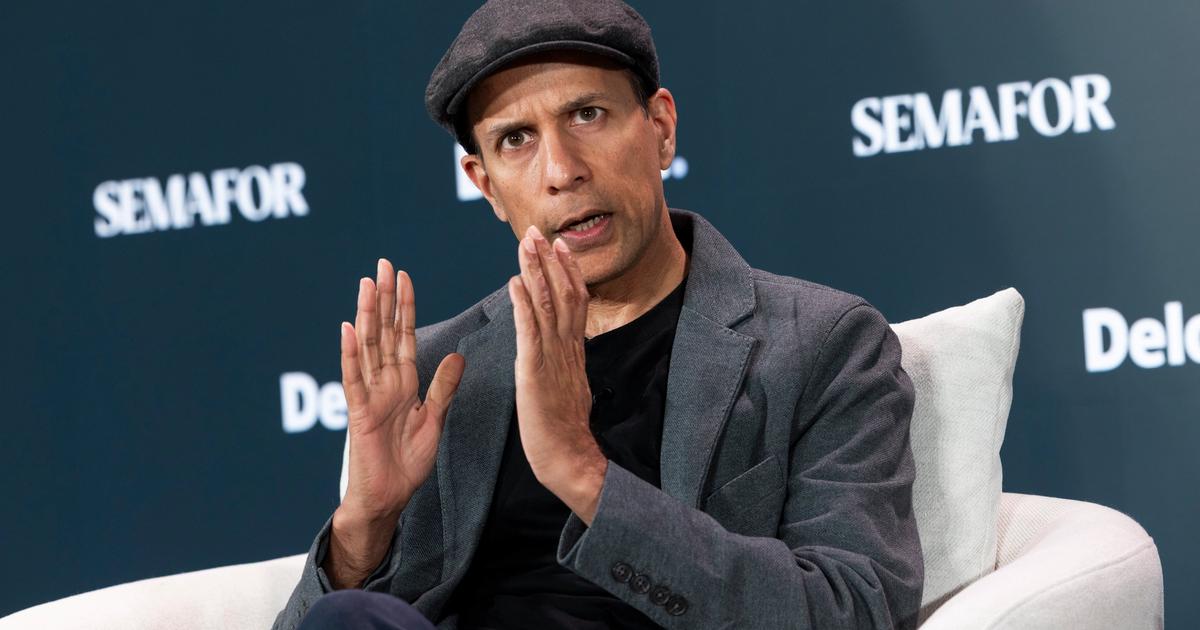
Photo via Semafor

AI agents still act like ‘Day 1 employees,’ Glean CEO says

Read the original at Semafor ↗
Cite

Kesslen, B. (2026, November 17). AI agents still act like ‘Day 1 employees,’ Glean CEO says. Semafor. https://www.semafor.com/article/11/16/2026/ai-agents-still-act-like-day-1-employees-glean-ceo-says

Dated from the outlet's own feed. Check the original for its byline.

Semafor · collected 2026-11-17 · by Ben Kesslen

Quick Summary

Glean CEO Arvind Jain discussed AI capabilities at Semafor’s Silicon Valley & The World event, stating that current AI agents perform tasks as if they are new employees lacking context and experience. Jain emphasized the need for integrating tacit knowledge and experience into AI systems to bridge the gap between AI and skilled human performance. He also highlighted the pressure companies face to adopt AI despite its limitations, which may contribute to technological disruptions seen in recent weeks.
Written by AI on 2026-11-17, from this article's own text only (the story summary below draws on all the coverage).

AI analysis

Story summary

Glean CEO Arvind Jain stated on November 17, 2026, that AI agents still operate like "Day 1 employees" when deployed, lacking the context and experience to outperform skilled humans. Jain made this assertion during a conversation with The Verge's editor-in-chief, Nilay Patel, at Semafor’s Silicon Valley & The World event. He emphasized that AI systems are not yet capable of replacing experienced workers and are under "enormous pressure" to be adopted by companies. This pressure, according to Jain, may contribute to recent high-level technological disruptions, such as the outages experienced by banks and airlines. Glean, founded by Jain in 2019, aims to integrate tacit knowledge and company experience into AI systems to address this "Day 1 employee" issue.
Written for “AI Agents Employee Status” on 2026-11-18, grounded in this article and the 0 other(s) covering the same event.

Compared with similar articles

This article reads unscored and hedges 10% of its claims. Each row says how that neighbour differs.
Semafor
Hedges 0 of 8 claims Outlet record 65/100
“Both articles discuss AI at Semafor’s Silicon Valley & The World event, but they cover different speakers and topics: one is about AI agents' performance, and the other is about access to AI resources for universities and public sectors.”

Story

AI Agents Employee Status
Technology · 1 article(s) covering the same event.
How this article was measured signals, leaning charts, publisher record, byline, topics and claims

Signals How these are calculated →

Claims extracted
10
sentences that state something as happening or true
Uncertain
10%
1 of 10 hedged ("reportedly", "may", "according to")
Leaning
not political
takes no side on a contested political question
Publisher signals
65/100
Semafor's corrections and hedging, across everything collected from it. Not a measure of accuracy.
Outlets on this story
1
Technology
Same framing elsewhere
1
articles that frame the event the way this one does
Analyzed 2026-11-17 · how these are computed

How this is being covered How these are calculated →

Article leaning vs. publisher reliability
Source leaning vs. consistency

Publisher

Semafor · 1852 article(s) · 6 correction(s) detected
Running correction rate · 6 correction(s)

Who wrote this

Ben Kesslen
6 article(s) here · 1 carrying a prediction
LeCun predicts a short period “where AI tools facilitate cyberattacks and favor the attacker over the defender,” but that will be “just a short period of transition.”
Investing in African AI would be “creating a market,” Gill said, and could improve AI’s reputation by showing how it can be used to improve water scarcity, public health, and public services issues.
That may be one reason, he said, for recent high-level technological disruptions, like the outages this week reported by banks and airlines.
“If it wasn’t for Jensen, there wouldn’t be a lot of funding going into US open model companies like Reflection and others.
Also by Ben Kesslen
Nothing else under this byline is closely related to this article, so these are simply their most recent.
All 6 articles by Ben Kesslen →

Topics

Glean Semafor The Verge

Subjects

Jain PERSON · 5× Arvind Jain PERSON · 1× Glean ORG · 1× Nilay Patel PERSON · 1× Semafor ORG · 1× The Verge ORG · 1×

Narrative

“When you deploy AI agents, and you actually point them to the right data and knowledge that they need to do their work, they still come and act more like Day 1 employees,” Jain told the editor-in-chief of The Verge, Nilay Patel, at Semafor’s Silicon Valley & The World.
framing: assertive · carried by 1 article(s) · first seen 2026-11-17
That may be one reason, he said, for recent high-level technological disruptions, like the outages this week reported by banks and airlines.
2026-11-17 · Semafor
AI agents still act like ‘Day 1 employees,’ Glean CEO says · assertive framing

Claims (10 extracted, 1 hedged)

AI agents are nowhere near having the “context” to outperform skilled humans, Glean CEO Arvind Jain said Monday. asserted
Jain → have → humans
“When you deploy AI agents, and you actually point them to the right data and knowledge that they need to do their work, they still come and act more like Day 1 employees,” Jain told the editor-in-chief of The Verge, Nilay Patel, at Semafor’s Silicon Valley & The World. asserted
Jain → deploy → Valley
“That’s the gap that needs to close before we can come and talk about fancy things like job elimination.” asserted
we → ’ → elimination
Jain, who co-founded the AI platform Glean in 2019, asserted
who → co → 2019
said “nobody’s anywhere close” to building AI systems capable of replacing experienced workers. asserted
nobody → say → workers
Glean, he said, is meant to bring “tacit knowledge” and experience with a company to its internal AI systems, to combat that “Day 1 employee” problem. asserted
he → say → problem
Despite AI’s limitations, Jain also said companies are under “enormous pressure” to adopt it. asserted
companies → say → it
That may be one reason, he said, for recent high-level technological disruptions, like the outages this week reported by banks and airlines. uncertain
he → say → banks
“Sometimes businesses didn’t get time to actually set the right foundation” before rolling out AI tools, Jain said. asserted
Jain → get → tools
Jain also predicted a future in which around 90% of work can be done by open-source and non-frontier AI models, though the remaining “10% of the tasks will actually still consume the majority of your AI spend.” asserted
% → predict → spend
Give feedback · no sign-in needed

No sign-in needed for now. Your note is sent without a name, so it cannot be answered.

History Support