ONE WOULD THINK THAT, in late 2026, Vladimir Putin’s Russia has no more milestones to pass on its journey toward full-fledged totalitarianism.
asserted
Russia → think → totalitarianism
Last week saw the official demise of Novaya Gazeta, the independent newspaper that began publishing in 1993.
asserted
that → see → 1993
On November 9, the paper’s staff turned off the lights and closed the doors behind them for the last time.
asserted
staff → turn → time
In late 2021, Novaya Gazeta had a print circulation of about 100,000 and close to 20 million monthly online views.
asserted
Gazeta → have → 100,000
After the full-scale invasion of Ukraine commenced in early 2022, censorship in Russia escalated dramatically, and Novaya became a prime target for a crackdown.
asserted
Novaya → commence → crackdown
In November 2022, it was stripped of registration as a media outlet, making its print edition illegal (or, at least, making it illegal to print more than 1,000 copies of an issue; in response, the Novaya team published occasional paper issues with 999 copies)
asserted
team → strip → copies
Access to its website in Russia was blocked, though it remained available via widely used virtual private networks (VPNs).
asserted
it → block → networks
Novaya’s editors still tried to comply with the new rules, such as avoiding the word “war” when describing the “special military operation” in Ukraine.
asserted
editors → try → Ukraine
Even so, in September, the outlet and its entire staff were officially designated as “foreign agents.”
asserted
outlet → designate → agents
Shortly afterward, banks cut all donations and transfers to the paper, almost completely choking off its lifeblood.
asserted
banks → cut → lifeblood
Finally, in late October, the editors were served with an eviction notice and given less than two weeks to vacate the office Novaya Gazeta had occupied for over three decades.
asserted
Gazeta → serve → decades
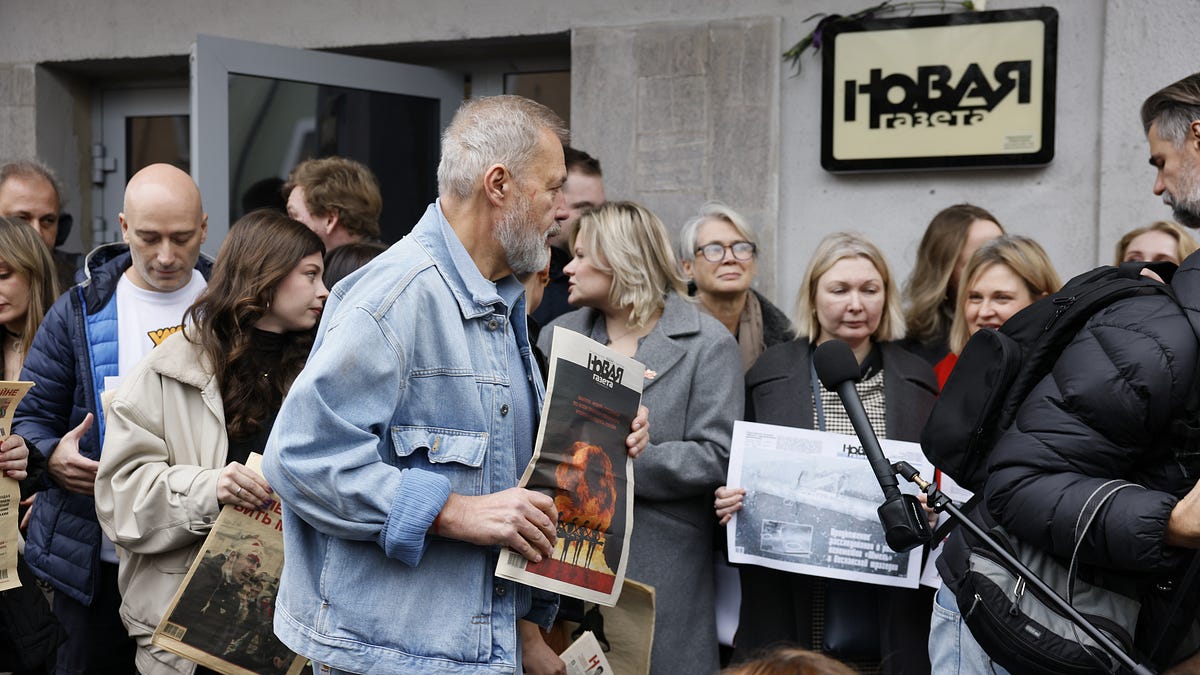
In today’s environment of pervasive fear and state surveillance, it’s remarkable that a sizable crowd—dozens, at least—gathered in the narrow lane outside Novaya’s offices as the journalists left the building for the last time.
asserted
journalists → ’ → time
Founder and former editor-in-chief Dmitry Muratov, who used the occasion to reiterate his view that the Russian people should not be equated with the Putin regime, said that the paper was finding “tremendous solidarity and support” among the public.
asserted
paper → use → public
It’s hard to say what portion of the population offered or even felt such solidarity.
asserted
portion → ’ → solidarity
But there is no doubt that for many antiwar, anti-Putin Russians, even if they can use VPNs to access other news sources—including Russian-language websites and YouTube channels run by expatriate journalists—Novaya Gazeta’s physical presence in Moscow had real significance.
asserted
presence → be → significance
“Psychologically, emotionally, it mattered to a lot of people,” journalist Andrei Kolesnikov told Zhivoi Gvozd (“Live Nail”), a dissident YouTube channel that also manages, for now, to stay in Russia.
asserted
that → matter → Russia
“WE HAVE BEEN MURDERED.”
That’s how Novaya Gazeta’s editors announced the shutdown.
asserted
editors → murder → shutdown
Some émigré social media users criticized the language, arguing that it diminished the horror of actual daily slaughter carried out by the Putin regime in Ukraine.
asserted
it → criticize → Ukraine
But Novaya Gazeta had very painfully earned the right to use the term: If Russia, in the last quarter of a century, has been a country of murdered journalists, Novaya has been the epicenter of that reign of terror.
asserted
Novaya → earn → terror
The staffers’ last goodbye was made all the more poignant by tributes to slain colleagues and the removal of their photos and other exhibits honoring their memory.
asserted
goodbye → make → memory
The most famous of these victims was Anna Politkovskaya, the investigative journalist shot dead in the elevator of her apartment building in October 2006.
asserted
famous → shoot → October
The always-intrepid Politkovskaya, who could not be frightened off such dangerous topics as human rights abuses in Chechnya—the “autonomous republic” ruled, warlord-style, by former-separatist-chief-turned-Putin-crony Ramzan Kadyrov—remains an international symbol of journalistic courage and integrity twenty years after her death.
uncertain
who → frighten → death
(Five men were convicted of her murder in 2014, though the mastermind, very likely linked to Kadyrov, was never identified.
asserted
mastermind → convict → Kadyrov
In a final insult, one of the killers, who received a twenty-year sentence, was pardoned in 2023 after six months of combat service in Ukraine.
asserted
who → receive → Ukraine
In 2000, Novaya Gazeta reporter Igor Domnikov died two months after he was attacked with a hammer outside his home; while several gang members were convicted, the likely instigator—a former regional deputy governor displeased by Domnikov’s corruption exposés—was not charged until 2015.
asserted
instigator → die → 2015
The state of limitations having expired, all charges were dismissed.
asserted
charges → expire → limitations
In 2003, veteran investigative journalist, Novaya Gazeta contributor, and liberal Duma member Yuri Shchekochikhin died of a mysterious “allergic reaction”—very likely radioactive poisoning.
asserted
Shchekochikhin → die → poisoning
(His beats included not only corruption but the possible role of the FSB, Russia’s federal security service, in the apartment building explosions that helped bring Putin to power.
asserted
that → include → power
In 2009, 25-year-old Anastasia Baburova, a freelance reporter for Novaya Gazeta, was gunned down by two neo-Nazis in downtown Moscow with human rights lawyer Stanislav Markelov, once Politkovskaya’s attorney.
asserted
Baburova → gun → Markelov
The same year, Novaya journalist and human rights activist Natalia Estemirova was abducted and murdered in Chechnya after publicizing the extrajudicial execution of a villager by law enforcement.
asserted
Estemirova → abduct → enforcement
In 2018, three Novaya Gazeta reporters were shot and killed in the Central African Republic, where they had been investigating the activities of PMC Wagner, the Kremlin-protected mercenary unit that became notorious during the war in Ukraine.
asserted
that → shoot → Ukraine
This grim list leaves out some who came very close to being murdered—such as reporter Pavel Kanygin, who was abducted by pro-Russia militants in Eastern Ukraine twice, in 2014 and 2015, while covering Russia’s covert war in Donetsk; during the first of these kidnappings, Kanygin was repeatedly threatened with execution before being released on payment of a $30,000 ransom.
asserted
Kanygin → leave → ransom
A regular contributor, writer and poet Dmitry Bykov (now living in the United States), survived a likely poisoning attempt in 2019.
asserted
contributor → live → 2019
Perhaps inevitably in Russia, it blended journalism with advocacy, with staffers trying to help desperate people who reached out with stories of persecution and abuse.
asserted
who → blend → persecution
It was also a platform for careful investigative journalism, thoughtful historical and cultural essays (such as historian Andrei Zubov’s deep dives into the Russian Revolution, World War II, and the fortunes of Russian liberalism), and even poetry, including Bykov’s brilliant verses providing satirical commentary on current events.
asserted
It → include → events
Over its thirty-plus years, Novaya Gazeta has seen its share of controversies.
asserted
Gazeta → see → controversies
Some dissidents saw it as too close to the Russian political establishment.
asserted
dissidents → see → establishment
Its founders and part-owners included the Soviet Union’s last president, Mikhail Gorbachev, who used his Nobel Peace Prize money to launch the newspaper.
asserted
who → include → newspaper
Perhaps more oddly, until 2015, it was also partly bankrolled by Alexander Lebedev, KGB operative and Russian oligarch turned British newspaper tycoon—who, at least in the late 2000s, retained close ties to many of his former KGB associates and even attended the annual Kremlin gala for “Chekist [i.e., secret police agent] Day.”1
asserted
who → bankroll → Day
All this led to speculation that Novaya Gazeta was a “project” of a faction within the Kremlin, or even within the state security forces.
asserted
Gazeta → lead → forces
…and 40 more, not listed.
 The Aporia