Photo via Times of India

New York City volunteers planted 20,000 marsh seedlings in 2003; 80% were healthy by 2005

Read the original at Times of India ↗
Cite

TOI World Desk. (2026, September 17). New York City volunteers planted 20,000 marsh seedlings in 2003; 80% were healthy by 2005. Times of India. https://timesofindia.indiatimes.com/world/us/new-york-city-volunteers-planted-20000-marsh-seedlings-on-a-dying-salt-marsh-in-2003-but-80-of-the-site-was-healthy-just-two-years-later/articleshow/134306485.cms

Dated when The Aporia collected the article, usually within hours of publication. Check the original for its exact date and byline.

Times of India · collected 2026-09-17 · by TOI World Desk

Quick Summary

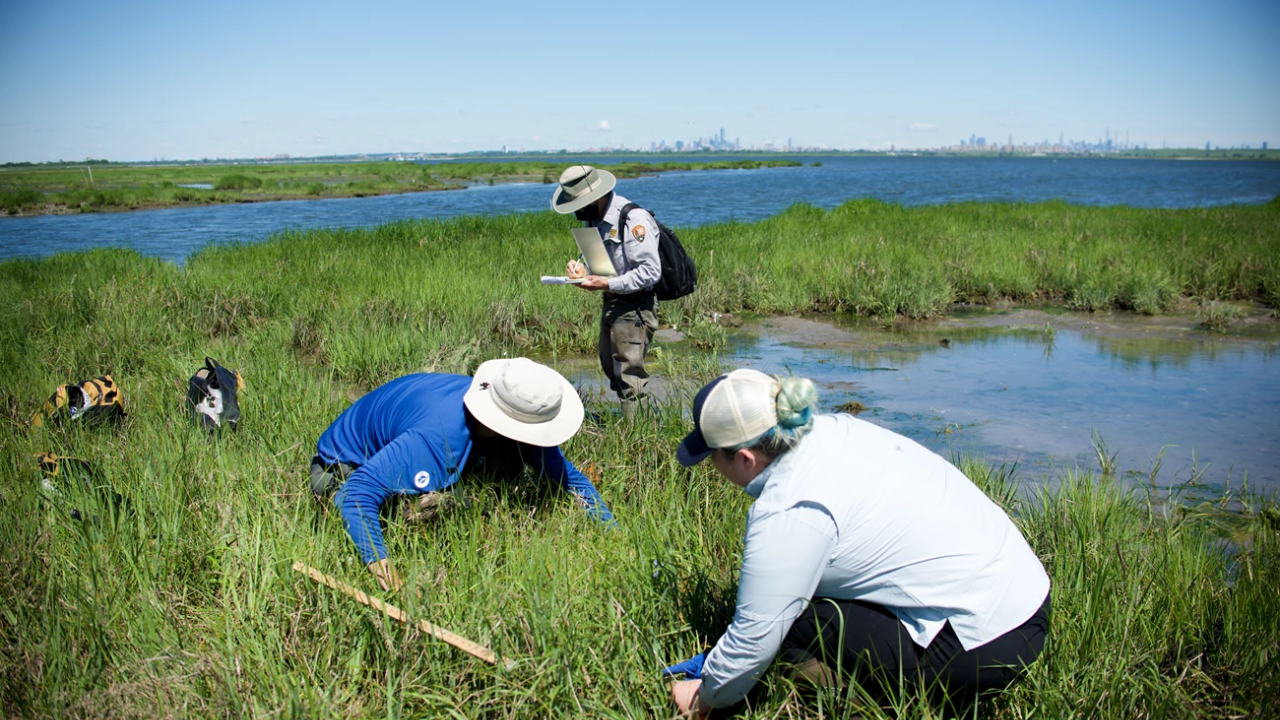
In 2003, National Park Service scientists and volunteers planted 20,000 smooth cordgrass seedlings at New York City’s Big Egg Marsh as part of a salt marsh restoration project. Despite initial challenges like grazing by geese and marine debris, more than 80% of the site was healthy just two years later in 2005. The article highlights the successful early stages of this environmental recovery effort aimed at revitalizing damaged wetlands.
Written by AI on 2026-09-17, from this article's own text only (the story summary below draws on all the coverage).

AI analysis

Story summary

In 2003, National Park Service scientists and 100 volunteers planted 20,000 smooth cordgrass seedlings at Big Egg Marsh in Jamaica Bay, New York City. This was part of a restoration project aimed at reviving the area's salt marshes, which had been declining for decades due to various factors like urban development and pollution. Despite initial challenges such as grazing by geese and marine debris, the seedlings flourished remarkably well. By 2005, over 80% of the planted area was reported to be healthy vegetation, providing a promising indicator for the long-term sustainability of the marsh restoration efforts.

Written for “NYC Marsh Restoration Project” on 2026-11-02, grounded in this article and the 0 other(s) covering the same event.

Story

📰 NYC Marsh Restoration Project
Environment · 1 article(s) covering the same event.

Compared with similar articles

Nothing to compare against. No article is close enough to this one for the pipeline to have linked or judged the pair.
How this article was measured signals, leaning charts, publisher record, byline, topics and claims

Signals How these are calculated →

Claims extracted
23
sentences that state something as happening or true
Uncertain
9%
2 of 23 hedged ("reportedly", "may", "according to")
Leaning
not political
takes no side on a contested political question
Publisher signals
59/100
Times of India's corrections and hedging, across everything collected from it. Not a measure of accuracy.
Outlets on this story
1
Environment
Same framing elsewhere
1
articles that frame the event the way this one does
Analyzed 2026-09-17 · how these are computed

How this is being covered How these are calculated →

Article leaning vs. publisher reliability
Source leaning vs. consistency

Publisher

Times of India · 3966 article(s) · 3 correction(s) detected
Running correction rate · 3 correction(s)

Who wrote this

TOI World Desk
1377 article(s) here · 1 carrying a prediction
🔮 While their decision to buy an abandoned French hamlet might appear like an unexpected adventure, Yip and Paul's official website reveals that their story together began decades earlier.
🔮 Hundreds of polar bears are expected to gather near the Canadian town of Churchill in Manitoba as temperatures fall and the animals wait for Hudson Bay to freeze.
🔮 Together they would support the reforestation of Mutuba trees in Uganda for three years.
🔮 In the letter, he apologised for forgetting to send his greetings earlier and expressed hope that they would meet the following year again.
🔮 Meeker told Signal Akron that the sculpture contained details that people could continue discovering over time.
🔮 The possibility that the farm could eventually reach another generation now seems less remote.
🔮 According to his plea agreement, he repeatedly gave investors false information about how their money would be used.
🔮 The couple challenged the move in court, and a judge subsequently ordered that the fence could not be removed or relocated while the legal dispute continued.
🔮 According to the court's ruling, available on Justia under Lampton Securities Partnership, LLP v. Louisville-Jefferson County Metro Government, the landowner had not obtained a final decision from the relevant authorities about what could be built on the property.
🔮 In one incident in May 2025, Scotty took the child out of school without informing Jill or the school.
Wire or desk byline, not an individual reporter.
Also by TOI World Desk
Nothing else under this byline is closely related to this article, so these are simply their most recent.
All 1377 articles by TOI World Desk →

Topics

National Park Service New York City’s the National Park Service

Subjects

National Park Service ORG · 2× New York City’s GPE · 2× the National Park Service ORG · 2× George W. Frame PERSON · 1×

Narrative

In 2003, a restoration effort at New York City’s Big Egg Marsh took a major step when National Park Service scientists and 100 volunteers planted 20,000 smooth cordgrass seedlings across an area that had been raised with clean sand.
framing: assertive · carried by 1 article(s) · first seen 2026-09-17
🔮 That peat creates a stronger foundation for further plant growth, meaning the vegetation could contribute to the longer-term development and stability covering the restored ground.

Claims (23 extracted, 2 hedged)

In 2003, a restoration effort at New York City’s Big Egg Marsh took a major step when National Park Service scientists and 100 volunteers planted 20,000 smooth cordgrass seedlings across an area that had been raised with clean sand. asserted
that → take → sand
The work was part of an experiment to restore a salt marsh in Jamaica Bay, where marshes had been disappearing for decades. asserted
marshes → restore → decades
The seedlings faced early setbacks, including grazing by geese, tides and marine debris. asserted
seedlings → face → geese
The vegetation continued to spread. asserted
vegetation → continue → ?
Just two years into the restoration, more than 80% of the experiment site was reported to be vegetated and healthy, offering an encouraging result for the damaged marsh. asserted
% → report → marsh
Once the marsh had been raised, the restoration team needed to establish vegetation across the treated area. asserted
team → raise → area
In October 2003, National Park Service scientists and 100 volunteers planted 20,000 seedlings of smooth cordgrass, known scientifically as Spartina alterniflora. asserted
scientists → plant → alterniflora
The planting covered the part of Big Egg Marsh where the sand had been sprayed. asserted
sand → cover → Marsh
Smooth cordgrass was particularly suited to the difficult conditions of a salt marsh because it can thrive in high-salinity environments. asserted
it → thrive → environments
According to the National Park Service, the plant’s roots trap sediment, allowing it to build up into nutrient-rich peat. uncertain
it → accord → peat
That peat creates a stronger foundation for further plant growth, meaning the vegetation could contribute to the longer-term development and stability covering the restored ground. uncertain
vegetation → create → ground
Scientists begin monitoring Big Egg Marsh The planting was followed by systematic monitoring. asserted
planting → begin → monitoring
Scientists established one-metre-by-one-metre plots across Big Egg Marsh and repeatedly returned to record elevation, plant numbers, soil characteristics and the animals present. asserted
Scientists → establish → elevation
This allowed researchers to track changes over time rather than judging the restoration from a single observation. asserted
researchers → allow → observation
Monitoring began in 2004 and continued several times a year through 2008. asserted
Monitoring → begin → 2008
Geese ate some of the seedlings, while tides washed others away and marine debris such as logs, bottles, plastic bags and straw buried or suffocated some plants. asserted
debris → eat → plants
Despite these losses, smooth cordgrass continued to grow, while new seedlings appeared naturally and saltmeadow cordgrass, or salt hay (Spartina patens), also began to establish. 80% of the experiment site becomes healthy asserted
% → continue → site
Two years into the restoration, the results showed a substantial change across the experiment area. asserted
results → show → area
The National Park Service reports that over 80% of its experimental site was vegetated and healthy. asserted
% → report → site
This meant that despite the early losses among planted seedlings, vegetation had successfully become established across most of the restoration site. asserted
vegetation → mean → site
Monitoring continued to provide information about what happened to the marsh over the longer term. asserted
what → monitor → term
In 2021, nearly two decades after restoration began in 2002, Dr George W. Frame returned to Big Egg Marsh to examine its condition. asserted
Frame → begin → condition
The restoration also helped pave the way for other projects in Jamaica Bay, with efforts across the bay eventually restoring more than 150 acres of marshland. asserted
efforts → pave → marshland

💬Give feedback
🕘History 🎫Support