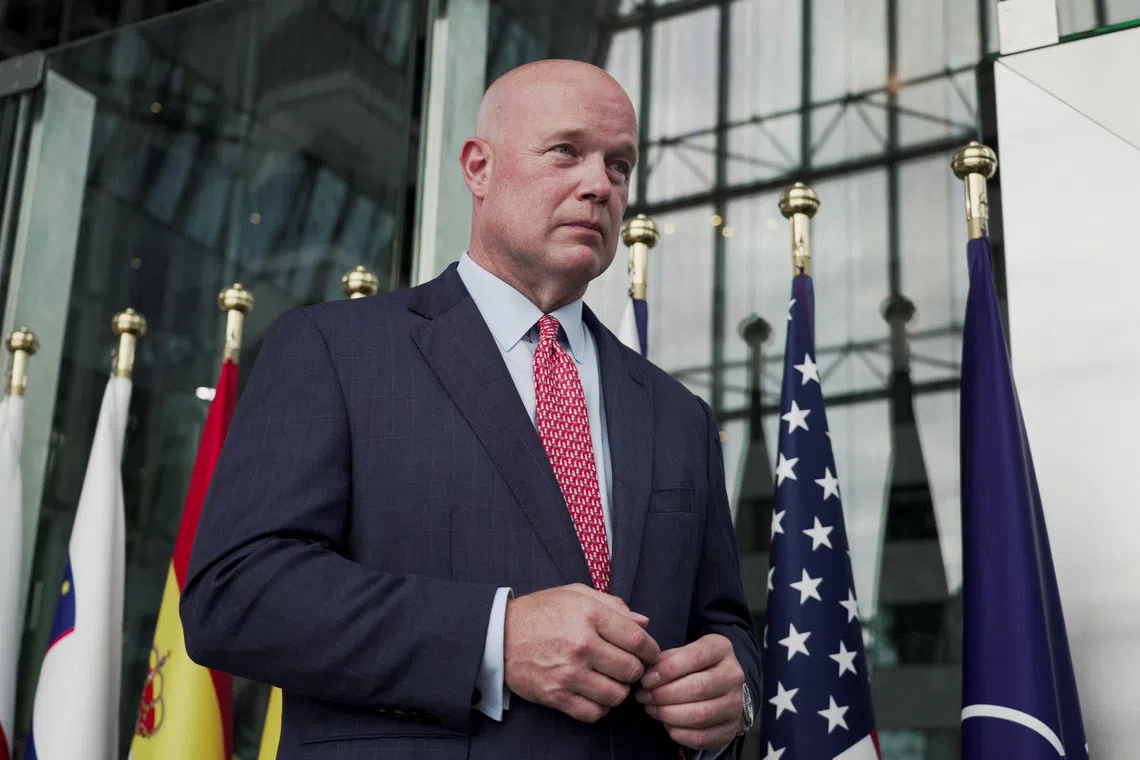
Photo via Evening Standard

Nato chief: UK needs credible path of yearly hikes to hit defence spending goal

Read the original at Evening Standard ↗
Cite

Wingate, S. (2026, September 17). Nato chief: UK needs credible path of yearly hikes to hit defence spending goal. Evening Standard. https://www.standard.co.uk/news/politics/mark-rutte-nato-gdp-andy-burnham-vladimir-putin-b1297386.html

Dated when The Aporia collected the article, usually within hours of publication. Check the original for its exact date and byline.

Evening Standard · collected 2026-09-17 · by Sophie Wingate

Quick Summary

Jens Stoltenberg, NATO Secretary General, emphasized during an interview with Press Association that the UK needs to commit to a yearly increase in defense spending to reach the 3.5% of GDP goal by 2035. He praised the current UK government's commitment but stressed the necessity for a credible and incremental approach towards this target. Stoltenberg also supported the UK’s stance against EU efforts to limit arms procurement to European manufacturers, advocating instead for an inclusive NATO defense industrial base.
Written by AI on 2026-09-17, from this article's own text only (the story summary below draws on all the coverage).

AI analysis

Story summary

Mark Rutte, NATO's secretary general, emphasized during recent meetings with UK Prime Minister Andy Burnham and other officials that the UK must commit to a credible path of yearly increments towards reaching a defense spending target of 3.5% of GDP by 2035. This commitment is critical amid escalating tensions with Russia, as highlighted by Russian President Vladimir Putin’s actions in Ukraine and aggressive military spending. Rutte stressed that NATO countries cannot afford to wait until the last minute; instead, they need a clear roadmap for gradual increases. Despite predecessor Sir Keir Starmer's initial pledge to this goal, there has been pressure on Burnham to outline an interim target of 3% by 2030, reflecting concerns over Britain’s seriousness about the commitment. Rutte’s visit underscored NATO's ongoing efforts to ensure its member states stay ahead of potential threats and maintain a robust defense posture.

Written for “UK Defence Spending Goals” on 2026-11-03, grounded in this article and the 3 other(s) covering the same event.

Story

📰 UK Defence Spending Goals
Politics · 4 article(s) covering the same event. Compare every outlet's account →

Compared with similar articles

This article reads unscored and hedges 12% of its claims. Each row says how that neighbour differs.
Evening Standard
Hedges 3 of 12 claims Outlet record 64/100
The Guardian
Hedges 3 of 20 claims Outlet record 66/100
BBC News
⚖️ Leans right Hedges 2 of 17 claims Outlet record 68/100
The Straits Times
Hedges 0 of 10 claims Outlet record 66/100
“The articles discuss different aspects of NATO's defense spending requirements and do not describe the same specific incident or meeting.”
The Guardian
⚖️ Leans strongly right Hedges 0 of 15 claims Outlet record 66/100
“While both articles discuss NATO Secretary General Mark Rutte's comments on UK defense spending, they appear to cover separate instances or different aspects of his statements rather than the exact same occurrence.”
The Guardian
⚖️ Leans left Hedges 0 of 36 claims Outlet record 66/100
“The articles discuss different aspects of NATO Secretary General Mark Rutte's activities, with Article A focusing on a statement about defense spending goals and Article B mentioning his visit to Des Moines, Iowa.”
How this article was measured signals, leaning charts, publisher record, byline, topics and claims

Signals How these are calculated →

Claims extracted
17
sentences that state something as happening or true
Uncertain
12%
2 of 17 hedged ("reportedly", "may", "according to")
Leaning
withheld
no quote in the article backed the model's score
Publisher signals
64/100
Evening Standard's corrections and hedging, across everything collected from it. Not a measure of accuracy.
Outlets on this story
4
Politics
Same framing elsewhere
1
articles that frame the event the way this one does
Analyzed 2026-09-17 · how these are computed

How this is being covered How these are calculated →

Article leaning vs. publisher reliability
Source leaning vs. consistency

Publisher

Evening Standard · 8264 article(s) · 73 correction(s) detected
Running correction rate · 73 correction(s)

Who wrote this

Sophie Wingate
36 article(s) here · 1 carrying a prediction
🔮 Skilled migrants settling in Britain are expected to contribute billions more to the public finances than they cost over their lifetimes, according to analysis published before an immigration rules overhaul on Monday.
🔮 Ms Mahmood will set out reforms on the length of time people will have to be in the UK before becoming eligible for permanent settlement, measures which have caused deep splits at the top of the Labour Government.
🔮 Skilled migrants settling in Britain are expected to contribute billions more to the public finances than they cost over their lifetimes, according to analysis published before an immigration rules overhaul on Monday.
🔮 She will make a statement in the House of Commons, a Home Office source confirmed.
🔮 Mrs Badenoch on Sunday argued an apology would give countries a reason to ask Britain for money.
🔮 “Often with a budget, people would have come home from work and said, ‘Well, this doesn’t help me.
🔮 The influential Institute for Fiscal Studies (IFS) think tank said the Budget’s “raft of fiddly measures” would do little to boost growth and warned it delayed tough decisions, and the left-leaning Resolution Foundation think tank said Mr Healey had “spread the jam thin”.
Also by Sophie Wingate
Nothing else under this byline is closely related to this article, so these are simply their most recent.
All 36 articles by Sophie Wingate →

Topics

Defence Nato Russians Ukraine the Press Association

Subjects

Nato ORG · 8× Rutte PERSON · 5× Burnham PERSON · 2× Ed Miliband PERSON · 1× John Healey PERSON · 1× Keir Starmer PERSON · 1× Putin PERSON · 1× Russians NORP · 1× Ukraine GPE · 1× the Press Association ORG · 1×

Narrative

Chancellor John Healey quit as defence secretary in Sir Keir Starmer’s administration in a row over funding, arguing that it was necessary to reach 3% by 2030. Read More He has since appeared unwilling to recommit to the interim target and said he will set out the timetable for spending 3.5% of GDP on defence by 2035 at next year’s spending review.
framing: assertive · carried by 1 article(s) · first seen 2026-09-17
🔮 Mr Rutte said reaching the 3.5% target could not happen immediately because Nato countries needed time to expand their armed forces and defence industries.
2026-09-17 · Evening Standard
Nato chief: UK needs credible path of yearly hikes to hit defence spending goal · assertive framing

Claims (17 extracted, 2 hedged)

The Nato secretary general told the Press Association that members of the defensive alliance “have to stick to that path” towards allocating 3.5% of gross domestic product – a measure of the size of the economy – for core defence spending by 2035, and set out “yearly increments”. asserted
members → tell → increments
Mr Rutte said reaching the 3.5% target could not happen immediately because Nato countries needed time to expand their armed forces and defence industries. uncertain
countries → say → forces
In an exclusive interview with PA on Thursday, the Nato chief said: “You cannot spend it today, but you can also not wait ’til 2035. asserted
you → say → 2035
“And that is why you need a credible path towards that 3.5%, and yearly increments.” asserted
you → need → %
With Mr Putin willing to “sacrifice 1.2 million of his own people in Ukraine” and spend 50% of his state budget on defence, “we have to make sure that we stay ahead of them”, he said. asserted
he → sacrifice → them
“I think we are on the right path now to make sure that also going forward we stay ahead of the Russians. asserted
we → think → Russians
“But again, that means that all of us, the UK and all the others, have to to stick to that path to the 3.5% with yearly increments.” asserted
all → mean → increments
Chancellor John Healey quit as defence secretary in Sir Keir Starmer’s administration in a row over funding, arguing that it was necessary to reach 3% by 2030. Read More He has since appeared unwilling to recommit to the interim target and said he will set out the timetable for spending 3.5% of GDP on defence by 2035 at next year’s spending review. asserted
he → quit → review
Mr Rutte praised Mr Burnham’s Government for its commitment to the Nato goal. asserted
Rutte → praise → goal
After meeting Mr Burnham on Wednesday, and Ed Miliband and Wes Streeting on Thursday, Mr Rutte told PA: “I’m really happy with the Prime Minister and also all the other key political players, including the Foreign Secretary and Defence Secretary, really committing to the 3.5%, but also committing to the need for a credible path to get there. “ asserted
I → meet → path
And of course, I understand that next year’s spending review … will probably lead to more decisions on what that path exactly will be.” asserted
path → understand → decisions
He added that allies could not “in 2034 do in one step” the increase to 3.5% from the current level of defence spending, and that there “has to be a glide path”. The head of Nato also appeared to side with the UK in its pushback against the European Union’s efforts to encourage the bloc’s domestic arms industry by limiting the role of outsiders. uncertain
head → add → outsiders
Mr Rutte said: “I agree with the British Government that we need to have a defence industrial base which is encompassing the whole of the alliance, from the US up to Turkey. asserted
which → say → Turkey
“And I know some are saying, ‘Hey, buy European or buy this or buy that’, asserted
some → know → that
but this type of protection will not help us.” asserted
type → help → us
Following his talks with the UK Cabinet ministers, Mr Rutte said he had pushed to “do more in sharing the big innovation coming out of the UK with the rest of Nato.” asserted
he → follow → Nato
“I was speaking to the converted, but if I have been pressing one thing, it is this: that we need to speed up innovation in Nato, and the UK is a leader here, and with the extra defence spending, it means also being able to spread faster these innovations amongst the Nato alliance.” asserted
it → speak → alliance

💬Give feedback
🕘History 🎫Support