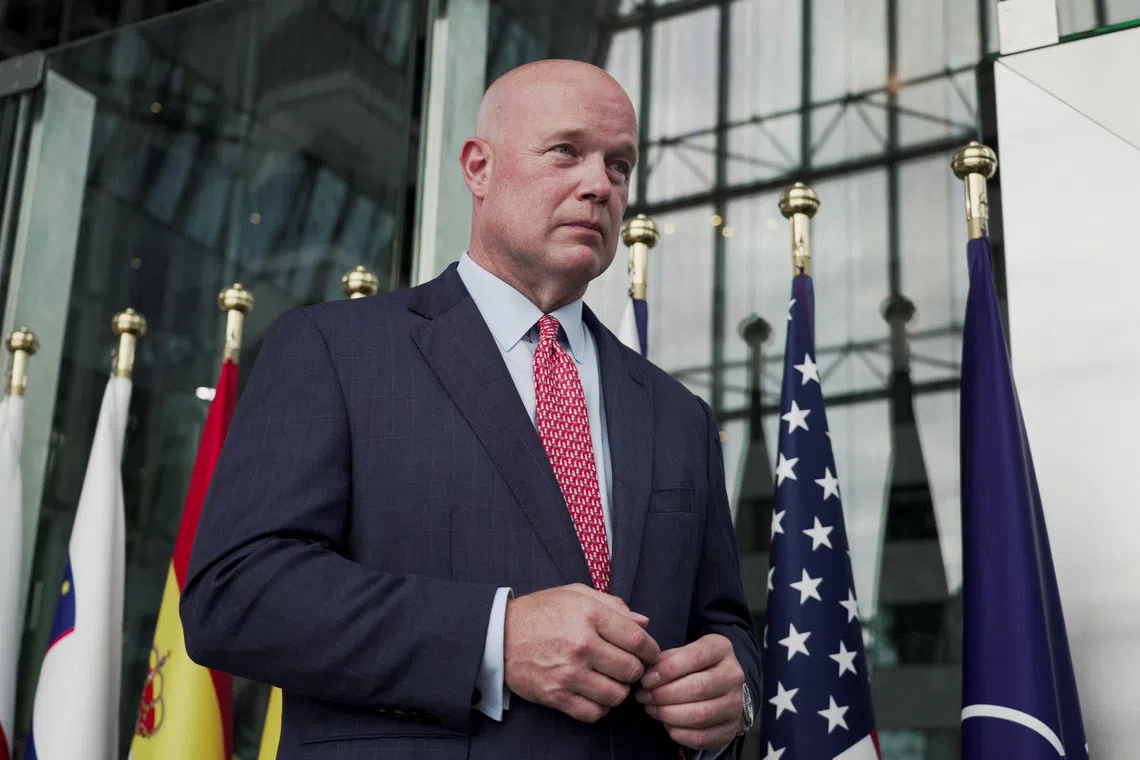
Photo via The Guardian

Nato head: Britain must show ‘credible path’ of annual defence budget increases

Read the original at The Guardian ↗
Cite

Sabbagh, D. (2026, September 17). Nato head: Britain must show ‘credible path’ of annual defence budget increases. The Guardian. https://www.theguardian.com/world/2026/sep/17/nato-head-britain-must-show-credible-path-of-annual-defence-budget-increases

Dated when The Aporia collected the article, usually within hours of publication. Check the original for its exact date and byline.

The Guardian · collected 2026-09-17 · by Dan Sabbagh

Quick Summary

NATO Secretary General Mark Rutte called on Britain to show clear annual increases in defense spending to meet a target of nearly £30 billion more by the mid-2030s. During meetings with British officials, including Prime Minister Andy Burnham and Defence Secretary Wes Streeting, Rutte emphasized the need for a gradual approach rather than sudden increases near 2035 to reach the 3.5% GDP spending goal set earlier by former Prime Minister Keir Starmer. Current UK defense spending plans level off at 2.7%, raising questions about how the target will be achieved and whether it requires higher taxes or budget cuts.
Written by AI on 2026-09-18, from this article's own text only (the story summary below draws on all the coverage).

AI analysis

Story summary

Mark Rutte, NATO's secretary general, emphasized during recent meetings with UK Prime Minister Andy Burnham and other officials that the UK must commit to a credible path of yearly increments towards reaching a defense spending target of 3.5% of GDP by 2035. This commitment is critical amid escalating tensions with Russia, as highlighted by Russian President Vladimir Putin’s actions in Ukraine and aggressive military spending. Rutte stressed that NATO countries cannot afford to wait until the last minute; instead, they need a clear roadmap for gradual increases. Despite predecessor Sir Keir Starmer's initial pledge to this goal, there has been pressure on Burnham to outline an interim target of 3% by 2030, reflecting concerns over Britain’s seriousness about the commitment. Rutte’s visit underscored NATO's ongoing efforts to ensure its member states stay ahead of potential threats and maintain a robust defense posture.

Written for “UK Defence Spending Goals” on 2026-11-04, grounded in this article and the 3 other(s) covering the same event.

Story

📰 UK Defence Spending Goals
Politics · 4 article(s) covering the same event. Compare every outlet's account →

Compared with similar articles

This article reads unscored and hedges 15% of its claims. Each row says how that neighbour differs.
BBC News
⚖️ Leans right Hedges 2 of 17 claims Outlet record 66/100
Evening Standard
Hedges 3 of 12 claims Outlet record 64/100
Evening Standard
Hedges 2 of 17 claims Outlet record 64/100
The Straits Times
Hedges 0 of 10 claims Outlet record 66/100
“The articles discuss different countries (Britain and Czech Republic) being urged to meet NATO defence spending targets, indicating separate events.”
The Guardian
Hedges 4 of 19 claims Outlet record 66/100
“The articles discuss related topics but cover different events and timeframes with distinct speakers and contexts.”
Daily Mail
⚖️ Leans strongly right Hedges 2 of 28 claims Outlet record 69/100
“The articles discuss different issues related to UK defense: one focuses on naval readiness against Russia, while the other is about NATO's requirement for annual increases in defense budgets.”
The Guardian
⚖️ Leans left Hedges 0 of 36 claims Outlet record 66/100
“The articles discuss different aspects of Mark Rutte's role as NATO Secretary General, but describe distinct events or engagements rather than the same specific incident.”
The Guardian
⚖️ Leans strongly right Hedges 0 of 15 claims Outlet record 66/100
“While both articles involve Mark Rutte speaking about NATO's security concerns in Britain, they describe different parts of his visit and statements made on separate days.”
Daily Mail
Hedges 3 of 25 claims Outlet record 69/100
“The articles discuss different aspects of defense spending commitments and criticisms towards Prime Minister Andy Burnham's approach to meeting NATO targets, but they do not describe the same specific incident or occurrence.”
Evening Standard
Hedges 2 of 20 claims Outlet record 64/100
“The articles discuss related topics but describe different events: one focuses on NATO's Secretary General urging Britain to meet defense spending targets, while the other is about a Tory leader criticizing Burnham for not adequately addressing defense funding.”
How this article was measured signals, leaning charts, publisher record, byline, topics and claims

Signals How these are calculated →

Claims extracted
20
sentences that state something as happening or true
Uncertain
15%
3 of 20 hedged ("reportedly", "may", "according to")
Leaning
not political
takes no side on a contested political question
Publisher signals
66/100
The Guardian's corrections and hedging, across everything collected from it. Not a measure of accuracy.
Outlets on this story
4
Politics
Same framing elsewhere
1
articles that frame the event the way this one does
Analyzed 2026-09-18 · how these are computed

How this is being covered How these are calculated →

Article leaning vs. publisher reliability
Source leaning vs. consistency

Publisher

The Guardian · 2937 article(s) · 6 correction(s) detected
Running correction rate · 6 correction(s)

Who wrote this

Dan Sabbagh
7 article(s) here · 1 carrying a prediction
🔮 The prime minister told MPs the UK would bring further sanctions against Tehran and the IRGC as a result, with more information to follow in an update from the home secretary, Shabana Mahmood.
🔮 A key line of inquiry remains to identify any potential motivation behind why the men were at that location, and this includes whether it may be connected to any criminal activity,” she added.
🔮 Any British, Irish or qualifying Commonwealth citizen over 18 may stand for parliament – as long as they are not bankrupt or members of the police, armed forces, civil servants or judges.
🔮 The Conservatives will announce plans to build a £10bn British “Iron Dome” similar to Israel’s air and missile defence system, which the party will christen “Britannia Shield” in an announcement at conference on Tuesday.
🔮 He said that the US was confident in the security of all its bases and “with the Brits, we’ve worked very closely a long time, including on this investigation, and they couldn’t be more cooperative”.
🔮 Mark Rutte, Nato’s secretary general, said that Britain could not wait until just before 2035 to lift defence spending to 3.5% of GDP, in an unusually pointed intervention a day after he met prime minister Andy Burnham.
🔮 Chancellor John Healey resigned as defence secretary from Keir Starmer’s government in June because the former prime minister would not commit to 3% by 2030, arguing that it would require too great a step up in the next decade. But Healey refused to recommit to the interim target when he was appointed to the Treasury by Burnham a month later, raising questions that the new government was backloading spending increases until after the next election.
Also by Dan Sabbagh
Nothing else under this byline is closely related to this article, so these are simply their most recent.
All 7 articles by Dan Sabbagh →

Topics

BBC Britain Dutch Nato the Press Association

Subjects

Nato ORG · 6× Rutte PERSON · 5× Burnham PERSON · 4× Britain GPE · 3× Healey PERSON · 3× BBC ORG · 2× Andy Burnham PERSON · 1× Dutch NORP · 1× Mark Rutte PERSON · 1× the Press Association ORG · 1×

Narrative

A day earlier, Rutte gave a speech to at Ditchley Park in Oxfordshire, in which he warned that the 32 country military alliance faced “the most dangerous and complex security environment in a generation” with wars in Ukraine, the Middle East coming at time of rising state competition.
framing: assertive · carried by 1 article(s) · first seen 2026-09-18
🔮 Mark Rutte, Nato’s secretary general, said that Britain could not wait until just before 2035 to lift defence spending to 3.5% of GDP, in an unusually pointed intervention a day after he met prime minister Andy Burnham.

Claims (20 extracted, 3 hedged)

Britain needs to show “a credible path” of annual increases in its defence budgets to meet a Nato target of spending nearly £30bn more on the military by the middle of the next decade, the head of the alliance said on Thursday. asserted
head → need → Thursday
Mark Rutte, Nato’s secretary general, said that Britain could not wait until just before 2035 to lift defence spending to 3.5% of GDP, in an unusually pointed intervention a day after he met prime minister Andy Burnham. uncertain
he → say → Burnham
In an interview with the Press Association, he said: “And that is why you need a credible path towards that 3.5%, and yearly increments.” asserted
you → say → %
The alliance’s secretary general, a former Dutch prime minister, made similar remarks to the BBC, where he said that the UK understood that the target could not be met “in one go in 2034” and that it would have to be achieved gradually. uncertain
it → make → 2034
Earlier on Thursday, Rutte met with Wes Streeting, the defence secretary, and Ed Miliband, the foreign secretary. asserted
Rutte → meet → Streeting
He saw Burnham on Wednesday, at a business park in Didcot, and also met representatives from the defence industry. asserted
He → see → industry
Keir Starmer signed the UK up to a Nato-wide target of increasing defence spending to 3.5% of GDP in the summer of 2025, under pressure from the US president, Donald Trump. asserted
Starmer → sign → president
The figure has since been endorsed by Burnham and his chancellor, former defence secretary John Healey. asserted
figure → endorse → Burnham
Current spending plans, covering until 2028/9, show defence spending levelling off at 2.7%, nearly £30bn below the ultimate target, raising the question of how it would be achieved after the next general election. asserted
it → cover → election
It is unclear if taxes or borrowing would have to rise, or other government spending cuts. uncertain
taxes → have → ?
Healey resigned as defence minister in June because Starmer would not commit to lifting defence spending to 3% of GDP by 2030. asserted
Starmer → resign → 2030
At the time Healey said Labour needed to set “a clear path” to meet the Nato commitment, similar language to that used by Rutte in his interviews. asserted
Labour → say → interviews
But since then Healey and Burnham have avoided committing to the 3% by the end of the decade. asserted
Healey → avoid → decade
Decisions on future spending are likely to be left to the next government spending review due next year, prompting the Nato leader to engage in public lobbying on his trip to Britain. asserted
Decisions → leave → Britain
Rutte said he was certain the Burnham government remained behind the ultimate goal and the need to increase defence spending gradually. asserted
government → say → spending
“I am absolutely confident that when it comes to the yearly increments, they totally take it and accept it, that they have to be there,” he told the BBC. asserted
he → come → BBC
What that credible path exactly will be, we will see with the spending review next year,” Rutte added. asserted
Rutte → see → review
A day earlier, Rutte gave a speech to at Ditchley Park in Oxfordshire, in which he warned that the 32 country military alliance faced “the most dangerous and complex security environment in a generation” with wars in Ukraine, the Middle East coming at time of rising state competition. asserted
wars → give → competition
Nato needed “more UK and more Europe”, he added, to take up the slack as the US reduces its military commitment to the alliance. asserted
US → need → alliance
Trump has long argued that the UK and Europe should match US levels of defence spending and take the lead in defending the continent from Russia aggression. asserted
UK → argue → aggression

💬Give feedback
🕘History 🎫Support