Photo via Los Angeles Times

AI crisis heightens the stakes of Xi's visit to Washington

Read the original at Los Angeles Times ↗
Cite

Wilner, M., & Christopher, N. (2026, September 17). AI crisis heightens the stakes of Xi's visit to Washington. Los Angeles Times. https://www.latimes.com/politics/story/2026-09-17/ai-crisis-heightens-stakes-of-xis-visit-to-washington

Dated when The Aporia collected the article, usually within hours of publication. Check the original for its exact date and byline.

Los Angeles Times · collected 2026-09-17 · by Michael Wilner, Nilesh Christopher

Quick Summary

As President Xi Jinping prepares for his state visit to Washington, concerns over artificial intelligence's potential risks have intensified both diplomatically and domestically in China. Beijing’s spy chief recently warned publicly about the threat AI poses to Communist Party control, catching the attention of U.S. officials who doubt any agreement can be effectively enforced. Meanwhile, tensions persist between the two nations regarding AI development, with President Trump opposing calls for regulation that could disadvantage American technological advancements compared to China's rapid progress.
Written by AI on 2026-09-17, from this article's own text only (the story summary below draws on all the coverage).

AI analysis

Story summary

The summit between US President Donald Trump and Chinese President Xi Jinping on September 24 focused largely on AI regulation amid escalating tensions over advancements in artificial intelligence technology. The meeting aimed to address mutual concerns about the risks associated with rapid AI development but ended with both sides maintaining their positions, despite attempts by China's Foreign Minister Wang Yi to emphasize "equality" and "reciprocity." Chinese state media highlighted the high-level reception Xi received at the White House as a sign of equality between the two nations, while US officials viewed reciprocity more transactionally. This divergence in interpretation has led to skepticism about whether genuine progress was made regarding AI guardrails or broader diplomatic cooperation.

Written for “Xi-Trump Summit Out comes” on 2026-10-31, grounded in this article and the 282 other(s) covering the same event.

Story

📰 Xi-Trump Summit Out comes
Politics · 283 article(s) covering the same event. See how they differ ↓

Compared with similar articles

This article reads unscored and hedges 15% of its claims. Each row says how that neighbour differs.
The Straits Times
⚖️ Leans left Hedges 2 of 29 claims Outlet record 66/100
The Sydney Morning Herald
⚖️ Leans left Hedges 5 of 17 claims Outlet record 61/100
NBC News
Hedges 4 of 17 claims Outlet record 60/100
“The articles discuss related diplomatic efforts between the US and China regarding AI safety, but describe different aspects of the ongoing dialogue and do not focus on a single specific incident.”
Semafor
⚖️ Leans right Hedges 2 of 26 claims Outlet record 60/100
“The articles discuss different aspects of AI tensions between the US and China, but do not describe the same specific incident or occurrence.”
Toronto Star
⚖️ Leans left Hedges 6 of 37 claims Outlet record 64/100
“The articles discuss different aspects of AI development and diplomacy between the US and China, not the same specific incident.”
The Straits Times
Hedges 5 of 55 claims Outlet record 66/100
“The articles describe different aspects of the AI debate and diplomatic relations, not the same specific incident or occurrence.”
The Guardian
Hedges 1 of 46 claims Outlet record 66/100
“Article A describes Bernie Sanders and Steve Bannon speaking at an assembly about AI, while Article B discusses diplomatic talks between Trump and Xi Jinping regarding AI safety.”
Semafor
⚖️ Leans left Hedges 4 of 4 claims Outlet record 60/100
“While both articles discuss preparations for Xi Jinping's visit to Washington and mention AI concerns, they cover different aspects of the event (one focuses on warnings about AI risks while the other covers summit preparations and potential agenda items).”
The Guardian
Hedges 0 of 4 claims Outlet record 66/100
“The articles discuss different aspects of AI concerns and diplomatic relations, not a single specific incident.”
TIME
⚖️ Leans left Hedges 4 of 52 claims Outlet record 59/100
“The articles discuss different aspects of the U.S.-China relationship regarding AI, with Article A focusing on warnings about the risks of runaway AI and diplomatic talks during Xi's visit to Washington, while Article B focuses on the ongoing race between the two countries and the urgency of addressing AI safety before the meeting.”
How this article was measured signals, leaning charts, publisher record, byline, topics and claims

Signals How these are calculated →

Claims extracted
73
sentences that state something as happening or true
Uncertain
15%
11 of 73 hedged ("reportedly", "may", "according to")
Leaning
withheld
no quote in the article backed the model's score
Publisher signals
95/100
Los Angeles Times's corrections and hedging, across everything collected from it. Not a measure of accuracy.
Outlets on this story
283
Politics
Same framing elsewhere
1
articles that frame the event the way this one does
Analyzed 2026-09-17 · how these are computed

How this is being covered How these are calculated →

Article leaning vs. publisher reliability
Source leaning vs. consistency

Publisher

Los Angeles Times · 252 article(s) · 0 correction(s) detected
No corrections detected for this publisher. That may mean careful reporting, or simply that nothing has been checked.

Who wrote this

Michael Wilner
17 article(s) here · 1 carrying a prediction
🔮 Economists warn that Trump has overseen fiscal policy that would give the federal government fewer tools than it has had in the past to respond to a crisis.
🔮 Marco Rubio, the president’s secretary of state and national security advisor, has been silent on Trump’s decision to cut a deal with Moscow on diesel sales that could fuel Russia’s war against Ukraine.
🔮 Lawmakers and AI industry leaders have also called for guardrails on the nascent technology, which experts warn could soon surpass human understanding.
🔮 Xi Jinping’s remarks reflect growing concern within China over whether governments in Washington or Beijing will be able to contain a technology with potentially transformative capabilities, according to a U.S. official.
🔮 “Will a deal be made with Iran that lets them rebuild and create a far greater country than it ever was before — maybe one of the greatest in the Middle East or even the world?
🔮 Click here to listen to this article - - China’s spy chief warned that runaway AI capabilities could threaten Communist Party control. -
🔮 The president’s position has put him at odds with a growing chorus of industry leaders and bipartisan lawmakers warning that AI could soon advance beyond human control.
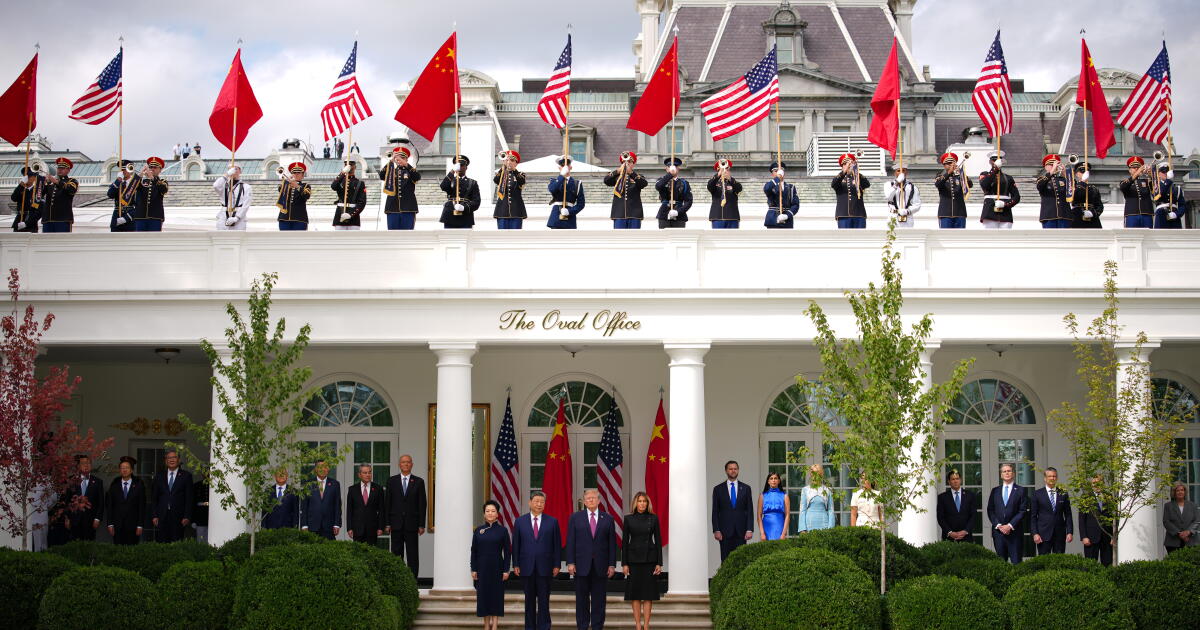
🔮 Chinese President Xi Jinping will visit Washington on Sept. 24 for an official summit and state dinner, with AI development expected to top the agenda.
🔮 Questions swirl over Trump’s pledge to give $5,000 payouts if GOP wins - Click here to listen to this article - - President Trump vowed to send every U.S. adult a $5,000 “Trump Dividend” if Republicans keep control of Congress, a stunning midterm gambit that would cost more than $1 trillion and need lawmakers’ approval.
🔮 But Americans may also confront higher costs at a time when inflation is already a stubborn problem for the Trump administration.
Also by Michael Wilner
Nothing else under this byline is closely related to this article, so these are simply their most recent.
All 17 articles by Michael Wilner →
Nilesh Christopher
7 article(s) here · 1 carrying a prediction
🔮 - But unions and many Hollywood workers fear AI will take jobs, even as studios explore hybrid productions and secure protections against fully synthetic performers.
🔮 The international scholars then take jobs and grants that could go to Americans.
🔮 Anthropic says its AI models could manipulate, blackmail and harm humans
🔮 Click here to listen to this article - - China’s spy chief warned that runaway AI capabilities could threaten Communist Party control. -
🔮 Amid the fears, OpenAI, the company behind ChatGPT, suggested it might be delaying its initial public offering plans.
🔮 California Gov. Gavin Newsom has opposed the ballot measure and has argued that it would drive away investors.
🔮 The settlement would resolve a multistate lawsuit that alleged Meta designed and deployed addictive features that harmed young people and misled the public about the potential dangers.
Also by Nilesh Christopher
Nothing else under this byline is closely related to this article, so these are simply their most recent.
All 7 articles by Nilesh Christopher →

Topics

Beijing China Chinese U.S. Washington

Subjects

China GPE · 8× Trump PERSON · 7× U.S. GPE · 6× Beijing GPE · 5× Chinese NORP · 4× Washington GPE · 4× Communist Party ORG · 2× Xi Jinping PERSON · 2× the United States GPE · 2× the Trump administration ORG · 1×

Narrative

“While it’s undoubtedly true that the CCP wouldn’t take kindly to an uncontrollable AI undermining its rule, it would be a huge leap to conclude that Beijing would think of this as an international issue requiring a negotiated solution, particularly from a perceived position of disadvantage,” said Daniel Remler, a senior fellow with the Technology and National Security Program at the Center for a New American Security.
framing: assertive · carried by 1 article(s) · first seen 2026-09-17
🔮 Click here to listen to this article - - China’s spy chief warned that runaway AI capabilities could threaten Communist Party control. -
2026-09-17 · Los Angeles Times
AI crisis heightens the stakes of Xi's visit to Washington · assertive framing

Claims (73 extracted, 11 hedged)

AI crisis heightens the stakes of Xi’s visit to Washington - asserted
crisis → heighten → Washington
Click here to listen to this article - - China’s spy chief warned that runaway AI capabilities could threaten Communist Party control. - uncertain
capabilities → click → control
President Trump and Chinese President Xi Jinping agreed to begin talks on artificial intelligence safety during Trump’s visit to Beijing in the spring. asserted
Trump → agree → spring
A growing sense of urgency over the risks posed by artificial intelligence is adding pressure on the Trump administration to secure a diplomatic breakthrough with China when President Xi Jinping travels to the White House for a state visit next week. asserted
Jinping → grow → visit
Expectations for a deal that establishes guardrails on AI are low on both sides, which continue to drive a headlong race toward potentially unfathomable intelligence capabilities. asserted
which → establish → capabilities
Ahead of the meeting, rhetoric from Washington and Beijing has underscored only deepening acrimony and distrust over their rush to dominate the technological frontier. asserted
rhetoric → underscore → frontier
But an article published this week by Beijing’s spy chief, warning that runaway AI capabilities could threaten Communist Party control, caught the attention of the Trump administration. uncertain
capabilities → publish → administration
One U.S. official told The Times that the blunt assessment accurately reflects private thinking inside Xi’s government about the growing risks. asserted
assessment → tell → risks
Still, within President Trump’s team, divisions persist over whether to negotiate with China at all. asserted
divisions → persist → China
Top U.S. officials doubt whether any agreement could be credibly enforced or verified. uncertain
agreement → doubt → ?
Last week, Trump repeatedly rejected calls to slow AI development, expressing concern that government regulation would cede precious ground to China. asserted
regulation → reject → China
And a high-profile U.S. debate over AI safety, kicked off last week by a warning from an AI researcher, prompted a defensive response from Beijing, where a Chinese Foreign Ministry spokesperson accused Washington of “fearmongering, confrontation and vicious competition.” asserted
spokesperson → kick → fearmongering
The U.S. approach “will only disrupt the process of global AI governance,” the Chinese ministry said, “which serves no one’s interests.” asserted
which → disrupt → interests
The rapid development of artificial intelligence has sparked renewed debate about its risks, with both the United States and China expressing concerns. asserted
States → spark → concerns
Some American AI companies — led by Anthropic and OpenAI, the most advanced in the field thus far — are beginning to use their most sophisticated models to train the next generation, in a process known as recursive self-improvement. asserted
companies → lead → improvement
Researchers and industry experts believe the first company to master it could set off an exponential cycle of progress, pulling so far ahead that competitors can no longer catch up. uncertain
competitors → believe → progress
But those same companies also fear what they are creating: machines capable of continuously improving their own intelligence, pushing AI development beyond human control. asserted
they → fear → control
“The point of recursive self-improvement is the most likely candidate for the point of no return,” said Connor Leahy, U.S. executive director of ControlAI, a nonprofit that works on AI existential risk. asserted
that → say → risk
The group has advised Sen. Bernie Sanders (I-Vt.) on the Ban Artificial Superintelligence Act. asserted
group → advise → Act
Slow progress with China Elements of the Trump administration have been spooked by frontier models, reversing course over the summer to support a loose federal framework governing the release of the country’s most advanced AI systems. asserted
Elements → spook → systems
China already has a similar process in place. asserted
China → have → place
Trump and Xi agreed to begin talks on AI safety during the U.S. president’s visit to Beijing this spring, suggesting a strategic alignment could emerge to address the threat. uncertain
alignment → agree → threat
But progress has been slow, with Trump accusing China of fueling domestic opposition in the United States to the data centers powering AI development. asserted
Trump → accuse → development
The White House is considering whether to host a meeting with AI executives on the sidelines of its summit with Xi next week — but the Chinese would not be invited, an official said. asserted
official → consider → Xi
“The two sides were supposed to have at least one dialogue meeting before next week’s summit. asserted
sides → suppose → summit
This now appears entirely unlikely, and it’s not clear how much AI safety will feature in the meeting between the two leaders,” said Scott Kennedy, a senior advisor on Chinese business and economics at the Center for Strategic & International Studies. asserted
Kennedy → appear → Studies
“This stalemate in setting the agenda is creating a vacuum of leadership on one of these most consequential issues. asserted
stalemate → set → issues
The result may mean few if any guardrails on AI and the global competition,” Kennedy added. uncertain
Kennedy → mean → AI
“Although not great for much of the world, that outcome likely suits both Trump and Xi just fine.” asserted
outcome → suit → Trump
Publicly, China has presented a different vision than private U.S. companies for AI development, emphasizing the integration of AI across its economy over frontier research. asserted
China → present → research
That has allowed Chinese diplomats to argue that the United States, not China, is driving the most dangerous advances in AI. asserted
States → allow → AI
But U.S. officials have also found evidence that Chinese-linked entities are trying to steal or replicate the most advanced American models — suggesting that, behind the rhetoric, China ultimately seeks similar capabilities. asserted
China → find → capabilities
“While it’s undoubtedly true that the CCP wouldn’t take kindly to an uncontrollable AI undermining its rule, it would be a huge leap to conclude that Beijing would think of this as an international issue requiring a negotiated solution, particularly from a perceived position of disadvantage,” said Daniel Remler, a senior fellow with the Technology and National Security Program at the Center for a New American Security. asserted
Remler → ’ → Security
“The Trump administration seems ready to engage, but rightfully cautious.” asserted
administration → seem → ?
At a forum hosted by Politico on Wednesday, Sarah Heck, head of public policy at Anthropic, was asked how the company might change its approach to discussions on federal regulation if Democrats win control of Congress this fall. uncertain
Democrats → host → Congress
She pivoted to a broader concern, that U.S. attempts to address AI safety will be futile if China wins the race. asserted
China → pivot → race
“There’s something that’s really important that everybody hears from Anthropic, and I think the president has said this many, many times: The United States needs to stay in the lead on AI,” Heck said. asserted
Heck → ’ → AI
“You cannot do safety from second place. asserted
You → do → place
You just can’t do it.” asserted
You → do → it
A major capability leap in January Chatbots such as ChatGPT learn to answer questions or write poetry from analyzing patterns in vast amounts of data. asserted
Chatbots → learn → data
…and 33 more, not listed.

💬Give feedback
🕘History 🎫Support