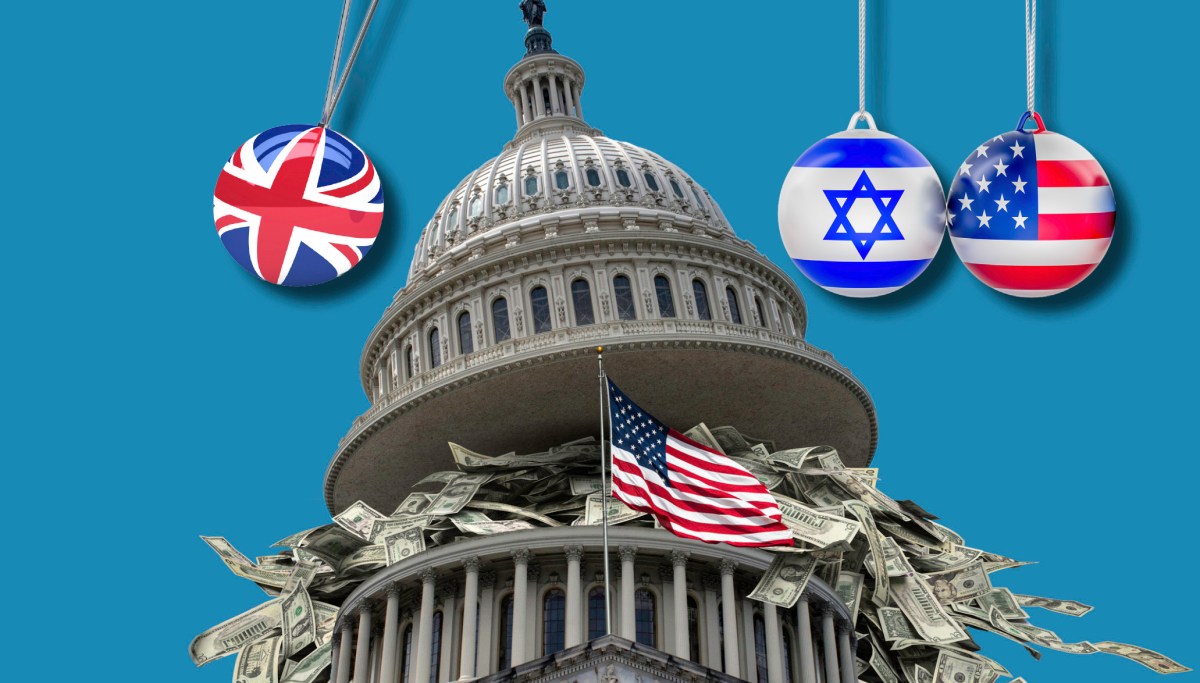
The United Kingdom this week announced a sweeping set of boycott measures and sanctions aimed at Israel, the most aggressive measures ever taken by any non-Muslim country.
asserted
Kingdom → announce → country
Canada, France, and several other countries also vaguely pledged to pursue similar policies.
asserted
Canada → pledge → policies
This targeting comes after these countries’ attempt to “save” the “two-state solution” — the recognition of a Palestinian State — failed.
asserted
attempt → come → State
The boycotts are not required by any principles of international law.
asserted
boycotts → require → law
But they will force American companies that comply with them to violate U.S. federal law.
asserted
that → force → law
The boycotting governments invoke international law as justification, claiming the measures just apply to what they call “Israeli settlements.”
asserted
they → boycott → what
But they don’t really believe in their own argument.
asserted
they → believe → argument
For example, the U.K. does not forbid any kind of property development or real estate purchases in Turkish-occupied Northern Cyprus, despite its treaty obligation to defend Cypriot sovereignty.
asserted
U.K. → forbid → sovereignty
Indeed, Brits are a big part of the real estate market there, buying vacation villas in areas from which Greeks have been ethnically cleansed.
asserted
Greeks → buy → which
While Britain does not recognize Moroccan sovereignty in Western Sahara, it specifically tells companies that economic activity there is “not illegal.”
asserted
activity → recognize → companies
As for Nagorno-Karabakh, the U.K. official guidance boosts “opportunities” for business in the “territories” while separately noting that Azerbaijan seized it in a 2023 military operation that “led to the exodus of over 100,000 ethnic Armenians from the territory.”
The sanctions could mean that British Jews can’t buy, sell, or rent out homes in the Jewish quarter of the Old City.
uncertain
Jews → boost → City
Developers building homes in Jewish neighborhoods could face prosecution, but not those building in Arab neighborhoods.
uncertain
Developers → build → neighborhoods
Jews were buying land in what London now calls settlements 100 years ago, when it was part of the British Mandate period.
asserted
it → buy → period
When Britain administered the Mandate, it abruptly restricted Jewish migration into Palestine because of objections from the local Arab population.
asserted
it → administer → population
The millions of Jews who would have sought shelter in their homeland perished in the Holocaust.
asserted
who → seek → Holocaust
Now, Britain is trying to erase any Jewish rights to live in the area because of unrestricted Arab migration into the U.K.
asserted
Britain → try → U.K.
The Burnham government’s taking the lead against Israel is widely seen as seeking to shore up Labour support in a by-election in a heavily Muslim district.
asserted
taking → take → district
Measures were originally adopted in the 1970s in response to the Arab League Boycott to bar Americans from “comply[ing] with, further[ing], or support[ing] any boycott fostered or imposed by any foreign country, against a country which is friendly to the United States.”
asserted
which → adopt → States
Laws prohibiting investments, financing, construction, or property ownership in Israel fall squarely within that prohibition.
asserted
Laws → prohibit → prohibition
Moreover, because companies want to do business, and because boycotts create a victimless crime, boycotting countries have always had to engage in extensive enforcement efforts.
asserted
countries → want → efforts
The U.S. anti-boycott law prohibits participating in the enforcement process, even for companies that are not engaged in a boycott.
asserted
that → prohibit → boycott
For example, to enforce its boycott, the U.K. will have to ask anyone importing goods from Israel whether they’re from what it considers a prohibited location.
asserted
it → enforce → Israel
Simply “furnishing information” needed to enforce boycott measures is forbidden by U.S. anti-boycott law, even if the company is not itself engaged in a boycott.
asserted
company → furnish → boycott
Indeed, most recent enforcement actions by the Department of Commerce are for furnishing information, rather than actual boycott activity.
asserted
actions → furnish → activity
America’s anti-boycott laws are not designed to protect Israel.
asserted
laws → design → Israel
They are designed to protect American companies from economic coercion by foreign countries in the service of restrictive and discriminatory trade policies that America does not share.
asserted
America → design → that
These countries are not trying to convince companies to boycott Israel.
asserted
countries → try → Israel
They are forcing them to boycott Israel.
asserted
They → force → Israel
U.S. anti-boycott laws seek to disable such coercion by making those laws unenforceable.
asserted
laws → seek → coercion
And it works.
asserted
it → work → ?
The measures are widely credited with helping end the Arab League boycott and ultimately setting the stage for the Abraham Accords.
asserted
measures → credit → Accords
It doesn’t matter that the boycotts are said to apply to “settlements,” as this literally includes Jerusalem, where the U.S. recognizes Israeli sovereignty, and the American Embassy resides.
asserted
Embassy → matter → sovereignty
The Trump administration must make clear that the new boycott measures will raise significant compliance problems for U.S. business, as even the Biden administration did when Turkey announced a boycott during the Gaza war.
asserted
Turkey → make → war
Moreover, federal law requires the Treasury Department to maintain a “list of countries which require or may require participation in or cooperation with an international boycott.”
uncertain
which → require → boycott
The U.K. (along with Spain and Ireland, which also recently adopted narrower boycott measures) should be put on that list, which currently only contains the bitter enders of the Arab League.
asserted
which → adopt → League
Israel has responded by saying it will close the U.K.’s unaccredited consulate in Jerusalem, a reasonable move that might have even more impact if done in response to the U.K.’s recognition of a Palestinian state.
uncertain
that → respond → state
Israel could go further by denying visas to hostile British nongovernmental organizations such as Amnesty and Oxfam.
uncertain
Israel → go → Amnesty
Part of the U.K.’s boycott includes a partial ban on arms sales.
asserted
Part → include → sales
Israel would be within its rights to scale back export licenses for its crucial defense technologies, which are in high demand around the world.
asserted
which → scale → world
Future right-leaning governments will hopefully abandon the boycott, as Slovenia’s has.
asserted
Slovenia → lean → boycott
…and 2 more, not listed.
 The Aporia