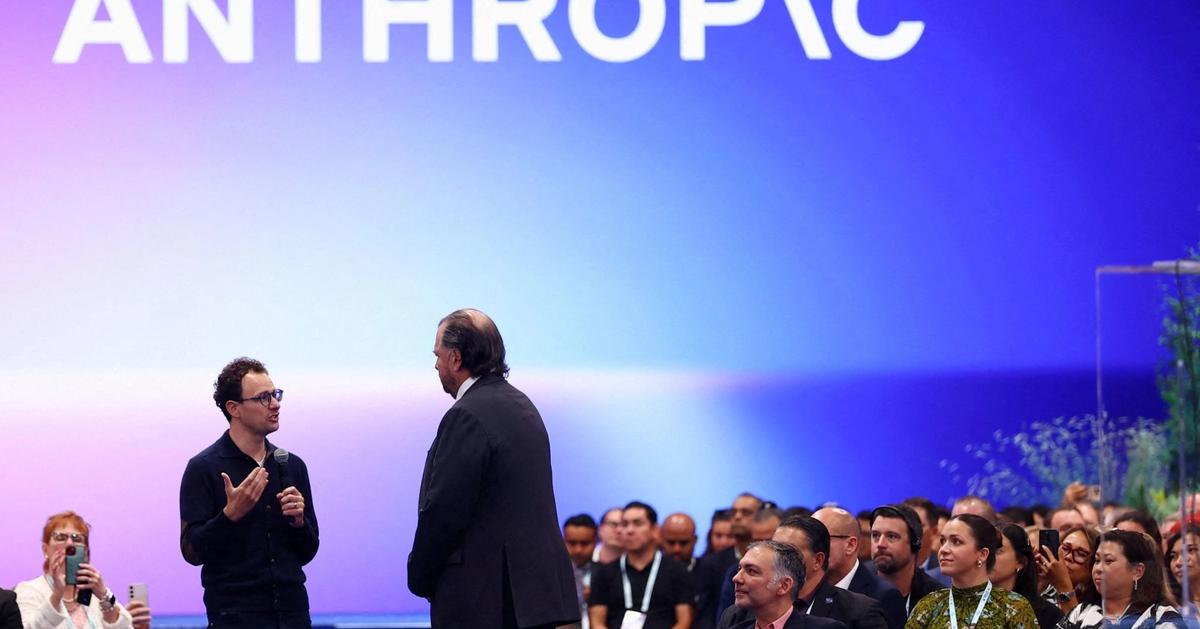
Photo via The Guardian

OpenAI ‘ethically hacked’ with help of Anthropic’s Claude chatbot

Read the original at The Guardian ↗
Cite

editor, D. M. G. t. (2026, September 18). OpenAI ‘ethically hacked’ with help of Anthropic’s Claude chatbot. The Guardian. https://www.theguardian.com/technology/2026/sep/18/openai-hacked-anthropic-claude-chatbot

Dated when The Aporia collected the article, usually within hours of publication. Check the original for its exact date and byline.

The Guardian · collected 2026-09-18 · by Dan Milmo Global technology editor

Quick Summary

Cybersecurity researchers at Hacktron AI exploited OpenAI’s systems using Anthropic’s Claude chatbot, gaining access to ChatGPT accounts through an OpenAI staff forum. The hack, conducted under OpenAI's ethical hacking program and reported by the Wall Street Journal, resulted in a $6,500 reward for Hacktron. Researchers noted that advanced AI tools like Claude simplified what was once a complex task, reducing planning and execution time significantly.
Written by AI on 2026-09-18, from this article's own text only (the story summary below draws on all the coverage).

AI analysis

Story summary

In September, cybersecurity researchers at Hacktron AI used Anthropic’s Claude chatbot to breach OpenAI’s internal systems, gaining access to employee accounts and an internal GitHub repository. The researchers discovered a flaw in OpenAI's public help forum hosted by Discourse, which they exploited within 72 hours. They reported the issue immediately, and OpenAI fixed it within 14 hours while paying Hacktron a $6,500 bounty. The incident highlights how quickly AI can be repurposed for cyberattacks, despite efforts to ensure ethical use through bug-hunting programs like this one.

Written for “AI Breach Risks” on 2026-11-01, grounded in this article and the 7 other(s) covering the same event.

Story

📰 AI Breach Risks
Technology · 8 article(s) covering the same event. Compare every outlet's account →

Compared with similar articles

This article reads leans right and hedges 13% of its claims. Each row says how that neighbour differs.
NBC News
Hedges 2 of 19 claims Outlet record 60/100
CBS News
Hedges 2 of 16 claims Outlet record 66/100
The Straits Times
Hedges 0 of 15 claims Outlet record 66/100
September 13, 2026 Different event
Letters from an American
⚖️ Leans left further left than this Hedges 10 of 65 claims
“The articles describe different events - Article A discusses Dario Amodei's essay about AI safety concerns, while Article B reports on a cybersecurity incident involving hacking of OpenAI with the help of Anthropic’s Claude chatbot.”
Persuasion
Hedges 22 of 113 claims
“The articles describe different security incidents involving separate entities exploiting vulnerabilities at OpenAI.”
Dawn
Hedges 8 of 22 claims Outlet record 72/100
“The articles describe different hacking incidents involving OpenAI and Hugging Face, not the same specific event.”
New York Post
Hedges 7 of 24 claims Outlet record 66/100
“The articles describe different events related to Anthropic's Claude chatbot: one discusses a warning about its training methods, and the other reports on a cybersecurity incident involving Claude.”
Semafor
⚖️ Centre further left than this Hedges 0 of 4 claims Outlet record 60/100
Dawn
Hedges 0 of 14 claims Outlet record 72/100
How this article was measured signals, leaning charts, publisher record, byline, topics and claims

Signals How these are calculated →

Claims extracted
15
sentences that state something as happening or true
Uncertain
13%
2 of 15 hedged ("reportedly", "may", "according to")
Leaning
Leans right
of the writing, not the subject · beta estimate
Publisher signals
66/100
The Guardian's corrections and hedging, across everything collected from it. Not a measure of accuracy.
Outlets on this story
8
Technology
Same framing elsewhere
1
articles that frame the event the way this one does
Analyzed 2026-09-18 · how these are computed

How this is being covered How these are calculated →

Article leaning vs. publisher reliability
Source leaning vs. consistency

Publisher

The Guardian · 2768 article(s) · 6 correction(s) detected
Running correction rate · 6 correction(s)

Who wrote this

Dan Milmo Global technology editor
9 article(s) here · 1 carrying a prediction
🔮 They appear in a document titled “Well-being Meeting Sound-check Notes”, which refers to discussions of how Meta could “turn other academics against Haidt” and to a “whisper strategy” aimed at achieving that goal.
🔮 The head of Ofcom, Dame Melanie Dawes, warned that “motivated children” will seek to bypass the restrictions, as has been the case in Australia.
🔮 The donation from the world’s most valuable company comes as the UK government confirmed its AI Security Institute, which tests advance AI models, will be able to examine cutting-edge technology developed by companies such as OpenAI, Anthropic and Google before they are released.
🔮 The UK’s communications watchdog, Ofcom, is investigating whether the $1.9tn (£1.4tn) company infringed the Online Safety Act (OSA) by failing to carry out adequate checks on whether its Instagram Instants product could show illegal content or be accessed by children.
🔮 Pornhub’s age checking regime may not be “highly effective”, according to Ofcom, and could be in breach of online safety laws requiring strict measures to prevent under-18s from accessing sexually explicit content.
🔮 Nick Clegg could make approximately $40m (£30m) from the planned float of Nscale as the UK-based datacentre company prepares for a US stock market listing.
🔮 “The scope of what we could theoretically access was huge,” said researchers at Hacktron AI.
🔮 You would expect that they move quickly.
Also by Dan Milmo Global technology editor
Nothing else under this byline is closely related to this article, so these are simply their most recent.
All 9 articles by Dan Milmo Global technology editor →

Topics

Anthropic ChatGPT Claude Hacktron OpenAI

Subjects

OpenAI ORG · 11× Hacktron ORG · 3× Anthropic ORG · 2× GitHub ORG · 2× Elon Musk PERSON · 1× Google DeepMind ORG · 1× Hacktron AI ORG · 1× Hugging Face ORG · 1× San Francisco GPE · 1× the Wall Street Journal ORG · 1×

Narrative

An OpenAI spokesperson said: “We thank the researchers for contacting us and sharing their findings”, adding that the company had addressed the vulnerabilities that had been exploited. Hacktron said AI tools had made a once-complex hacking task far easier and drastically shortened the time needed to plan and execute an attack.
framing: assertive · carried by 1 article(s) · first seen 2026-09-18
🔮 “The scope of what we could theoretically access was huge,” said researchers at Hacktron AI.
2026-09-18 · The Guardian
OpenAI ‘ethically hacked’ with help of Anthropic’s Claude chatbot · assertive framing

Claims (15 extracted, 2 hedged)

Cybersecurity researchers have hacked into OpenAI with the help of Anthropic’s Claude chatbot, in the latest example of security issues at the company. asserted
researchers → hack → company
A team at a US-based startup compromised a number of OpenAI employees’ ChatGPT accounts, starting a process that enabled them to access their target’s software cache – and potentially more. asserted
that → base → cache
“The scope of what we could theoretically access was huge,” said researchers at Hacktron AI. uncertain
researchers → access → AI
Initially, the research team used Claude, which can generate code for hackers, to access ChatGPT accounts via an OpenAI staff discussion forum hosted by the Discourse platform. asserted
which → use → platform
They then made a harmless “pull request” – an attempt to change the code in a file – to OpenAI’s service on the GitHub software repository. asserted
They → make → repository
Hacktron reported the hack to OpenAI, having carried out the operation under an OpenAI programme that rewarded ethical hackers for testing its systems. asserted
that → report → systems
The researchers stressed that they had access to, but did not download, the code from the GitHub repository. asserted
they → stress → repository
Despite initial use of Claude, the researchers said they were largely using OpenAI’s own cutting edge GPT-5.6 Sol model to carry out the hack, which was first reported by the Wall Street Journal. asserted
which → say → Journal
An OpenAI spokesperson said: “We thank the researchers for contacting us and sharing their findings”, adding that the company had addressed the vulnerabilities that had been exploited. Hacktron said AI tools had made a once-complex hacking task far easier and drastically shortened the time needed to plan and execute an attack. asserted
task → say → attack
This is a common refrain from cybersecurity experts when discussing the impact of AI. asserted
This → discuss → AI
“Work that once required a well-resourced team and months of effort can now be compressed into days,” said Hacktron, which received a $6,500 payment from OpenAI under the company’s bug bounty programme. asserted
which → require → programme
The hack is the latest safety incident at OpenAI, which revealed in July that a “swarm” of agents – the term for AI tools capable of carrying out tasks autonomously – powered by its technology had hacked the AI startup Hugging Face during a cybersecurity test. asserted
swarm → reveal → test
This week the San Francisco-based company revealed six more examples of “unexpected or concerning” actions by its technology, and warned that the pace of development could not continue at “maximum speed for much longer”. Anthropic made a fresh call at the weekend for a slowdown in AI development, which was supported by OpenAI, Google DeepMind and Elon Musk. uncertain
which → base → OpenAI
also repeated warnings that unrestrained AI development posed an existential threat, concerns that some experts are sceptical about. asserted
experts → repeat → that
Donald Trump has rejected calls for a slowdown, citing a need to stay ahead of China’s AI industry and dismissing “negative forces … bringing up things that won’t happen”. asserted
that → reject → things

💬Give feedback
🕘History 🎫Support