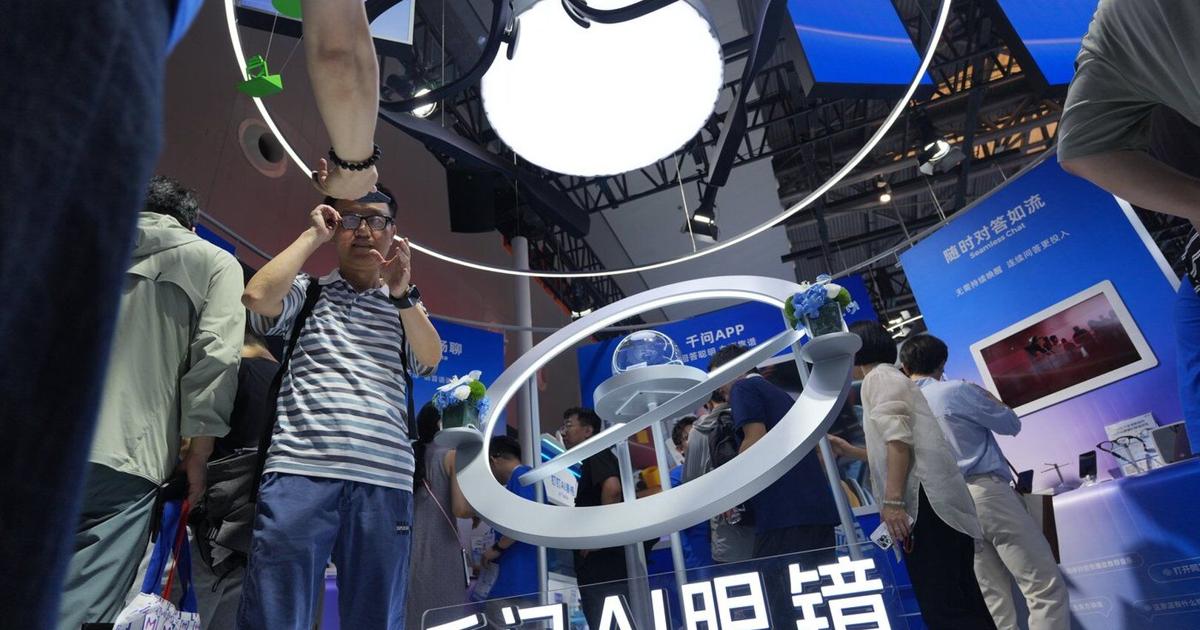
Photo via Toronto Star

China and the US are competing for AI dominance but have shared concerns over safety

Read the original at Toronto Star ↗
Cite

Ho-him, C. (2026, September 21). China and the US are competing for AI dominance but have shared concerns over safety. Toronto Star. https://www.thestar.com/news/world/china-and-the-us-are-competing-for-ai-dominance-but-have-shared-concerns-over-safety/article_9127a816-ba58-50a5-b102-de226a5f208b.html

Dated when The Aporia collected the article, usually within hours of publication. Check the original for its exact date and byline.

Toronto Star · collected 2026-09-21 · by Chan Ho-him

Quick Summary

President Trump and Chinese leader Xi Jinping are set to meet amid increasing competition between their nations in artificial intelligence (AI) technology. Despite tensions, both sides have expressed concerns over AI risks such as cyberattacks and loss of human control. During preliminary talks, U.S. Treasury Secretary Scott Bessent and Chinese Vice Premier He Lifeng proposed a notification mechanism for AI incidents impacting national security, aiming to address shared threats rather than focusing solely on geopolitical competition.
Written by AI on 2026-09-21, from this article's own text only (the story summary below draws on all the coverage).

AI analysis

Story summary

The summit between US President Donald Trump and Chinese President Xi Jinping on September 24 focused largely on AI regulation amid escalating tensions over advancements in artificial intelligence technology. The meeting aimed to address mutual concerns about the risks associated with rapid AI development but ended with both sides maintaining their positions, despite attempts by China's Foreign Minister Wang Yi to emphasize "equality" and "reciprocity." Chinese state media highlighted the high-level reception Xi received at the White House as a sign of equality between the two nations, while US officials viewed reciprocity more transactionally. This divergence in interpretation has led to skepticism about whether genuine progress was made regarding AI guardrails or broader diplomatic cooperation.

Written for “Xi-Trump Summit Out comes” on 2026-11-01, grounded in this article and the 282 other(s) covering the same event.

Story

📰 Xi-Trump Summit Out comes
Politics · 283 article(s) covering the same event. See how they differ ↓

Compared with similar articles

This article reads unscored and hedges 20% of its claims. Each row says how that neighbour differs.
Global News
Hedges 8 of 38 claims Outlet record 63/100
South China Morning Post
Hedges 0 of 5 claims Outlet record 64/100
“The articles describe different events: one is about an expected meeting between leaders discussing AI safety concerns, while the other reports on a forum in Singapore where scholars and industry leaders urge cooperation on AI risks.”
Semafor
Hedges 0 of 4 claims Outlet record 60/100
South China Morning Post
Hedges 0 of 4 claims Outlet record 64/100
The Guardian
Hedges 11 of 59 claims Outlet record 66/100
Los Angeles Times
Hedges 7 of 44 claims Outlet record 95/100
Semafor
Hedges 1 of 3 claims Outlet record 60/100
“Article A describes conflicting opinions on AI regulation at an event, while Article B discusses upcoming talks between U.S. and Chinese leaders about AI safety amid competition.”
Fox News
Hedges 3 of 23 claims Outlet record 69/100
“While both articles discuss concerns over AI safety and competition between the US and China, they describe different aspects of the broader topic rather than the same specific incident.”
Fox News
Hedges 2 of 70 claims Outlet record 69/100
“While both articles discuss the potential meeting between Trump and Xi Jinping regarding AI, they do not describe the exact same specific incident or occurrence.”
The Hindu
Hedges 4 of 27 claims Outlet record 60/100
“While both articles discuss the upcoming summit and AI concerns, they describe different stages of events - one focuses on preparatory talks between economic officials, while the other discusses the broader context leading up to the leaders' meeting.”
How this article was measured signals, leaning charts, publisher record, byline, topics and claims

Signals How these are calculated →

Claims extracted
41
sentences that state something as happening or true
Uncertain
20%
8 of 41 hedged ("reportedly", "may", "according to")
Leaning
not political
takes no side on a contested political question
Publisher signals
64/100
Toronto Star's corrections and hedging, across everything collected from it. Not a measure of accuracy.
Outlets on this story
283
Politics
Same framing elsewhere
1
articles that frame the event the way this one does
Analyzed 2026-09-21 · how these are computed

How this is being covered How these are calculated →

Article leaning vs. publisher reliability
Source leaning vs. consistency

Publisher

Toronto Star · 10939 article(s) · 28 correction(s) detected
Running correction rate · 28 correction(s)
2026-10-26
Correction
2026-10-24
Correction
2026-10-07
Correction
2026-09-24
Correction

Who wrote this

Chan Ho-him
16 article(s) here · 1 carrying a prediction
🔮 As the rivalry intensifies, experts say the window for countries to be able to choose freely between the two AI superpowers may be narrowing, forcing them to at one point pick between the U.S.-led Pax Silica and the China-inspired World AI Cooperation Organization.
🔮 Earlier this month, the International Monetary Fund trimmed its forecast for China’s 2026 economic growth to 4.5%, just meeting the lower end of Beijing’s goal.
🔮 Index provider MSCI warned it would downgrade Indonesia from its “emerging market” status, triggering growing concerns of a capital flight.
🔮 Despite the seeming European unity this week, it remains unclear what the EU can or is willing to do.
🔮 Investors and traders are monitoring closely the U.S. monthly jobs report for September to be released on Friday, as the data could provide more signal to the likelihood of an October interest rate hike by the Federal Reserve, after the Fed raised rates in September for the first time in three years.
🔮 China’s Alibaba unveiled new artificial intelligence chip technologies and plans for more powerful models on Tuesday, including what it said was China’s most powerful AI chip, days ahead of a meeting between Chinese and U.S. leaders at which competition to lead on AI technology is expected to be a major theme.
🔮 HONG KONG (AP) — U.S. President Donald Trump and Chinese leader Xi Jinping, leaders of rival nations in a race to dominate artificial intelligence, are expected to meet this week against a backdrop of rising concerns about the threats that rogue AI could pose to humanity.
🔮 HONG KONG (AP) — Asian shares advanced Monday ahead of the expected meeting between U.S. President Donald Trump and Chinese leader Xi Jinping this week in Washington, which could cover trade, artificial intelligence and geopolitics.
🔮 But a taste for a cheap, crowd-pleasing meal may be something the two leaders share.
🔮 The current debate takes on greater importance ahead of Chinese President Xi Jinping’s expected visit to Washington this month to meet U.S. President Donald Trump, and as experts say the future of AI will depend significantly on what China and the U.S. do and don’t do.
Also by Chan Ho-him
Nothing else under this byline is closely related to this article, so these are simply their most recent.
All 16 articles by Chan Ho-him →

Topics

China Chinese HONG KONG U.S. U.S.-China

Subjects

China GPE · 10× U.S. GPE · 8× Chinese NORP · 3× Sun ORG · 3× Beijing GPE · 2× Trump PERSON · 2× Tsinghua University ORG · 2× U.S.-China GPE · 2× Donald Trump PERSON · 1× HONG KONG GPE · 1×

Narrative

Many of them are making inroads globally, including in the U.S. “Export controls have not stopped China from developing frontier-competitive models, but they slow its rate of expansion by limiting the compute it can use to serve users,” said professor Will Cong of Nanyang Technological University in Singapore.
framing: assertive · carried by 1 article(s) · first seen 2026-09-21
🔮 HONG KONG (AP) — U.S. President Donald Trump and Chinese leader Xi Jinping, leaders of rival nations in a race to dominate artificial intelligence, are expected to meet this week against a backdrop of rising concerns about the threats that rogue AI could pose to humanity.

Claims (41 extracted, 8 hedged)

HONG KONG (AP) — U.S. President Donald Trump and Chinese leader Xi Jinping, leaders of rival nations in a race to dominate artificial intelligence, are expected to meet this week against a backdrop of rising concerns about the threats that rogue AI could pose to humanity. uncertain
AI → dominate → humanity
The hopes for finding common ground on concerns around global AI safety are clouded by competition between the two countries. asserted
hopes → find → countries
As China narrows the technology gap with the U.S., each country has expressed concern over how AI in the other’s hands could hurt them. uncertain
AI → narrow → them
“The U.S.-China conversation in AI is getting caught in the ups and downs in the broader U.S.-China relationship,” said Scott Singer, co-director of the China AI Initiative at the Carnegie Endowment for International Peace. asserted
Singer → catch → Peace
On Sunday, U.S. Treasury Secretary Scott Bessent said after talks in New York with Chinese Vice Premier He Lifeng ahead of the meeting between Trump and Xi that the two countries discussed the setting up of a mechanism on AI dialogue and proposed a new “notification mechanism” for AI incidents that could impact national security. uncertain
that → say → security
Here is a look at some topics that may — or may not — come up for discussion around AI. uncertain
that → come → AI
Communicating about AI emergencies is one focus asserted
Communicating → communicate → emergencies
The agenda could focus on AI risks that could harm both countries, such as AI-enabled cyberattacks, biological misuse, major model failures or loss of human control, said Sun Chenghao, a senior fellow at the Center for International Security and Strategy at Tsinghua University in Beijing. uncertain
Chenghao → focus → Beijing
In that case, “there is still meaningful room for cooperation,” Sun said. asserted
Sun → be → cooperation
“It would be a mistake to dismiss the entire safety debate as geopolitical competition,” Sun said. asserted
Sun → dismiss → competition
“China itself is paying growing attention to loss-of-control risks, malicious use, cyber threats and the safety of AI agents.” asserted
China → pay → agents
Bessent said after his meeting with He that the U.S. proposed a notification mechanism between the United States and China, such as when there are incidents that rises up to the national security level from AI. asserted
that → say → AI
“We want a shared vision of common goals and common threats,” he told reporters. asserted
he → want → reporters
Michael Kratsios, Trump’s science and technology adviser, told Fox News Sunday it’s important to have conversations with China about AI. asserted
it → tell → AI
“The key thing that we want to talk to them about is avoiding shared risks, and that’s something that I think we can have a fruitful conversation on,” Kratsios said. asserted
Kratsios → want → conversation
Both governments are concerned about how AI could be used to attack critical infrastructure. uncertain
AI → use → infrastructure
In China, AI governance documents identify finance, electricity, telecommunications and transportation as areas potentially exposed to frontier-AI risks, Sun said. asserted
Sun → identify → risks
The Chinese side has shown real interest in discussing issues like AI and cyber incident information sharing with U.S. experts, said Samm Sacks, a senior fellow at the Johns Hopkins School of Advanced International Studies’ Institute for America, China, and the Future of Global Affairs. asserted
Sacks → show → Affairs
If the two countries can discuss how to report and communicate in the event of an AI-related emergency, said Xiao Qian, vice dean of the Institute for AI International Governance at Tsinghua University, “it can help the two countries to build technical confidence over time.” asserted
it → discuss → time
US export controls affect China’s AI development asserted
controls → affect → development
Trump has repeatedly said “whoever wins AI, wins.” asserted
wins → say → AI
He has insisted the U.S. needs to keep a technological edge over China and downplayed calls by American tech leaders to slow AI’s development over safety concerns. asserted
U.S. → insist → concerns
Beijing, in turn, has accused the U.S. of pursuing an AI monopoly as it curbs China’s AI growth including in restricting its access to the world’s most advanced chips. asserted
it → accuse → chips
At the meeting, any loosening of U.S. export controls on advanced technologies related to AI is likely to be off the table, said Alfredo Montufar-Helu with the consultancy Ankura. asserted
Helu → relate → Ankura
With each country seeking competitive advantages in so many areas, Montufar-Helu said the room for U.S. and China to collaborate on AI is “quite narrow.” asserted
U.S. → seek → AI
In his essay this month calling for an AI slowdown, Anthropic CEO Dario Amodei called on the U.S. to continue seeking ways to limit Chinese AI development. asserted
Amodei → call → development
China’s Ministry of Foreign Affairs said Amodei’s warnings about China were confrontational and a form of “fearmongering” and that all parties should work together on AI. asserted
parties → say → AI
Despite the restrictions, Chinese AI models increasingly challenge American frontier models. asserted
models → challenge → models
Chinese AI models led by Moonshot AI and DeepSeek this year have shown they can be, by some measures, as powerful as those of U.S. rivals like Anthropic and OpenAI, often at a lower cost. asserted
they → lead → cost
Many of them are making inroads globally, including in the U.S. “Export controls have not stopped China from developing frontier-competitive models, but they slow its rate of expansion by limiting the compute it can use to serve users,” said professor Will Cong of Nanyang Technological University in Singapore. asserted
Cong → make → Singapore
Despite the constraints, China’s chip developers have been catching up with the U.S., and companies in China are turning more to domestic chips. asserted
companies → catch → chips
That’s giving Xi more confidence in his talks with Trump, George Chen with The Asia Group said. asserted
Chen → give → Group
U.S. claims that China is ripping off American AI technology are another sore spot in the relationship. uncertain
China → rip → relationship
The U.S. government and AI companies have stepped up allegations of “malicious” extraction of capabilities, or “distillation,” from top American AI models, claims that Chinese officials have rejected. uncertain
officials → step → that
Anthropic has accused Chinese AI models of DeepSeek and Moonshot of routing a number of their user requests to its Claude AI models. asserted
Anthropic → accuse → models
Chinese labs are likely attempting to “piggyback on the massive training and inference infrastructure of their U.S. rivals” given how U.S. restrictions are limiting China’s compute power, Rebecca Arcesati, with the Mercator Institute for China Studies, said. asserted
Arcesati → attempt → Studies
Chinese officials and some technology analysts have argued that distillation is not uncommon across the AI industry and is not the main explanation behind Chinese models’ improving capabilities and ability to innovate. asserted
distillation → argue → capabilities
Beijing, meanwhile, has expressed worries over threats to China’s critical infrastructure from American AI, including Anthropic’s powerful Claude Mythos, and more broadly, the risk of AI’s aiding of spreading of political misinformation and potentially challenging its governance. asserted
Beijing → express → governance
“We cannot expect meaningful cooperation on AI safety if one side increasingly treats the other side’s technological progress as a national security threat,” Xiao said. asserted
Xiao → expect → threat
Disagreements between the U.S. and China “make dialogue even more necessary,” she added. asserted
she → make → U.S.
…and 1 more, not listed.

💬Give feedback
🕘History 🎫Support