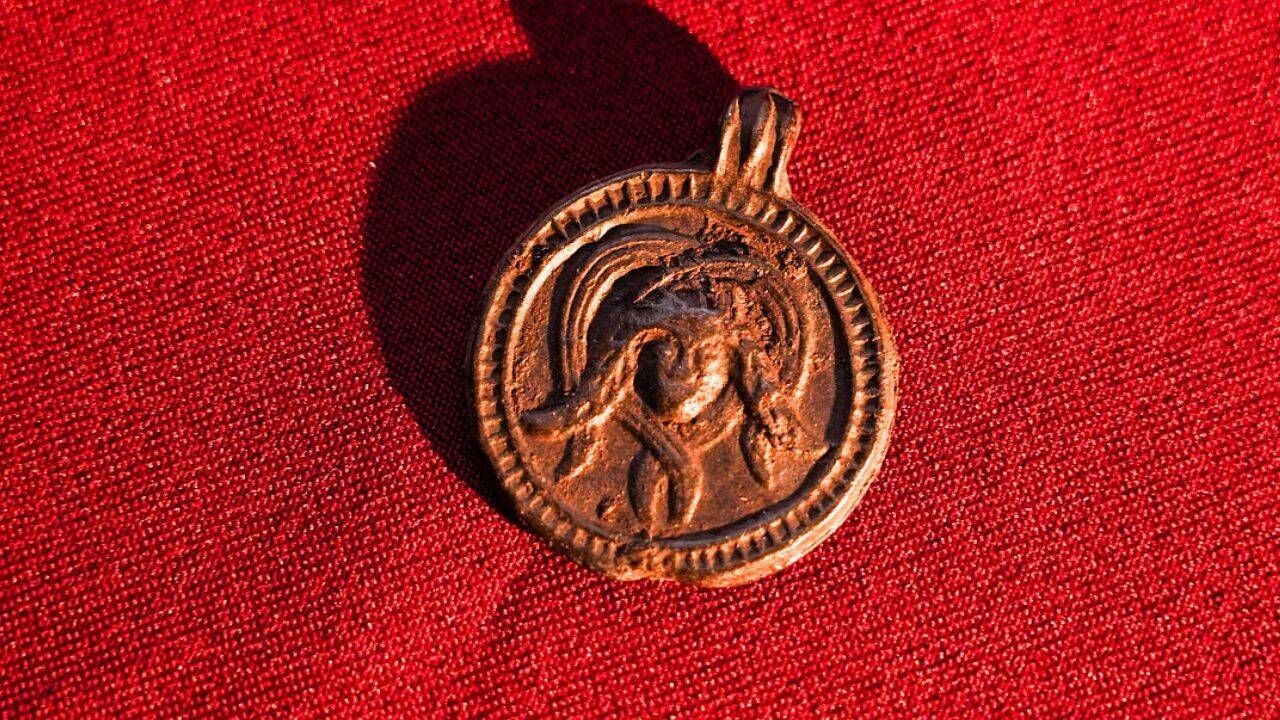
Photo via Times of India

Archaeologists found an pendant in Russia showing a Christian saint and a Medusa-like figure

Read the original at Times of India ↗
Cite

TOI World Desk. (2026, September 22). Archaeologists found an pendant in Russia showing a Christian saint and a Medusa-like figure. Times of India. https://timesofindia.indiatimes.com/world/rest-of-world/archaeologists-found-an-11th-century-pendant-in-russia-showing-a-christian-saint-and-a-medusa-like-figure/articleshow/134406965.cms

Dated when The Aporia collected the article, usually within hours of publication. Check the original for its exact date and byline.

Times of India · collected 2026-09-22 · by TOI World Desk

Quick Summary

Archaeologists discovered an 11th-century copper-alloy pendant in Staraya Russa, Russia, during excavations at the Pyatnitsky site. One side of the pendant features Saint Theodore Stratelates, a warrior saint, while the other depicts a woman with snake-like hair, resembling Gorgon Medusa. This find indicates early Christian and pagan coexistence, suggesting cultural ties to Byzantium and local craftsmanship in medieval Novgorod land.
Written by AI on 2026-09-22, from this article's own text only (the story summary below draws on all the coverage).

AI analysis

Story summary

Archaeologists in Staraya Russa, Russia discovered an 11th-century pendant made from copper alloy during excavations at the Pyatnitsky site. The two-sided amulet features a Christian image on one side and a serpent-related figure on the other, consistent with patterns identified by Novgorod State University (NovSU). One side depicts Saint Theodore Stratelates, a warrior saint holding a spear and shield, while the reverse shows a woman’s head with snake-like hair reminiscent of Medusa. The pendant is one of the earliest known examples from medieval Novgorod land, providing insight into the interplay between Christian iconography and pagan symbols during that period in Eastern Europe.

Written for “Ancient Russian Artifact Found” on 2026-11-05, grounded in this article and the 0 other(s) covering the same event.

Story

📰 Ancient Russian Artifact Found
Science · 1 article(s) covering the same event.

Compared with similar articles

Nothing to compare against. No article is close enough to this one for the pipeline to have linked or judged the pair.
How this article was measured signals, leaning charts, publisher record, byline, topics and claims

Signals How these are calculated →

Claims extracted
31
sentences that state something as happening or true
Uncertain
23%
7 of 31 hedged ("reportedly", "may", "according to")
Leaning
not political
takes no side on a contested political question
Publisher signals
59/100
Times of India's corrections and hedging, across everything collected from it. Not a measure of accuracy.
Outlets on this story
1
Science
Same framing elsewhere
1
articles that frame the event the way this one does
Analyzed 2026-09-22 · how these are computed

How this is being covered How these are calculated →

Article leaning vs. publisher reliability
Source leaning vs. consistency

Publisher

Times of India · 4148 article(s) · 4 correction(s) detected
Running correction rate · 4 correction(s)

Who wrote this

TOI World Desk
1411 article(s) here · 1 carrying a prediction
🔮 Ellenbogen’s account of the watch and its acquisition was published in Magicol in May 1988, giving collectors a documented history of the object.
🔮 However, the latest inspection by The Washington Post suggests that the problems may not be entirely behind it.
🔮 The matter has not been settled, and the estate argues it could still change.
🔮 Racing owners sell horses for many practical reasons, from stable planning to bloodstock strategy, and few could have predicted that this particular three-year-old would become the central figure in a Melbourne Cup for the ages.
🔮 Speaking to Fox News on Tuesday, the POTUS claimed he had a 99 per cent approval rating in Israel and suggested he could pursue a political career there if his popularity in the United States declined.
🔮 The Brennan Center's 2026 survey also found that more than half of local election officials were concerned that threats, harassment and intimidation could make it harder to recruit and retain election workers.
🔮 These videos may depict candidates taking part in unpopular activities or appearing alongside controversial public figures.
🔮 Chutkan further warned that beginning construction or demolition before the National Park Service issues its final authorization, or proceeding without the required 14-day notice, could violate earlier court orders, AP News reported.
🔮 As votes are counted, three main outcomes could shape the future of Congress.
🔮 "It is back to the way Abraham Lincoln would have wanted it."
Wire or desk byline, not an individual reporter.
Also by TOI World Desk
Nothing else under this byline is closely related to this article, so these are simply their most recent.
All 1411 articles by TOI World Desk →

Topics

Christian NovSU Novgorod State University Serpentine Staraya Russa

Subjects

Christian NORP · 6× Staraya Russa GPE · 5× Byzantium GPE · 2× NovSU ORG · 2× Novgorod State University ORG · 2× Pyatnitsky PERSON · 2× Serpentine NORP · 2× Theodore Stratelates PERSON · 2× Gorgon Medusa PERSON · 1× Novgorod GPE · 1×

Narrative

PC: Novgorod State University Christian and snake-related images shaped Serpentine pendants Serpentine pendants were two-sided amulets, with a Christian image on one side and a snake-related image on the other.
framing: mixed · carried by 1 article(s) · first seen 2026-09-22
🔮 According to NovSU, the Christian side could show Jesus Christ, the Virgin Mary, the Archangel Michael, or saints linked to defeating serpents, including George the Victorious.

Claims (31 extracted, 7 hedged)

Archaeologists have found an 11th-century pendant in Staraya Russa that combines an image of a Christian saint with a woman’s head featuring snake-like hair. asserted
that → find → hair
The copper-alloy pendant was uncovered during excavations at the Pyatnitsky site, in an ancient urban household in an area that was being developed in the 11th century. asserted
that → uncover → century
Its two sides carry different images. asserted
sides → carry → images
One features a relief of a warrior saint holding a spear and shield, identified as probably Saint Theodore Stratelates. asserted
One → feature → Stratelates
According to Novgorod State University, the other depicts a woman’s head with snake-like hair, based on the image of Gorgon Medusa. uncertain
other → accord → Medusa
What does the 11th-century pendant found in Staraya Russa depict asserted
depict → find → Russa
The newly found serpentine dates to the 11th century and is one of the earliest examples known from the medieval Novgorod land. asserted
serpentine → find → land
It was found during excavations at the Pyatnitsky site in Staraya Russa, inside an ancient urban household. asserted
It → find → household
At the time, the area was still being developed. asserted
area → develop → time
The pendant is made from a copper-based alloy. asserted
pendant → make → alloy
One side shows a raised image of a warrior saint holding a spear and shield, probably Theodore Stratelates. asserted
side → show → spear
The other side shows a woman’s head with snake-like hair. asserted
side → show → hair
Archaeologists note that this figure was likely a general representation of dark forces rather than a specific creature from ancient mythology. asserted
figure → note → mythology
PC: Novgorod State University Christian and snake-related images shaped Serpentine pendants Serpentine pendants were two-sided amulets, with a Christian image on one side and a snake-related image on the other. asserted
pendants → relate → other
According to NovSU, the Christian side could show Jesus Christ, the Virgin Mary, the Archangel Michael, or saints linked to defeating serpents, including George the Victorious. uncertain
side → accord → George
The other side was based on the image of the Gorgon Medusa from ancient Greek mythology. asserted
side → base → mythology
These inscriptions indicate that the pendants were probably worn as protective amulets against illness. asserted
pendants → indicate → illness
The two different images brought Christian and pagan traditions together. asserted
images → bring → traditions
What the Staraya Russa pendant reveals about Byzantine connections asserted
reveals → reveal → connections
The Staraya Russa pendant adds to evidence about the community that lived in the settlement during the 11th century and its connections with other regions. asserted
that → add → regions
Archaeologists note that the non-canonical tradition of wearing serpentine pendants came to Rus from Byzantium. asserted
tradition → note → Byzantium
The earliest such pendants found in Ancient Rus date to the 11th century, the same period as the newly discovered pendant. asserted
pendants → find → pendant
Along with other archaeological finds, the pendant shows that a Christian community was already present in Staraya Russa at that time. asserted
community → show → time
NovSU also says the finding points to well-developed cultural ties with Byzantium and the presence of local craft workshops. asserted
finding → say → workshops
Before this discovery, only four serpentine pendants had been found in Staraya Russa. asserted
pendants → find → Russa
All four dated to the late 12th to 14th centuries. asserted
four → date → centuries
Archaeologists also looked at who may have owned the pendant and where it may have been made. uncertain
it → look → pendant
Sergei Toropov, director of the Novgorod State University Center for Archaeological Research, said it may have belonged to a resident of the household who was part of the broad middle social group. uncertain
who → say → group
According to the university, poorer people could not afford such an item, while members of the elite wore jewellery made from expensive silver and gold. uncertain
members → accord → silver
Researchers also indicate that the pendant may have been made using another similar object as a model. uncertain
pendant → indicate → model
A workshop that could produce such an item may have operated in the same household where the pendant was found. uncertain
pendant → produce → household

💬Give feedback · no sign-in needed

No sign-in needed for now. Your note is sent without a name, so it cannot be answered.

🕘History 🎫Support