Ukraine's army seeks to give frontline commanders more authority
KYIV, Sept 23 - Ukrainian staff sergeant Vitalii Tomchyshak believes he knows how to beat Russia on the battlefield: empower frontline leaders such as himself to make critical decisions.
asserted
he → seek → decisions
Too often, Tomchyshak says, combat commanders are overruled by senior officers who do not understand the specifics of a battlefield situation.
asserted
who → say → situation
"It doesn't matter who you are — a sergeant, an officer, anyone — you need to be listened to," the 27-year-old former software developer said.
asserted
developer → matter → ?
Tomchyshak was among 103 battle-hardened squad commanders pulled from the front line by Ukraine's military and put through an intensive three-month course this summer aimed at increasing their effectiveness as leaders.
asserted
Tomchyshak → harden → leaders
As Russia wages its war in Ukraine, the Ukrainian army is trying to transform itself — not just in terms of technological innovation, but also in its culture and leadership.
asserted
army → wag → culture
That means dismantling a Soviet-era culture of rigid, top-down command and encouraging more initiative from battle-tested troops.
asserted
That → mean → troops
Despite innovating its way through more than four years of war to hold back a bigger, better-armed enemy, Ukraine’s military has faced criticism for heavy losses in some units and poor treatment of some troops — factors blamed by some for discouraging men from joining the military.
asserted
military → innovate → military
Expectations are high that the new commander-in-chief, 43-year-old General Mykhailo Drapatyi, will deliver on his pledge to promote better command practices and prioritise soldiers’ lives.
asserted
commander → deliver → lives
It aims to train a younger generation of leaders — already expert in infantry tactics, drone warfare, artillery and logistics — to make autonomous decisions on the battlefield.
asserted
It → aim → battlefield
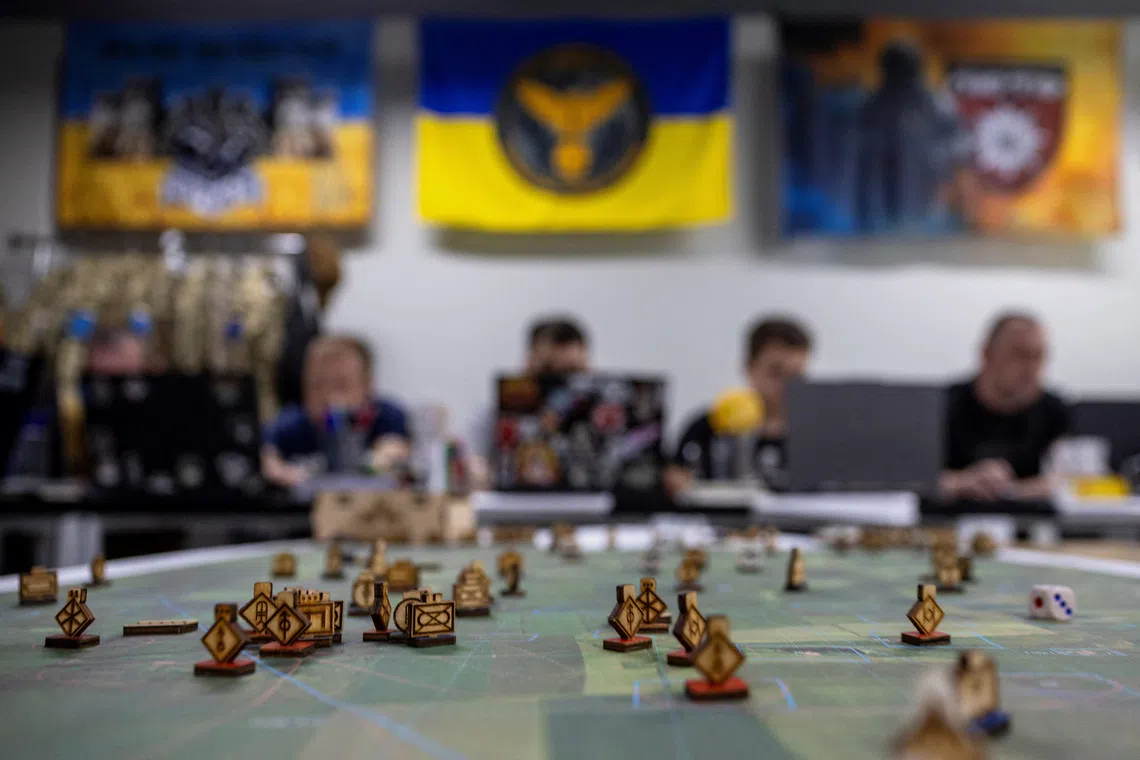
Crowded around a map covered in tokens denoting military units, a dozen commanders are war-gaming how to repel a Russian assault on a village.
asserted
commanders → crowd → village
A roll of a dice decides whether operations succeed or fail, forcing them to improvise and communicate with colleagues.
Run by the Military Institute of Kyiv National University and partly financed by charity Come Back Alive, the Captain’s Course has trained more than 1,200 officers since it was launched during the first year of the war.
asserted
it → decide → war
With Ukraine struggling to draft frontline troops, the emphasis is on preserving manpower, said Artem Chukharev, a 23-year-old sergeant in the Territorial Defence Forces.
asserted
Chukharev → struggle → Forces
This is in stark contrast to Russian infantry assaults that have come at a high human cost.
asserted
that → come → cost
"We simply cannot afford to treat them the way our age-old enemy does," Chukharev said, praising the course for encouraging commanders to take informed decisions.
asserted
Chukharev → afford → decisions
"I finally realised what an officer is, and what he should be like."
asserted
he → realise → what
Although 88 commanders graduated on July 18, 15 students did not – two for health reasons and the remainder for academic shortcomings.
asserted
students → graduate → shortcomings
Despite efforts to modernise after Russia's annexation of Crimea in 2014, Soviet-style attitudes have persisted among some senior officers trained at traditional top-brass institutes, said battalion commander “Houston”, asking to be identified only by his military call sign.
asserted
Houston → modernise → sign
"Officers there are immediately instilled with a certain hatred toward sergeants and soldiers," said Houston, a career soldier who signed up long before the war, unlike much of Ukraine's 800,000-strong military.
asserted
who → instill → military
Drapatyi took over as commander-in-chief in July from 61-year-old Oleksandr Syrskyi, whose critics said he tolerated heavy losses and imposed a heavy-handed style, micromanaging the 1,200-km (745-mile) front line.
asserted
he → take → line
This month, Drapatyi held a high-level meeting with senior sergeants to discuss ways to empower the NCO corps.
asserted
Drapatyi → hold → corps
Today, he is the commander who is closest to the soldier," he said.
asserted
he → say → soldier
“They are the ones who care about the interests and needs of the ordinary soldier first and foremost.”
asserted
who → care → soldier
Ukraine’s armed forces, in response to questions for this article, said Drapatyi had published a list of problems to be addressed after the meeting – including an expansion of powers for non-commissioned officers, a clearer command structure and better pay.
asserted
Drapatyi → say → officers
Work on solving the problems was underway, it said.
asserted
it → solve → problems
Drapatyi has promoted several senior commanders known for embracing NATO-style command culture – including Andriy Biletsky, who commands the Third Army Corps - to oversee critical parts of Ukraine’s eastern defences.
asserted
who → promote → defences
With new technology rapidly changing the nature of warfare, the course pushes commanders "to constantly seek out and find new solutions, adapt old solutions, modify them, modernise them," Chukharev said.
asserted
Chukharev → change → them
Tomchyshak, who did not comment on the reforms at the highest level of the military, said that showing initiative was still often punished, particularly among sergeants.
asserted
showing → comment → sergeants
Letting local commanders take more of the initiative would hand Ukraine an advantage on the battlefield, he said, especially over an enemy known for treating its troops poorly.
asserted
he → let → troops
"We would begin to see radical change," he said.
asserted
he → begin → change
 The Aporia